Spongy or sinking brake pedal: air, a hose or the master cylinder?
- Автор
- Talha Kırmızıaslan
- Первая публикация
- Первая публикация:
- Последнее обновление
- Последнее обновление:
- Время чтения
- 6 мин чтения
- Категория
- Легковые и лёгкие коммерческие автомобили
Эта статья пока доступна только на английском языке.
A spongy brake pedal, a low pedal and a pedal that sinks while held are three different faults. Spongy means air in the circuit, fluid that has taken up moisture or a part moving beyond its range; a hose that swells under pressure adds travel too. Low but firm: check the rear shoe adjustment, the caliper pistons and the pushrod. Sinking means pressure is being lost through an external leak or an internally leaking component; the master cylinder is tested first.
Short answer
- Spongy: air in the circuit, moisture-laden fluid, a part moving beyond its range.
- Low, long travel: a hose that bulges, a caliper that flexes, rear shoes out of adjustment, a piston retracting too far, pushrod play.
- Sinking while held: a leak at a pipe, hose, fitting or wheel cylinder; if all is dry outside, test the master cylinder first.
How do you tell a spongy, low and sinking pedal apart?
Spongy, low and sinking brake pedals are told apart by how the pedal comes to rest: it springs under the foot, stops firm but near the floor, or keeps sinking while held. MOTOR, a US trade magazine, opens its diagnosis there: “Does the pedal slowly drift to the floor when at a stop, or does it stop solid, but too close to the floor?” It suggests trying doubtful brakes in a parking lot, not on the road.
Inspection rules draw the same lines. The UK MOT inspection manual checks reserve travel with the engine off on power-assisted systems, and fails a car for insufficient reserve only if the pedal is touching the floor. Turkey’s inspection defects table, applied since 1 June 2026, rates incorrect pedal free play a Hafif Kusur (light defect) and lists “the pedal drops when the brake pedal is pressed” under the master cylinder as an Ağır Kusur (serious defect).
What causes a soft or spongy brake pedal?
Air in the hydraulic circuit is the first cause our sources list for a soft or spongy brake pedal: brake fluid hardly compresses, air does. MOTOR: “The smallest amount of air trapped anywhere in the system will have a big effect on brake pedal feel.” The brake module of Turkey’s Ministry of National Education (MEB) gives two causes for a soft, springy pedal: air in the hydraulic system and brake shoes out of adjustment.
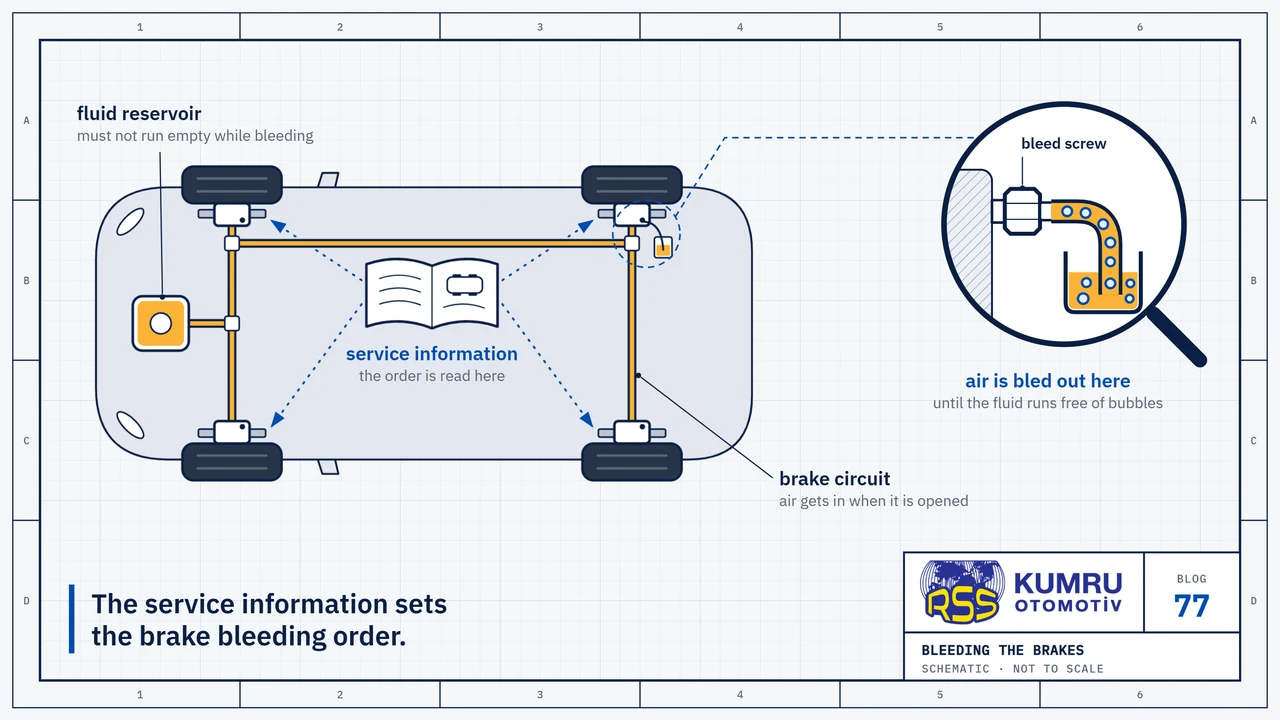
Air does not only come from a repair. MOTOR notes that caliper piston seals and wheel cylinder cup seals can act as a one-way valve: “Fluid can’t get out but air can get in.” A caliper fitted on the wrong side has its bleeder below the inlet, which makes it hard to bleed. The bleeding sequence is covered in its own article.
The second cause is the fluid:
“Fluid used for a long time absorbs moisture and its boiling point falls. When brake fluid exceeds its boiling point, vapour lock occurs in the brake system and the brakes do not hold.”
Ministry of National Education (Turkey), Brake Systems course module, 2013
MOTOR adds that water-contaminated fluid “turns a darker color”, and gives two years as the recommended change interval.
What does a swollen brake hose do to the pedal?
A brake hose that bulges or twists under pressure adds pedal travel. MOTOR wants the rubber hoses watched while a helper pumps the pedal:
“Look for a bulge in the hose that appears under pressure, then disappears when the pedal is released.”
MOTOR Magazine, “Abnormal Brake Pedal Diagnosis”, June 2019
The author has also seen hoses twist under pressure at a defect where the rubber meets the metal crimp, and sums up: “Excess hose movement causes excess pedal movement.” In the MOT manual, “Brake hose bulging under pressure” is a major defect: the car fails. Hose expansion limits and braided hoses are covered in a separate article.
What causes a low brake pedal?
MOTOR traces a low brake pedal to either a hydraulic or a mechanical fault. In the mechanical case a part is moving beyond its designed range; the first example is rear brake shoes out of adjustment. The second is a caliper piston that retracts too far when released; rear calipers with integral parking brakes, it says, “are notorious for this”.
Where the pedal stops hard at the bottom but has excess play at the top, MOTOR usually looks to the master cylinder or the pushrod: “a little play at the pushrod is a lot at the pedal.” The MEB fault table lists similar causes for a dropping pedal: shoes out of adjustment, linkage adjustment, worn linings, low fluid, air and a worn master cylinder. The servo is not among them; the module says a failed servo makes the pedal hard.
Why does the brake pedal go to the floor?
A brake pedal that goes to the floor is losing hydraulic pressure, and MOTOR names two routes: an external leak or an internally leaking component. External leaks do not always drip: “Just a little seepage at a fitting can cause big trouble at the pedal.”
A Ford recall report shows the hose side. On 2013–2018 Ford Fusion and Lincoln MKZ cars the internal reinforcement braid of the front brake hoses could fail from cyclic fatigue under suspension and steering movement. A ruptured hose leaks progressively. The report: “The driver may experience an increase in pedal travel together with a reduction in the rate of deceleration, increasing the risk of a crash.” The brake fluid warning light also comes on. Where steel brake pipes rust through is covered in the brake pipe article.
If everything outside is dry and the reservoir level holds, that leaves an internal leak. MOTOR does not put it this way; it follows from its two routes. Its test is to plug the master cylinder ports: “If the master cylinder is good, the pedal should be rock hard”. If the pedal moves at all, the master cylinder leaks internally, there is a pushrod issue or the fluid is contaminated.
Do not drive on a pedal that goes to the floor or sinks while held. In the MOT manual a leaking hydraulic brake pipe, hose, connection or master cylinder is a dangerous defect, a category it defines as “a direct and immediate risk to road safety”. Turkey’s table rates a leaking brake pipe, hose or master cylinder an Ağır Kusur.
In what order should a mechanic check?
MOTOR works from easy to hard: look first, then block off sections of the circuit. If the vehicle’s service information gives another sequence, follow it.
- Sort the complaint. Spongy, low or sinking? Does the car pull under braking? Is a brake warning lamp on?
- Reservoir and leaks. Fluid level, fittings, pipes, hose ends. No fluid should sit behind the wheel cylinder boots.
- Hoses and calipers under pressure. With a helper on the pedal, look for a hose that bulges or twists and a caliper that flexes sideways on worn pins or wrongly installed pads.
- Master cylinder. Plug its outlet ports; the pedal should be firm.
- Each wheel. Plug “at the steel line, before the rubber hose”, which takes hose, caliper and wheel cylinder out of the circuit. Do not pinch the hose with locking pliers: a damaged hose can “work like a one-way valve” and hold the caliper on.
- ABS unit. If the wheels show nothing, block the unit’s outlet ports. A defective unit can feel like air or a pressure loss; before condemning it, MOTOR asks for a scan-tool service bleed, then all wheels bled again.
Источники
- MOTOR Magazine, “Abnormal Brake Pedal Diagnosis”, trade magazine article, June 2019 issue (page dated 5 June 2019); how the pedal complaints differ, the hose and caliper checks, and the block-off sequence.
- T.C. Millî Eğitim Bakanlığı, “Motorlu Araçlar Teknolojisi: Fren Sistemleri (modül)”, vocational training module of Turkey's Ministry of National Education, Ankara 2013 (in Turkish); fault table 2.6 for drum brakes, section 3.5.1 on bleeding and section 4 on the servo.
- Driver and Vehicle Standards Agency (DVSA), “MOT inspection manual: cars and passenger vehicles, section 1: Brakes”, official UK inspection manual for cars and passenger vehicles; published 20 May 2018, last updated 1 June 2026; items 1.1.2, 1.1.10, 1.1.11 and 1.1.12, with the defect categories as defined in the manual's introduction.
- T.C. Ulaştırma ve Altyapı Bakanlığı, “Araç Muayenesi Sonucu Belirlenen Eksikliklere İlişkin Kusur Grupları Yönergesi ve eki Kusurlar Tablosu”, Turkish Ministry of Transport and Infrastructure directive (2021) and its annex; the link opens the defects table applied from 1 June 2026 (PDF dated 4 June 2026), in Turkish; items 2.13 and 2.14 and the brake pipe and hose rows.
- NHTSA (raporu sunan: Ford Motor Company), “Part 573 Safety Recall Report 23V-162”, safety recall report filed with the US National Highway Traffic Safety Administration, 31 May 2023; front brake hoses of the 2013-2018 Ford Fusion and Lincoln MKZ.
Дата повторной проверки источников: 13 октября 2026 г.
RSS Kumru Automotive
Компания RSS Kumru Automotive основана в 1990 году и специализируется на гидравлических системах и системах управления жидкостями. Our range includes brake and steering hoses, turbo pipes and hoses, and oil pipes.
Названия марок и номера OEM используются исключительно для идентификации и указания совместимости.