Braided brake lines vs rubber: are stainless steel brake hoses worth it?
- Author
- Talha Kırmızıaslan
- First published
- First published:
- Last updated
- Last updated:
- Reading time
- 6 min read
- Category
- Cars and light commercials
A stainless steel braided brake hose swells less under pressure than a rubber one, so the pedal travels less and feels firmer. It does not add braking force. The US regulator NHTSA wrote in a 1996 rule that this type of hose “may have safety advantages”. Drivers who have run both mostly report a small gain over new rubber hoses and a large one over old ones.
Short answer
- What you gain: a shorter, firmer pedal; braking force is unchanged.
- Against what: by drivers’ accounts, little next to new rubber hoses and a lot next to old ones.
- DOT: not an approval stamp but the hose assembler’s own certification.
- Weak point: where the hose enters its end fitting, and wherever the braid rubs.
Braided brake lines vs rubber: what is actually different?
A braided brake line is a hose wrapped in a braid of stainless steel wire. A rubber brake hose carries its reinforcement as cords under the outer cover; New Zealand’s inspection manual rejects a hose whose cover has cracked far enough to expose them. In the hose behind the 1996 rule the inner tube was not rubber at all: its maker described it as “stainless armored teflon”. The two materials are compared in the PTFE versus rubber article.
The US brake hose standard, FMVSS 106, favours neither design. In the words of the trade magazine Brake & Front End, FMVSS 106 and SAE J1401 “do not specify construction or materials”; they set out tests for the finished hose, and a braided hose faces the same ones as a rubber hose.
Do braided brake lines actually work?
Braided brake lines work, but the gain is in the pedal, not in braking force. When the pedal is pressed, part of the fluid goes into expanding the hoses; the less a hose expands, the less the pedal moves. When NHTSA proposed changing its rule in 1995, it reached a tentative conclusion about one braided hose. The 1996 notice restates it:
“Among those safety advantages are the elimination of hose swell under pressure which results in a significant reduction in brake pedal travel and a much firmer brake pedal feel.”
NHTSA, Federal Register 61 FR 41510, 9 August 1996
The same notice says why a firm pedal is wanted: “it allows the driver to modulate braking force more precisely”. Two limits apply: the conclusion concerned one manufacturer’s hose, made for race cars since the 1960s, and the notice gives no measurements.
Braking force does not change. In a 2017 thread on a car enthusiasts’ forum the recurring observation is that the same push on the pedal gives the same braking; the pedal just moves less. None of the sources we opened says stopping distance gets shorter.
How big is the difference against new rubber hoses?
By drivers’ accounts the difference between new rubber hoses and braided ones is small; the large difference is between an aged hose and any new one. The person who started the forum thread summed up the replies: “most people seem to agree that the difference between new rubber and new SS is relatively small”, while old rubber hoses are noticeably worse than either.
A few contributors see no gain at all over new rubber hoses; those who felt one place it in hard, sustained braking: the end of a track straight, or towing a trailer.
A rubber hose is not free to swell either. FMVSS 106 limits the expansion of every hydraulic brake hose and sorts hoses into two classes: HR for regular expansion, HL for low. For an inside diameter of 1/8 inch or less, the limit at 1,000 psi is 0.66 cc per foot for HR and 0.33 for HL; at 2,900 psi, 1.21 and 0.61. The table has no column for material; the measurement sets the class, not the braid.
What does “DOT approved” mean on a brake hose?
The letters DOT on a brake hose are not an authority’s approval stamp but the certification of the company that assembled the hose. NHTSA said so in 1995 to a firm that wanted to sell stainless steel braided brake lines in the United States: “NHTSA does not approve manufacturers’ products or conduct pre-sale testing of their products.” Under the standard, a hose assembly sold as a part carries a band with the DOT symbol, or a maker’s mark on an end fitting. That is the US arrangement; we opened no official text for Turkey or the European Union that mentions braided hoses.
| Test | Requirement |
|---|---|
| Pressure hold | 4,000 psi for 2 minutes |
| Burst, hose of 1/8 inch or smaller | no rupture below 7,000 psi |
| Pull on the end fittings | 325 pounds slow, 370 pounds fast |
Source: 49 CFR 571.106, S5.3.
Where is a braided brake hose weakest?
A braided brake hose is weakest where the stiff hose enters its end fitting. That spot is behind the 1996 rule. One race hose could not pass the standard’s whip test: 35 hours on a flexing machine that imitates steering and suspension movement. Its maker put the failure down to cyclic stress where the hose meets the swaged collar at the fixed end.
NHTSA allowed the test to be run with a supplemental support that cannot be removed from the hose and is fixed to the vehicle; other makers said their stainless hoses passed without one. The spot is not peculiar to braid. Of brake hoses in general, Brake & Front End writes: “Failure typically occurs at the ends of the hose.”
The forum thread adds three drawbacks. The braid wears whatever it rubs on. Dirt works into the braid and wears the inner liner, so a hose with a coating over the braid lasts longer. A braided hose is less flexible and harder to route. A fourth follows from the inspection manual: its test for rubber, a cover cracked deep enough to show the cords, cannot be read the same way when the braid is already outside. The manual does not say this; it is our conclusion.
Are stainless steel braided brake lines worth it?
Stainless steel braided brake lines are worth it, in the forum’s prevailing view, on a vehicle that brakes hard and for long; on a daily driver, new rubber hoses give most of the same gain. NHTSA describes such hoses as designed for conditions “more severe than those experienced in typical road environments”, racing among them, and as typically costing more. We make braided brake hoses ourselves. To fit them, work in this order:
- Check the band and the ends. Is the DOT band, or the maker’s mark on a fitting, there? The end fittings should be permanently crimped or swaged on; New Zealand’s manual does not accept a fitting that can be undone with hand tools.
- Lay it next to the old hose. Length, ends and bracket positions should match. New Zealand’s manual asks for no separate modification certificate when braided hoses are direct replacements fitted using all the original mounts. If the hose comes with a support and bracket, fit them; the standard makes the instructions say what happens otherwise.
- Look for contact. The braid must touch nothing it could rub on, and the hose goes in without twist.
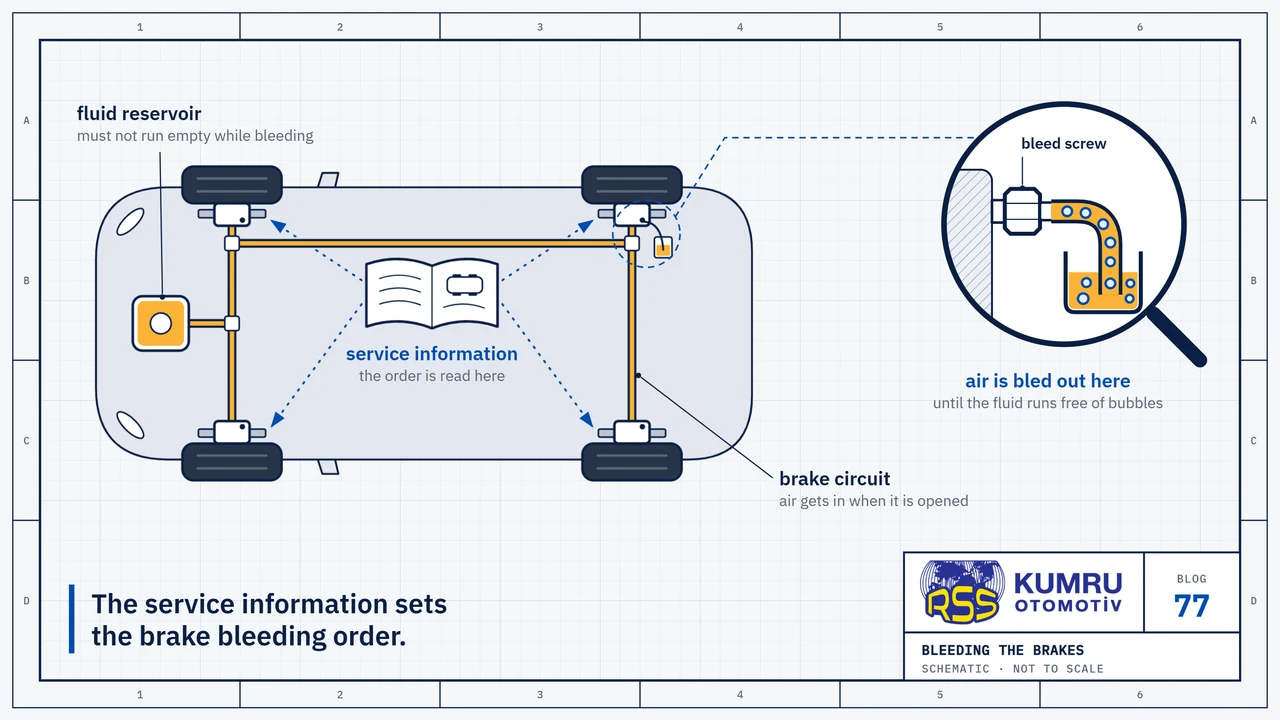
- Bleed the brakes. The sequence is in the brake bleeding article.
- At later services, look for leaks, chafe marks, twist and corroded fittings. What an inspection counts as a defect is in the brake hose inspection article.
Sources
- National Highway Traffic Safety Administration (NHTSA), “Federal Motor Vehicle Safety Standards; Brake Hoses; Whip Resistance Test (final rule), 61 FR 41510”, final rule published in the US Federal Register, 9 August 1996.
- National Highway Traffic Safety Administration (NHTSA), “49 CFR 571.106, Standard No. 106; Brake hoses (FMVSS 106)”, US federal motor vehicle safety standard; current eCFR text, section last amended 29 September 2017.
- National Highway Traffic Safety Administration (NHTSA), “Interpretation nht95-7.60 (Standard No. 106; stainless steel braided brake hose assemblies)”, interpretation letter from NHTSA's Chief Counsel, 12 December 1995; read from the Internet Archive copy.
- NZ Transport Agency Waka Kotahi, “Vehicle Inspection Requirements Manual: In-service certification (WoF and CoF), 8-1 Service brake and parking brake”, vehicle inspection manual of New Zealand's transport agency, brakes section; page updated 27 February 2023.
- Brake & Front End (Babcox Media), “What DOT Really Means: The Do's And Don'ts Of Inspection And Replacement”, trade magazine article, Andrew Markel, 2 January 2019; read from the Internet Archive copy.
- Grassroots Motorsports forumu, “Oem rubber or stainless steel brake hoses?”, forum thread, 29–30 September 2017; used for field observations.
Sources were checked again on October 13, 2026.
RSS Kumru Automotive
RSS Kumru Automotive was founded in 1990 and specialises in hydraulic systems and fluid management. Our range includes brake and steering hoses, turbo pipes and hoses, and oil pipes.
Brand names and OEM reference numbers are used for identification and compatibility information only.