Hydraulic coupler won’t connect: how to relieve the pressure trapped in the hose
- Autor
- Selami Kumru
- Erstveröffentlichung
- Erstveröffentlichung:
- Zuletzt aktualisiert
- Zuletzt aktualisiert:
- Lesezeit
- 6 Min. Lesezeit
- Kategorie
- Hydraulikschläuche
Dieser Beitrag liegt derzeit nur auf Englisch vor.
When an implement hose will not go into the outlet on a tractor or skid steer, look first at the oil trapped behind the coupler, not at the coupler. A quick coupler has check valves that shut when the line is pulled apart and hold the oil behind them under pressure. Until that pressure is released, the tip will not seat.
Short answer
- Cause: a check valve holds oil under pressure in the hose or at the machine outlet. Oil warmed by the sun expands and the pressure climbs.
- Machine side: engine off, then work the control lever back and forth or put it in float. Skid steers and electrically switched outlets have their own release.
- Implement side: set it on the ground, unload the cylinders, let it cool. Do not strike the tip or slacken a fitting under pressure.
Hydraulic coupler won’t connect: what is stopping it?
A coupler that will not connect is held shut from behind: the tip cannot push the check valve off its seat against the oil behind it. A 1985 US patent for a pressure-releasing tool puts it in two sentences:
“The check valves maintain the fluid under pressure in the valve assemblies and lines. This fluid pressure must be relieved before the lines can be connected to the couplers.”
US Patent 4,499,796, 19 February 1985
The pressure can sit on either side. With the control lever centred, John Deere’s manual for the 5310 S tractor says, the remote cylinder is “hydraulically locked in position”. An Ohio State University Extension training sheet adds that fluid can stay trapped “even when the engine and hydraulic pump are stopped”, and that a raised implement can hold pressurised fluid even when it is disconnected.
Heat does the rest. The same sheet: “Heat causes the fluid to expand, increasing the pressure.” It adds that the pressure of trapped fluid can be more than 2,000 psi. On a tractor forum, owners describe implements uncoupled cold and left in the sun that will not couple once warm.
How do you relieve hydraulic pressure on a tractor?
On the tractor side the pressure is released with the engine stopped, by working the control lever or putting it in float. The Ohio State routine: engine off, brake on, implement on the ground, control lever moved back and forth several times.
Float does the same job where the valve has it. In John Deere’s manual for the 110 tractor loader backhoe, moving the lever past the detent into float relieves the pressure on both quick couplers.
On an electrically switched outlet that may not be enough: on some electro-hydraulic controls, a forum reply notes, the ignition has to go back to run without starting. The 110’s third outlet is of this kind, and its manual has a routine of its own: engine off, key switch at RUN, outlet switched on, then each hose connected with the flow switch set to its side. Another tractor’s sequence is in its own manual. The 110 manual’s caution: “Do not attempt to connect hoses to machine SCV couplers until all hydraulic system pressure has been relieved.”
How to relieve hydraulic pressure on a skid steer?
A skid steer or compact track loader has its own pressure release, and it differs by model. On Bobcat’s T190 compact track loader, the front auxiliary couplers release the pressure themselves:
“Push the quick couplers tightly together and hold for five seconds; the pressure is automatically released as the couplers are installed.”
Bobcat, T190 Operation & Maintenance Manual, September 2006
Disconnecting is the same movement, followed by pulling the sleeve back. The rear auxiliary couplers have a pressure release button on the instrument panel. Before an attachment comes off, the manual wants it flat on the ground, the engine stopped and the auxiliary circuit relieved.
This is one model. A Kubota, a Cat or another Bobcat has its own routine, in its own manual.
What can be done on the implement hose, and what not?
No lever on the machine relieves the implement side: as one forum reply puts it, float does nothing for pressure built up in the attachment. What can be done is to remove the cause: rest the implement on the ground so that no cylinder carries a load and, if it has stood in the sun, let it cool. Forum owners wait, or run cold water over the hoses.
The field is cruder: a rag over the male tip and a push against the frame, a tap with a hammer, or a spanner on a hose fitting. The 1985 patent describes what striking costs. Striking the check valve on a hard, rough surface, it says, can damage the valve’s outer surface until it will “leak hydraulic fluid when in the closed position”. And the oil sprays: “The spray is not controlled so that it can contaminate the fixed object and the operator.”
The forum is divided: some owners tap the tip through a rag as routine, and one refuses because he expects the oil to come straight at him.
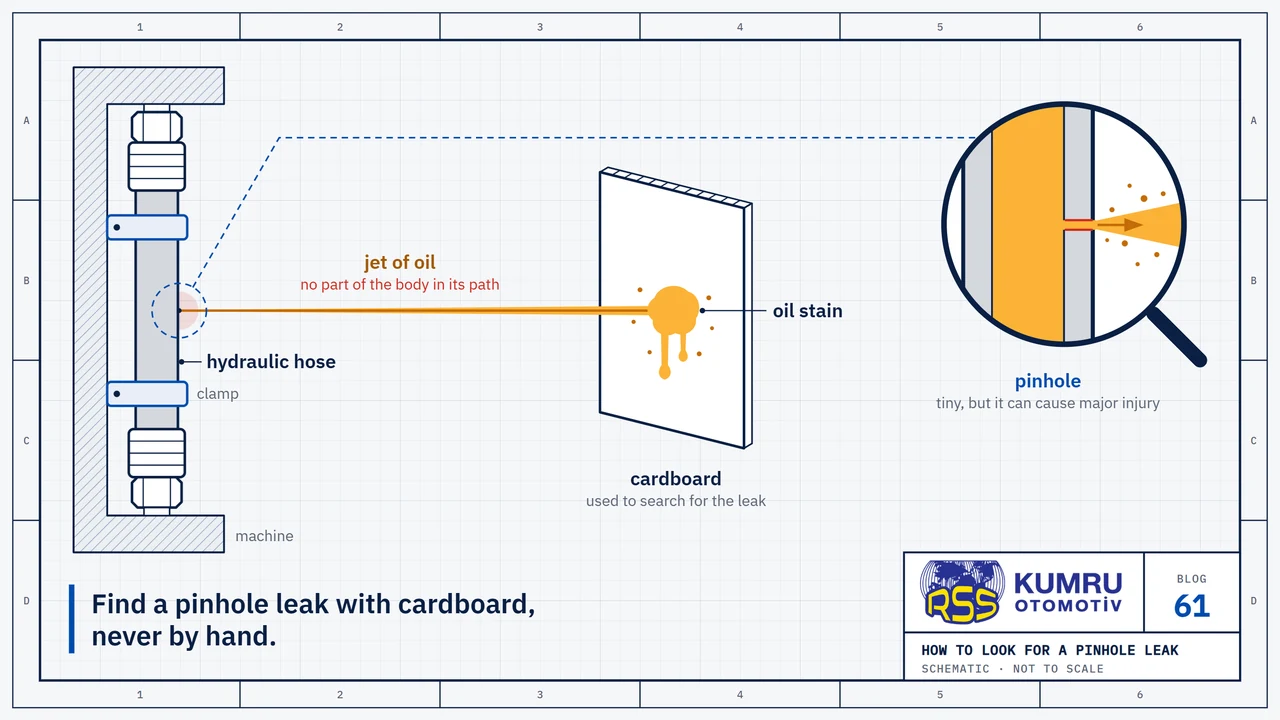
Do not strike the tip, and do not slacken a fitting under pressure. The Ohio State sheet: “Always relieve hydraulic pressure before loosening hydraulic fittings. The hot, high-pressure spray of the hydraulic fluid can cause injury.” Oil under pressure can go through skin, as described in our article on hydraulic injection injuries. Bobcat warns that fluid, fittings and quick couplers get hot in work.
Apart from Bobcat’s self-relieving couplers, the manuals we read give no method for relieving the implement side. The conclusion is ours, not theirs: deal with the pressure when the implement comes off, not when it goes back on.
How do you leave the hoses without pressure when the implement comes off?
A hose uncoupled with the implement on the ground, the cylinders unloaded and the outlet relieved has nothing trapped in it. John Deere’s 5310 S manual gives two steps: retract the remote cylinder as far as possible, to protect the rod, then pull the hoses with “as much hydraulic pressure relieved as possible”. Forum habits add two more: uncouple with the lever in float, and couple the implement’s two hoses to each other.
Pressure relieved and it still won’t connect?
With no pressure behind it, a tip that will not go in is dirty, damaged or the wrong pattern. Bobcat’s manual has dirt removed from the faces of both couplers before connecting, and a coupler replaced if it shows corrosion, cracking, damage or excessive wear. Deere’s 5310 S manual says the outlets take a standard hose tip as recommended by ISO and SAE, and that older John Deere tips need an adapter.
Thread types at the hose end are covered in our article on fittings and threads. A hose in the wrong outlet is not a coupler fault: the Ohio State sheet wants lines taped or colour-coded so they are not crossed.
What order should you try things in?
- Implement on the ground. Nothing raised, no cylinder carrying a load.
- Machine side. Engine off; lever back and forth, or into float. Skid steer or electric outlet: the release in its manual.
- Clean and push. Wipe both halves, push the tip in firmly.
- Still not in? The pressure is on the implement. Let it cool. Do not hit the tip or crack a fitting.
- Then the hardware. Damage, wear, wrong tip pattern, crossed hoses.
- Next time. Uncouple on the ground with the outlet relieved; cap the ends.
Quellen
- Bobcat (Bobcat Europe), “T190 Compact Track Loader Operation & Maintenance Manual, S/N 531711001 & Above (6904144-EN)”, operation and maintenance manual of the compact track loader, September 2006 edition (copy on the Internet Archive); connecting couplers (p. 22), relieving pressure (p. 23), removing an attachment (pp. 41, 43).
- John Deere (Deere & Company), “110 Tractor Loader Backhoe Operator's Manual (OMLVU19603, A9): Operating - Machine”, operator's manual of the tractor loader backhoe, on the manufacturer's own site; issue code A9, no publication date on the page (site footer copyright 1996-2009); float position, pressure relief sequence for the third outlet, caution on connecting.
- John Deere (John Deere Equipment Private Limited), “5310 S Tractor Operator's Manual (OMRE247111, Issue G6)”, tractor operator's manual, printed in India, 2006 (page footer print code 082206; copy on the Internet Archive); section "Remote Hydraulic Cylinders", pp. 60-1 to 60-5.
- United States Patent and Trademark Office, “US Patent 4,499,796: Fluid Pressure Releasing Tool (Jon L. Miller)”, US patent, 19 February 1985; granted to an individual inventor (a hand tool for releasing pressure); only the background section is used (field practice of the day and its drawbacks). Official image: image-ppubs.uspto.gov.
- Ohio State University Extension, “Safe Use of Hydraulic Systems for Trainers and Supervisors (AEX-892.2.62)”, training sheet from the university extension's Agricultural Safety and Health Program, 8 June 2018.
- TractorByNet, “Attaching quick couplers?”, forum thread, 9 to 10 May 2014 (first page only, 20 posts); owners who could not connect their couplers, and the replies; used as a field account, not a manufacturer instruction.
- TractorByNet, “Detaching hoses in the warm”, forum thread, 17 to 26 June 2023 (first page only, 20 posts); on couplers that will not come apart or go together once warm; used as a field account, not a manufacturer instruction.
Die Quellen wurden am 13. Oktober 2026 erneut geprüft.
RSS Kumru Automotive
RSS Kumru Automotive wurde 1990 gegründet und ist auf Hydrauliksysteme und Fluidmanagement spezialisiert. Our range includes hydraulic hoses, hydraulic pipes and fittings.
Markennamen und OEM-Referenznummern dienen ausschließlich der Identifikation und der Angabe der Kompatibilität.