Hydraulic fluid injection injury: why a pinhole leak is dangerous and what to do in the first hour
- Autor
- Selami Kumru
- Erstveröffentlichung
- Erstveröffentlichung:
- Zuletzt aktualisiert
- Zuletzt aktualisiert:
- Lesezeit
- 6 Min. Lesezeit
- Kategorie
- Hydraulikschläuche
Dieser Beitrag liegt derzeit nur auf Englisch vor.
A hydraulic fluid injection injury happens when a jet of oil under pressure breaks the skin and drives fluid into the tissue underneath. A pinhole leak in a hose is enough. The entry wound is small and hurts little in the first hours, which is why it gets ignored. The response is fixed: go to a doctor at once, say it is an oil injection, and name the fluid.
Short answer
- What it is: a jet of pressurised fluid punctures the skin and the fluid ends up in the tissue.
- Why it misleads: the entry hole is small and the first hours bring little pain.
- First step: a doctor, immediately. Say it is an oil injection and take the fluid’s safety data sheet.
- Prevention: never feel for a leak; never loosen a fitting under pressure.
What is a hydraulic injection injury?
Nothing sharp is involved: in an injection injury the fluid itself does the cutting. The UK Health and Safety Executive (HSE) defines it in a 2014 safety alert:
“Hydraulic injection injury occurs when the outer layer of skin is broken by a jet of fluid under pressure.”
HSE, Safety alert FOD 4-2014, 23 September 2014
The alert names two kinds of harm: the penetration, with the damage it does to the tissue beneath, and the toxicity of the injected fluid. Severity depends on three things: pressure, proximity and jet size. HSE’s agricultural machinery page puts it briefly: “Even pinprick punctures in pipework can cause major injury.”
At what pressure can it happen?
The HSE alert says serious cases of hydraulic injection have been reported at pressures over 100 bar, and that anecdotal evidence suggests injury may occur at pressures as low as 7 bar. DGUV, Germany’s statutory accident insurance body, notes in its booklet on safe hydraulic maintenance that general mechanical engineering works with up to 350 bar.
The comparison is ours, not the sources’: machine hydraulics run far above the lowest pressure quoted for injury. Pressure ratings are explained in our article on hose pressure classes.
The hazard is not confined to hoses. HSE issued its alert after a maintenance fitter died: he was tensioning the track of a piling rig with a hand-powered grease gun when the grease nipple came off and released grease under pressure.
Why is the wound so misleading?
An injection wound looks small and hurts little in the first hours, while the damage is under the skin. A 2019 study in the Journal of Clinical Medicine, drawn from records of Italian university occupational medicine and hand surgery units, covers 71 workplace injuries from high-pressure equipment; in 40 the injected material was hydraulic oil.
The early signs in every case were “few symptoms, slight pain, and limited reduction of joint functionality”. Pronounced pain and swelling followed after about 2–3 hours. Of the 71 people, 45 were treated more than 6 hours after the accident, 35 of them because the early symptoms were poor. In three cases the first-aid unit’s staff underestimated the event.
HSE describes the same course: without medical treatment, after four to six hours the victim may experience “intense throbbing pain that is unresponsive to pain medication”.
What should you do in the first hour?
After an oil injection, the job of the first hour is to reach a doctor. No source sets a one-hour limit; all say to go without waiting. The safety bodies give three steps:
- Go to a doctor at once. However small the wound or slight the pain. HSE’s wording is “immediate professional medical treatment”.
- Say what happened. DGUV’s first-aid table marks this as very important; its sentence is quoted below.
- Name the fluid. The same booklet wants the emergency service told at once what kind of fluid it is, with the current safety data sheet or operating instruction to hand.
“Call in a doctor immediately; very important: point out how the accident happened (oil injection), otherwise small wounds in particular could be overlooked or wrongly treated!”
DGUV Information 209-070, June 2019 (our translation)
Two things not to do: wait for the pain to build, or wash the wound and go back to work. An Ohio State University Extension training sheet sets the second as a true-or-false question and marks it false. Treatment is the doctor’s decision; HSE’s page says the injury “may need amputation or major surgery”.
In the Italian study amputation was needed in 20 of the 71 cases: in 5 of the 26 people treated within 6 hours and in 15 of the 45 treated later. Of the 40 people injected with hydraulic oil, 6 ended with an amputation. The authors note that their sample is small and that injection pressures were not recorded.
How do you look for a leak, and do gloves protect you?
Do not feel for the leak. The first item on HSE’s list of operator errors is “Searching for leaks with bare hands”. DGUV’s rule, in our translation: “Keep your distance from possible leak points in every case!” Gloves do not change it. The same booklet says protective clothing, protective gloves included, does not give complete protection.
A leak is found with an aid, not the body. The Ohio State sheet says: “Use a piece of cardboard or paper to search for leaks.” DGUV wants the search done systematically, at reduced system pressure where possible, with protective equipment such as gloves, goggles or a visor, and with aids such as blotting paper. Our article on truck steering hoses has another hands-off method: wipe the area, then watch the joints.
The manufacturer’s guide quoted in our article on hose failure signs is stricter: nobody goes near the hose until the pressure is fully released. Common to all: no part of the body goes into the path of the jet.
What has to happen before a hose or fitting is loosened?
A hydraulic connection under pressure is not loosened: the pressure is released first, then the release is checked. DGUV sums this up as the “five-finger rule” of fluid power:
- Disconnect the energy supply.
- Secure it against being switched back on.
- Depressurise the system, including any accumulators. Lower or support raised loads and release residual energy.
- Check that no pressure is left.
- Prevent hazards from neighbouring installations.
Stopping the engine is not enough. The Ohio State sheet warns that fluid can be trapped “even when the engine and hydraulic pump are stopped”, and a raised implement can hold pressurised fluid even when disconnected. Its routine: lower the implement to the ground and move the control lever back and forth several times.
DGUV adds that even after release a fitting is opened slowly and carefully. If pressure is still there, it is not loosened further and the release is repeated.
Which rules belong in the workshop?
For the workshop, the sources come down to six rules:
- A leak is never traced by hand: cardboard or paper, and distance.
- No hose or fitting is loosened until the pressure has been released and the release checked.
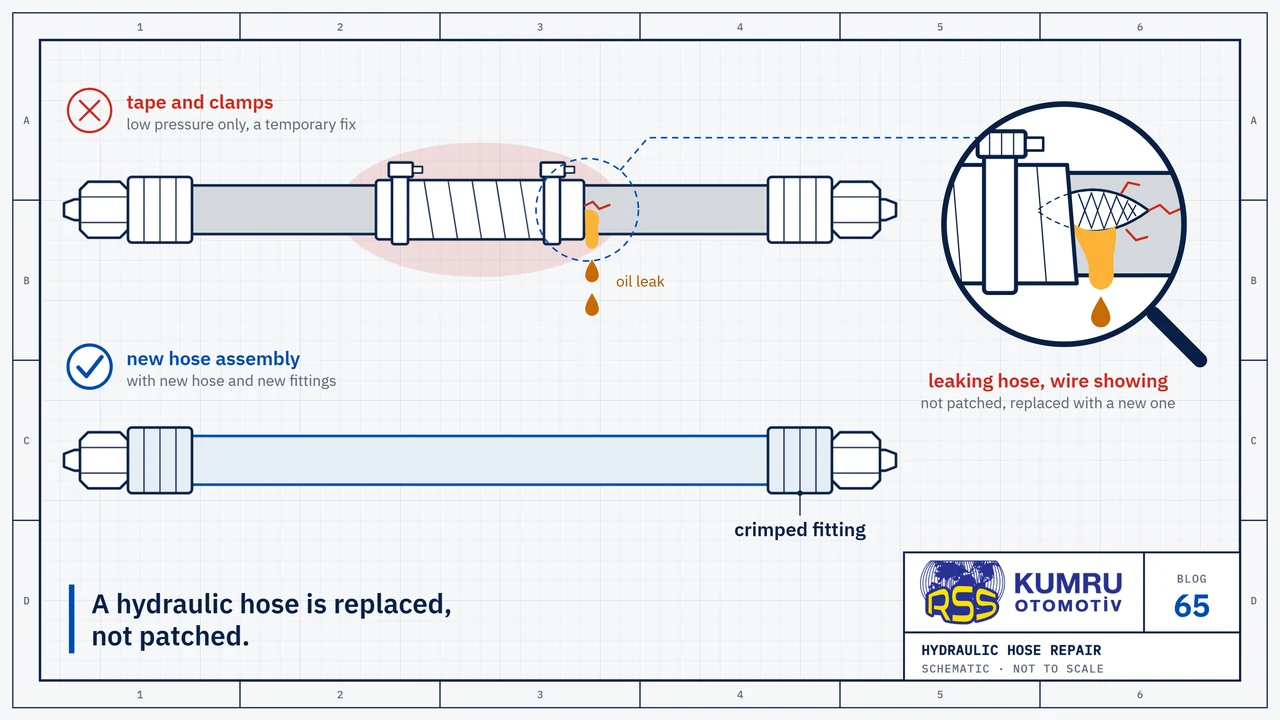
- A damaged hose is replaced. HSE also counts incorrect couplings and makeshift repairs as operator errors.
- Gloves are not complete protection, and no reason to go closer to a leak.
- The safety data sheet for the fluid in use is kept within reach.
- If oil under pressure has broken the skin, work stops: straight to a doctor, and say how it happened.
HSE wants personnel to know these steps in advance; DGUV has employees instructed on accident response at least once a year.
Quellen
- Health and Safety Executive (HSE), “Hydraulic injection injury (Safety alert, Bulletin No. FOD 4-2014)”, safety alert by the UK health and safety regulator, 23 September 2014; definition, pressure figures, course of the injury.
- Health and Safety Executive (HSE), “High pressure fluid injection hazards”, page on agricultural machinery by the UK health and safety regulator; last updated 24 October 2024; list of operator errors.
- Deutsche Gesetzliche Unfallversicherung (DGUV), “DGUV Information 209-070: Sicherheit bei der Hydraulik-Instandhaltung”, booklet on safety in hydraulic maintenance by the German statutory accident insurance body, June 2019; in German; five-finger rule (section 1.5), leak search (2.3), opening connections (5.1.1), first-aid table (section 8).
- Journal of Clinical Medicine (MDPI), “Vitale E., Ledda C., Adani R. et al.: Management of High-Pressure Injection Hand Injuries: A Multicentric, Retrospective, Observational Study”, peer-reviewed open-access medical journal article (CC BY); J. Clin. Med. 8(11):2000, 16 November 2019; retrospective review of 71 workplace injuries in Italy; text taken from the full text on Europe PMC (PMC6912633).
- Ohio State University Extension, “Safe Use of Hydraulic Systems for Trainers and Supervisors (AEX-892.2.62)”, training sheet from the university extension's Agricultural Safety and Health Program (Tailgate Safety Training for Landscaping and Horticultural Services), 8 June 2018.
Die Quellen wurden am 13. Oktober 2026 erneut geprüft.
RSS Kumru Automotive
RSS Kumru Automotive wurde 1990 gegründet und ist auf Hydrauliksysteme und Fluidmanagement spezialisiert. Our range includes hydraulic hoses, hydraulic pipes and fittings.
Markennamen und OEM-Referenznummern dienen ausschließlich der Identifikation und der Angabe der Kompatibilität.