Hydraulic fitting types: JIC, ORFS, BSP, NPT, metric, and 37° versus 45° flare
- Author
- Selami Kumru
- First published
- First published:
- Last updated
- Last updated:
- Reading time
- 6 min read
- Category
- Fittings and selection
A hydraulic fitting is identified by where it seals, not by its thread: on a flared cone, on an O-ring against a flat face, in the thread itself, or under the washers of a banjo. The same thread turns up on more than one type, so the eye is easily fooled. Identification takes a caliper, a pitch gauge and a seat-angle gauge.
Short answer
- Four families: flared cone (JIC 37°, SAE 45°), O-ring on a flat face (ORFS), seal in the thread (NPT, tapered BSP), and banjo.
- 37° and 45°: six sizes share a thread but not a seat angle. Mixed, they leak.
- Tape and sealant: on tapered threads only.
What decides a fitting’s type: the thread or the seal?
The seal decides, not the thread. On a straight-thread fitting the thread only holds the two halves together, and the sealing is done on a cone, an O-ring or a washer. On a tapered thread the thread does both jobs. Swagelok’s thread and end connection identification guide states the seal location for each end connection; the table collects them.
| Type | Thread | Seal location | Standard |
|---|---|---|---|
| JIC (SAE 37° flare) | Straight, inch | Mating 37° cones, metal to metal | SAE J514 |
| SAE 45° flare | Straight, inch | Mating 45° cones | SAE J512, SAE J513 |
| ORFS (O-ring face seal) | Straight, inch | O-ring in the male face, against a flat face | SAE J1453, ISO 8434-3 |
| O-ring boss (ORB) | Straight, inch | O-ring at the thread root, in the port chamfer | SAE J1926, ISO 11926 |
| BSPP (parallel BSP) | Straight, 55° | 30° cone or O-ring | BS 5200; thread ISO 228/1 |
| BSPT (tapered BSP) and NPT | Tapered; 55° and 60° | The thread, with sealant | ISO 7/1; ASME B1.20.1 |
| Metric | Straight, 60°, millimetres | Depends on the end: cone, washer or O-ring | Thread ISO 261; DIN 7631, DIN 3852, ISO 6149 |
Source: Swagelok, MS-13-77, February 2025. Standard numbers are given as the guide cites them; we have not opened the standards themselves.
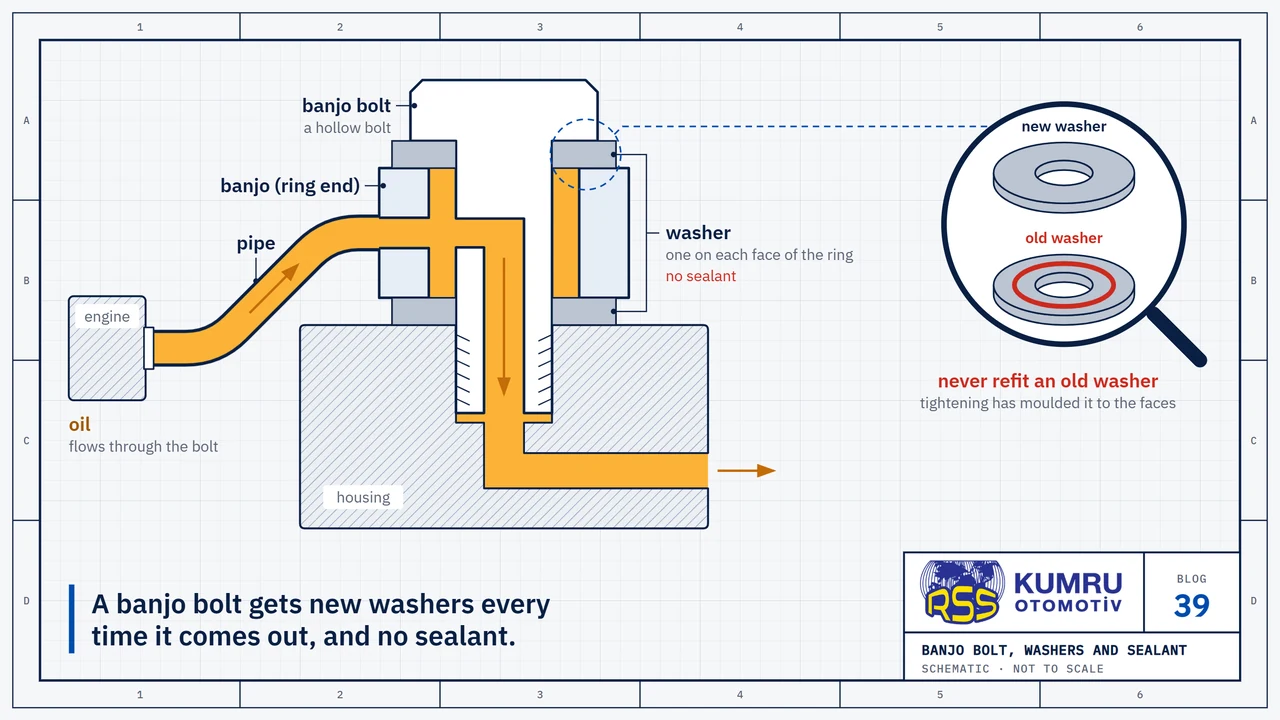
Brennan Industries, a fittings manufacturer, describes ORFS connections as “considered the best for leak control”. The banjo sits outside the table: a hollow bolt and two washers, covered in a separate article. The formed cone on a high-pressure injector pipe also seals metal to metal, and has an article of its own.
The thread alone does not name the type. In the guide’s size table the 37° flare and the O-ring boss use the same thread in every size listed.
Why can’t 37° and 45° flares be mixed?
In six sizes a 37° flare and a 45° flare screw together but do not seat at the same angle. Brennan lists the dash sizes with identical threads as -02, -03, -04, -05, -08 and -10, and adds:
“Intermixing the two different types of fittings will result in leakage, so use care in measuring seat angles.”
Brennan Industries, Connection Types: American Connections, 5 September 2017
Those dash sizes are 1/8, 3/16, 1/4, 5/16, 1/2 and 5/8 in., and Swagelok’s size table shows the same six matches. According to Brennan, 45° connections “are used in automotive, refrigeration and truck pipe systems” and are typically brass.
The question comes from the field as well. On a tractor forum, an owner who wanted to remake crushed steel hydraulic lines asked: “I have flaring tools from plumbing. Will they work on steel?” The reply: “most low pressure flares are 45 degrees. JIC fittings require a 37 degree flare.”
Are JIC and AN the same thing?
JIC and AN are the same in dimensions and different in specification. Brennan’s JIC page says JIC and AN (Army Navy) fittings are dimensionally identical, but “the AN military standard calls for tighter tolerances”. Its conclusion is that the two “are not functionally interchangeable”.
Field opinion is looser. In the same forum thread one contributor writes that AN fittings “can be interchanged with JIC in most industrial applications”. Of the two statements, Brennan’s is the manufacturer’s.
How do you tell BSP, NPT and metric threads apart?
BSP, NPT and metric threads are told apart with three measurements: is the thread tapered or straight, what is its diameter, and what is its pitch. A caliper answers the first two, a pitch gauge the third. On inch threads, pitch means threads per inch. On metric threads it is the distance between adjacent threads, in millimetres.
Pitch separates NPT from tapered BSP in most sizes. Swagelok’s table gives 27 threads per inch for 1/8 in. NPT and 28 for BSP, and 18 against 19 in the 1/4 and 3/8 in. sizes. The thread angle differs too: 60° for NPT, 55° for BSP. The 1/2 and 3/4 in. sizes are the exception, with 14 threads per inch in both. For those two the guide warns that “positive identification may not be possible without the use of an optical comparator”.
Metric thread (ISO 261) is straight and read in millimetres, M14 × 1.5 for example. But metric is not one end form. Caterpillar’s coupling identification poster sorts straight-thread couplings by seat angle: 90°, 45°, 37°, 30° and 12°. The DIN and BSPP 60° cones and the JIS 30° flare sit in the 30° group, the DIN 24° cone in the 12° group. The poster does not say so in words, but the grouping shows it: the angle in a cone’s name is the included angle, and a seat gauge reads half of it.
Which threads take tape or sealant?
Tape and sealant go on tapered threads only. Swagelok’s guide: “Tapered pipe threads always need a sealant to seal system fluids and reduce the potential for galling of the threads.” For straight threads the ruling is the opposite: “A sealant is not required or recommended on straight threads.”
The guide’s reason: the threads of the two halves run parallel, so there is no interference between them, and the seal has to be made by a gasket, an O-ring or metal-to-metal contact.
In what order do you identify a fitting?
- Look at the end. Flange, banjo or threaded?
- Measure the thread with a caliper. Take the diameter on the first, fourth and last full thread. If it grows on a male end, the thread is tapered; if not, it is straight.
- Find the pitch with a pitch gauge. Try forms until one sits in the thread without gaps. If no inch form fits, go to metric.
- Look at the seat. A cone, an O-ring in the face, or an O-ring at the root of the thread? On a cone, hold the seat gauge parallel to the centre line: 37°, 45° or 30°.
- Check against the tables. Your reading may not match the nominal size exactly; the guide puts that down to manufacturing tolerances.
- Measure the mating half as well. Threads that engage are not enough. Both halves must be the same type.
Do not decide from a photograph. On the same forum, one elbow fitting posted as a photo was called BSP by one contributor and NPSM by two others, while another wrote that such fittings look like JIC from a distance and that his own turned out to be BSPP once measured. Swagelok’s own note: “Even experienced workers sometimes have difficulty identifying threads, regardless of their thread identification procedure and the quality of their gauges.”
For anyone reading Turkish parts lists: the dictionary word for a pipe fitting is rakor, from the French raccord (Turkish Language Association dictionary). Rekor, which that dictionary lists only as a record in sport, is how some of our Turkish articles write the same word.
Sources
- Swagelok, “Thread and End Connection Identification Guide (MS-13-77, RevH)”, manufacturer's guide, February 2025; thread and end connection identification, seal locations, standard references.
- Brennan Industries, “Connection Types: American Connections”, article by a fittings manufacturer, 5 September 2017; excerpt from its thread identification and measurement guide.
- Brennan Industries, “Fittings 101: JIC (Joint Industry Council) Fittings Guide”, manufacturer's information page, undated; JIC compared with SAE 45° and AN.
- Caterpillar, “Coupling Identification (poster, PEWP4128-04)”, coupling identification poster, 2012; from a Caterpillar dealer's website; couplings grouped by seat angle.
- Türk Dil Kurumu, “Güncel Türkçe Sözlük: rakor ve rekor maddeleri”, online dictionary of the Turkish Language Association, undated; accessed 8 October 2026.
- TractorByNet, “Make Hydraulic line?”, forum thread, June 2014; cited for a question from the field and for field opinion on AN and JIC, not a manufacturer instruction.
- TractorByNet, “What is this fitting called and thread type?”, forum thread, April 2022; cited as an example of how identifying from a photo misleads, not a manufacturer instruction.
Sources were checked again on October 8, 2026.
RSS Kumru Automotive
RSS Kumru Automotive was founded in 1990 and specialises in hydraulic systems and fluid management. Our range includes fittings, injector lines, fuel lines and turbo oil pipes.
Brand names and OEM reference numbers are used for identification and compatibility information only.