Collapsed brake hose symptoms: a dragging wheel, pulling to one side, an overheated brake
- Автор
- Talha Kırmızıaslan
- Первая публикация
- Первая публикация:
- Последнее обновление
- Последнее обновление:
- Время чтения
- 6 мин чтения
- Категория
- Легковые и лёгкие коммерческие автомобили
Эта статья пока доступна только на английском языке.
A brake hose whose inner liner has collapsed looks sound from outside but narrows the path for the fluid. Either pressure reaches the wheel late and the car pulls to the other side as the brakes go on, or it cannot get back: the caliper stays on, the wheel drags and the brake runs hot. A seized piston, stuck slides or a parking brake give the same symptoms; opening the bleeder screw tells them apart.
Short answer
- Symptoms: one wheel that drags, runs hot and smells of hot brake, or a pull lasting a second or two at the start of each stop.
- Test: open the bleeder on the dragging wheel. If the wheel frees, the caliper is fine.
- Caution: not every dragging brake is a hose. One trade magazine called this diagnosis mostly a myth in 2012.
- What harms a hose: clamping it with locking pliers, a rusted bracket, road debris.
What happens when a brake hose collapses inside?
A brake hose that has collapsed internally narrows the bore for the fluid while its outer cover stays intact. Brake & Front End, a US trade magazine for workshops, counts it among the causes of brake pull:
“An often-misdiagnosed cause of pull is a collapsed brake hose. The hose will look OK on the outside, but the inner liner will cause a restriction on the inside.”
Brake & Front End, “Finding the Cause of Brake Pulls”, 21 August 2023
The article describes two forms. In the first the hose acts as a restrictor: a caliper needs a relatively large volume of fluid to move its piston, and the narrowed hose delivers it late. In the second it acts as a check valve: fluid “will freely flow into the caliper, but will not return to the master cylinder”.
What does the driver notice?
With a restricting hose, Brake & Front End says, the driver feels the car pull toward the side with the good hose as the brakes first go on; the pull fades “after a second or two”. With a hose that traps pressure the wheel keeps dragging after the pedal is released.
A dragging brake makes heat, so one wheel clearly hotter than the rest after a test drive means a brake fault, not a steering or suspension fault. But, the article adds, “the hot brake is not necessarily the problem side”: if the right front caliper is not applying at all, it stays cool and the left runs hot.
The fault tables in the vocational brake module of Turkey’s Ministry of National Education name both causes: pressure left in the system makes brakes run very hot, and a blocked hydraulic pipe makes one brake bind or drag.
Do not keep driving on a dragging brake. A 2019 recall report to the US regulator NHTSA (19V-635) concerns a caliper seal, not a hose, but describes the same condition, a caliper that does not release with the pedal: “Brake drag can cause overheating of the brake pads, brake rotor, and brake fluid which may result in a reduction in front brake system performance.” The warning signs: “Drivers may notice heavy brake drag or detect an odor of hot brakes.”
Is the collapsed brake hose real, or a workshop myth?
One trade-press author has described the collapsed brake hose two ways: mostly a myth in 2012, an often-misdiagnosed cause of pull in 2023. His 2012 article, written as editor of Brake & Front End for the sister title Tire Review, lists “Damaged Brake Hoses Can Cause Brakes to Drag” among seven brake myths. Its verdict: “False, with a dash of truth.”
It grants that a liner flap acting as a check valve is known from older brake lines of the 1960s. On a modern hose it expects the whole liner to fail and the fluid to reach the softer outer layers: “This would make the hose bulge and eventually burst.” For a brake stuck on at one wheel it points instead to a stuck emergency brake, caliper slides or the metering/combination valve.
What the two articles share, in our reading, is that a hose is not replaced before it has been tested. Hydraulic hoses hide internal damage too, as we noted in the article on hydraulic hose failure signs.
What restricts or damages a brake hose?
Clamping a brake hose shut, rust on its bracket, road debris and careless fitting are the causes these trade articles name.
- Clamping with locking pliers. Some technicians pinch a hose shut to isolate one wheel during diagnosis. The 2023 article warns that this can permanently damage the hose and “collapse the inner liner”, and asks for block-off plugs instead. The magazine’s 2019 hose article is more lenient: if you must, “clamp the hose in the middle, not near the ends or where it curves”. Both are magazine advice; the workshop manual decides.
- A rusted bracket. The same 2019 hose article: “Rust on the brackets can constrict a hose.”
- Road and fitting. The 2012 article: “Brake hoses can be damaged by road debris and some clamps.” The 2019 list adds “Never let a caliper dangle by the hose” and warns against twisting the hose.
Hose or caliper: in what order should a mechanic check?
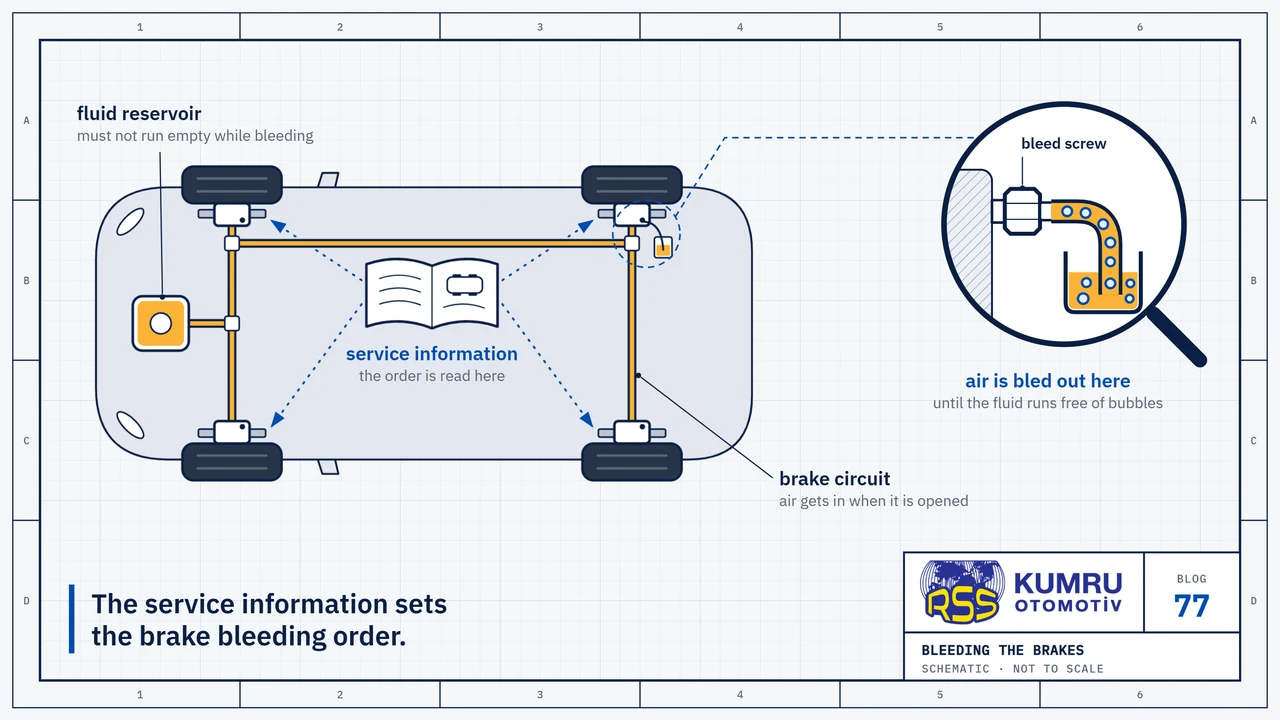
The bleeder screw on the dragging wheel separates a collapsed hose from a seized caliper. The sequence, put together from two Brake & Front End articles, starts with a road test:
- Road test. Is the pull there without braking, or only as the brakes first go on? Stop somewhere safe, press the pedal hard and drive on: if the pull is worse, a stuck piston is the most likely cause. Then compare the heat at each wheel.
- Turn by hand. Raise the car and compare how hard the dragging wheel turns with the one opposite.
- Bleeder screw. Loosen it. If the wheel then turns freely, the caliper is OK; with only one wheel affected, the magazine says it is probably the hose.
- Body fitting. Apply and release the brakes, then loosen the hose at its fitting on the body, not at the caliper. “If the problem goes away, the hose is in good condition”; look at the proportioning valve, master cylinder or ABS unit.
- Caliper. If the bleeder does not free the wheel, suspect a seized piston or binding mounting hardware; an outer pad worn more than the inner one points to the hardware. With the bleeder open the piston should push back easily through its whole stroke.
- Hose. Check the ends, the bracket for rust, flat spots and twist. After a new hose, bleed the system and repeat the road test.
The article does not spell out the reverse of step 4; it follows from the logic of the test: a wheel that stays tight with the body fitting loosened but frees at the bleeder has a hose holding the pressure. Brake pressure gauges give a second check: “a restriction will also cause the pressure to drop slowly when the brake is released”, though a dented metal brake line can do the same.
None of the sources we opened requires brake hoses to be replaced in pairs; the 2019 list only recommends a new hose with a new caliper. When a hose is due for replacement and what fails an inspection is covered in the brake hose inspection article.
Источники
- Brake & Front End (Babcox Media), “Finding the Cause of Brake Pulls”, trade magazine article, Andrew Markel, 21 August 2023; read from the Internet Archive copy.
- Tire Review (Babcox Media), “Seven Brake Myths Busted”, trade magazine article, Andrew Markel (editor of Brake & Front End), 12 June 2012; read from the Internet Archive copy.
- Brake & Front End (Babcox Media), “What DOT Really Means: The Do's And Don'ts Of Inspection And Replacement”, trade magazine article on brake hose inspection and replacement, Andrew Markel, 2 January 2019; read from the Internet Archive copy.
- NHTSA (raporu sunan: Chrysler / FCA US LLC), “Part 573 Safety Recall Report 19V-635”, safety recall report filed with the US National Highway Traffic Safety Administration, 29 August 2019; it concerns a caliper piston seal and is used here for its description of brake drag and its warning signs.
- T.C. Millî Eğitim Bakanlığı, “Motorlu Araçlar Teknolojisi: Fren Sistemleri (modül)”, vocational training module of Turkey's Ministry of National Education, Ankara 2013 (in Turkish); fault tables 1.6.4 and 2.6, and section 5 on brake pipes and hoses.
Дата повторной проверки источников: 13 октября 2026 г.
RSS Kumru Automotive
Компания RSS Kumru Automotive основана в 1990 году и специализируется на гидравлических системах и системах управления жидкостями. Our range includes brake and steering hoses, turbo pipes and hoses, and oil pipes.
Названия марок и номера OEM используются исключительно для идентификации и указания совместимости.