When does a brake hose need replacing? What counts as a defect at inspection
- Author
- Ufuk Şahin
- First published
- First published:
- Last updated
- Last updated:
- Reading time
- 6 min read
- Category
- Trucks
A brake hose on a truck, tractor unit or trailer has no age or mileage limit in the official inspection texts we opened. They judge its condition, and the line they draw is the reinforcement: surface cracking and chafing are a minor defect, but once the cords show, the hose bulges or it leaks, the vehicle fails. The one figure comes from a brake manufacturer: TRW gives 50,000 km or five years at the latest for hydraulic hoses.
Short answer
- Interval: none in the inspection texts. TRW’s recommendation is for hydraulic hoses.
- Passes: cracking or chafing with no cords exposed (Minor). In Turkey’s table hairline cracks are a Hafif Kusur.
- Fails: cords exposed, bulging, kinked or leaking (Major). In Turkey’s table a damaged or leaking hose is an Ağır Kusur.
- Worst category: imminent risk of failure, and any hydraulic fluid leak (Dangerous).
How is a brake hose checked at inspection?
By eye, with the system under pressure. The UK Heavy Goods Vehicle Inspection Manual has the tester ask the driver to pressurise the braking systems. The EU directive on periodic roadworthiness tests, 2014/45/EU, gives the method as “visual inspection of the components while the braking system is operated, if possible”. For surface damage the UK manual sets the test in one sentence:
“A hose should be considered a major or dangerous deficiency for surface cracking or damage by chafing only if the reinforcement is visible.”
DVSA, Heavy Goods Vehicle Inspection Manual, section 59
Both texts use the same three categories. A Minor deficiency has “no significant effect on the safety of the vehicle”, and with only minor defects the vehicle passes. A Major deficiency “may prejudice the safety of the vehicle” and the test is failed. A Dangerous deficiency is “a direct and immediate risk to road safety”.
Directive 2014/47/EU carries the same list to roadside inspections of commercial vehicles, where any major or dangerous deficiency “is to be rectified before the vehicle is further used on public roads”.
Which condition falls into which category?
In most rows the category turns on the cords and the extent of the damage. The table sets the UK manual beside item 1.1.12 of the two EU directives.
| Condition | UK (DVSA) | EU directives |
|---|---|---|
| Cracked or chafed, no cords exposed | Minor | Damaged or chafing: Minor or Major |
| Cracked with cords exposed, excessively chafed | Major | Cord impaired: Dangerous |
| Bulging under pressure | Major | Major |
| Kinked | Major | – |
| Twisted or stretched | Minor; Major where damage is evident | Twisted or too short: Minor |
| Deteriorated or porous | Deteriorated: Major | Porous: Major |
| Leaking air | Major | Major |
| Leaking hydraulic fluid | Dangerous | Dangerous |
| Imminent risk of failure | Dangerous | Dangerous |
Sources: DVSA manual, section 59; Directive 2014/45/EU, Annex I, and Directive 2014/47/EU, Annex II. A dash: not listed in that text.
A hose on its way to bursting is in the last two rows, both in the worst category. TRW explains the bulge: with age the hose material loses its strength, which can lead to “a bulge in the wall of the brake hose which can affect the braking performance”.
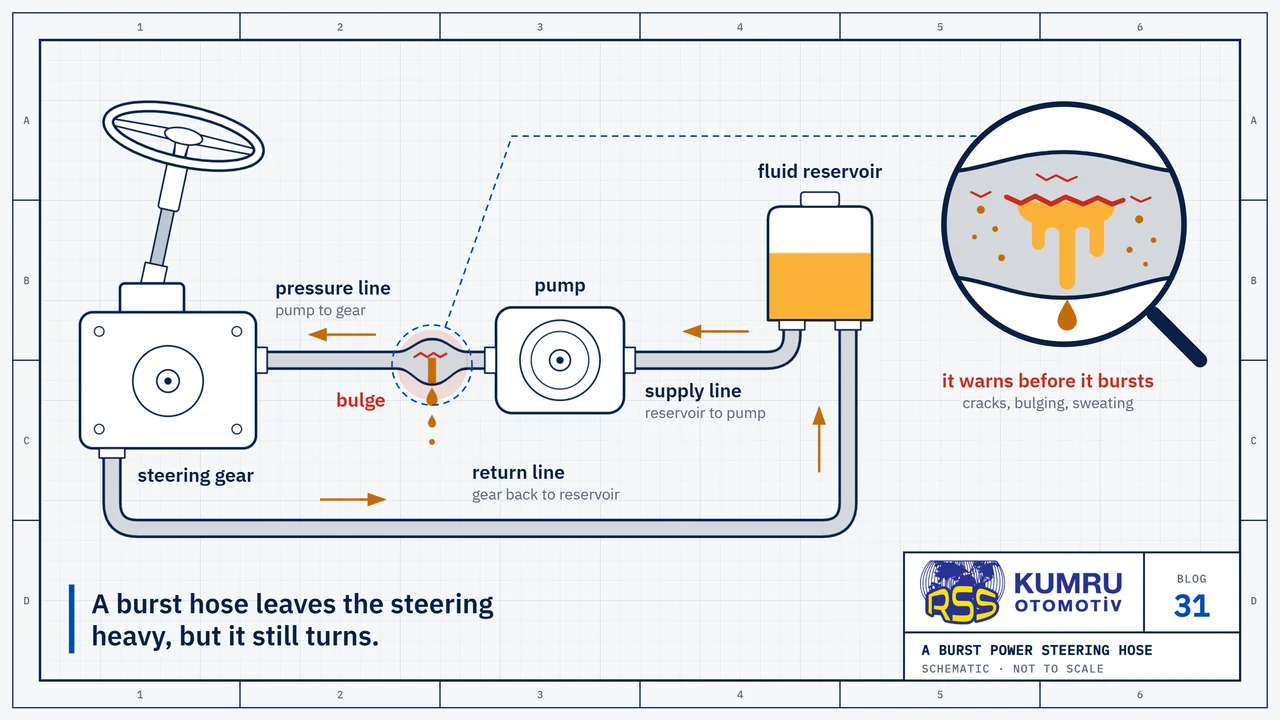
The UK manual also looks at routing: a hose “inadequately clipped or otherwise inadequately supported” is a Major deficiency. Steering hoses are judged differently: in the same manual, exposed structural cords on a power steering hose are acceptable as long as the cords are not damaged. Steering hoses have their own article.
What does Turkey’s defect table say?
Turkey uses different names. The Ministry of Transport and Infrastructure’s directive sorts defects into three groups: Hafif Kusur (light defect), Ağır Kusur (serious defect) and Emniyetsiz (unsafe). By its definitions a light defect needs no re-inspection, a serious defect needs repair, and unsafe means dangerous to life, property and traffic safety. The defect table applied since 1 June 2026 has these lines for brake hoses:
- Hairline cracks, or a hose not fitted properly: Hafif Kusur.
- Damaged or leaking hose: Ağır Kusur.
- Brake coupling hoses damaged or improperly replaced: Ağır Kusur.
The table has no separate line for bulging or for the reinforcement.
What is checked on the air lines between tractor and trailer?
Two things: whether a line leaks, and whether the trailer brakes itself when a line parts. In section 12 of the UK manual the service (yellow) and emergency (red) lines are disconnected, and a trailer emergency brake that is not applied automatically is a Dangerous deficiency. The EU directives rate it the same. Turkey’s table lists it as Emniyetsiz: “when the red coupling breaks away, the trailer does not brake”.
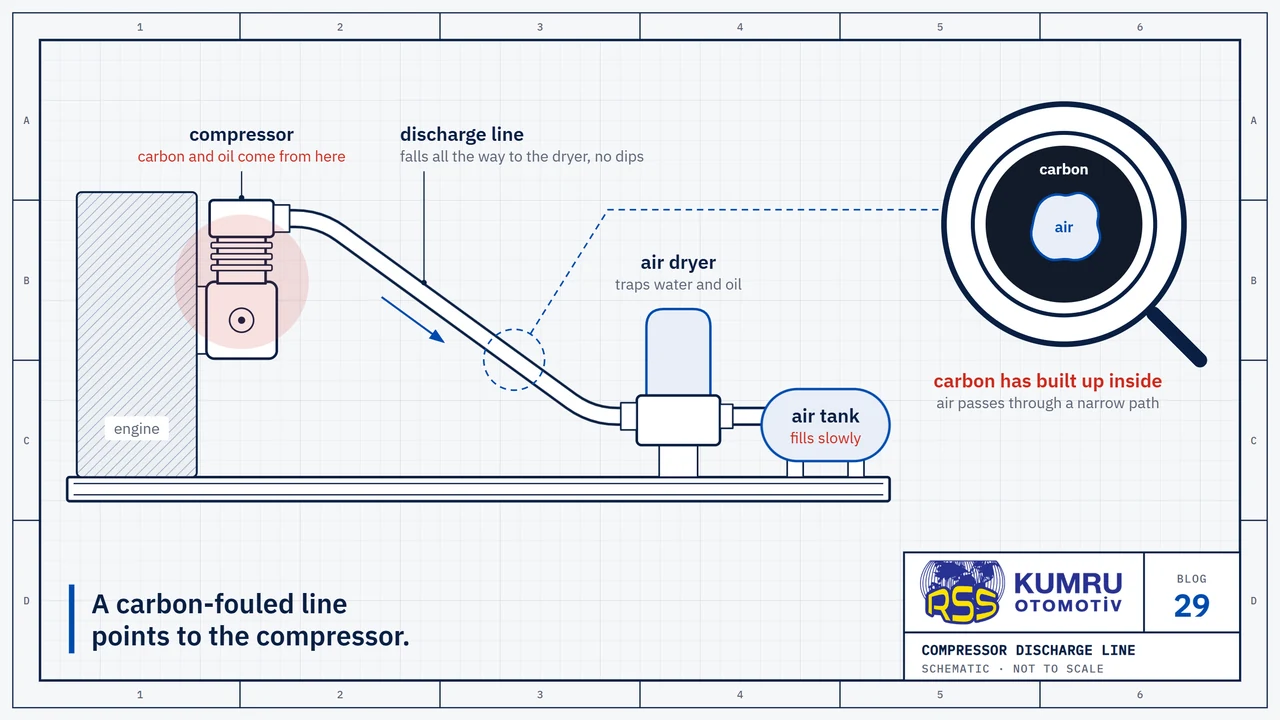
Leaks are a defect in all three texts: air leaking from a pipe or connection is Major, and a leaking coupling head is an Ağır Kusur. In the UK manual, non-metallic pipes “exposed to excessive heat” are a Major deficiency, and a sleeved repair is not acceptable on plastic brake pipes. None of these texts uses the word coil; that a coiled line falls under the same items is our inference. The manual also treats the air pipe between compressor and reservoir as a brake pipe; see the article on the compressor discharge line.
When should a brake hose be replaced?
The inspection texts give no interval. A brake manufacturer does. TRW Aftermarket’s workshop guide to changing a brake hose opens with it:
“Whether or not a brake hose is worn or damaged, TRW recommends that hoses should be changed every 50,000 km or after five years, at the latest.”
TRW Aftermarket, in Professional Motor Mechanic, 12 April 2017
The reason given is that “the rubber from which these hoses are made is a perishable item and has a defined lifetime”. The guide describes a hydraulic hose running to a caliper and names no class of vehicle. For air brake hoses we found no manufacturer’s interval; if the vehicle’s service schedule gives one, follow that.
A hose can need replacing before any interval is up. The UK manual calls its own criteria “minimum acceptable standards, which do not necessarily allow for further deterioration when the vehicle is in service”. The manual does not say so; the conclusion we draw is that cracking or chafing recorded as a minor defect is reason enough not to leave the hose until the next test.
Fit the new hose so that the cause goes with the old one: clear of moving parts and properly clipped. TRW warns against over-tightening the connections, and its hoses carry a marker line along their length; if the line looks twisted, the hose is “under stress and incorrectly fitted”. The UK manual counts “unsuitable joint fittings” as a Major deficiency; fitting types are covered separately.
What order should a mechanic check in?
Apply the tractor unit’s handbrake before you disconnect the red line. The UK manual’s note concerns EBS tractor units: when the red (emergency) line is dropped “the brakes may not come on”, and to apply them the ISO 7638 electrical connection is disconnected.
- Put the system under pressure. As the test does.
- Follow each hose along its whole length. For cracking and chafing there is one question: can you see the cords?
- Look for bulging and leaks. With the hose under pressure.
- Check the routing. Kinks, twist, a hose pulled tight; anywhere it touches a moving part; inadequate clips.
- Check for heat. Is a non-metallic pipe exposed to excessive heat?
- Look at repairs and fittings. An inadequate repair is a Major deficiency too.
- Test the trailer lines. With the red line disconnected, does the trailer brake?
Sources
- Driver and Vehicle Standards Agency (DVSA), “Heavy Goods Vehicle Inspection Manual”, UK official inspection manual; latest entry in the revision record 1 April 2026; section 12 (trailer air line connections), section 54 (steering) and section 59 (brake systems).
- European Parliament and Council of the European Union, “Directive 2014/45/EU on periodic roadworthiness tests for motor vehicles and their trailers”, EU directive of 3 April 2014 (Official Journal L 127, 29 April 2014); Articles 7 and 9, Annex I, items 1.1.12 and 1.1.20; item 1.1.12 reads the same in the consolidated text of 20 May 2023.
- European Parliament and Council of the European Union, “Directive 2014/47/EU on the technical roadside inspection of the roadworthiness of commercial vehicles”, EU directive of 3 April 2014 (Official Journal L 127, 29 April 2014); Articles 12 and 14, Annex II, items 1.1.12 and 1.1.20; item 1.1.12 reads the same in the consolidated text of 27 September 2022.
- T.C. Ulaştırma ve Altyapı Bakanlığı, “Araç Muayenesi Sonucu Belirlenen Eksikliklere İlişkin Kusur Grupları Yönergesi ve eki Kusurlar Tablosu”, Turkish ministry directive (2021) and its annex; the link opens the defect table applied from 1 June 2026 (PDF created 4 June 2026); the directive itself is on the ministry's page uhdgm.uab.gov.tr/yonergeler (both in Turkish).
- TRW Aftermarket, “How to Replace the Brake Hose”, workshop guide published in Professional Motor Mechanic, 12 April 2017; hydraulic brake hose; the guide does not say which class of vehicle it covers.
Sources were checked again on October 8, 2026.
RSS Kumru Automotive
RSS Kumru Automotive was founded in 1990 and specialises in hydraulic systems and fluid management. Our range includes more than 200 cab tilt hose references for Renault Trucks, Volvo, Scania, MAN, Iveco, Mercedes-Benz and DAF.
Brand names and OEM reference numbers are used for identification and compatibility information only.