When to replace a hydraulic hose: the failure signs
- Author
- Selami Kumru
- First published
- First published:
- Last updated
- Last updated:
- Reading time
- 6 min read
- Category
- Fittings and selection
A hydraulic hose is replaced as soon as it shows damage, whatever its age. The signs are well defined: a fitting that has slipped on the hose, a cover worn through to the reinforcement, hardening and cracks, blisters, leaks, crushing, kinks and twist. Where nothing is visible, age decides: Germany’s statutory accident insurance body, DGUV, recommends six years in normal service, as a guide value and not a binding limit.
Short answer
- Replace at once: a hose with a slipped fitting, exposed reinforcement, cracks, blisters, a leak, or a crushed, kinked or twisted section.
- Age: DGUV’s guide value is 6 years in normal service and 2 years in severe service. The hose maker’s instruction comes first.
- Never feel for a leak: oil from a pinhole goes through skin.
- Before removal: bring the pressure to zero. Stopping the pump may not be enough.
Which signs mean a hose is replaced immediately?
Parker’s safety guide for hose and fittings lists the findings of a visual inspection that “require immediate shut down and replacement” of the hose:
- fitting slippage on the hose;
- a damaged, cracked, cut or abraded cover, with any reinforcement exposed;
- hard, stiff, heat-cracked or charred hose;
- cracked, damaged or badly corroded fittings;
- leaks at the fitting or in the hose;
- kinked, crushed, flattened or twisted hose;
- a blistered, soft, degraded or loose cover.
DGUV’s information sheet on inspecting and replacing hydraulic hoses lists similar criteria and has its own word for fitting slippage: the hose “wandering out” of the fitting. Both rule out repair: Parker forbids patching a failed hose, and DGUV, in our translation, says hoses “may neither be repaired nor reassembled from old parts”. For the same signs in a steering circuit, see our article on a burst truck steering hose.
Why does a hose crack, blister or burst?
A hydraulic hose is damaged by rubbing, heat, incompatible fluid, pressure surges, poor routing and faulty crimping. Gates’ page on hose failure pairs each sign with its causes:
| Sign | Possible cause |
|---|---|
| Cover worn away, reinforcement exposed | Continuous chafing against equipment components or other hoses; non-compatible fluids. An abraded hose is open to rust. |
| Cracks in the cover or the tube | Excessive heat, ozone; flexing at very low temperatures. |
| Blisters on the cover | Incompatible fluid that has passed through the tube and collected under the cover, or compressed gas. |
| Weep at the end of the ferrule | Hose not inserted far enough, under-crimping; vibration, flexing, tugging. |
| Coupling separates from the hose | Over- or under-crimping, mismatched hose and fitting, wrong crimping dies. |
| Burst along the hose body | Pressure surges, excessive flexing, kinking, crushing, bending tighter than the minimum bend radius. |
| Burst at the coupling | Too little slack, excessive bending, an over-crimped end. |
Source: Gates, “Troubleshoot and Understand Hose Failure”, read in its Internet Archive copy.
A twisted hose shows in its printed label, which spirals round the hose. Gates puts a figure on it: “Twisting a high-pressure hose only 7° may reduce the service life up to 90%.” Parker wants fittings tightened without passing any twist to the hose.
How long does a hydraulic hose last, and is there a replacement interval?
No binding service life holds for every hydraulic hose. There are guide values. DGUV’s sheet says so directly:
“Because hydraulic hose assemblies are used so widely, it is not possible for technical reasons to state a maximum permissible service life that is generally valid and binding for all purposes.”
DGUV, Fachbereich AKTUELL FBHM-015, 18 February 2019 (our translation from the German)
Its guide values: 6 years for a hose in normal service, of which no more than 2 may be storage; 2 years in severe service, such as multi-shift operation or short machine cycles. The recommended inspection interval is 12 months in normal and 6 months in severe service. The sheet is written for German workplaces. It puts a hose manufacturer’s instructions first in every case and extends the period only with a written risk assessment and regular inspection.
The sheet gives its reasons: a hose ages even when stored properly and loaded within its limits, and one that looks sound from outside can be damaged between its layers. Parker agrees that “Hose Assemblies have a finite life” and wants inspection and replacement timed so that hoses “are replaced before any failure occurs”.
On a tractor forum the habit is different. Asked whether every hose on a loader around 10 years old and stored outside should be replaced, most owners say a hose is replaced when it starts to leak. A few differ: one replaces hoses in pairs, one inspects them at every greasing, and one pulled old hoses that would have sprayed oil on the exhaust if they burst.
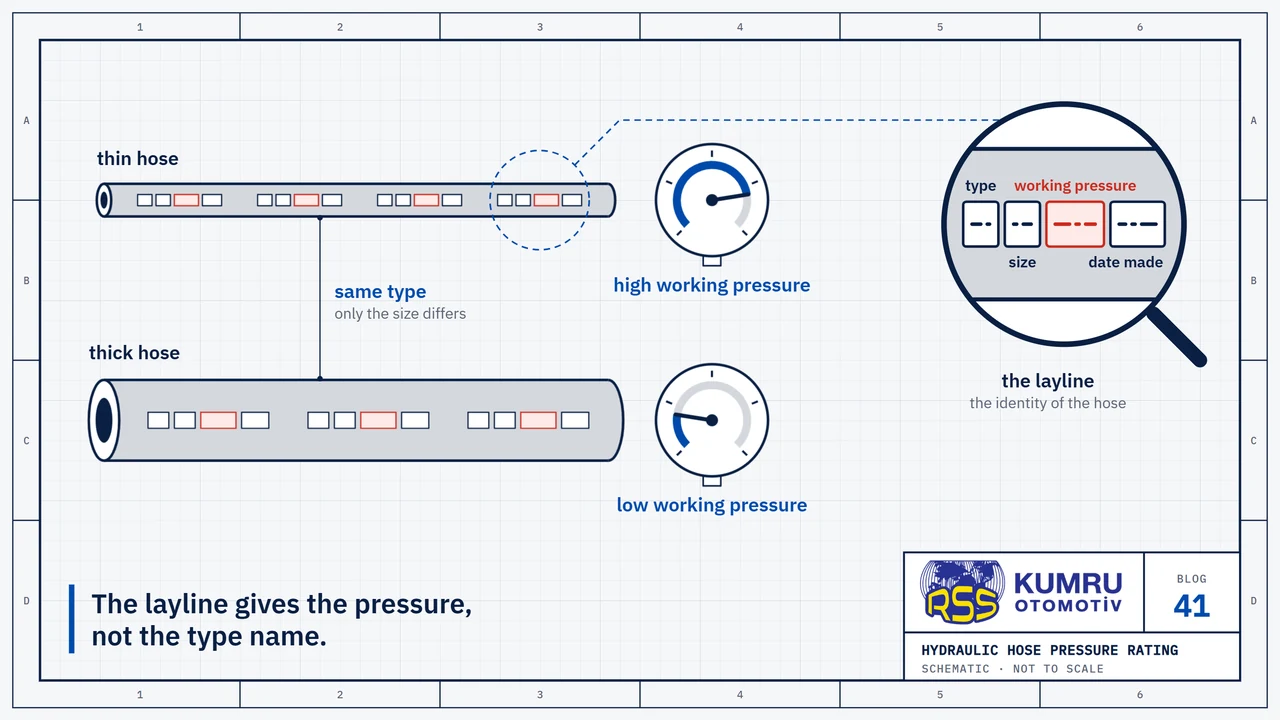
A hose’s age is printed on it: DGUV’s checklist looks for the quarter and year of manufacture on the hose and the year and month on the fitting.
Why should a leak never be traced by hand?
Do not feel for the leak. Parker warns that a pinhole can throw a jet of oil that is hard to see and dangerously powerful: “Under no circumstances should the user attempt to locate the leak by ‘feeling’ with their hands or any other part of their body.” A 2014 safety alert from the UK Health and Safety Executive (HSE) says serious cases have been reported above 100 bar and that, on anecdotal evidence, injury may occur at pressures as low as 7 bar. Even a wound that looks minor goes to a doctor at once; without proper care, HSE says, it can end in amputation.
The safety sheet quoted in our article on tractor steering pipe leaks has the leak found with a piece of cardboard. Parker goes further: the machine is shut down and nobody goes near the hose until the pressure is fully released.
What has to happen before a hose is disconnected?
A hose is not disconnected until the pressure in it is zero. HSE lists failure to release pressure during repair or maintenance among operator errors. Parker: “Simply shutting down the hydraulic pump may or may not eliminate the pressure in the Hose Assembly.” Check valves can hold pressure in a hose with the pump stopped, and the guide allows “several minutes or even hours” for it to fall.
A load the hose is holding goes on a mechanical support first; HSE expects hydraulic equipment to have one. How pressure is released on a given machine is in its operator’s manual.
In what order should a mechanic check?
- Stop and release. Support any load the hose is holding; bring the pressure to zero.
- Fittings. Signs of slippage, cracks, corrosion, oil at the end of the ferrule.
- Cover. Abrasion, cuts, cracks, hardness, blisters. Is the reinforcement showing?
- Shape. Crushed or kinked sections. Does the printed label spiral round the hose?
- Routing and clamps. Rubbing points, hot parts close by, worn clamps and guards.
- Age. The manufacturing date on the hose and on the fitting.
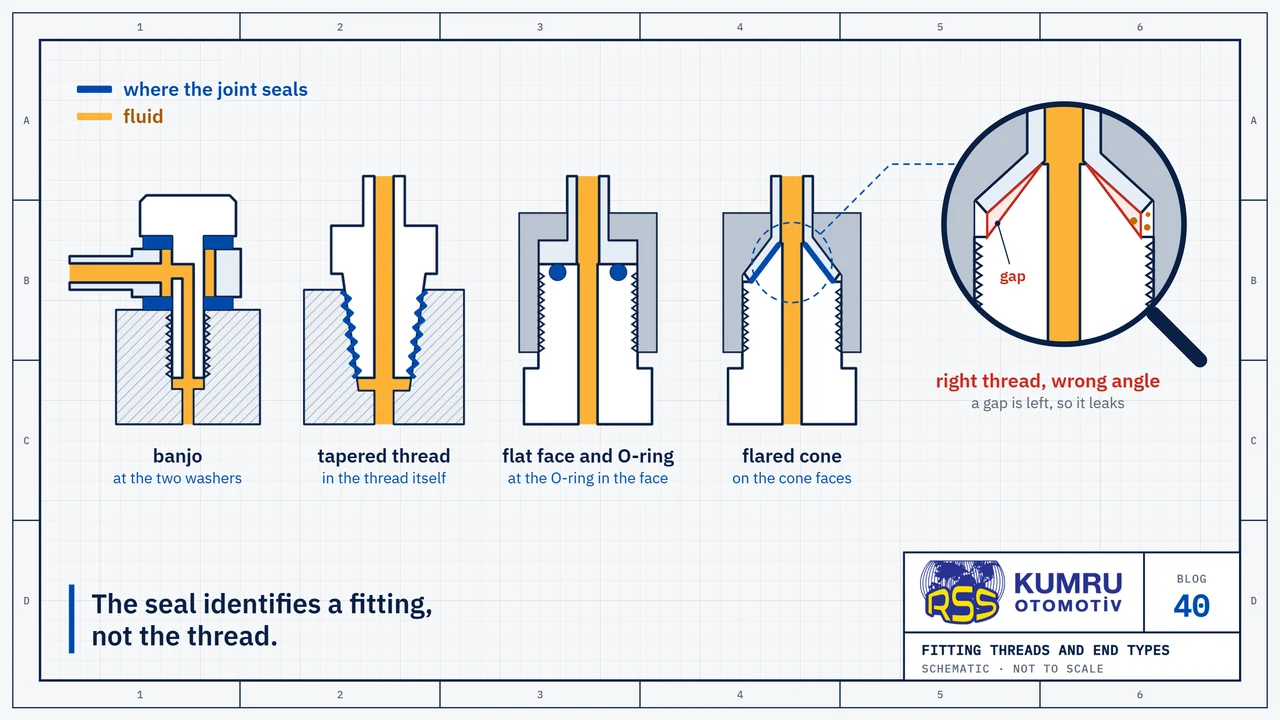
- Replacement. A hose that shows a sign is replaced, not repaired. Do not choose the fitting by its thread alone; fitting types have their own article.
- Test. Bleed the air, run the system at maximum operating pressure and check for leaks, staying out of the hazardous area.
Parker refers to SAE J1273 and ISO 17165-2 for routing, DGUV to DIN 20066 for installation. We have not opened the text of those standards.
Sources
- Parker Hannifin, “Parker Safety Guide for Selecting and Using Hose, Tubing, Fittings, Connectors, Conductors, Valves and Related Accessories (Publication No. 4400-B.1)”, manufacturer's safety guide, 28 September 2015; Internet Archive copy of 4 January 2024 of the document on parker.com.
- Deutsche Gesetzliche Unfallversicherung (DGUV), “Fachbereich AKTUELL FBHM-015: Hydraulik-Schlauchleitungen, Prüfen und Auswechseln”, information sheet of the German statutory accident insurance body, 18 February 2019; in German; inspection criteria and guide values for inspection and replacement intervals.
- Gates, “Troubleshoot and Understand Hose Failure”, manufacturer's information page, undated; Internet Archive copy of 12 August 2024 (the page did not open on the manufacturer's site on 8 October 2026).
- Health and Safety Executive (HSE), “High pressure fluid injection hazards”, page on agricultural machinery by the UK health and safety regulator; last updated 24 October 2024.
- Health and Safety Executive (HSE), “Hydraulic injection injury (Safety alert, Bulletin No. FOD 4-2014)”, safety alert, 23 September 2014.
- TractorByNet, “Massey/Agco vs aftermarket replacement hydraulic hoses and replacement interval”, forum thread, March 2024 (last post read 9 March 2024); cited only for field habit on replacement intervals, not a manufacturer instruction.
Sources were checked again on October 8, 2026.
RSS Kumru Automotive
RSS Kumru Automotive was founded in 1990 and specialises in hydraulic systems and fluid management. Our range includes fittings, injector lines, fuel lines and turbo oil pipes.
Brand names and OEM reference numbers are used for identification and compatibility information only.