What is MOQ? How a minimum order quantity is set for spare parts
- Автор
- Alperen Kumru
- Первая публикация
- Первая публикация:
- Последнее обновление
- Последнее обновление:
- Время чтения
- 6 мин чтения
- Категория
- Номера OEM и поставки
Эта статья пока доступна только на английском языке.
MOQ stands for minimum order quantity: the smallest quantity a supplier will accept in one order. In manufacturing it comes from set-up. A machine is changed over and proved once for each batch, however many parts follow, so a short run loads that work onto a few pieces. Before accepting a minimum, find out what it is tied to.
Short answer
- Meaning: the lowest number of units a supplier will sell in one order.
- Where it comes from: set-up time is spent once per batch. The larger the batch, the smaller the share each part carries.
- Custom hose assemblies and tubes: die and tooling changes, trial parts and buying in material for the batch set the minimum.
- Lead time: the interval between ordering and receiving. For a made-to-order part it runs from ordering the material to the last operation.
What is MOQ?
MOQ is the abbreviation of minimum order quantity: the smallest number of pieces a supplier will accept in a single order. The supplier sets it, and unless the buyer agrees something else, every order has to reach it. Alibaba.com puts it this way in its guide for sellers:
“Minimum order quantity (MOQ) is the lowest number of units a wholesale supplier allows buyers to purchase at one time.”
Alibaba.com, seller blog, 19 November 2020
The same page gives the supplier’s reason: without a minimum, time and resources go into orders that return very little. It says there is no formula; suppliers generally “use the breakeven point on the specific product as a starting point”.
What is MOQ in manufacturing?
In manufacturing, the MOQ is the batch size below which the set-up does not pay for itself. A production textbook used for an engineering course at Penn State defines set-up as the time from the last good part of one batch to the first good part of the next, trial pieces included.
The book works an example with 240 minutes of set-up and 2 minutes per part. In a batch of 50, each part carries 6.8 minutes; in a batch of 500, 2.48 minutes. The book’s conclusion is where minimum order quantities begin:
“Some companies only accept orders that exceed certain lot sizes to make production with setup profitable.”
Improving Your Factory System, chapter 5; course text for IE 450, Penn State, November 2004
The reverse holds too. With a 10-minute set-up the same two batches come to 2.2 and 2.02 minutes per part, and the book concludes that chasing large lots then makes no sense. Saylor Academy’s open operations management textbook gives the general rule: “The longer it takes, and the more expensive it is to setup equipment and labor to produce an item, the greater the quantity of items that have to be produced in a given production run.”
Buying material follows the same logic. OpenStax’s managerial accounting textbook counts the material itself as a unit-level cost, but calls a cost batch-level when it is incurred “every time a batch of items is manufactured, for example, costs associated with purchasing and receiving materials”.
What sets the MOQ and lead time for custom hydraulic hose assemblies and tubes?
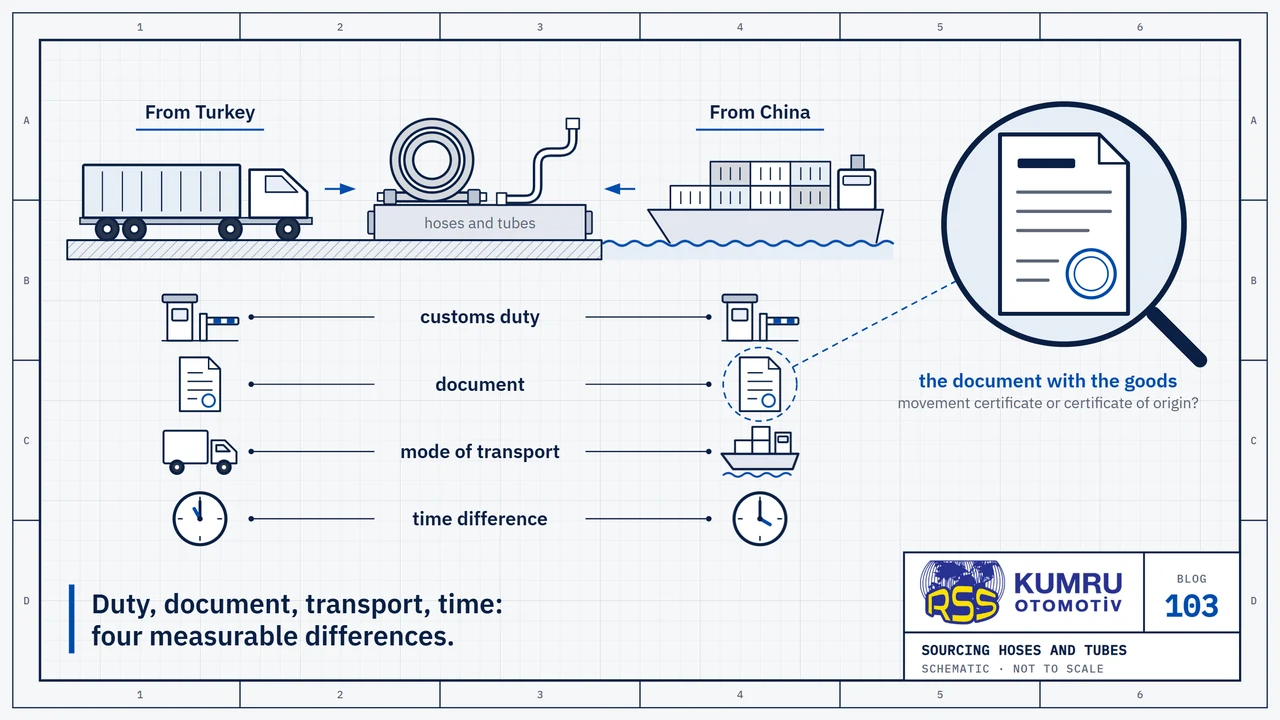
For a hydraulic hose assembly or a steel tube made to order, the minimum quantity is set by the work done once per batch: changing dies or tooling, setting and measuring, making trial parts, and buying in material. Lead time is the sum of those phases in sequence, starting with the material. None of the sources we read publishes a typical quantity or number of days for these parts, for manufacturers in Turkey or anywhere else, so we quote neither.
The Penn State text lists four classes of set-up work that occur on any machine: preparing and checking materials and tools, removing the old tooling and installing the new, measuring and calibrating, and producing trial parts while the machine is adjusted.
The book does not mention hoses or tubes; reading the list onto them is our own step. On a tube that means the bender’s tooling, the end-forming tool and a first piece checked against the sample or drawing; on a hose assembly, the dies of the crimping press and a first crimp measured before the run.
A press maker’s pages point the same way: Uniflex presents its production crimpers with “quickly exchangeable tools” and lists “short set-up times” among their savings. For tubes, tooling is specified for the tube’s diameter, wall thickness and bend radius, which we covered in the article on having a pipe made from a sample.
Our own figure, as one manufacturer in Turkey: at RSS Kumru the minimum order for made-to-order parts is 50 pieces and above per item, depending on the product, as stated in our guide to sourcing from Turkey, and lead time is quoted together with the price.
What does lead time depend on?
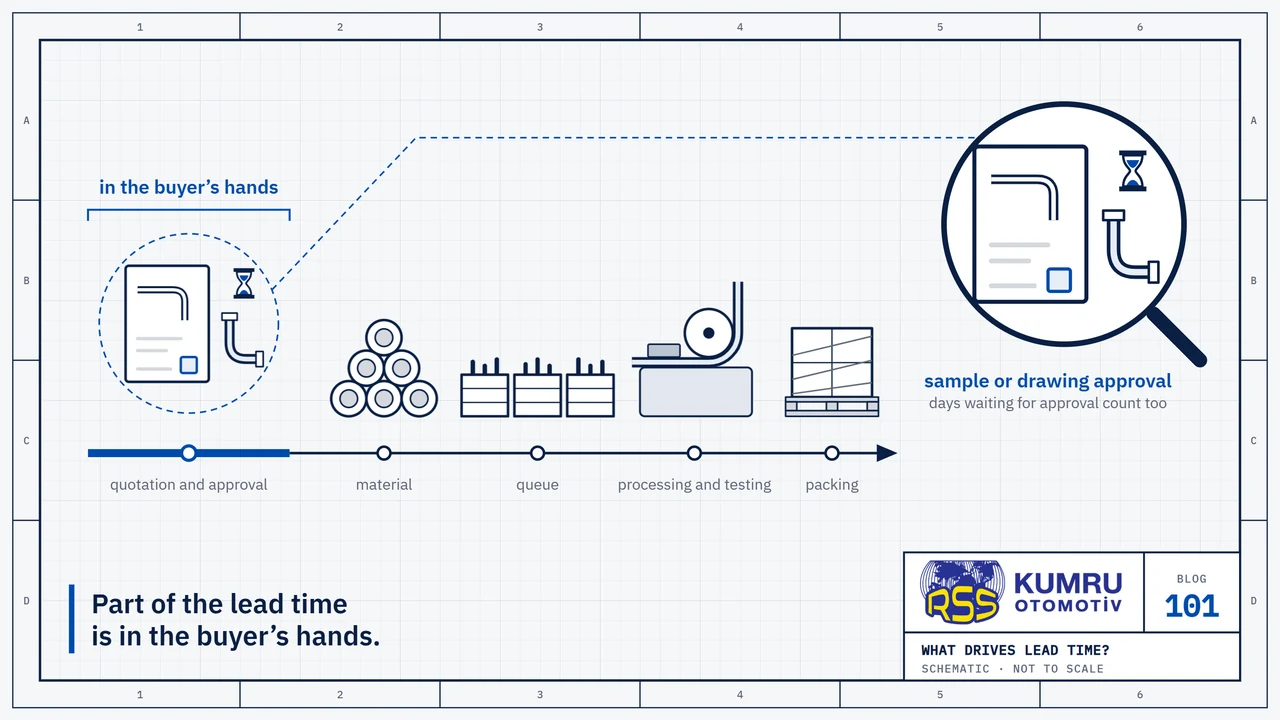
Lead time is “the time interval between ordering and receiving the order”, in the words of the Saylor textbook. For something that has to be made, the same book uses cumulative lead time: “the sum of the lead times that sequential phases of a process require, from ordering of parts or raw materials to completion of final assembly”. The clock therefore starts with the material, not at the first machine.
The Penn State text names two places where set-up time is lost or hard to forecast. Tools and materials have to be on hand when the set-up is scheduled, or the machine stands idle. And the last step, producing initial parts and adjusting, depends in most cases on the setter’s know-how and “can be difficult to predict with precision”.
What is MOQ on Alibaba?
On Alibaba.com the MOQ is the minimum a seller has set for a product listing. Buyers can search by it: Alibaba’s guide says to enter the quantity you want in the “Min Order” field and to tick “Ready to Ship” for products with lower minimums. For an exact quantity it points to the Request for Quotation (RFQ) market, where the supplier sees the quantity from the start and can choose whether to take the order.
Can an MOQ be negotiated?
Sometimes. Alibaba’s guide says that “in some instances, it is possible to negotiate MOQs with the seller”. Its advice is to ask for a quantity close to the stated minimum, not a small fraction of it. Where buyer and seller have a long history, “the seller may be flexible with these restrictions”. For a trial it suggests asking to buy a few units at the retail price.
On the factory side the minimum is not absolute either. The Penn State text notes that in many cases a company cannot choose not to supply a product and has to make smaller lots. The set-up is still done; it lands on fewer parts.
What should you ask before accepting an MOQ?
The order we suggest:
- What the number counts. Per part number, per order or per shipment? An OEM number and a supplier’s own number are different things, as the OEM number article explains.
- What it is tied to. Set-up, tooling that has to be made, or material bought in for the batch.
- The price on either side of it. Unit price at your quantity and at the minimum; whether a small trial lot is possible.
- Where lead time starts. From the order, from sample approval or from arrival of the material? Have it written into the quotation.
- The repeat order. Does the same minimum apply once tooling and settings exist?
Источники
- Alibaba.com, “What is minimum order quantity (MOQ's Meaning)?”, the marketplace's own guide for sellers, 19 November 2020; definition of MOQ, how buyers search by it on the site, negotiation.
- Pennsylvania State University, IE 450, “Improving Your Factory System, Chapter 5: Equipment Efficiency: Availability, quality and SMED”, course textbook chapter (PDF) on the university's engineering site, November 2004; definition of set-up time, its effect on batch size, the four classes of set-up work.
- Saylor Academy, “Operations Management (open textbook): 3.5 Process Selection, 6.4 JIT Pull Systems, 9.3 Inventory Control”, openly licensed operations management textbook, 2021; definitions of lead time and cumulative lead time, the link between set-up time and run size.
- OpenStax (Rice University), “Principles of Accounting, Volume 2: Managerial Accounting, 6.3 Calculate Activity-Based Product Costs”, openly licensed managerial accounting textbook, 14 February 2019; definitions of unit-level and batch-level cost.
- UNIFLEX-Hydraulik, “Production Crimpers (product page)”, product page of a hose crimping press maker, undated; viewed 13 October 2026; die change and set-up time on the press.
Дата повторной проверки источников: 13 октября 2026 г.
RSS Kumru Automotive
Компания RSS Kumru Automotive основана в 1990 году и специализируется на гидравлических системах и системах управления жидкостями. Our range includes injector lines, fuel and oil lines, hoses and fittings.
Названия марок и номера OEM используются исключительно для идентификации и указания совместимости.