Sourcing pipes and hoses from Turkey: how to evaluate a manufacturer
- Author
- Alperen Kumru
- First published
- First published:
- Last updated
- Last updated:
- Reading time
- 6 min read
- Category
- OEM numbers and sourcing
A pipe or hose manufacturer in Turkey can be evaluated from a distance if you ask only for things that can be checked: where each operation is done, what the quality certificate covers and whether it is active, how samples are approved, and which records and customs documents come with the goods. The rest is agreed in writing before the first order.
Short answer
- Manufacturer or trader: ask where tube bending, end forming, machining and hose crimping are done, then compare the answer with the certificate scope.
- Certificates: ISO 9001 is looked up in IAF CertSearch, IATF 16949 in the IATF Customer Portal. Both describe a management system, not a part.
- Customs: inside the EU–Turkey customs union the document is the A.TR movement certificate. It shows free circulation, not origin.
- Before the first batch: approved sample, batch records, delivery term and minimum quantity, all in writing.
Is the supplier a manufacturer or a trading company?
Ask where each operation is done: tube bending, tube end forming, machining of the fittings, hose cutting and crimping. A manufacturer names its own plant and says what it buys in; a trading company names its suppliers. Neither answer rules a supplier out. It tells you who can answer a technical question and who holds the test records.
The answer can be checked. A certificate found in IAF CertSearch is shown with its scope, which should name the activity you are buying. The IATF Customer Portal can be searched by “the name of a manufacturing site”. Then ask for a video call from the shop floor with your part on the machine, or visit.
What does a quality certificate tell you, and how do you check it?
A quality certificate says that a certification body audited the company’s quality management system against a standard. ISO 9001 is the general standard; IATF 16949 is the automotive one. Neither is a test report for a pipe. That is our reading, not a quotation: the two databases below list companies, sites and scopes, not parts.
Ask for a copy of the certificate. For ISO 9001, and ISO 14001 in the same way, enter the certificate number or the company name in IAF CertSearch. The entry shows the standard, status, scope, certification body and accreditation body. The site’s test is short:
“A certificate is valid if it appears in IAF CertSearch, has an Active status, and is up to date.”
IAF CertSearch, How to check a certificate
The database covers accredited certification only. If your supplier’s certificate does not appear, ask the certification body named on it to confirm it directly.
IATF 16949 has its own check, the IATF Customer Portal, searched by IATF certificate number or by site. IATF also lists the certification bodies under contract with it, which “are authorized to conduct IATF 16949:2016 certification activity”. If a certification is still in progress, ask for the audit dates and look it up once it is issued.
What should be agreed before the first batch?
Before the first batch, agree the reference and then the proof. The reference is an OEM number, a drawing or a sample; for a pipe with no readable number, the measurements that describe it do the same job. The order we suggest:
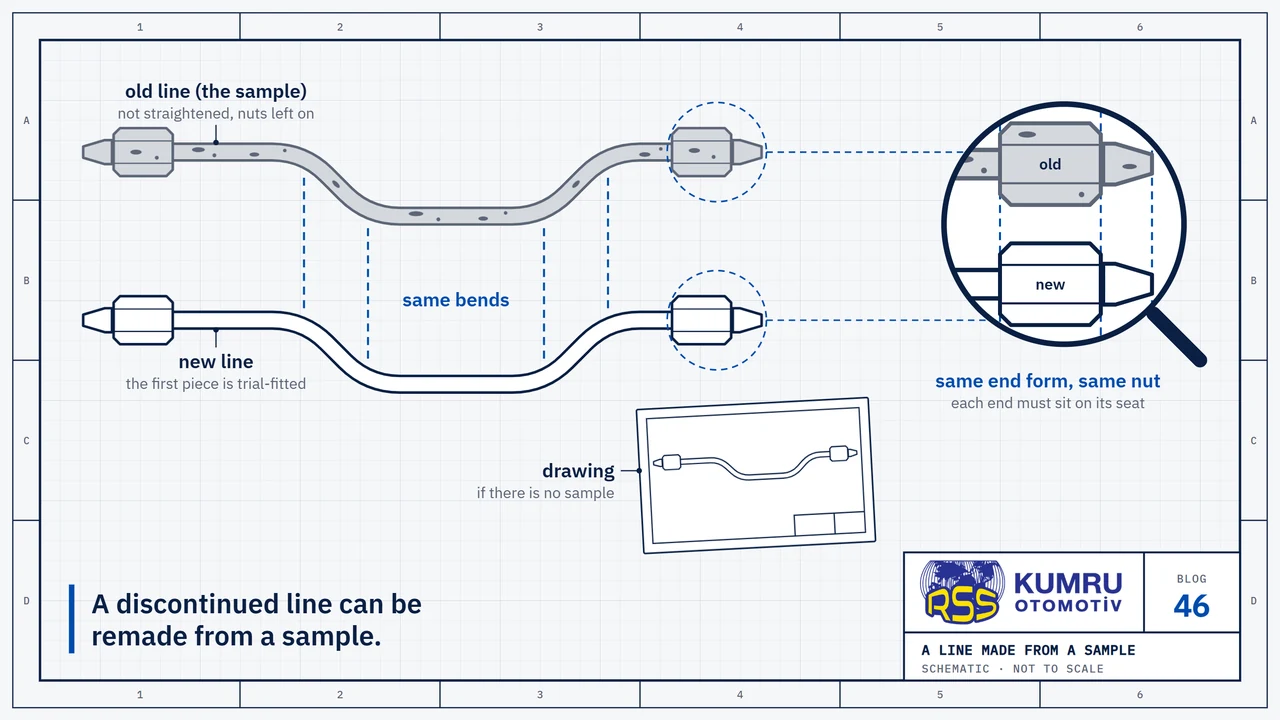
- Sample approval. Samples come before series production. You fit or measure them and approve in writing; each side keeps one.
- First-batch measurements. A report on parts from the batch: tube diameter, length, bend positions, thread and seat at each end.
- Material and pressure test records. The material certificate of the steel tube; for hose assemblies the test pressure, and whether every piece or a sample was tested.
- Traceability. A batch mark on the part, bag or label that leads back to those records.
Write the thread and seat type into the order too. A thread that screws in is not always the right connection, as the guide to fitting and thread types shows.
Which customs documents should come with the goods?
Which document comes with the goods depends on the destination. Inside the EU–Turkey customs union it is the A.TR movement certificate. The European Commission’s page for importers says goods produced in the customs union, or put into free circulation in it, can move anywhere in its territory “as long as they are accompanied by the proof of their customs status, established by an A.TR. movement certificate”.
The same page gives the tariff position as “zero customs duties and zero quotas for goods covered by the customs union”, and names industrial products as covered. Turkey’s Ministry of Trade adds a distinction that matters whenever origin is asked for:
“The A.TR movement certificate is a document showing that the goods are in free circulation; it does not show the origin of the goods.”
Republic of Türkiye Ministry of Trade, Frequently asked questions: Origin, 20 January 2025
| Document | Used for | What it shows |
|---|---|---|
| A.TR movement certificate | Goods in free circulation within the EU–Turkey customs union | Free circulation status, not origin |
| EUR.1 movement certificate or invoice declaration | Countries with a preferential trade agreement with Turkey | Preferential origin; opens the reduced tariff |
| Certificate of origin (menşe şahadetnamesi) | Issued when the importing country asks for it | Non-preferential origin; no tariff reduction |
Source: Ministry of Trade, 20 January 2025. Which row applies depends on the destination and on the tariff code of the part. Have your customs broker confirm it before the first shipment.
What should a quotation say about delivery and minimum quantity?
A quotation should name the delivery term, the place and the minimum quantity per part number. Delivery terms come from the Incoterms® 2020 rules of the International Chamber of Commerce (ICC), which ICC calls “a set of eleven three-letter trade terms”.
ICC recommends writing rule, place and edition together: “[the chosen Incoterms Rule followed by the named place] Incoterms® 2020”. Prices quoted under different rules are not yet comparable.
For the minimum order quantity, ask what it is tied to. The explanation is ours, not from the sources: a made-to-order pipe needs its bending set-up, end-forming tooling and first-part check whatever the quantity, and the minimum is the batch that work is spread over.
Incoterms® is a trademark of ICC. The Incoterms® rules are protected by copyright owned by ICC.
How do we answer the same questions?
We manufacture in Gebze, Kocaeli, as RSS Kumru Otomotiv: turbo oil pipes, injection pipes, hydraulic pipes and hoses, and fittings since 1990, in a 3,500 m² plant we moved to in 2013. Tube bending, tube end forming, CNC turning and machining, hose cutting and crimping are done in that plant. Parts are measured in our own laboratory and hoses are pressure tested.
Our quality management system is certified to ISO 9001:2015 and our environmental management system to ISO 14001; for IATF 16949 the certification process is under way. We produce to an OEM number, a technical drawing or a sample and have matched more than 1,800 parts to OEM references; the minimum order for made-to-order parts is usually between 50 and 100, depending on the product.
In what order should the checks be done?
- Certificates. Ask for copies and look them up first.
- Operations. Ask where each one is done, and compare the answer with the certificate scope.
- Sample. Fix the reference, then approve a sample in writing.
- Records and quotation. Agree the batch records, the delivery term with its named place and the minimum quantity.
- Customs. Have your customs broker confirm the document for your destination and tariff code before the first shipment.
Sources
- IAF CertSearch, “IAF CertSearch: home page, About IAF CertSearch, Manual Search (How to check a certificate), ISO 9001 page”, online database of accredited certifications, undated; viewed 8 October 2026; how a certificate is looked up and what the entry shows.
- IATF, “IATF Customer Portal (certificate validity check) and IATF Global Oversight pages: About IATF, IATF 16949:2016, Certification Bodies under contract”, oversight website of the International Automotive Task Force and its certificate lookup portal (iatf-customerportal.org); update note on the portal dated 5 August 2024, pages viewed 8 October 2026.
- European Commission, “Access2Markets: EU-Türkiye Customs Union”, European Commission information page for importers, undated; viewed 8 October 2026; scope of the customs union, tariffs and the A.TR movement certificate.
- T.C. Ticaret Bakanlığı, “Sıkça Sorulan Sorular: Menşe”, customs FAQ page of Türkiye's Ministry of Trade, 20 January 2025, in Turkish; A.TR, EUR.1, invoice declaration and certificate of origin.
- ICC, “Incoterms® 2020 and Incoterms® rules trademark and copyright policy”, Incoterms® pages of the International Chamber of Commerce, undated; viewed 8 October 2026; used for rule names and the recommended wording only, not for the text of the rules.
Sources were checked again on October 8, 2026.
RSS Kumru Automotive
RSS Kumru Automotive was founded in 1990 and specialises in hydraulic systems and fluid management. Our range includes injector lines, fuel and oil lines, hoses and fittings.
Brand names and OEM reference numbers are used for identification and compatibility information only.