What happens when a truck power steering hose bursts? Replacement and bleeding
- Author
- Ufuk Şahin
- First published
- First published:
- Last updated
- Last updated:
- Reading time
- 6 min read
- Category
- Trucks
When a power steering hose bursts or leaks on a truck, the system loses its fluid and the hydraulic assist with it. The truck still steers, but the wheel turns heavy. A failing hose leaves marks first: it sweats, cracks or goes soft, and the pump starts to whine. After the new hose goes on, the system needs fresh fluid and bleeding.
Short answer
- If it bursts: the fluid drains and the assist is lost; the steering still works, heavily.
- Signs beforehand: a wet, mud-caked hose; cracks, soft spots, bulging; foam in the reservoir; pump whine.
- When replacing: cleanliness, new seals, a route that rubs on nothing, fresh fluid.
- Afterwards: fill the reservoir, top up between short engine runs, then steer to bleed the air out.
Which hoses does a truck power steering system have?
A truck’s hydraulic steering circuit has three lines. TRW’s maintenance guide for commercial vehicle steering systems (TRW800) names all three: the supply line from reservoir to pump, the pressure line from pump to steering gear, and the return line from the gear back to the reservoir.
What happens when a hose bursts or leaks?
When a steering hose bursts, the fluid drains and the hydraulic assist is lost; the truck still steers, but heavily. TRW’s maintenance guide: “A leak could ultimately cause the loss of fluid, which could result in a loss of power steering assist.” Its diagnostics manual defines hard steering like this:
“Steering is still possible, but there is not enough power assist.”
TRW Commercial Steering Systems, Steering Diagnostics Service Manual (TRW1250), April 2002
The second consequence is at the pump. As the level falls, air can get into the system. TRW’s noise chart pairs low fluid level with a loose inlet line, and its note on cavitation says continual cavitation causes “internal pump damage, and ultimately, failure”. The manual does not join the two; that a pump short of fluid gets damaged is our inference.
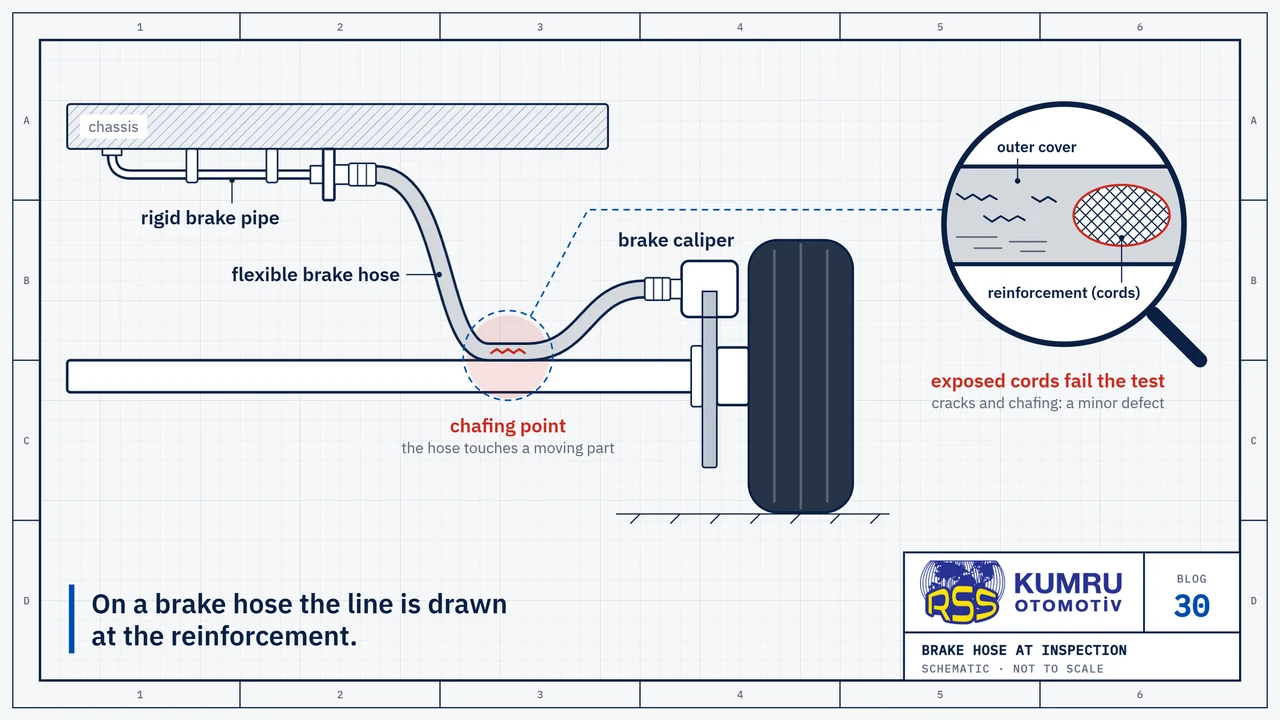
The third is at the annual test: the UK inspection manual for heavy goods vehicles rates a fluid leak anywhere in the power steering system as Major, and an empty reservoir too. Brake hose defects are covered in the brake hose article.
What are the warning signs before a hose fails?
A failing steering hose gets wet, cracks, goes soft or bulges. TRW’s maintenance guide says to inspect all hydraulic hoses “for cracks, soft or sweat spots and signs of local collapse”, covers and corrugated tubing off, and to replace any found defective.
- Wet mud. Leaking steering hoses, the guide notes, “are usually covered with a ‘wet mud’ when the rubber part starts to fail”.
- Bulging, damage, rubbing. The UK manual rates a pipe or hose that is excessively corroded, damaged, bulging or fouling other parts of the vehicle as Major; Dangerous where steering control is obviously affected.
- Foam in the reservoir. TRW reads foam or bubbles as air being sucked in through cracks or loose fittings.
- Whine. TRW describes cavitation as a whining or noisy pump; its causes include a twisted, loose or cracked inlet line and separation of the hose’s inner liner.
TRW’s interval is twice a year: tighten the hose clamps and inspect every hydraulic hose and connection for leaks.
What matters when the hose is replaced?
Four things decide a steering hose replacement: cleanliness, routing, new seals and the right fluid.
Keep the hose clear of live terminals. A 2018 recall report filed with NHTSA in the US concerned a power steering hose that could rub on the starter motor’s power stud, causing an electrical arc and a fluid leak. Its risk statement: “A power steering leak in the presence of an electrical arc could increase the risk of fire”. TRW also asks for precautions against hot hydraulic fluid.
- Clean first. Clean around the fittings before you undo them. ZF Aftermarket’s service sheet, published under the TRW brand, gives the reason: steering systems are made to tolerances of a few thousandths of a millimetre, and “The smallest particles of dirt can cause leaks and ultimately cause failure!” Never pressure-wash or steam-clean a steering gear, TRW adds.
- The route. The new hose must run without twist, rub on nothing and have its clamps tightened. TRW’s leak checklist for hoses lists loose clamps, twisting and abrasion together.
- Seals. The sheet: “All seals must always be replaced for safety reasons.”
- Fittings. The same checklist names fittings that are loose, overtightened, damaged on the sealing surface or mismatched to the hose. Thread alone does not identify one; fitting and thread types have an article of their own. Torque is the figure in the truck’s workshop manual.
- Fluid. “Never re-use old hydraulic fluid!” Use the fluid the vehicle maker approves; do not mix types.
On flushing the two documents differ: TRW’s commercial vehicle guide requires it whenever a gear, pump or reservoir is replaced; the service sheet asks for flushing and bleeding after any work on the system.
How do you top up and bleed the system afterwards?
A steering system is bled by running the engine in short bursts, topping up the reservoir each time, and then turning the wheel. TRW’s sequence for commercial vehicles:
- Fill the reservoir.
- Start the engine, run it for 10 seconds without steering, and shut it off. Top up if the level has dropped. Do this at least three times.
- Idle the engine for 2 minutes without steering. Shut it off and check the level.
- With the engine running, steer slowly from full left to full right several times. If bubbles show in the reservoir, stop, hold the wheel still, and carry on once the fluid has cleared.
- Check the level one last time.
A gear with a manual bleed screw on top needs one more step: engine idling, wheels straight ahead, loosen the screw two to three turns, close it when the fluid runs free of bubbles, repeat three or four times. Do not turn the wheel while the screw is loose.
Two cautions from the same guide: do not let the level drop significantly, which lets air in; and if the fluid foams until the top of the filter is hidden, shut down, wait 5 to 10 minutes and start again.
ZF Aftermarket’s service sheet names no class of vehicle and describes a different routine: fill to the MAX mark, raise the wheels, and at idle turn the steering 10 to 15 times from side to side “without reaching the steering limit”. Foamy or clouded fluid means waiting at least 15 minutes with the engine off. One procedure goes to full lock, the other stops short; the truck’s workshop manual decides.
A badly bled system can be heard: the sheet describes “a brief squeak or drone or a continuous dragging sound”, and the wheel may vibrate. If the air will not clear, check the line between pump and reservoir, and the pump itself.
In what order should a mechanic check?
On a truck losing steering fluid, start at the reservoir.
- Reservoir. Level, foam, a burnt smell.
- Hoses, end to end. Open the covers: wetness, cracks, soft spots, bulges, rub marks.
- Fittings and clamps. A leak at a hose fitting can pass for a leaking input shaft seal, TRW notes.
- Wipe and watch. Wipe the area, then watch the connections for 5 to 10 minutes with the engine running and the wheel being turned.
- Supply line. If the pump whines: kinks, loose clamps, cracks.
- Replace, refill, bleed. After the test drive, check the level and look for leaks again.
Sources
- TRW Commercial Steering Systems, “Steering System Maintenance Guidelines (TRW800)”, maintenance guide for commercial vehicle steering systems, revised January 2020 (Rev. 1/20); written for the North American market.
- TRW Commercial Steering Systems, “Steering Diagnostics Service Manual: Chart Your Way to Easy Steering (TRW1250)”, diagnostics manual for heavy truck steering, revised April 2002 (Rev. 4/02); written for the North American market.
- ZF Aftermarket (TRW), “Service Information XZS144A: Flush and bleed the hydraulic steering system”, service information sheet, undated; the sheet does not say which class of vehicle it covers.
- Driver and Vehicle Standards Agency (DVSA), “Heavy Goods Vehicle Inspection Manual”, UK official inspection manual; latest entry in the revision record 1 April 2026; section 54 (steering).
- NHTSA, “Part 573 Safety Recall Report 18V-198”, safety recall report filed with the US regulator, 27 March 2018; vehicle type: buses, medium and heavy vehicles.
Sources were checked again on October 8, 2026.
RSS Kumru Automotive
RSS Kumru Automotive was founded in 1990 and specialises in hydraulic systems and fluid management. Our range includes more than 200 cab tilt hose references for Renault Trucks, Volvo, Scania, MAN, Iveco, Mercedes-Benz and DAF.
Brand names and OEM reference numbers are used for identification and compatibility information only.