How to read a hydraulic hose pressure rating: what the layline tells you
- Author
- Selami Kumru
- First published
- First published:
- Last updated
- Last updated:
- Reading time
- 6 min read
- Category
- Fittings and selection
The line of print along a hydraulic hose gives the standard it was built to, its inside diameter and its maximum working pressure. The type name alone does not give the pressure rating: within one type, working pressure falls as the bore grows. Type, size and pressure have to be read together.
Short answer
- The layline: part number, size, standard and type, working pressure, date of manufacture.
- A type name is not a pressure: in Semperit’s catalogue 2SN carries 400 bar at DN 6 and 165 bar at DN 25.
- Burst pressure: four times working pressure in the same catalogue; a test figure, not a margin.
- The right question: what is the highest pressure in the system, and are there spikes?
What does the layline on a hose tell you?
The layline is the identity of a hydraulic hose. The glossary in Danfoss’s hose catalogue defines it like this:
“the line of printed information that runs parallel on the side of a manufactured hose giving details such as part number, psi rating, hose size, and manufacturing data.”
Danfoss, EMEA rubber hydraulic hose and fitting catalogue, February 2025
The main items of one layline from the same catalogue: EC215-06 · 9.5 mm (0.38 in) · DN10 · EN857 2SC • ISO 18752 · 345 BAR (5000 PSI) · -40°C to +100°C. In order: part number with its size code, inside diameter, nominal size, standard and type, working pressure, temperature range.
The date of manufacture is there too; the catalogue’s example is 2Q99, the second quarter of 1999. Danfoss also uses the layline to show whether a hose was twisted during installation.
What do 1SN, 2SN, 2SC and 4SP mean?
Type names such as 1SN, 2SN, 2SC and 4SP describe the reinforcement of the hose: how many layers of wire, braided or spiralled. Wire braid types sit in EN 853, compact wire braid types in EN 857 and wire spiral types in EN 856.
| Type | Reinforcement | Standard |
|---|---|---|
| 1SN | One wire braid | EN 853 |
| 2SN | Two wire braids | EN 853 |
| 1SC, 2SC | Compact; one and two wire braids | EN 857 |
| 4SP, 4SH | Four wire spirals | EN 856 |
Reinforcement as described in the Danfoss catalogue. We did not open the standards themselves; for EN 853 and ISO 18752 we read only the scope, on the pages of the Estonian standards body (EVS).
Catalogues print an SAE name next to the same hose: Semperit lists 1SN with SAE 100R1AT and 2SN with SAE 100R2AT.
How is hose size written: dash, DN or inch?
Hose size is written three ways, and on these types all three describe the inside diameter: inches, DN (the nominal size in millimetres) and the dash size. Danfoss’s definition: “Dash size designates the nominal size in 16th of an inch.” It follows the part number after a dash, like the 06 in EC215-06.
Semperit’s tables print the three side by side: DN 6, 1/4 inch, -4; DN 10, 3/8 inch, -6; DN 12, 1/2 inch, -8.
Does every size of the same type carry the same pressure?
No. In the classic wire braid and spiral types, working pressure changes with size and falls as the bore grows. Five rows from Semperit’s catalogue:
| Nominal size | 1SN | 2SN | 4SP |
|---|---|---|---|
| DN 6 (1/4 in) | 225 | 400 | – |
| DN 12 (1/2 in) | 160 | 275 | 425 |
| DN 19 (3/4 in) | 105 | 215 | 350 |
| DN 25 (1 in) | 88 | 165 | 320 |
| DN 51 (2 in) | 40 | 80 | 165 |
Source: Semperit, hydraulic hoses catalogue, March 2023; a sample, not the full tables. A dash means that size is not listed. The figure that counts is the one printed on the hose in your hand.
So the question of how many bar a 2SN hose takes has no single answer. For the same pressure in every size there is a separate standard, ISO 18752. Its scope says: “Each class has a single maximum working pressure for all sizes.” Manuli calls such hoses isobaric and lists them apart from the traditional types “where working pressure varies according to the hose size”.
What is the difference between working pressure and burst pressure?
Working pressure is the highest pressure a hose is meant to be used at; burst pressure is the pressure at which it ruptures on test. Danfoss describes the test: “Burst is a one time pressure test where hose is taken to failure and required to meet a 4 to 1 safety factor.”
The tables show the same ratio. The EC215-06 above has a working pressure of 345 bar and a minimum burst pressure of 1,380 bar; Semperit’s 2SN table gives 1,600 bar against 400. On an equipment forum one member puts the minimum at three times working pressure; in the two manufacturer documents cited here it is four.
The gap is not a margin to work in. Danfoss’s catalogue: “Maximum operating pressure should not exceed pressures listed in the hose data.”
Will a 3000 psi hose do, and how should the question be asked?
Whether a 3000 psi hose will do depends on the system, not the hose: what is the highest pressure in the circuit, and does it see spikes? The SAE J1273 recommendations, reproduced in Danfoss’s catalogue, ask for a hose whose maximum operating pressure is equal to or greater than the system pressure. They go on:
“Surge pressures higher than the maximum operating pressure will shorten hose life and must be taken into account by the hydraulic designer.”
SAE J1273 recommendations as reproduced in the Danfoss catalogue, February 2025
On the same forum, an owner whose excavator blew a 3/4 inch hose asks: “Does this excavator require 5000 psi hose? Would 3000 psi hose be as good?” Two members reply that machines of this class run at around 5000 psi; one adds that a 3000 psi hose would get by for a short time but would not last.
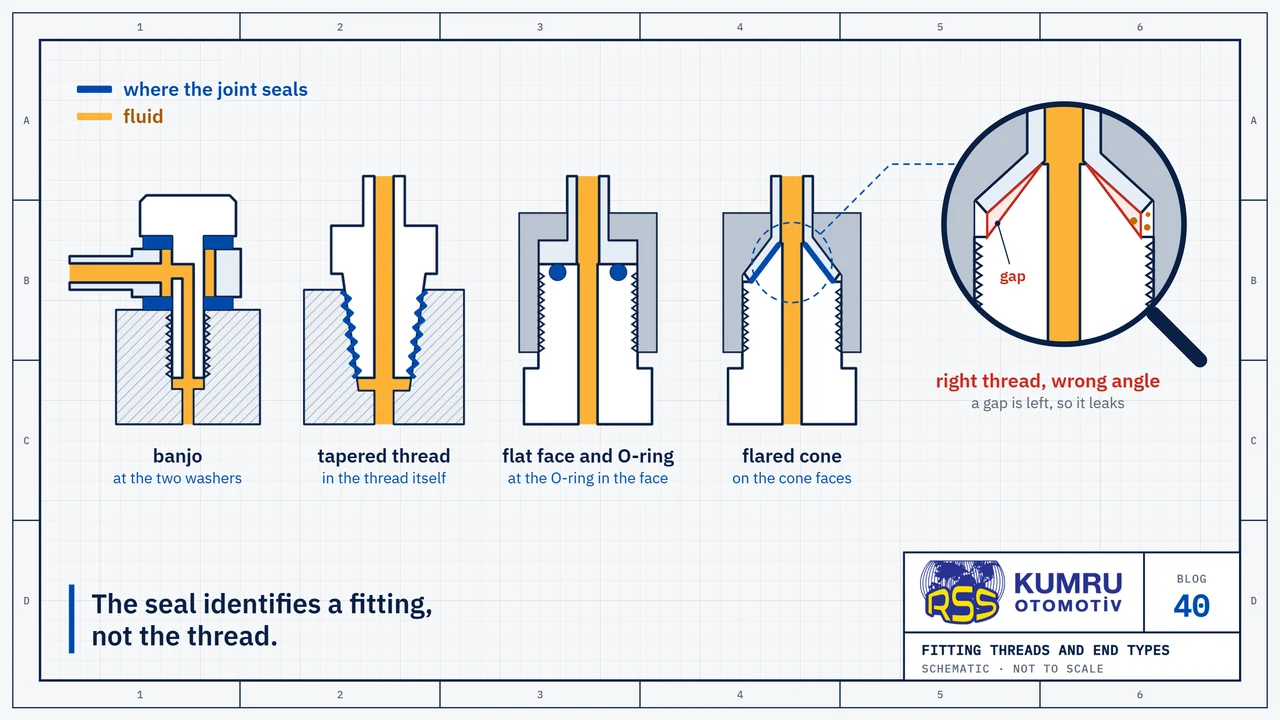
In Semperit’s catalogue a 3/4 inch 2SN hose is rated at 215 bar (3120 psi), a 3/4 inch 4SP at 350 bar (5075 psi). The assembly is also only as strong as its weakest part; the scope of ISO 18752 says: “The hose assembly maximum working pressure is governed by the lowest maximum working pressure of the components.” For the ends, see our guide to fitting and thread types.
What else matters besides pressure?
Pressure is not the only thing to check when choosing a hydraulic hose. Semperit’s notes on use name maximum operating pressure, maximum temperature and minimum bending radius as conditions that cut operating hours, and add: “When several of these factors coincide, the product deteriorates more rapidly and therefore must be replaced sooner.” A workable order:
- Read the old hose. Type, size, working pressure, date. If the print has worn off, take the pressure from the machine’s service data.
- Pressure. The highest system pressure, spikes included, must not exceed the working pressure of the hose.
- Temperature. The scope of EN 853 gives -40 °C to +100 °C for hydraulic fluids and an upper limit of +70 °C for water-based fluids.
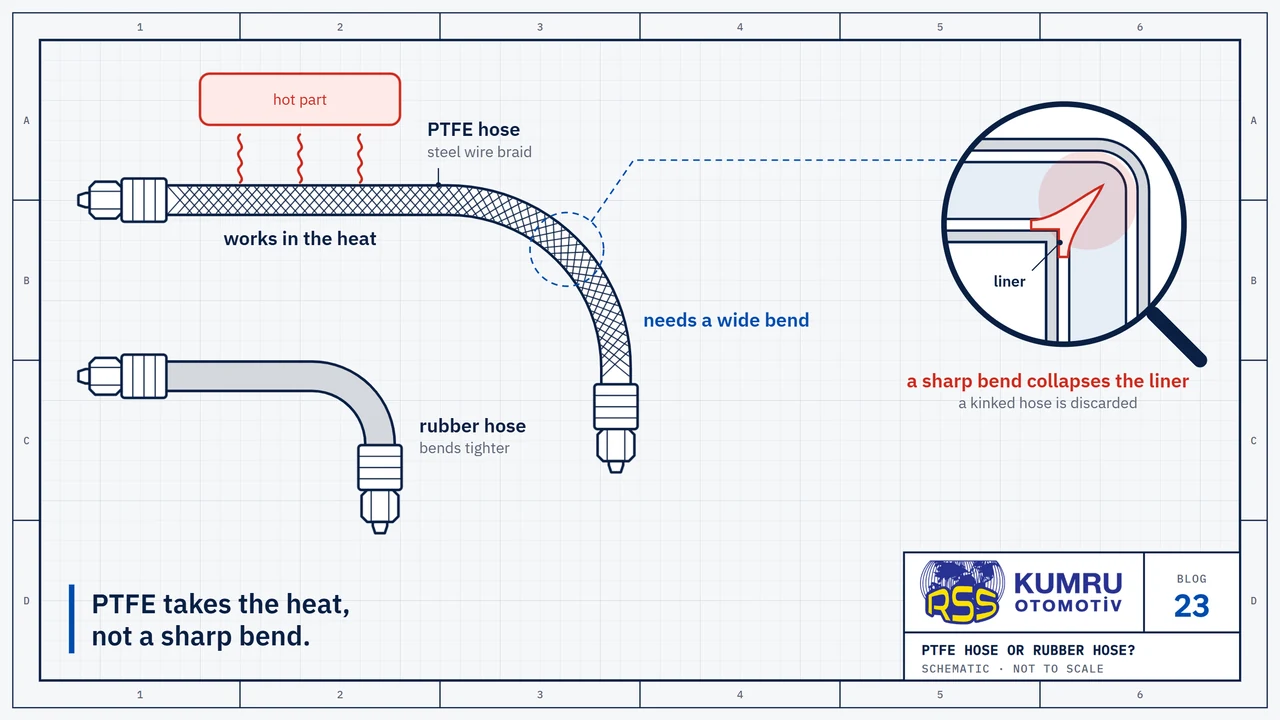
- Bend radius. Danfoss measures it on the inside of the bend. In Semperit’s catalogue the minimum at DN 12 is 180 mm for 2SN and 130 mm for the compact 2SC.
- Fluid. The same scope says these hoses are “not suitable for use with castor oil based and ester-based fluids”. Check compatibility in the manufacturer’s chart.
- Routing. No twist and no rubbing. The same reasoning applies to cab tilt hoses.
Sources
- Danfoss, “EMEA Rubber hydraulic hose and fitting, tooling and accessories catalog (EC600-12)”, manufacturer's catalogue, February 2025; layline definition and sample laylines, table of hose types, burst test, the SAE J1273 selection recommendations as reproduced in the catalogue.
- Semperit, “Hydraulic Hoses (catalogue, 03-2023)”, manufacturer's catalogue, March 2023; tables for 1SN, 2SN, 2SC and 4SP (working and burst pressure, bend radius), notes on use.
- Manuli Hydraulics, “Hydraulic Hoses (catalogue, V2)”, manufacturer's catalogue, undated (the PDF file is dated November 2021); the distinction between traditional and isobaric hoses.
- Eesti Standardimis- ja Akrediteerimiskeskus (EVS), “ISO 18752:2025, Rubber hoses and hose assemblies: Wire- or textile-reinforced single-pressure types for hydraulic applications (scope)”, scope of the standard, on the catalogue page of the Estonian national standards body; edition valid from 30 June 2025; the standard itself was not opened.
- Eesti Standardimis- ja Akrediteerimiskeskus (EVS), “EVS-EN 853:2026, Rubber hoses and hose assemblies: Wire braid reinforced hydraulic type (scope)”, scope of the standard, on the catalogue page of the Estonian national standards body; edition valid from 4 May 2026; the standard itself was not opened.
- Heavy Equipment Forums, “PC200-6 hydraulic hose psi rating”, forum thread, 28 September to 6 October 2022; cited for a question from the field and for field opinion, not a manufacturer instruction.
Sources were checked again on October 8, 2026.
RSS Kumru Automotive
RSS Kumru Automotive was founded in 1990 and specialises in hydraulic systems and fluid management. Our range includes fittings, injector lines, fuel lines and turbo oil pipes.
Brand names and OEM reference numbers are used for identification and compatibility information only.