P0087, fuel rail pressure too low: what to check on a common-rail diesel, and in what order
- Autor
- Selami Kumru
- Erstveröffentlichung
- Erstveröffentlichung:
- Zuletzt aktualisiert
- Zuletzt aktualisiert:
- Lesezeit
- 6 Min. Lesezeit
- Kategorie
- Einspritz- und Kraftstoffleitungen
Dieser Beitrag liegt derzeit nur auf Englisch vor.
P0087 means the engine control unit could not reach the fuel rail pressure it asked for. It does not say which part has failed. On a common-rail diesel, the manufacturer documents we could open go to the line side before the high-pressure pump: a restricted filter, a low-pressure line that draws air or is pinched, a weak lift pump, a leaking high-pressure pipe, and injectors passing too much fuel to the return.
Short answer
- What it means: actual rail pressure stayed below target. The threshold differs by engine.
- When it sets: under load, when fuel demand is highest; sometimes with hard starting.
- Check first: fuel level, external leaks, filters, supply pressure and the low-pressure line; then the injector return.
- Leave for last: rail pressure sensor, pressure valves, high-pressure pump.
What does P0087 mean?
P0087 stands for fuel rail/system pressure too low: the control unit is not measuring the rail pressure it commanded. A Mack dealer note for MP7 and MP8 engines says the code sets when rail pressure stays below about 260 bar (3370 psi) for more than 4 seconds with the engine running; torque is then derated.
Detroit Diesel’s DD-platform engines log the same condition as SPN 520268/FMI 16, when actual rail pressure is 200 bar (2900 psi) below the desired pressure under load. Both figures belong to those engines only. Nor is the code confined to diesels: Kia’s P0087 bulletin for its gasoline direct injection (GDI) engines also has the low-pressure line connections and the main pump’s pressure checked before the high-pressure pump is replaced.
When does P0087 set?
P0087 can set at the moment the engine wants most fuel, under load, while everything looks normal at idle. Mack gives the reason:
“P0087 (Fuel Rail System Pressure - Too Low Bank 1) is most likely caused by restricted fuel filters creating insufficient fuel supply to the high pressure fuel system. This fault can be intermittent and only set during high fueling demands.”
Mack Trucks, Solution K00585105, 7 August 2018
A workshop case in the UK trade magazine Professional Motor Mechanic shows the same pattern. A 2.7-litre diesel Audi A6 showed “no real effects” in stop/start traffic; at full throttle on the open road, rail pressure stayed around 900 bar and the car dropped into limp-home mode.
Hard starting can be part of the picture. Mack’s 2025 bulletin covers trucks with the low-pressure code P008A and P0087 active together: it lists difficult starting and low power for P008A, and low power with engine speed limited to 1500 rpm for P0087.
What causes low fuel rail pressure in a diesel?
Rail pressure on a diesel falls for one of three reasons: too little fuel reaches the high-pressure pump, fuel under pressure escapes, or the parts that measure and generate the pressure fail. Detroit Diesel’s procedure lists ten conditions; we have sorted eight of them under those headings:
- Supply: fuel level, fuel aeration, leaking fuel lines, restrictions; loose filter caps, plugged filters.
- Leakage: external leakage between the high-pressure pump and the injectors; internal leakage at the pressure limiting valve and at an injector.
- Measuring and generating: rail pressure sensor, internal failure of the high-pressure pump, the control module.
The other two are fuel contamination and an intermittent loss of the engine speed signal.
Where do you look on the line side?
On the line side there are four things to check: the filters, air in the low-pressure line, restriction in that line, and supply pressure.
Filters. When both codes are active, Mack’s first repair is a new primary and secondary filter. In the magazine case the blocked filter was found with a vacuum gauge and clear pipe on the low-pressure side: the 10 to 20 cmHg expected on that car climbed past 40 cmHg, and the author saw “cavitation air bubbles”.
Air. If the code appeared after filter maintenance or a fuel system repair, Detroit Diesel says “the code may be set due to air in the fuel system”. If the tank was under a quarter full when the code logged, “fuel sloshing in the tank may have caused aerated fuel and set this code”.
The procedure also includes a low-pressure leak test. Mack lists air in the fuel system and failed tank ventilation among the causes of P008A.
Restriction. Detroit Diesel has the chassis fuel system inspected for restrictions or debris. A crushed or kinked hose is a restriction too; the procedure does not name hoses, so that is our inference. How to find a line that draws air is covered in our article on air in the diesel fuel line.
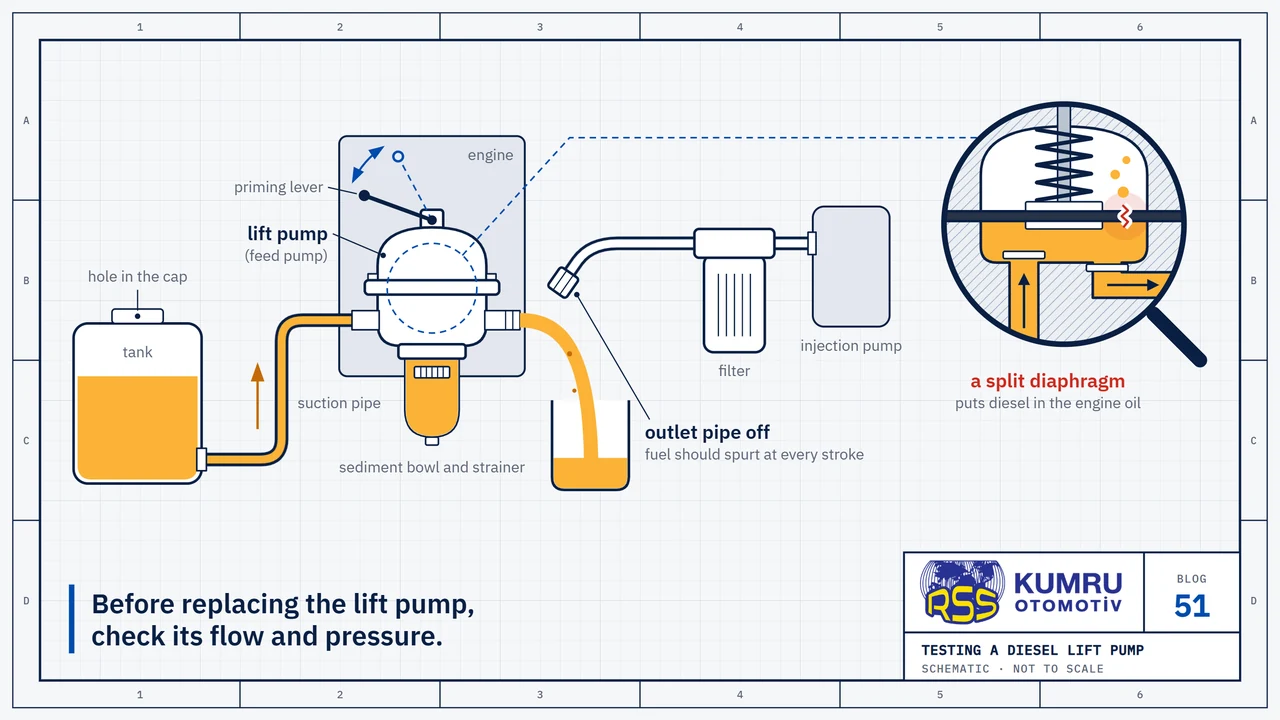
Lift pump. A training module from Turkey’s Ministry of National Education describes an electric low-pressure pump in the tank on common-rail vehicles, or a mechanical feed pump where there is none. Mack counts a malfunctioning fuel pump among the causes of P008A and has supply pressure measured before P0087 is diagnosed. For the MP7 and MP8 it gives about 350 to 450 kPa (50 to 65 psi) at idle, “for general reference ONLY”.
How do a leaking high-pressure pipe and the injector return lower rail pressure?
A high-pressure pipe or union leaking to the outside, and an injector passing too much fuel to the return, both drain fuel the pump has delivered to the rail. The first leaves a trace; the second has to be measured.
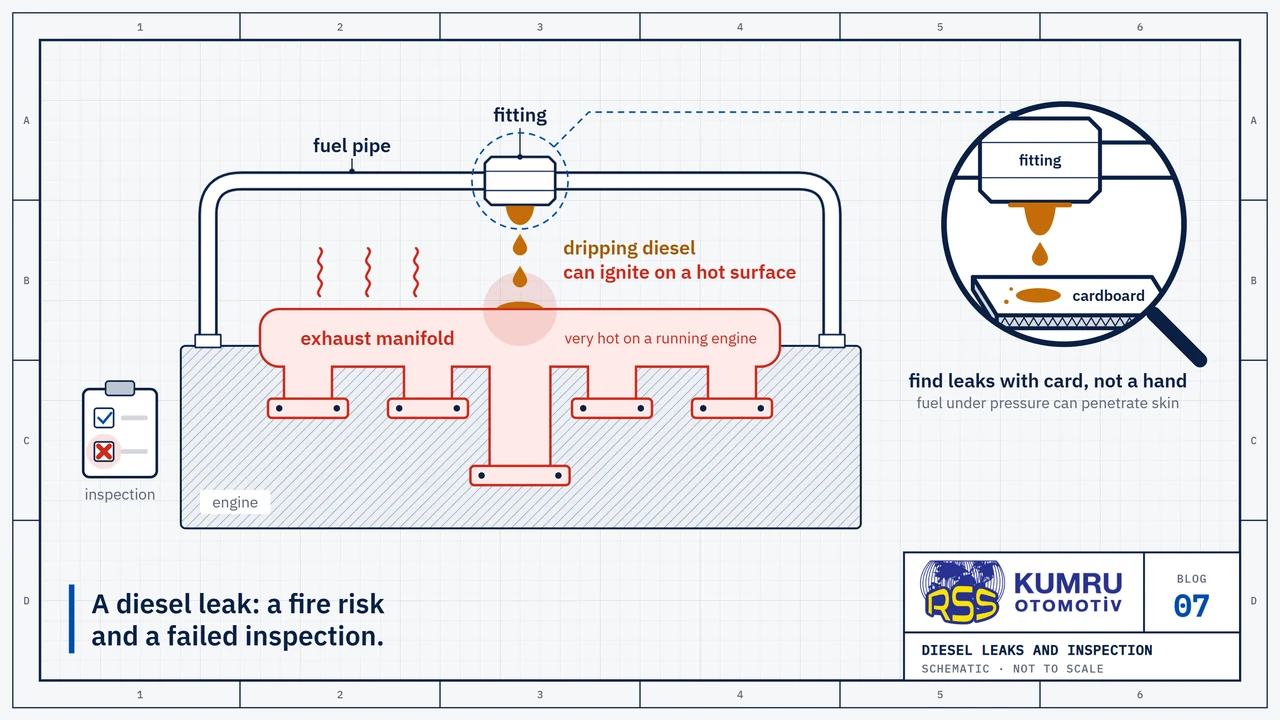
“External Fuel Leakage Between the High Pressure Pump and Fuel Injectors” heads Detroit Diesel’s list, and the procedure asks for a visual check on the engine and the chassis. Symptoms and pipe replacement are in our article on common-rail pipe leaks.
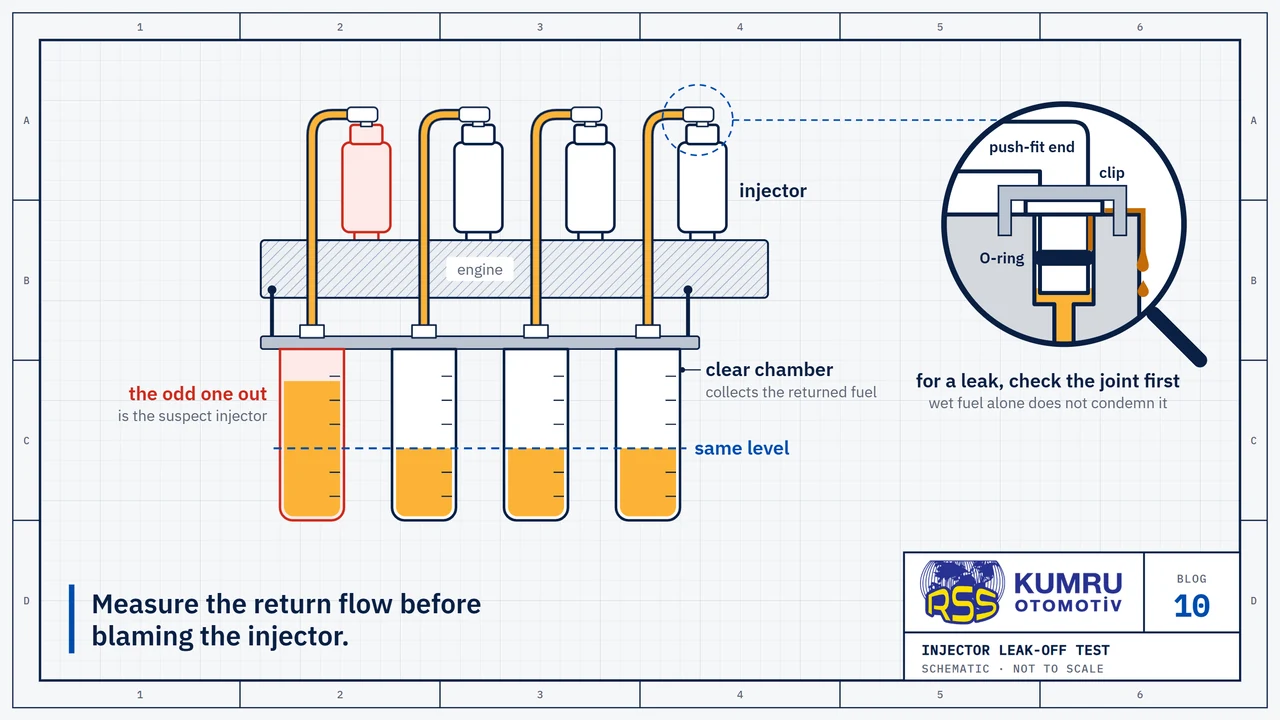
In the magazine case a leak-off test caught one injector: it filled the flask in 30 seconds, against the two to three minutes expected. The author adds that “one injector can’t be responsible for such a big drop in pressure”, and on that car the high-pressure pump proved faulty as well. The test itself is covered in the injector leak-off line article.
Do not look for a leak, or for a dead cylinder, by slackening a high-pressure pipe nut. In its section on bleeding, the Ministry’s module puts the pressure in the rail and injector circuit with the engine running at “approximately 1350-1800 bar” and is blunt: “The injector pipes must not be opened at the injector end or at the common rail.”
What order should you work in?
This order is compiled from the Detroit Diesel and Mack documents. Where the vehicle’s service data gives another sequence, follow that.
- Read the history and the codes. Has a filter or the fuel system just been opened? If a low-pressure code is stored too, Mack has it diagnosed first.
- Look at the tank. Fuel level, and water, petrol or DEF in the fuel.
- Look for external leaks. By eye, on engine and chassis.
- Go through the filters. A plugged element, a loose cap.
- Measure supply pressure. On a road test under load if necessary; the figure is in the service data.
- Look for air and restriction. Bubbles in the supply line, a leaking or narrowed line.
- Measure the return. Injectors and the pressure limiting valve.
- Leave the sensor, the valves and the pump for last. In Detroit Diesel’s procedure the pump test is step 22: the rail is capped at the injector connections, the engine is cranked for 10 seconds, and the pump is replaced if rail pressure does not reach the desired value. Sensor codes, the pressure limiting valve and the quantity control valve come first.
Quellen
- Mack Trucks, “Solution K00585105: Diagnostic Trouble Code (DTC) P0087-00 Illuminating The Malfunction Indicator Lamp (MIL) Or Stop Engine Light; Possible Engine Power / Torque Derate”, truck maker's dealer solution note, 7 August 2018; MP7 and MP8 engines (US17), model years 2018–2019; from the NHTSA archive.
- Mack Trucks, “GuardDog Connect Bulletin GDC25-002: DTC P008A-00 / P0087-00, Low Fuel Pressure”, truck maker's repair bulletin, 29 September 2025; US24 and newer emissions; from the NHTSA archive; table rows checked against the page image.
- Detroit Diesel, “SPN 520268/FMI 16 - GHG17: Fuel Rail Pressure too Low (service information 02 26-16)”, troubleshooting procedure (service manual update), February 2016; DD-platform engines, GHG17; from the NHTSA archive.
- T.C. Millî Eğitim Bakanlığı, “Dizel Motorları Yakıt Sistemleri (Motorlu Araçlar Teknolojisi, modül 525MT0297)”, vocational and technical education training module (in Turkish), Ankara, 2012; section on bleeding common-rail systems (pp. 94–97).
- Kia Motors America, “Technical Service Bulletin, Fuel System 026: MIL ON WITH DTC P0087 - Diagnosis and Repair”, technical service bulletin, September 2013; 2.0, 2.4 and 3.3-litre GDI (gasoline direct injection) engines; from the NHTSA archive.
- Professional Motor Mechanic, “Audi A6 with loss of engine power (Vehicle Troubleshooter)”, workshop case study in a trade magazine, 22 April 2015; a single car (Audi A6, 2.7-litre diesel), used as a field account; not a manufacturer instruction.
Die Quellen wurden am 13. Oktober 2026 erneut geprüft.
RSS Kumru Automotive
RSS Kumru Automotive wurde 1990 gegründet und ist auf Hydrauliksysteme und Fluidmanagement spezialisiert. Our range includes close to 700 injector line references, most of them for Caterpillar, Mercedes-Benz, Ford / New Holland and Scania engines.
Markennamen und OEM-Referenznummern dienen ausschließlich der Identifikation und der Angabe der Kompatibilität.