Injector leak-off line: what it does, why it leaks, and when the injector is to blame
- Author
- Selami Kumru
- First published
- First published:
- Last updated
- Last updated:
- Reading time
- 6 min read
- Category
- Injection and fuel lines
On a common-rail engine the injector leak-off line returns the fuel that has passed through each injector to lubricate and cool it. When the line leaks or a connector keeps coming off, look at the joint first: clip, O-ring, plastic connector. Wet fuel alone does not condemn an injector. That takes a leak-off test, which compares how much fuel each injector sends back.
Short answer
- What it carries: the fuel that lubricates and cools the injector. If too much comes back, rail pressure drops.
- Why it leaks: a missing or broken clip, a damaged O-ring, or a brittle plastic connector.
- What the test shows: an injector that returns clearly more or less fuel than the others. The limit is in the engine’s service data.
- Line or injector: with fuel on the outside, check the joint first. With hard starting or a rough idle, measure the return.
What does the leak-off line do on a common-rail engine?
The leak-off line collects the fuel that leaves each injector and feeds it into the low-pressure return system. Pico Technology, which makes diagnostic oscilloscopes, explains why:
“Common rail diesel systems use the fuel flow through an injector as a means to lubricate and cool its internal components.”
Pico Technology, guided test: CRD injector back-leakage
That flow is by design. The fault is a change in the quantity.
An article in Professional Motor Mechanic, describing a Laser Tools test kit, calls excessive fuel returning to the tank a common reason for pressure loss, because the pump can no longer build enough pressure. The result is “poor or no engine starting, rough running and poor acceleration”, most obvious at start-up and at idle.
Tractors with mechanical injectors have a different line and a different test, covered in our article on tractor leak-off hose leaks.
Why does the line leak, and why does a connector come off?
The first place to look on a leak-off line is the joint on top of the injector. The same article notes that the return connectors are “secured with wire or metal clips”. Highway and Heavy Parts (HHP), a truck parts supplier, warns that “these plastic fittings can be brittle” and has their O-rings inspected after a test. For diesel on or near an injector Delphi gives two possibilities: a damaged injector, or “the seal may have worn through”.
Not every line is a push-fit. On Isuzu’s 4HK1 and 6HK1 truck engines the service bulletin shows a leak-off pipe held by banjo bolts, refitted “with new gaskets”.
For a connector that keeps coming off, our one field account is a single vehicle on the Defender2.net forum. The owner of a 2013 2.2-litre diesel writes that the connector on injector number 4 “is popping off the injector body”, with a diesel smell in the cabin and fuel on the ground. Replies say the connector may be worn and that most are held by “plastic clips which break easily”. The thread ends with no cause found.
Nor is the line unpressurised on every system. According to Pico, some systems, piezo-injector ones for example, “malfunction without a minimum positive pressure in the injector fuel return system”. No source links that to the clips; our own inference is that on such a system a missing clip or a damaged O-ring shows up sooner. We could not open a manufacturer document saying that excessive back leakage pushes a connector off.
How is a leak-off test done?
In a leak-off test a clear chamber is connected to the return port of each injector, the engine idles, and the fuel collected in the chambers is compared. The article’s sequence:
- Warm the engine up. A cold start can give inaccurate results.
- Look first. Remove the engine cover and check for leaking pipes, loose hoses and chafed wiring.
- Remove the clips and keep them safe.
- Close off the disconnected return line. On some engines it shares a connection with the fuel pump, and fuel can be forced back out when the engine starts.
- Fit the tubes in injector order. Keep them away from pulleys and belts.
- Idle for a few minutes. Stop when the chambers are 50 to 75% full and compare the levels.
- Refit and check. Refit the connectors with their clips, run the engine for a minute or so and check for leaks.
How do you read the result?
A leak-off test compares the injectors with each other, and the one that stands apart is the suspect. The sources do not agree on how big a difference is a fault.
| Source | Returns more fuel | Returns less fuel | Threshold given |
|---|---|---|---|
| Laser Tools (magazine article) | A back-leakage problem; a blocked or malfunctioning injector | A worn injector over-fuelling its cylinder | About 10% either way |
| Pico Technology | Worn internal components or degraded internal seals | A blockage or sticking components | None |
| HHP | An internally leaking control valve | No return: blocked return port or stuck nozzle | 20 to 30% more |
None of these is an engine maker’s figure. Pico measures pressure pulses, not volume, and notes that the return also depends on the pump, the pressure control valves and rail pressure.
Is the test done the same way on every engine?
A leak-off test is not done the same way on every engine. The first limit is return pressure.
Do not improvise a bottle test on a piezo system or on any system with a pressurised return. Pico restricts its own measurement to solenoid injectors, because lowering return pressure can damage vehicles that depend on it. Opening the return to a chamber removes the same pressure. Pico does not say so; that is our inference. Delphi has residual pressure checked with a diagnostic tool before an injector comes out. For the high-pressure side see our article on common-rail pipe leaks.
The second limit: the return is not measured injector by injector on every engine. In a Cummins bulletin on fault code 4713 for the ISB6.7 and B6.7 (CM2350), what is measured is the combined drain flow, and unless the injectors are isolated, “collective drain measurements will not be able to identify the source of the malfunction”.
So the injectors are capped off one at a time and the combined flow is measured in millilitres over 30 seconds, three times, and averaged. The bulletin’s example gives 145 ml with no injector blocked, 120 ml with number 2 blocked and 125 ml with number 6. The two injectors that reduce the flow most are replaced. The figures are an example; the limits are in that engine’s service manual.
Line or injector: what order should you work in?
To tell a leaking leak-off line from a faulty injector, look at the outside first, then at the return quantity.
- Fuel at a return joint. Check the clip, the O-ring and the plastic connector, or the gaskets on a banjo joint.
- Dry outside, but hard starting or a rough idle. Read the fault memory first, as Delphi’s diagnosis does, then measure the return by the manufacturer’s method.
- One injector stands apart. Delphi says the measurement “indicates which injector may be faulty and in need of replacement”, so one is replaced instead of the whole set.
- A connector that looks sound and still comes off. The forum’s suggestion, not a manufacturer instruction, is to compare the return from all four injectors.
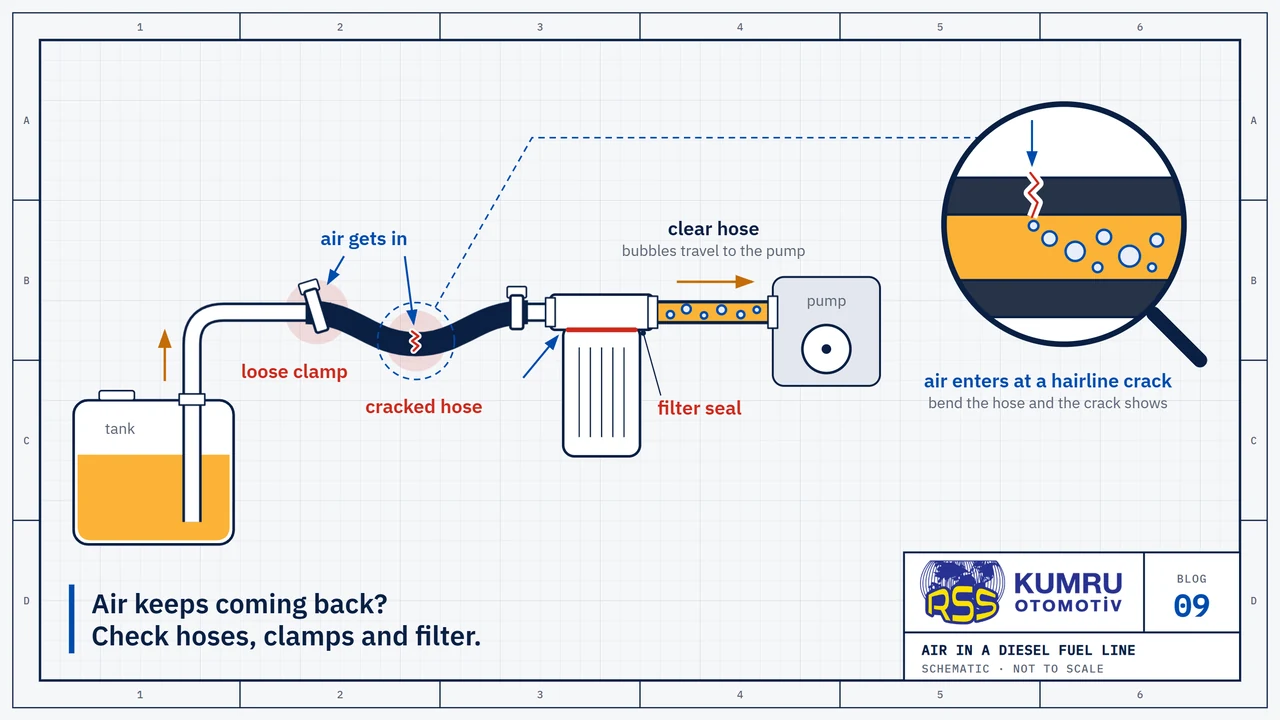
- Harder to start the longer it stands. The return line may be letting air in, the subject of our article on air in the diesel fuel line.
Sources
- Pico Technology, “CRD injector back-leakage (PicoScope Automotive guided test)”, diagnostic equipment maker's guided test page, undated; for solenoid-injector systems, described by Pico itself as an example and not a definitive procedure.
- Professional Motor Mechanic, “Common Rail Diesels – how to undertake a fuel return flow test”, trade magazine article, 10 August 2012; describes the use of a Laser Tools return flow test kit.
- Delphi, “Best practice advice for servicing Common Rail injectors”, injection system maker's technical article, 5 May 2022.
- Cummins, “Technical Service Bulletin TSB160006: Fault Code 4713 and Injector Isolation Test Procedure”, technical service bulletin, as updated 4 May 2021; ISB6.7 CM2350 B101 and B6.7 CM2350 B121B engines; from the NHTSA archive.
- Isuzu, “Service Bulletin IB12-J-003C: Long Block Replacement, Fuel Injector Pipe Installation”, service bulletin, August 2016; N-Series and F/H-Series trucks with the 4HK1 and 6HK1 engines; from the NHTSA archive.
- Defender2.net, “Fuel Leak Off Pipe connector popping off”, forum thread, 14 to 15 February 2025, 9 messages; the owner of a 2013 2.2-litre diesel and replies from three members, ends with no cause found; used as a field account, not a manufacturer instruction.
- Highway and Heavy Parts, “How to Test Diesel Fuel Injector Return Rate (Fuel Return/Leak-Off Test)”, truck parts supplier's blog article, 1 September 2026; used as a field source, not a manufacturer instruction.
Sources were checked again on October 8, 2026.
RSS Kumru Automotive
RSS Kumru Automotive was founded in 1990 and specialises in hydraulic systems and fluid management. Our range includes close to 700 injector line references, most of them for Caterpillar, Mercedes-Benz, Ford / New Holland and Scania engines.
Brand names and OEM reference numbers are used for identification and compatibility information only.