Common-rail pipe leak: symptoms and what to do
- Author
- Selami Kumru
- First published
- First published:
- Last updated
- Last updated:
- Reading time
- 6 min read
- Category
- Injection and fuel lines
A leaking common-rail pipe, the steel high-pressure fuel line between pump, rail and injectors, usually gives itself away by a smell of diesel, a wet line or fuel pooled near the injectors, and sometimes a fine mist. The engine can run normally with an empty fault memory. The manufacturer documents we could open agree on the response: stop the engine, let the pressure fall, find the real source and replace the pipe.
Short answer
- Symptoms: a smell of diesel, a wet pipe, fuel pooled around the injectors or the rail, sometimes a mist.
- Fault codes: a low rail pressure code is possible, but a hairline leak may set none and the code has many other causes.
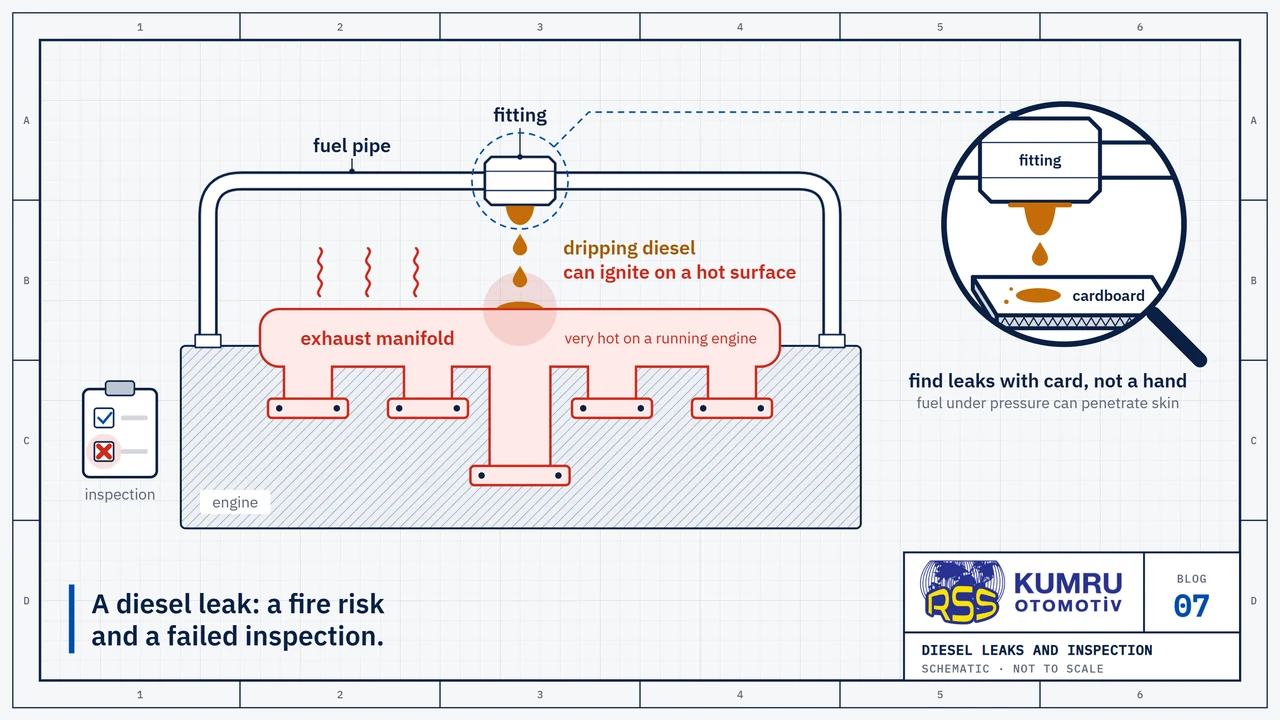
- Risk: fire, and injury from fuel under pressure. Do not run the engine and do not search for the leak by hand.
- Fix: find the source, fit a new pipe with its clamps, torque it to the service figure and check again.
What are the symptoms of a high-pressure fuel line leak?
A leaking high-pressure fuel line shows as a smell of diesel, fuel on or under the line, and sometimes a mist. The recall report filed with the US regulator NHTSA in 2022 for the injector supply tubes of the Cummins X12 engine lists the warning signs:
“Fuel leaks may be detected during maintenance. An operator may smell fuel or observe a mist due to the fuel leak”
NHTSA Part 573 Safety Recall Report 22V-120, 2 March 2022
The fuel does not always stay where it escapes. In General Motors’ bulletin for the 6.6-litre Duramax, customers report a fuel odour or fuel at the bottom of the flywheel housing, and the technician finds the leak at the line fittings between the high-pressure pump and the rail.
How the engine runs tells you little. In two threads on a UK forum for French cars, owners of 2.0 HDi engines found diesel pooled around the injectors, and both wrote that the car ran normally. We found no manufacturer document that lists hard starting as a sign of an external pipe leak.
Does a leak set a fault code or lower the rail pressure?
It can, but neither sign is dependable. A leak large enough to pull rail pressure away from its target sets a low-pressure code. A hairline weep may leave no trace, and the same code has other causes. Detroit Diesel’s troubleshooting procedure for its DD-platform truck engines shows the logic:
“The Motor Control Module (MCM) sets this fault code when fuel rail pressure deviation is greater than 200 Bar (2900 psi) while under a load (low speed).”
Detroit Diesel, SPN 520268/FMI 16 troubleshooting procedure, February 2016
The procedure lists ten conditions that can set this code. The first is “External Fuel Leakage Between the High Pressure Pump and Fuel Injectors”. The others include internal leakage at the pressure limiting valve or an injector, plugged filters, a failing pump and a faulty pressure sensor. The code says the pressure is low, not where the fuel went.
The code may also never come. On the forum, a member described a fracture near a union on a pump-to-rail pipe, “almost microscopic but enough to weep”: “There was no effect on performance or any fault codes.” The procedure does not say so; our reading of its threshold is that a weep too small to move rail pressure that far leaves the fault memory of that engine empty.
Pressure can also be watched after shut-down. The same procedure has the diagnostic tool record how long the rail pressure takes to bleed off; under 35 seconds, the next step is the high-pressure leak test. That figure belongs to that engine.
Can the engine be run with a leaking pipe?
No. Perkins states it without qualification: “Do not operate the engine with a fuel leak. Leaks can cause fires.” The X12 recall report records 29 warranty claims for leaking tubes, “not all of which had cracked tubes”, and a vehicle fire that Cummins traced in October 2021 to a leaking fuel tube on cylinder 5.
Do not search for the leak with your hand or with the engine running. Detroit Diesel warns that high-pressure fuel can penetrate skin and, on its DD15 and DD16, wants the engine stopped for at least 10 minutes before the high-pressure circuit is touched: “Residual high fuel pressure may be present within the circuit.” The waiting time for your engine is in its service data.
Is the fuel really coming from the high-pressure pipe?
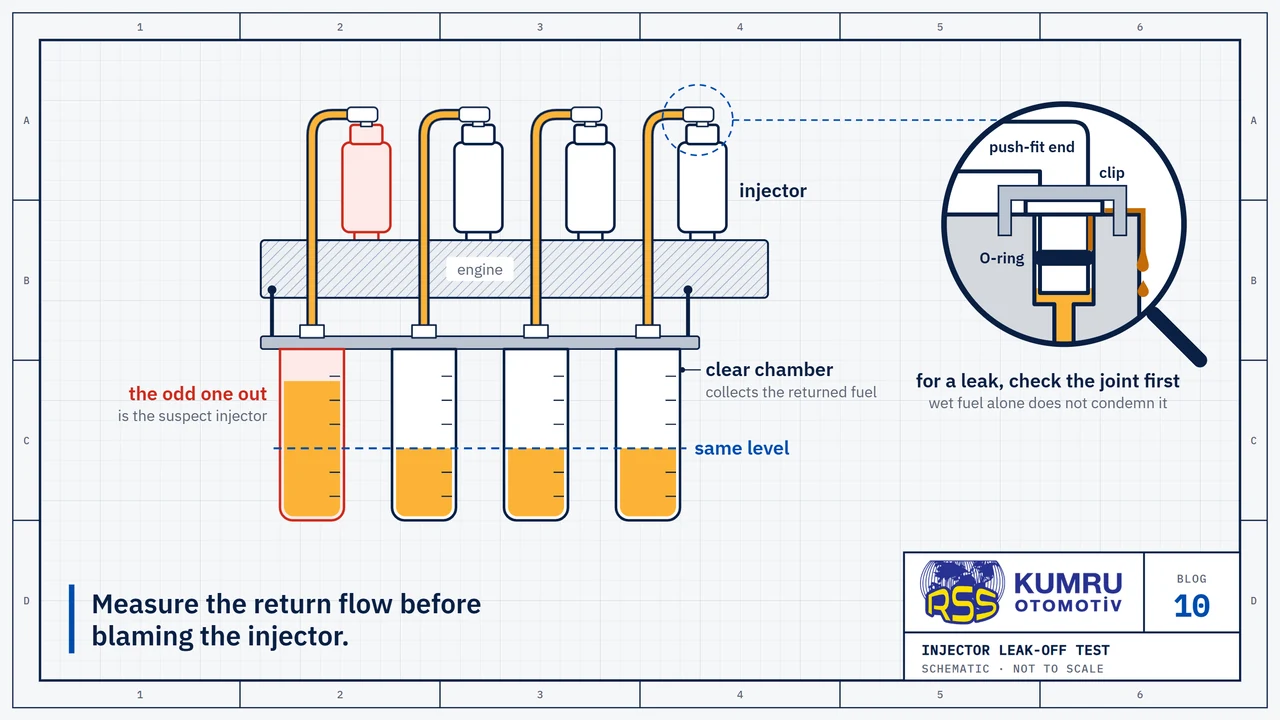
Not always. Fuel around the injectors or the rail can come from a high-pressure pipe or its union, and equally from the low-pressure return (leak-off) connections on top of the injectors. In one of the forum threads the owner fitted a new fuel rail and the leak stayed. The source turned out to be the return pipes. What the leak-off line does, and how to test it, is covered in the injector leak-off line article.
| What you find | What it can be | Source |
|---|---|---|
| Fuel odour, fuel at the bottom of the flywheel housing | The line fittings between pump and rail. GM: “Do Not replace the high pressure pump.” | GM, 6.6-litre Duramax |
| Fuel pooled around the injectors, engine running normally | A pipe union, a return (leak-off) connection or the injector seat in the head | Forum, 2.0 HDi |
| Low rail pressure code or fast bleed-off, nothing wet outside | Internal leakage (limiting valve, injector, pump) or the supply side | Detroit Diesel, DD platform |
Each row comes from one engine family. Read it as a pointer, not as a diagnosis.
What is the right order of work?
Find the source first and change parts second: stop the engine, wait for the pressure to fall, read the fault memory, locate the leak, replace the pipe and prove the repair.
- Stop the engine and wait. Perkins wants the pressure purged from the line “before any inspection, service or repair is performed”.
- Read the fault memory before you touch anything. GM’s bulletin starts there: “Complete the current SI diagnostic for any DTCs or symptoms found.”
- Clean, run briefly, stop, look. The forum advice matches workshop routine: “A good clean-up and then a short run should show where your leak is originating.” Detroit Diesel also asks for a visual check for external leaks before its automated test.
- Decide what is leaking. Pipe, union, return connection or internal leakage: use the table. Do not order a pump or a rail on suspicion.
- If the pipe or its union leaks, replace the pipe. Perkins: “If there is a leak do not over-tighten the connection to stop the leak. If high-pressure fuel lines are leaking the fuel lines must be replaced.” A leaking pipe is not sealed, brazed or welded. Checking the nut once against its service torque is a subject of its own.
- Refit everything that holds the pipe. Perkins: “Make sure that all clamps, guards, and heat shields are installed correctly.” Tighten the nuts with a torque wrench to the figure in the service data.
- Prove the repair. GM: “Evaluate the fuel leak after the lines have been replaced.” With new lines fitted, Detroit Diesel primes the fuel system and runs a rail pressure bleed-off test “to verify that there are no leaks”. A low-pressure code straight after the job need not be a new leak: the same maker notes that after a fuel system repair “the code may be set due to air in the fuel system”.
Sources
- NHTSA, “Part 573 Safety Recall Report 22V-120”, safety recall report, 2 March 2022; injector fuel supply tubes of the Cummins X12 engine.
- General Motors, “Service Bulletin 19-NA-138: Fuel Odor or Signs of Fuel At High Pressure Pump To High Pressure Fuel Lines”, technical service bulletin, June 2019; vehicles with the 6.6 L Duramax (LGH, LML).
- Detroit Diesel, “SPN 520268/FMI 16 - GHG17: Fuel Rail Pressure too Low (service information 02 26-16)”, troubleshooting procedure (service manual update), February 2016; DD-platform engines, GHG17; from the NHTSA archive.
- Perkins, “How to Service Fuel Pumps”, engine maker's service information page, undated.
- Detroit Diesel, “18SP727Rev: DD15/16 High Pressure Fuel Feed Lines, Mounting Bracket and P-clips Service Kit”, service kit installation instructions; in the NHTSA archive under 2019.
- French Car Forum, “C5 X7 120 kW 2.0 HDi fuel rail broken”, car forum thread, 6-25 January 2024; used as field opinion.
- French Car Forum, “Pool of diesel around injectors”, car forum thread, 20-24 August 2015; used as field opinion.
Sources were checked again on October 8, 2026.
RSS Kumru Automotive
RSS Kumru Automotive was founded in 1990 and specialises in hydraulic systems and fluid management. Our range includes close to 700 injector line references, most of them for Caterpillar, Mercedes-Benz, Ford / New Holland and Scania engines.
Brand names and OEM reference numbers are used for identification and compatibility information only.