Air in a diesel fuel line: hard starting caused by pipes and hoses
- Author
- Selami Kumru
- First published
- First published:
- Last updated
- Last updated:
- Reading time
- 6 min read
- Category
- Injection and fuel lines
A diesel that fills with air again after bleeding does not have a bleeding problem: air is getting into the fuel system somewhere. Look first at the pipes and hoses from tank to pump, their clamps and unions, the filter seals and the return line. The driver reports cranking that lengthens the longer the vehicle stands, or an engine that starts and dies.
Short answer
- Where it gets in: hoses, clamps and unions between tank and pump, the filter seals, the return line.
- What it looks like: cranking that lengthens with standing time, starting and stalling, a steady stream of bubbles in a clear hose.
- How to find it: by eye and hand, then a clear hose; shop air and soapy water only to the maker’s procedure.
- If the pipework is sound: air in the return can be combustion gas.
Where does air get into a diesel fuel system?
Air gets into a diesel fuel system in three places: the low-pressure circuit on the engine, the supply line on the vehicle side, or the combustion chamber. Detroit Diesel’s aerated fuel test for DD platform heavy-duty engines names all three:
“This condition exists if there is an external leak of the low pressure fuel system, if combustion pressure enters the fuel system or if there is leak of the vehicle side fuel supply system.”
Detroit Diesel, service bulletin 4 03-13, April 2013
Two of the three are pipe, hose and joint faults. Perkins also counts a low-pressure leak among the events that let air in. It calls fuel system hoses and clamps “often areas of failure”, with leaks “often caused by cracking, softness or loose clamps”. Its checklist: damaged or leaking end fittings, chafed or cut coverings, ballooning, kinked or crushed hoses.
The filter sits on the same path. Among the causes of low fuel pressure while cranking, Navistar’s note for the MaxxForce DT, 9 and 10 engines lists an “unseated fuel filter that causes fuel to drain back to tank”. T4-Wiki, a non-commercial collection of Volkswagen T4 guides, also points at the filter: a wrongly fitted preheating valve, or a loose water drain screw.
A blocked tank vent is covered in our bleeding article, the glass-bowl pre-filter of older tractors in the tractor article.
Why does it start badly after standing, or start and stall?
An engine that has stood starts badly because the line empties, or fills with air, while it is stopped; cranking lasts until the pump reaches fuel again. Navistar gives two symptoms of low fuel pressure while cranking: “Engine cranks but will not start” and “Engine starts and stalls”. Its causes include “Vehicle unused for long period of time”.
On French Car Forum the owner of a 2.1-litre turbodiesel Citroën Xantia wrote that bubbles appeared in the hose to the pump once the car had sat, and that the hand primer needed a few squeezes before starting. Then: “The car runs fine once started.”
Not every bubble is a leak. According to T4-Wiki, a single bubble moving towards the pump during cranking may be air let in once during maintenance. A continuous stream of bubbles points to a leak, or to a vacuum in the system.
Can the return line let air in?
The return line can let air in too. T4-Wiki notes that the rubber leak-off hoses between pump and injectors become porous enough over the years to let air in. A leaking hose often shows a film of diesel or drip marks. The page gives the symptom too: the longer the engine stands, the longer it must be cranked before enough fuel is drawn in.
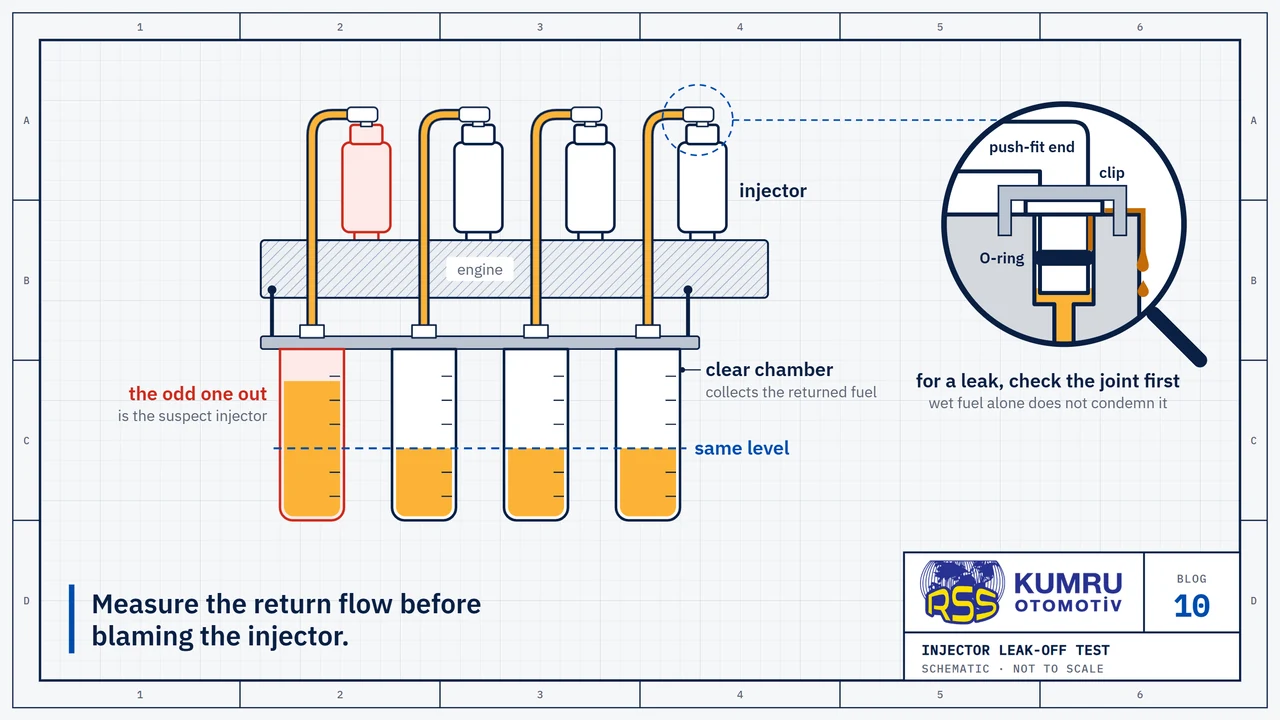
Air seen in the return need not come from a pipe. In Detroit Diesel’s test, aerated fuel in the return line leads first to a low-pressure leak test. If that passes, clear lines go on the injector return circuits.
Air there calls for a compression test, and a cylinder below 90% gets a new injector cup. With no air there, the bulletin suggests a loose line, a cylinder head fitting or that fitting’s damaged sealing washer.
How do you find the leak?
Our sources give four methods, simplest first.
- Eyes and hands. Go over hoses, clamps and end fittings with Perkins’s list. The forum advice is to bend each rubber hose in several places: hairline cracks then show at once.
- Clear hose or sight glass. Detroit Diesel has a sight glass fitted at the fuel filter module on each chassis-side line, supply and return. Its tip: a flashlight behind the lens makes the bubbles easier to see. On the T4 the hoses beside filter and pump already have clear sections.
- Run the engine from a container. In the same maker’s isolation test the chassis lines come off and the engine runs from a container of fuel, test-line ends kept submerged. It is then left “to sit long enough for previous hard start/no start complaint to be verified”. Still hard to start: the cause is on the engine side. Starts normally: the chassis lines.
- Shop air and soapy water. In the low-pressure leak test the system is pressurised with shop air. If it does not hold: “Using a soapy solution, spray connectors, fittings and hoses”. A leak that draws air in under suction blows bubbles out under pressure. The bulletin does not say so; the layout of the test implies it.
Run a pressure test at the maker’s figure and protect your eyes. Detroit Diesel’s warning: “wear a face shield or goggles when conducting a pressure test”. Its test takes the system to 517 kPa (75 psi); on the three-filter system pressure “should not drop more than 3.4 kPa (0.5 psi) in 10 minutes”. Those figures are for that engine family only; elsewhere, use the engine’s service data.
| Observation | Where to look |
|---|---|
| Bubbles in the supply-line sight glass | Chassis supply lines between tank and filter module |
| Bubbles in the return-line sight glass | Low-pressure leak test, then the injector return circuits |
| Bubbles in the hose right at the filter | Preheating valve on the filter, water drain screw |
| Trouble only when the tank is low | Suction pipe on the tank sender unit |
The first two rows are from Detroit Diesel’s DD platform bulletins, the last two from T4-Wiki. Part names and locations differ on other vehicles.
Is a non-return valve a fix?
A non-return valve removed the symptom in the one case we have, and the leak was never found. In the Xantia thread a non-return valve fitted ahead of the fuel filter ended the hard starting; in the owner’s words it did “solve the symptoms”. None of the manufacturer documents we opened lists such a valve as a remedy. Detroit Diesel has the leak found and repaired.
What order should you work in?
- Ask about history. Was the filter changed recently, and how long had the vehicle stood? Navistar’s diagnosis starts with the vehicle history.
- Check the filter. Is it fully seated, and are its seal and drain screw sound?
- Go over the hoses and clamps. Replace a hose that is cracked or soft. Perkins warns against over-tightening a connection to stop a leak.
- Watch the bubbles. Is the air in the supply or in the return?
- Separate engine from chassis. Feeding the engine from a container tells the two apart. Pressure-test only to the maker’s procedure.
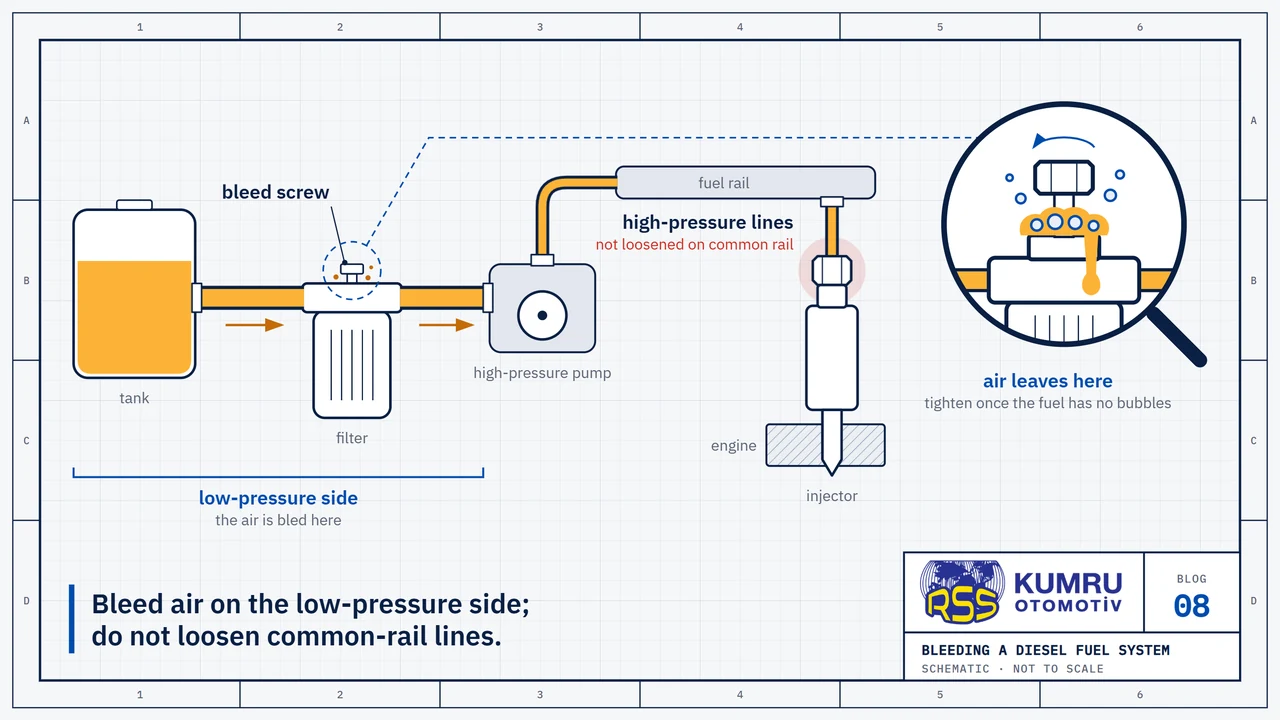
- Verify the repair. Detroit Diesel has the leak test repeated after the repair. Then bleed the system; the sequence is in our bleeding article.
Sources
- Detroit Diesel, “Service bulletin 4 03-13: Aerated Fuel Test, Two-Filter Fuel System (DDC-SVC-MAN-0084)”, service bulletin, April 2013; DD platform engines, from the NHTSA archive.
- Detroit Diesel, “Service bulletin 3 02-13: FIS Low Pressure Leak Test (DDC-SVC-MAN-0084)”, service bulletin, March 2013; DD platform engines, from the NHTSA archive.
- Detroit Diesel, “Service Information Bulletin 10 20-16: Chassis Fuel System Isolation Test”, service bulletin, October 2016; DD platform heavy-duty engines, from the NHTSA archive.
- Navistar, “IK1201139: SPN 94-18 Low Fuel Pressure While Cranking”, service knowledge article, last modified 2 July 2014; EPA 2013 MaxxForce DT, 9 and 10 engines, from the NHTSA archive.
- Perkins, “How to Service Fuel Pumps”, engine maker's service information page, undated.
- T4-Wiki, “Startprobleme”, non-commercial, user-written collection of guides for the Volkswagen T4 (in German); page last edited 8 January 2019; used as field knowledge.
- French Car Forum, “Xantia 2.1TD air leak”, forum thread, 9 May to 22 June 2006, 16 messages; used as a field account.
Sources were checked again on October 8, 2026.
RSS Kumru Automotive
RSS Kumru Automotive was founded in 1990 and specialises in hydraulic systems and fluid management. Our range includes close to 700 injector line references, most of them for Caterpillar, Mercedes-Benz, Ford / New Holland and Scania engines.
Brand names and OEM reference numbers are used for identification and compatibility information only.