Bad radiator cap symptoms: what pressure it should hold, and why hoses swell or collapse
- Author
- Talha Kırmızıaslan
- First published
- First published:
- Last updated
- Last updated:
- Reading time
- 6 min read
- Category
- Cars and light commercials
A failing radiator cap shows itself in four ways: the engine loses coolant, the reservoir overflows, a radiator hose is sucked flat once the engine has cooled, or the engine runs hot. The cap has two valves: one limits system pressure, the other lets coolant back in as the engine cools. The pressure it should hold is marked on the cap and given in the vehicle’s manual.
Short answer
- Symptoms: coolant loss, an overflowing reservoir, a hose that collapses as the engine cools, overheating.
- Pressure: the figure on the cap. Hella gives 1.0 to 1.5 bar for the cooling circuit.
- Swollen hose: the hose has lost its elasticity, or the system pressure is too high.
- Testing: on a pressure tester. A cap that does not hold its figure is replaced.
What does a radiator cap do, and what are its two valves for?
A radiator cap keeps the cooling system under pressure, and water under pressure boils later. The apprentice course notes published by SOLAS, Ireland’s further education and training authority, give the sequence. Heated coolant expands and pressure in the radiator rises, “and that lifts the boiling point of the water”. At a preset pressure a spring-loaded valve in the cap opens, and hot coolant flows out into an overflow container.
As the engine cools, the coolant contracts and the pressure drops. Atmospheric pressure in the overflow container then opens a second valve, the vacuum vent valve, and the coolant flows back. Its purpose, in the notes’ words:
“This system stops low pressure developing in the radiator and that stops atmospheric pressure collapsing the radiator hoses.”
SOLAS, Trade of Motor Mechanic, Module 3 Unit 3: Cooling System, November 2013
MOTOR magazine adds a point about layout: “Some vehicles have pressurized reservoirs.” Others have an unpressurised overflow bottle.
What pressure should a radiator cap hold, and what does the number on it mean?
The right pressure for a radiator cap is the one on your own cap and in your own manual. The SOLAS notes say “the outside of the radiator cap should be marked with its operating pressure”; at that pressure the relief valve discharges into the overflow system.
For a typical range, Hella tells workshops: “The cooling circuit is under pressures between 1.0 bar and 1.5 bar.” At that pressure, Hella says, water boils not at 100 °C but between 115°C and 130°C. SOLAS works in kilopascals: “Each 10 kPa (1.45 PSI) of cap-rated pressure changes the boiling point by 2°C.” In its examples a 90 kPa (13 PSI) cap raises the boiling point from 100°C to 118°C, and a 100 kPa (14.5 PSI) cap to 120°C.
By our conversion, 100 kPa is 1 bar and 90 kPa is 0.9 bar.
How do you recognise a bad radiator cap?
With a bad radiator cap, the symptom tells you which valve has failed. MOTOR magazine’s Trouble Shooter column of December 2017 covers both.
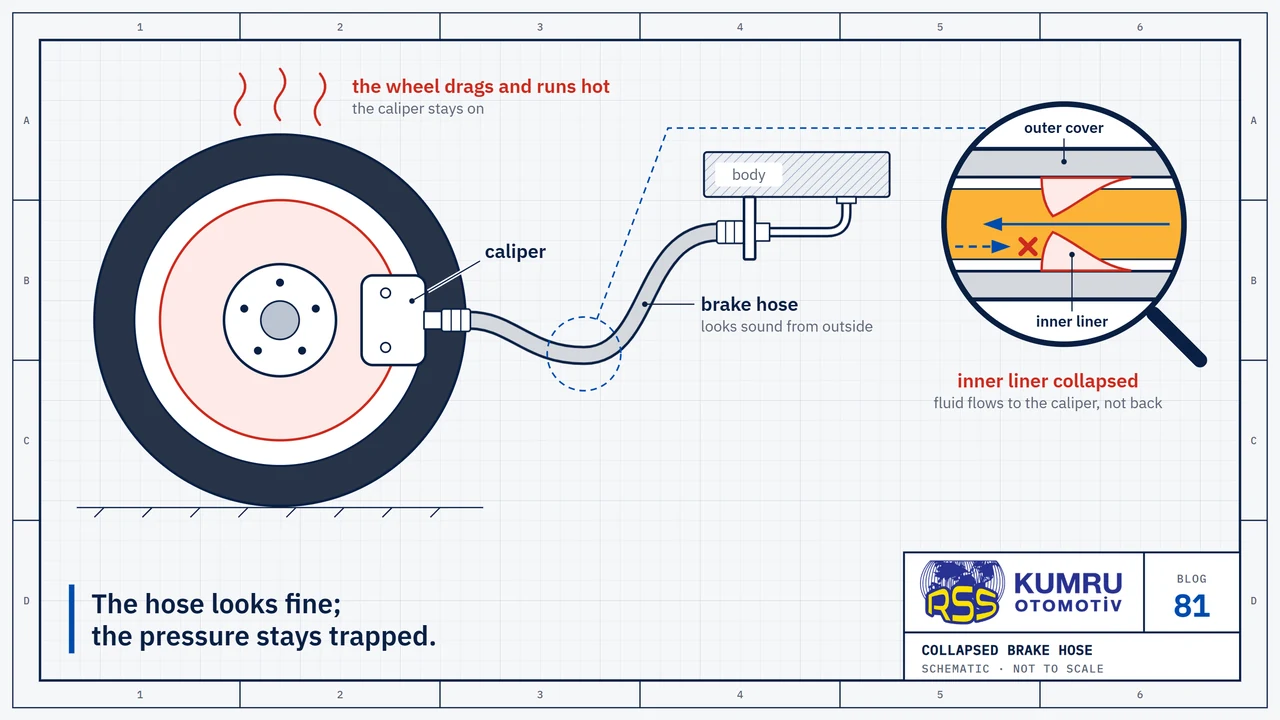
- Vacuum valve stuck closed or obstructed. As the engine cools, coolant cannot be drawn back from the reservoir. The column: “This may cause a radiator hose to suck inward and collapse.” The coolant stays in the reservoir, so the level remains at the hot mark with the engine cold.
- Pressure relief valve stuck open. The cap cannot pressurise the system. Coolant escapes, the reservoir overflows and the engine loses coolant. The column again: “An unpressurized cooling system can’t cool an engine as effectively as one that’s properly pressurized.” If it keeps happening, too little coolant is left to hold the engine at operating temperature, and it overheats.
The column traces one stuck relief valve to debris sucked back from the bottom of the reservoir. The cure: clean cap and reservoir, and replace a cap whose sealing rubber is pitted or damaged. A collapsed hose is not always the cap’s doing: SOLAS notes that a hose gone soft may collapse and close up completely.
Why does a radiator hose swell?
A radiator hose swells for one of two reasons: it has lost its elasticity, or the system pressure is too high. The SOLAS notes describe a swollen hose as one that has lost its elasticity, is swelling under pressure and may soon rupture. Squeezed, a sound hose “should feel pliable and springy”. Kia’s Seltos owner’s manual agrees: “Replace any swollen or deteriorated hoses.” Why rubber hardens is covered in our PTFE and rubber hose article.
The known source of excess pressure is the cylinder head gasket. SOLAS explains that combustion gas getting past a failing gasket forms bubbles of hot gas that “raise both the temperature and pressure inside the system”. MOTOR notes that at an abnormally high pressure the cap may let a great deal of coolant escape. A cap rated too high pushes the same way. MotoRad, a cap maker: “a cap with too high of a pressure rating can stress the cooling system components, potentially causing leaks”.
None of the three mentions the hose. They say the pressure rises; that it shows first in the weakest hose is our inference. Blisters on a hydraulic hose have other causes, listed in our hydraulic hose failure article.
How is a cap tested, and what happens with the wrong pressure rating?
A radiator cap is tested on a cooling system pressure tester, with an adaptor. SOLAS starts with the book: confirm from the workshop or owner’s manual that the cap has the correct rating, then fit it to the tester and pump. The pass mark: “The pressure should hold just below the relief pressure setting.” If it will not hold or cannot reach that pressure, fit a new cap of the correct type. MOTOR draws the same line: “If the cap is out of specification, replace it, even if it looks good.”
The system comes next: tester on the filler neck, pumped to slightly above the pressure marked on the cap. A steady reading means no leak. If it drops with nothing leaking outside, the leak is most probably internal. Do not exceed the manufacturer’s maximum pressure.
The wrong rating does harm in both directions. SOLAS: a lower-rated cap lowers the boiling point of the coolant. MotoRad: the wrong rating “can lead to coolant loss, overheating, and potential damage to your engine”.
Never open the cap on a hot engine. Kia’s manual: “Never attempt to remove the radiator cap whilst the engine is operating or hot.” Switch off and wait for the engine to cool. Wrap a thick towel round the cap, turn it slowly anticlockwise to the first stop and step back while the pressure is released. Only then press down and carry on turning. SOLAS adds that even a warm engine can spurt coolant when the cap is released.
In what order should a mechanic check?
- Engine cold. A reservoir level still at the hot mark, or a hose sucked flat, points to the vacuum valve.
- The cap. Clean it; inspect the sealing rubber and the valve seat.
- The rating. Compare the figure on the cap with the manual.
- Cap test. The pressure should hold just below the relief setting.
- System test. Slightly above the cap’s figure, the gauge should stay steady.
- Hoses. Squeeze them. Replace any that are swollen, very soft or very hard. Where one has failed, SOLAS expects the rest to follow.
- Reservoir still overfilling. If it still overfills at operating temperature with cap and reservoir clean, MOTOR points to a fault such as a blown head gasket.
Sources
- SOLAS (Ireland), “Trade of Motor Mechanic, Phase 2 Course Notes, Module 3 Unit 3: Cooling System (Revision 3.0)”, apprenticeship course notes, November 2013; Ireland's Further Education and Training Authority; read from the Internet Archive copy.
- MOTOR Magazine, “Trouble Shooter: Don't Get Steamed”, trade magazine, diagnostic column, December 2017.
- HELLA, “HELLA Tech World: Engine cooling - Basics”, technical information page for workshops; undated, read on 12 October 2026.
- MotoRad, “The Importance of Choosing the Correct Radiator Cap Pressure Rating for Your Car or Truck”, technical article by a cap and thermostat manufacturer, 31 January 2019; read from the Internet Archive copy.
- Kia, “Seltos Owner's Manual: Maintenance, Engine coolant, Checking the coolant level”, online owner's manual (Kia India); undated, read on 12 October 2026.
Sources were checked again on October 13, 2026.
RSS Kumru Automotive
RSS Kumru Automotive was founded in 1990 and specialises in hydraulic systems and fluid management. Our range includes brake and steering hoses, turbo pipes and hoses, and oil pipes.
Brand names and OEM reference numbers are used for identification and compatibility information only.