PTFE hose or rubber hose? Temperature, fluid, bending and service life
- Author
- Selami Kumru
- First published
- First published:
- Last updated
- Last updated:
- Reading time
- 6 min read
- Category
- Fittings and selection
A PTFE-lined, stainless-braided hose (PTFE, known by the trade name Teflon) runs hotter than a rubber hose, resists most fluids, and its shelf life counts as unlimited. In return it collapses when bent sharply, needs a conductive liner for fuel and takes its own end fittings. Where temperature and fluid stay within rubber’s limits, a rubber hose is not the wrong choice.
Short answer
- Temperature: Aeroquip catalogue: PTFE hose -73°C to +232°C, elastomer-lined hose up to +150°C.
- Bending: same catalogue, size -06: minimum bend radius 4.00 in for PTFE, 2.50 in for elastomer.
- Fuel: a PTFE fuel hose needs a conductive, carbon-filled liner.
- Shelf life: Parker gives 7 years for bulk rubber hose; PTFE counts as unlimited.
What is a PTFE hose, and what temperature does it take?
A PTFE hose has an inner tube of polytetrafluoroethylene instead of rubber, usually under a stainless steel braid. Danfoss’s Aeroquip Performance Products catalogue rates such a hose from -73°C to +232°C, and its stainless-braided hose with an elastomer inner tube up to +150°C. In Danfoss’s hydraulic hose catalogue many rubber hoses are listed at -40°C to +100°C. What counts is the hose’s own catalogue.
For petroleum-base oils such as engine oil and transmission fluid, the hydraulic catalogue recommends a maximum fluid temperature of +94°C for a synthetic rubber inner tube; for PTFE, +204°C at full pressure and +232°C in low-pressure service. Those figures hold while the air around the hose stays below +60°C for rubber (+82°C in low-pressure service) and +204°C for PTFE.
The same catalogue’s fluid chart rates synthetic rubber U (unsatisfactory) and PTFE E (excellent) for hot air at 201°F to 300°F (roughly 94°C to 149°C). For the line from a truck’s compressor to its air dryer, Haldex’s installation instructions call for wire-braided PTFE hose, copper tubing or a combination of both; see our article on the compressor discharge line.
Danfoss’s table of standard descriptions lists SAE 100R14 as PTFE-lined hydraulic hose with a single stainless steel braid.
Which one stands up to fuel, oil and chemicals?
A PTFE inner tube is rated E in the large majority of rows in Danfoss’s fluid compatibility chart. A synthetic rubber (nitrile) inner tube also copes with the common fluids: it is rated G (good) for petrol, diesel and automatic transmission fluid. For biodiesel above 180°F (about 82°C) rubber drops to C (conditional) while PTFE stays at E.
PTFE does not take the top mark in every row: it is rated U for oxygen and C for hydrogen. Brake fluid is not in the chart. The Aeroquip catalogue calls its PTFE hose compatible with a wide range of fluids, “including hydraulic brake fluids”, and lists off-road brake among its applications. That settles nothing for the brake hose of a road vehicle.
On one car forum several owners describe a braided rubber fuel hose, routed through the boot or the cabin, that does not drip but smells of petrol. Parker’s safety guide says permeation (seepage through the hose) will occur when a hose carries fuels such as petrol or diesel. Aeromotive claims its PTFE fuel line will not “permeate fuel vapor (vapor-walk) like normal rubber braided line”. The Aeroquip catalogue answers the same smell with a nylon-barrier rubber hose.
Why does a PTFE hose kink, and how tightly can it bend?
Bent too sharply, the inner tube of a PTFE hose collapses at that spot. Danfoss’s failure analysis puts it down to the material: “PTFE is a thermoplastic material which is not rubber-like. When bent sharply it simply collapses.” Heat combined with vacuum inside the hose can fold the tube too, it adds.
The minimum bend radius is larger too; the figures below are for two stainless-braided hoses in the Aeroquip catalogue.
| Size | PTFE: operating pressure | PTFE: bend radius | Elastomer: bend radius |
|---|---|---|---|
| -04 | 3,000 psi | 2.00 in | 2.00 in |
| -06 | 2,500 psi | 4.00 in | 2.50 in |
| -08 | 2,000 psi | 5.25 in | 3.50 in |
Source: Aeroquip Performance Products catalogue, July 2023, in its own units. Our approximate conversions: 4.00 in is 102 mm, 2.50 in is 64 mm, 2,500 psi is 172 bar. Sizes are nominal: the -04 PTFE hose has a listed bore of 0.19 in.
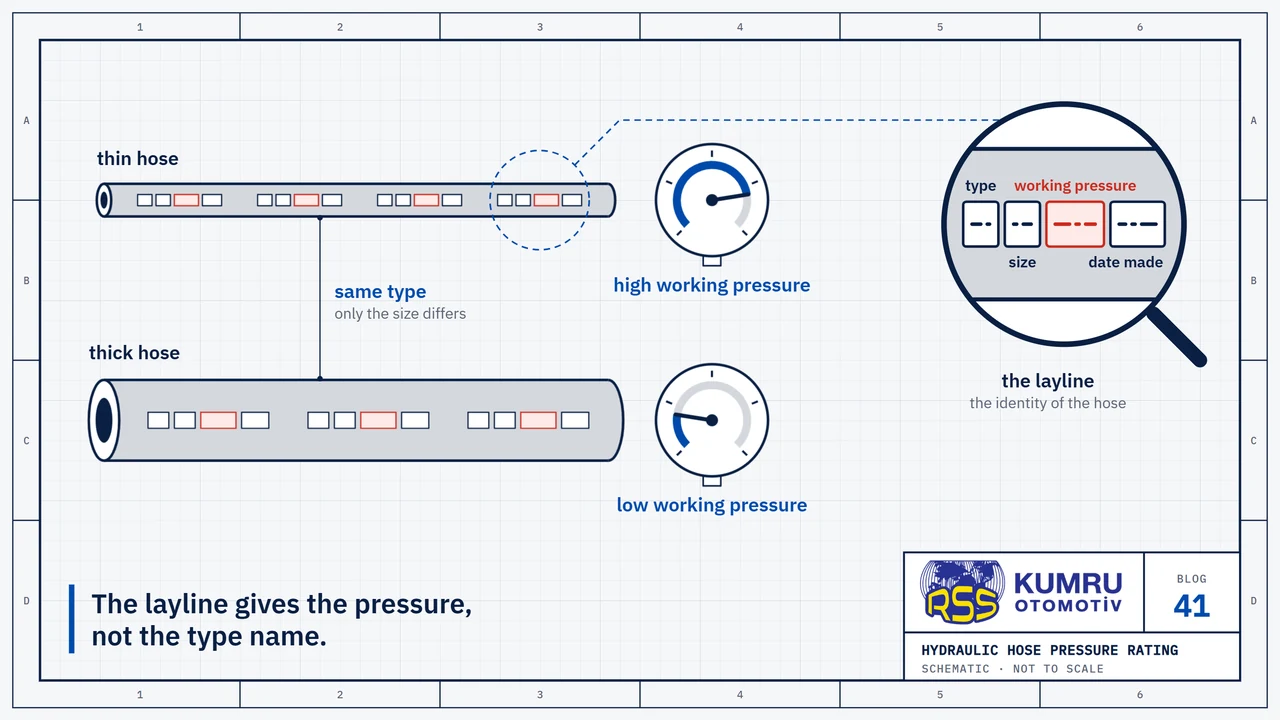
In PTFE hose the operating pressure falls as the size grows, and the bend radius grows quickly. Parker’s rule is the same for both hoses: “If any Hose is kinked during installation, the Hose must be discarded.” Other signs of a finished hose are in our article on when to replace a hydraulic hose.
Why does a fuel line need a conductive liner?
Static electricity that builds up on a non-conductive PTFE inner tube can burn holes through it. Danfoss explains pin-hole leaks in PTFE hose this way: a low-viscosity, petroleum-based fluid flowing at high velocity can generate a high voltage; the only ground in reach is the steel braid, and the arc to it goes through the tube. The remedy: “Specially constructed PTFE tubes are available that have enough carbon black in them so as to be conductive.”
Parker’s rule takes one sentence: “All hoses that convey fuels must be grounded.” Aeromotive says the liner of its PTFE fuel line is carbonised for conductivity, “which is critical for fuel handling”.
Does a PTFE hose take the same end fittings as a rubber hose?
No; a PTFE hose takes its own fittings. In the Aeroquip catalogue the two elastomer-lined hoses are qualified with the same fittings; those for the PTFE hose are listed separately. The elastomer hose is pushed into a socket and a nipple is screwed into it. The PTFE hose needs a third part: a sleeve pushed over the end of the inner tube, under the wire braid.
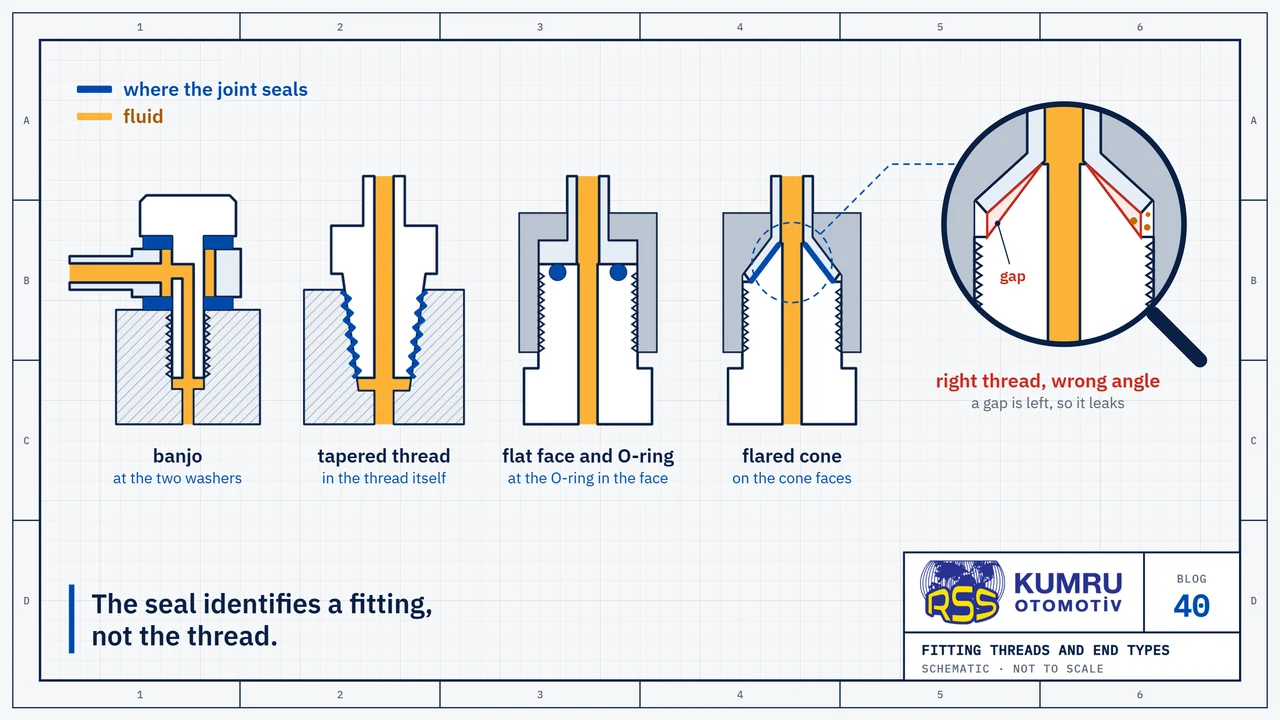
The catalogue does not say outright that the two kinds of fitting are not interchangeable; that is our conclusion from the separate parts lists and the assembly sequence. Thread and seat types are in our article on fitting and thread types.
Which ages faster, and how long does each keep on the shelf?
Heat and oxygen harden a rubber inner tube. According to Danfoss, heat leaches out the plasticisers that give the tube its flexibility, and oxygen speeds the hardening.
Unless the manufacturer specifies otherwise, Parker’s safety guide gives bulk rubber hose a shelf life of 28 quarters (7 years) from the date of manufacture, extended by 12 quarters (3 years) if stored in accordance with ISO 2230. The shelf life of PTFE hose “is considered to be unlimited”. Assemblies are all treated alike: a PTFE hose assembly, too, is stored for no longer than 2 years. Neither Parker nor the Aeroquip catalogue gives service life in years.
Which hose where?
- Temperature. Compare fluid and ambient temperature with the limits in the hose’s own catalogue; where oil or air runs hotter than rubber allows, as on the compressor discharge line, PTFE is the choice.
- Fluid. If the rubber inner tube is rated G or E and the temperature is within its limit, PTFE gains nothing. The chart does not say so; it is what the ratings add up to.
- Routing. In a tight space, check the minimum bend radius; the Aeroquip catalogue suggests elbow adapters and fittings there.
- Fuel and fittings. For fuel, look for a conductive liner; fit the hose with its own fittings and check the date of manufacture on a rubber hose.
Sources
- Danfoss, “EMEA Rubber hydraulic hose and fitting, tooling and accessories catalog (EC600-12)”, manufacturer's catalogue, February 2025; fluid compatibility chart, temperature recommendations, table of SAE descriptions, failure analysis section.
- Danfoss Power Solutions, “Aeroquip Performance Products by Danfoss (catalog, AF445763801901en-000101)”, manufacturer's catalogue, July 2023; tables for the PTFE and the elastomer-lined stainless braided hoses, fittings, assembly instructions, technical data.
- Parker Hannifin, “Parker Safety Guide for Selecting and Using Hose, Tubing, Fittings, Connectors, Conductors, Valves and Related Accessories (Publication No. 4400-B.1)”, manufacturer's safety guide, 28 September 2015; Internet Archive copy of 4 January 2024 of the document on parker.com; shelf life, permeation, grounding, kinked hose.
- Haldex, “PURest Air Dryer: Installation and Maintenance (L31170)”, installation and maintenance instructions, revised October 2006; material of the compressor discharge line.
- Aeromotive, “Fuel Line, PTFE, Stainless Braided”, product page of a fuel system manufacturer; published 28 December 2023 according to the shop record, read 8 October 2026; the maker's statements about its own product.
- Grassroots Motorsports, “Ditching braided hose.. Alternatives?”, forum thread, July 2018 to August 2022 (last post read 25 August 2022); cited only for the fuel smell reported in the field, not a manufacturer instruction.
Sources were checked again on October 8, 2026.
RSS Kumru Automotive
RSS Kumru Automotive was founded in 1990 and specialises in hydraulic systems and fluid management. Our range includes fittings, injector lines, fuel lines and turbo oil pipes.
Brand names and OEM reference numbers are used for identification and compatibility information only.