Buying an injector or fuel line for a Caterpillar engine: what to check
- Author
- Furkan Kumru
- First published
- First published:
- Last updated
- Last updated:
- Reading time
- 6 min read
- Category
- Caterpillar
An injector or fuel line for a Caterpillar engine is checked in a fixed order: ordered by the numbers on the engine plate, capped and clean on arrival, undamaged at the cone and hole, matched to the old line in length and bends, fitted with every clamp. A well-made line shows in its dimensions, in an unforced fit and in its paperwork.
Short answer
- Ordering: part number, engine serial number and arrangement number; for an injector line, the cylinder.
- In the box: both ends capped, bore clean; cone face unmarked, hole open.
- Comparison: length, bends and clamp positions against the old line. Never bend a line to fit.
- Fitting: nuts to the service manual torque, every clamp on; then bleed and check for leaks.
What information do you need when ordering?
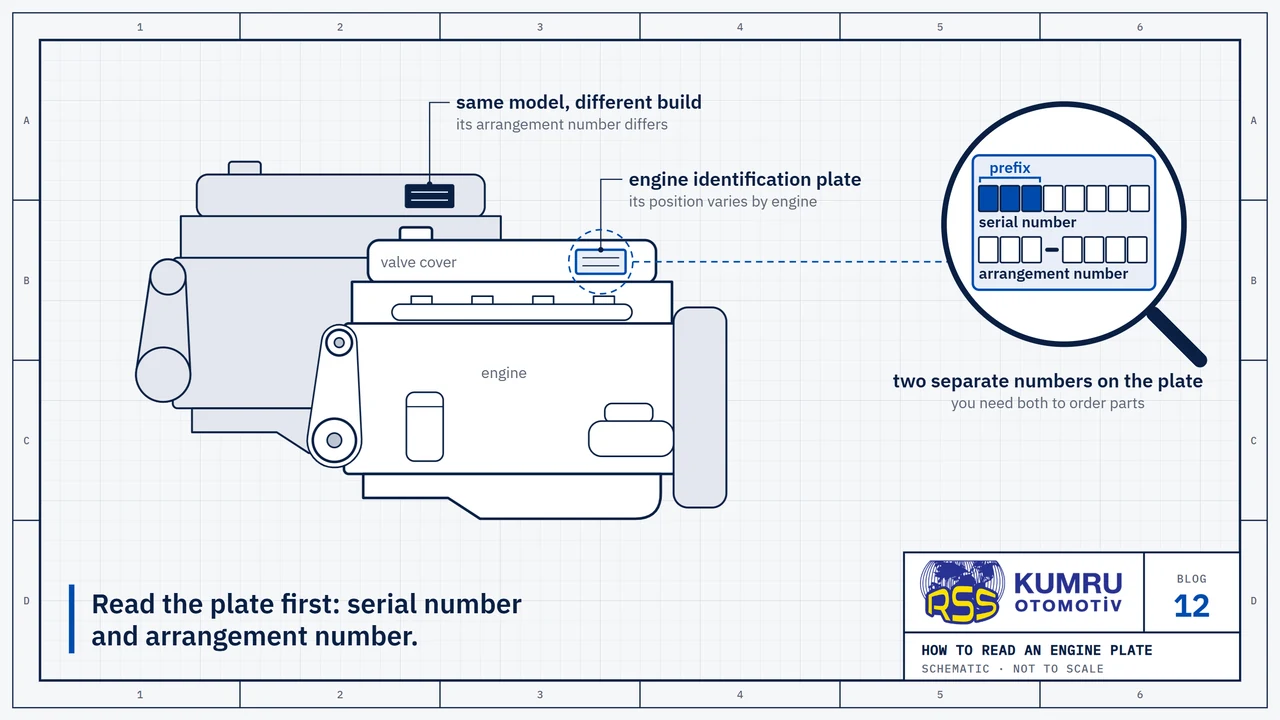
On a Caterpillar engine a line is looked up by two numbers on the engine plate, not by model name: the engine serial number and the arrangement number. Machines sharing a model name can differ in fuel pump and injector by arrangement number, as our article on serial and arrangement numbers shows. Add the part number from the old line or the parts book; if it has been replaced, the article on Caterpillar part numbers explains how to find the new one.
For an injector line, add the cylinder. Bosch’s Diesel Engine Management notes that more or less angled bends in the lines make up for the different distances between the pump outlets and the cylinders, so each cylinder’s line is bent differently.
What do you look at first when you open the box?
With the box open, look at the ends first: are both capped, and is the bore clean? Caterpillar’s contamination control brochure does not assume a new part is clean:
“Replacement parts and components, including brand new ones, can introduce contaminants into the systems on which they are installed.”
Caterpillar, Contamination Control (PEDJ0028-01), November 2017
Its rule is to keep parts in their original packaging “until the moment they are installed”, and hoses plugged and capped. The reason is size: today’s systems work to tolerances “between 2 and 30 microns”, and a particle of about 40 microns, half a hair’s width, can cause premature wear.
Caterpillar’s Operation and Maintenance Manual for the 3406C generator set says the same for the fuel system: “Do not allow dirt to enter the fuel system.” It wants a cover over any disconnected component. So leave the caps on until the line is offered up, and cover the open pump and injector connections once the old line is off.
An injector line sits downstream of the fuel filters, so dust or swarf left inside reaches the injector unfiltered. The manual does not say this about lines; it follows from its reason for not pre-filling a fuel filter: “The fuel would not be filtered and could be contaminated.”
How do you check the cone and the hole?
On an injector line the cone at each end makes the seal, so look at the cone face and the hole through it. Bosch, which describes the cone as formed on the tube end and pressed into the fitting by the union nut, has one rule for the hole:
“The cone’s open diameter should not be restricted, as this would obstruct fuel flow.”
Bosch, Diesel Engine Management, p. 168
The order we suggest:
- Cone face. Turn it under a good light: no nicks, dents, burrs or rust.
- Hole. Round and open. Hold it against the old line; if clearly smaller, ask the seller before fitting.
- Nut. It should turn freely on the tube and start on the thread by hand. Do not force it with a spanner.
A low-pressure fuel line may end differently; its seating face gets the same attention.
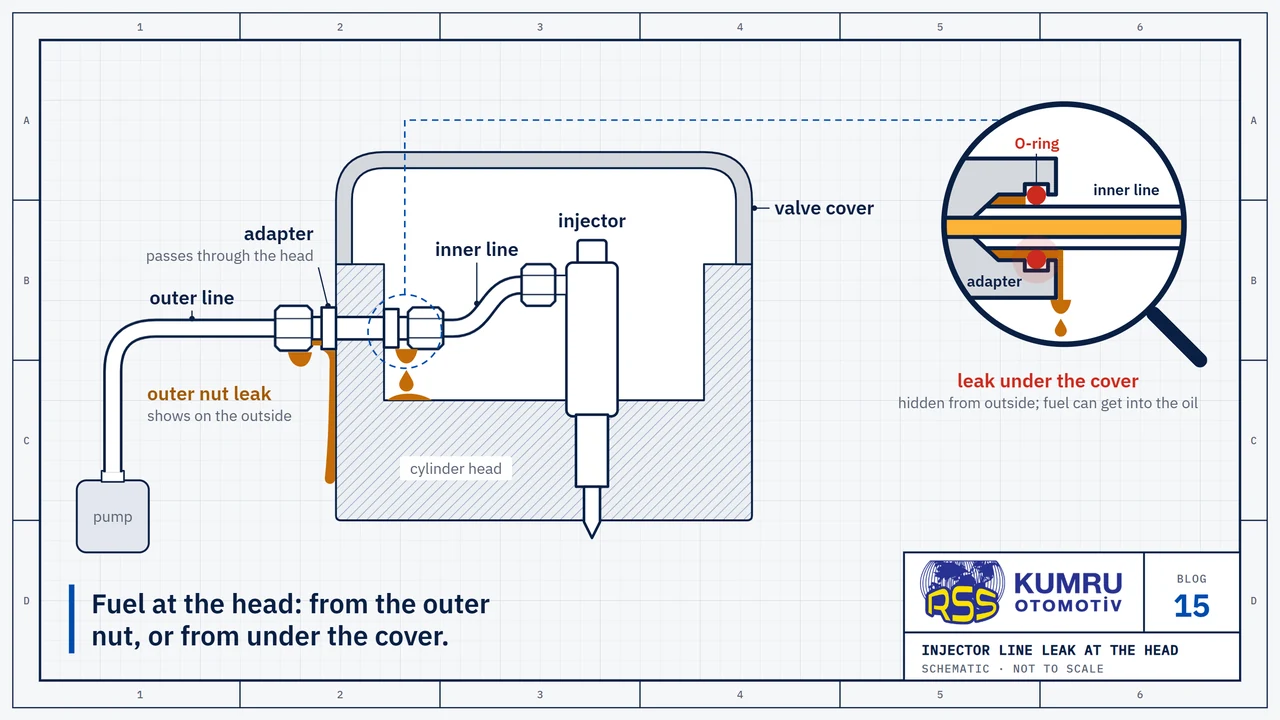
Look at the mating seat too. On a heavy equipment forum a mechanic describes a fuel leak around the number 3 injection pump of a 3406B: “I did install a new line too. No difference.” The cause was a “hairline crack at the injector line sealing cup” on the pump’s outlet fitting, “almost impossible to see”.
How do you compare the new line with the old one?
Lay the new line beside the old one from the same cylinder and compare length, the position and direction of each bend, and the straight sections where the clamps sit. Bosch’s rule is strict: “Tubing of other dimensions should never be installed during service and repairs.”
Then offer the line up to the engine: both ends should reach their seats on their own. If not, do not correct the line by hand. The Caterpillar manual: “Do not bend or strike high pressure lines. Do not install bent or damaged lines, tubes or hoses.” Recheck the number and cylinder, then ask the seller.
Compare the clamp positions too. Bosch says high-pressure lines on vehicle engines “are normally mounted with clamp brackets located at specific intervals”, so that little or no outside vibration reaches them. The new line’s clamp positions must meet the engine’s brackets.
What paperwork can you ask the seller for?
Ask the seller for four things: a dimensioned drawing, a material certificate, a pressure or leak test record and a batch marking. The list is our suggestion, not taken from the Caterpillar or Bosch texts.
- Drawing. Outside diameter, wall thickness, length, end form and bends, so you compare by measurement, not by eye.
- Material. Bosch describes high-pressure lines as “seamless precision-made steel tubing”; the certificate should name the steel and confirm the tube is seamless.
- Test. Ask at what pressure, and whether every line or a batch sample was tested.
- Batch. A mark on the line or its packaging, so the part can be traced later.
Whether the quote says genuine, OEM, matching quality or aftermarket does not answer these questions. What those words mean in the regulations is set out in a separate article.
What does the Caterpillar manual want at fitting and first start?
Caterpillar’s 3406C manual wants connections tightened to the recommended torque, no loose clamps, and the fuel system inspected for leaks once the engine has started. Its torque figure is for that engine only; the order of nuts and clamps is our suggestion.
- Nuts. With the clamps loose, start both nuts by hand, then torque them without letting the top of the injector turn; the manual says a nozzle is damaged if it does. For the line nuts at the valve cover base it gives 40 ± 7 N·m (30 ± 5 lb ft).
- Clamps. Tighten them last and leave none off. For fuel hoses the manual wants clamps that have been inspected, or new ones; its walk-around inspection says “Look for loose fuel line clamps.”
- Bleeding. The manual starts with the priming pump. If the engine runs rough, the line nuts are loosened “one at a time” and tightened once fuel runs free of air bubbles.
- Leak check. Run the engine, stop it, and look at every joint you opened. Our advice for a nut that leaks at the correct torque: do not tighten it further; take the line off and inspect the cone and the mating seat.
The Caterpillar manual says not to check high pressure fuel lines with the engine or starting motor running, and to wait 10 minutes after the engine stops before working on them. Never search for a leak by hand: “Always use a board or cardboard”.
Sources
- Caterpillar, “3406C Generator Set: Maintenance Intervals (Operation and Maintenance Manual Excerpt, SEBU7828-10)”, operation and maintenance manual excerpt, August 2010; the copy held by archive.org of a document marked safety.cat.com.
- Caterpillar, “Contamination Control: It Makes a Difference You Can See (PEDJ0028-01)”, Caterpillar's contamination control brochure, November 2017; the copy on a Caterpillar dealer's site.
- Bosch / Springer, “Diesel Engine Management: Systems and Components (ed. Konrad Reif), pp. 168-170”, reference book, 2014; pp. 168-170, read in Google Books partial view; sealing cone, line dimensions, bends and clamps.
- Heavy Equipment Forums, “A Cat driving me nuts”, forum thread, 18 October to 7 November 2018; a leak on a 3406B that a new line did not cure; a field account, not a manufacturer document.
Sources were checked again on October 9, 2026.
RSS Kumru Automotive
RSS Kumru Automotive was founded in 1990 and specialises in hydraulic systems and fluid management. Our range includes more than 1,000 pipe and hose references for Caterpillar engines and machines.
Brand names and OEM reference numbers are used for identification and compatibility information only.