Cat piston cooling nozzle: what it does, alignment, and what happens when it blocks
- Author
- Furkan Kumru
- First published
- First published:
- Last updated
- Last updated:
- Reading time
- 6 min read
- Category
- Caterpillar
On a Caterpillar engine the piston cooling nozzle, or piston cooling jet, is a small part bolted to the cylinder block, often a body with a thin bent tube, that sprays engine oil at the underside of the piston. If the tube is bent, broken or starved of oil, the piston is no longer cooled from below. Piston makers’ damage guides give the result: the piston head overheats and seizes.
Short answer
- What it does: sprays engine oil under the piston to carry heat away.
- Alignment: the nozzle stands still and the piston moves, so the stream has to be aimed exactly.
- Failure: a bent, broken or oil-starved nozzle leads to seizure all round the piston head.
- Torque and alignment: take the figure and the method from that engine’s service manual.
What does a piston cooling nozzle do, and where does it sit?
The nozzle uses engine oil to carry away part of the heat the piston takes from combustion. A Caterpillar patent of 1993 describes how: many high-output engines cool the piston crown “by spraying a cooling medium against the underside of the hot crown”.
“The cooling medium absorbs a portion of the heat within the crown, falls away from the crown, is cooled and recycled to cool the piston crown again.”
Caterpillar Inc., US Patent 5,267,534, 7 December 1993
A Caterpillar patent of 1980 describes the piston with a cooling gallery: a ring-shaped passage close to the ring grooves, open at the bottom, with a nozzle below the cylinder spraying oil up into it.
The nozzle sits low in the block. In the 1980 patent it is mounted “just below the lower end of the cylinder liner” and fed from a gallery supplied by the oil pump. The US Army’s maintenance manual for the 621B scraper, which has a Caterpillar 3406 engine, shows six “oil jet tubes”, each held to the block by one bolt.
A mechanic rebuilding a 3406 asked a heavy equipment forum where the jets were in the parts system. The reply: “The cooling jets are usually listed as part of the cylinder block assembly.” He was then asked for the full engine serial number; where it is stamped is covered in a separate article.
Why does alignment matter so much?
Because the nozzle stays where it is while the piston travels up and down. On a gallery-cooled piston the oil has to enter a small port in a moving part. For that type, Caterpillar’s 1980 patent says, “precise alignment of the nozzle with the inlet port is required since the nozzle will be stationary while the piston will be moving”.
It also names the result when oil does not reach every inner surface of the piston: “localized hot spots which can lead to cracking of the piston”.
The 1993 patent adds that existing cooling jets “must be manufactured and assembled to precisely direct the coolant to the proper location within the engine”, and that many do it with “a piece of tubing bent in a preestablished configuration”.
If the bend sets the aim, a tube knocked out of shape sprays somewhere else. The patent does not say that in so many words; it follows from the construction it describes.
What happens when the nozzle is bent, broken or blocked?
The piston is not cooled from below and overheats. The damage guide MS Motorservice publishes under the Kolbenschmidt brand describes an overheating seizure centred on the piston head: “Seizure marks are distributed around the entire circumference of the piston head.” Among the possible causes it lists: “Bent or faulty oil injection nozzles, which insufficiently cool the piston with oil from underneath.”
The same list includes combustion, cooling system and oil supply faults. A seized piston does not point to the nozzle on its own.
Writing in Engine Professional, the product development and technical support director of the parts maker IPD describes the notch in the piston skirt that clears the cooling tube; on non-symmetrical skirts it is on one side only. Fitted the wrong way round, the skirt hits the tube and breaks it. He goes on: “Without the cooling oil from the tube, the piston will overheat and seize.”
The designer allows for blockage too: on the nozzle in the 1980 patent the oil inlet ports are smaller than the jet bore, so they hold back particles large enough to plug it.
On a truckers’ forum, a 3406E that kept scoring pistons after a broken crankshaft drew two early questions: were the jets mixed up at the overhaul (“they are directional”, the member noted), and is their oil supply plugged? The one page of that thread we could read never settles the cause.
What should you watch when removing and refitting the nozzles?
A nozzle that is bent or cracked is replaced, and the bolts are tightened to a set torque. The only service manual we could open is the US Army’s, for the 3406-powered 621B; Caterpillar’s own for the 3406E we could not.
In the Army manual the jets belong to the cylinder block repair: once the crankshaft and pistons are out, six bolts and six oil jet tubes come off. Its inspection rule for removed parts is one sentence: “Replace if cracked, broken, distorted or threads or bore damaged.”
On refitting it gives 18 lb-ft (24 Nm) for the six bolts. That figure is for the 3406 in that manual; any other engine, the 3406E included, has its own.
A member of the heavy equipment forum warns: “It’s easy for them to get bent a little when the pistons are removed.” The mechanic in that thread took his jets off before pulling the pistons; the Army manual takes them off afterwards.
Can alignment be checked without the special tool?
In the field it gets a rough check; but by the accounts on two forums the manufacturer’s method needs special equipment. On the truckers’ forum an owner building a 3406 wrote that his manual talks about aligning the nozzle with a Cat special tool, and asked: “is it not that critical where the oil ends up spraying?”
A member who rebuilds engines for customers answered that he does the check “every time”. On the heavy equipment forum, Caterpillar’s method was recalled as one that “involves bolting the jets to a fuel pump test stand and aiming the stream at a target”.
Without the tool, the same engine builder suggested: “Take a couple of brake clean straws. Insert them carefully in the tubes and make sure they hit the piston in the proper place.” All should look the same. That is a field method, not the manufacturer’s instruction.
What order should a mechanic work in?
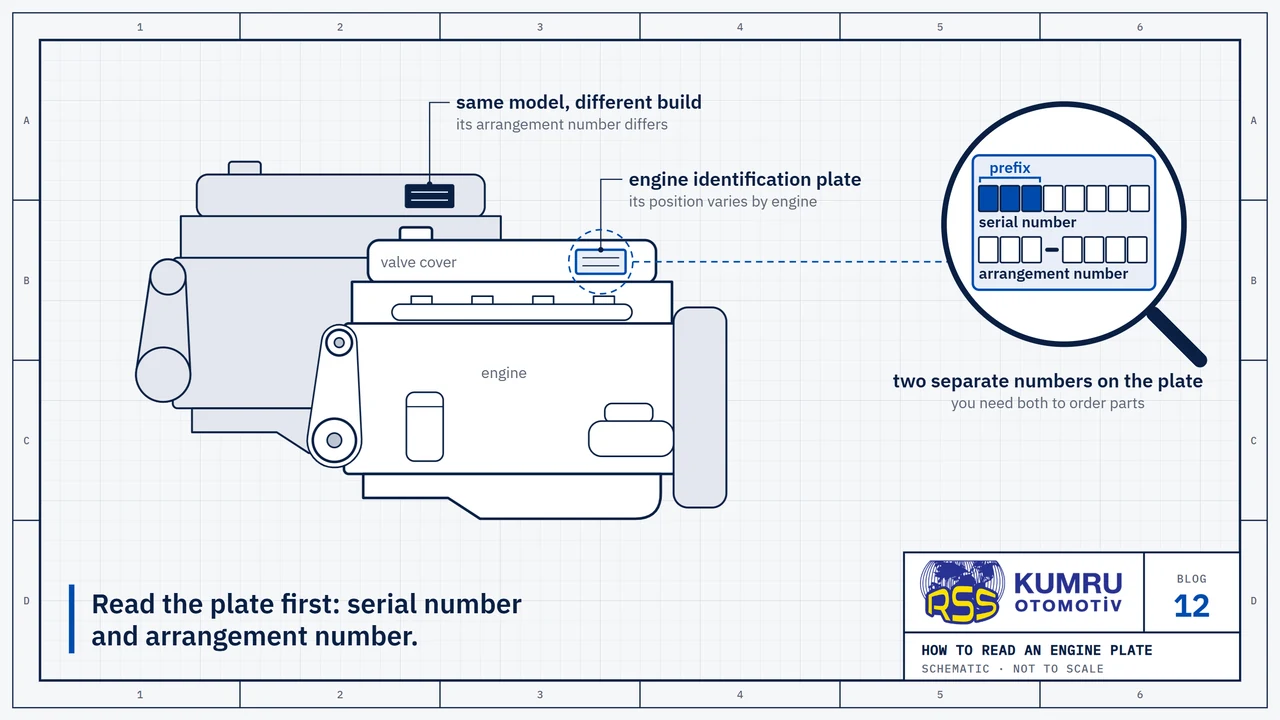
- Identify the engine. The serial and arrangement numbers decide the part number and the service manual; reading part numbers is covered in a separate article.
- Protect the nozzles. Keep the pistons clear of them on the way out, or take the nozzles off first.
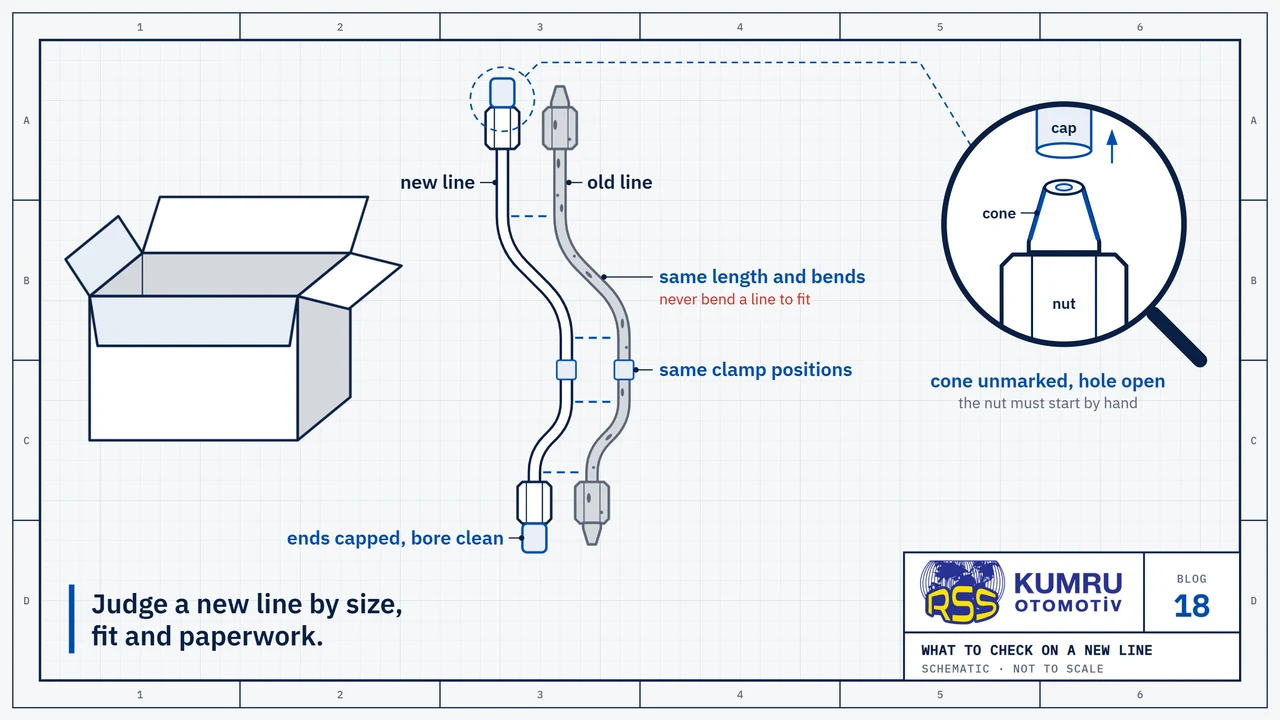
- Look at every nozzle. Replace any that is cracked, broken or bent.
- Clean the oil passages. After a crankshaft failure, the forum advice is to go back over a washed block and “blow through with shop air”.
- Fit and align the nozzles. Torque and alignment method are in the engine’s service manual.
- Fit the piston the right way round. Follow its direction mark and the service manual. Then turn the crankshaft by hand and check that the skirt clears the nozzle.
The hand-turning check is not in the sources; we draw it from the contact risk IPD describes.
Sources
- Caterpillar, “US Patent 5,267,534, Piston cooling nozzle (1993), and US Patent 4,206,726, Double orifice piston cooling nozzle for reciprocating engines (1980)”, two US patents granted to Caterpillar Inc. and Caterpillar Tractor Co., 7 December 1993 and 10 June 1980; the second is at patents.google.com/patent/US4206726A/en.
- U.S. Department of the Army, “TM 5-3805-248-23-1 and TM 5-3805-248-23-2: Scraper, Earth Moving, Motorized, Diesel Engine Driven, Model 621B (maintenance manual)”, US Army maintenance manual for the 621B scraper with the Caterpillar 3406 engine, two volumes; the copy read carries no print date, read on 8 October 2026.
- MS Motorservice (Kolbenschmidt), “Damage from overheating”, piston damage guide under the Kolbenschmidt brand, technical information page, undated; read on 8 October 2026.
- IPD, Engine Professional, “Heavy-Duty Engine Pistons: Which way did they go?”, technical article from AERA's Engine Professional magazine, July–September 2022, pp. 92–96; republished on IPD's site.
- TruckersReport, “166-3650 cooling nozzles alignment”, forum thread, 7 February 2026; first page read from the Internet Archive copy; a field account, not a manufacturer document.
- Heavy Equipment Forums, “Cat spacer plate sealant?”, forum thread, 24 January 2020 to 10 February 2023; the posts about the jets are dated 1 February 2020; a field account, not a manufacturer document.
- TruckersReport, “3406E keeps scoring pistons”, forum thread, 16–17 April 2012; first page read from the Internet Archive copy; a field account, not a manufacturer document.
Sources were checked again on October 8, 2026.
RSS Kumru Automotive
RSS Kumru Automotive was founded in 1990 and specialises in hydraulic systems and fluid management. Our range includes more than 1,000 pipe and hose references for Caterpillar engines and machines.
Brand names and OEM reference numbers are used for identification and compatibility information only.