Cab tilt hoses: choosing the right one, replacing it, and which end goes where
- Author
- Ufuk Şahin
- First published
- First published:
- Last updated
- Last updated:
- Reading time
- 6 min read
- Category
- Trucks
A hydraulic cab tilt system has two hoses between the pump and the cylinder, and they do different jobs: one lifts the cab, the other brings it down under control. They are not interchangeable, they are rarely the same length, and after either one is changed the system has to be bled. This guide covers all three points.
Short answer
- Find the hose by the truck maker’s OE reference, then check length and thread against the old hose.
- Mark both hoses before you remove them. Crossed hoses give a cab that goes up and will not come down.
- Bleed the system after every hose change, with the cab lowered.
What do the two hoses actually do?
Diesel Technic’s instruction sheet for its hydraulic cab tilt system (DB6010) explains one common design clearly. A hand pump with a selector valve feeds a double-acting cylinder through two lines. The push line runs to the bottom of the cylinder, the pull line to the top.
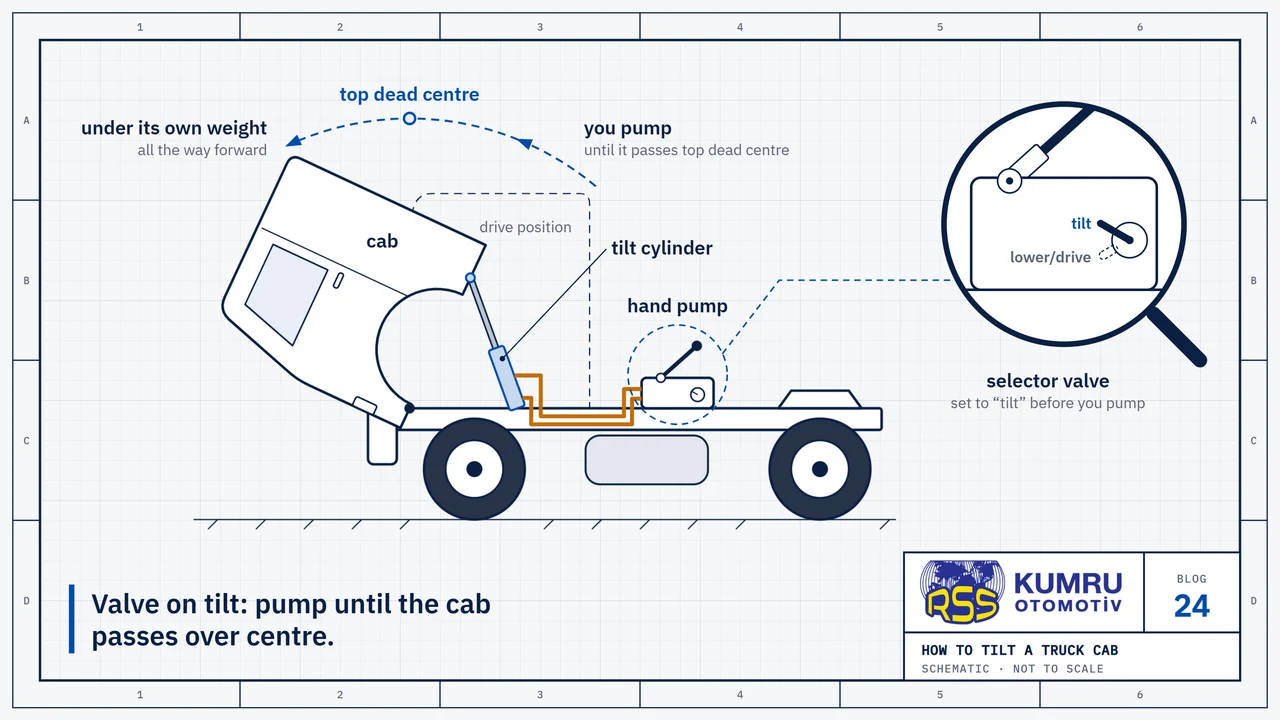
Going up, the pump puts both lines under pressure at once. The pressure is the same on both sides of the piston, but the side without the rod has the larger area, so the rod is driven out and the cab tilts. Once the cab has passed its top dead centre it carries on under its own weight, slowed by a restriction orifice.
Coming down, the pump feeds the pull line only. That same pressure opens a pilot-operated check valve, which lets the oil under the piston flow back to the reservoir through the push line. Stop pumping and the valve shuts, so the cab stays where it is. The sheet is explicit about the reason:
“In case of any pressure drops, line cuts etc., the POCV will immediately close and block off the return line.”
Diesel Technic, Assembly Instruction DB6010, Version 1, 9 September 2024
So the hoses are part of the safety function, not just plumbing. And if the two are crossed at the pump or at the cylinder, lifting still works, because both lines are under pressure on the way up anyway. Lowering does not.
Pump stopped: the check valve closes, the oil under the piston is trapped, and the cab stays where it is.
This is one manufacturer’s system. Electric pumps, cab-lock circuits and extra ports differ from truck to truck, and the vehicle manufacturer’s instructions always come first.
How do you identify the right hose?
Start with the truck maker’s OE reference. Then check three things on the hose you are taking off: overall length, the thread at each end, and the shape of each end fitting. The table shows how far apart the hoses for one family of trucks can be.
| Make | OE reference | Length | Thread | Listed for |
|---|---|---|---|---|
| Mercedes-Benz | 387 553 01 82 | 308 mm | M12 × 1.5 | LK/LN2, NG, SK |
| Mercedes-Benz | 380 553 00 82 | 3,520 mm | M12 × 1.5 | NG, SK |
| MAN | 06.54099.0007 | 300 mm | – | M90, F90, L2000 |
| MAN | 06.54099.0017 | 3,450 mm | M12 × 1.5 | F2000, TGA, TGS, TGX |
| Volvo | 1076178 | 230–240 or 400 mm | M14 × 1.5 | FH12, FH16, FM |
| Volvo | 1076188 | 2,510 mm | M14 × 1.5 | F10, F12, F16, FL, FM |
| Volvo | 1076194 | 3,730–3,760 mm | M14 × 1.5 | FH12, FH16 |
| DAF | 1311044 | 1,460 mm | M14 × 1.5 | 95XF, XF95, CF, LF |
| DAF | 1316859 | 2,600 mm | M14 × 1.5 | 75 |
| Iveco | 41003033 | 1,300–1,310 mm | M12 × 1.5 | Stralis, Trakker, Eurotech |
| Iveco | 41003028 | 5,180 mm | – | Eurotech, Eurotrakker |
| Renault Trucks | 5000792236 | 3,850 mm | – | Premium |
Lengths and threads are the figures published in aftermarket catalogues for each OE reference. A dash means no figure was published. Use them to check, not instead of measuring.
Three things stand out. First, a short hose and a long one for the same family of trucks can differ in length by a factor of ten. Second, the pressure ratings printed in those catalogues run from 325 to 500 bar, and Diesel Technic’s sheet gives about 350 bar as the pressure a healthy hand pump should reach. A general-purpose hydraulic hose that happens to have the right thread is not a replacement. Third, catalogues disagree: for Volvo 1076178 one lists 230–240 mm and another 400 mm. Measure the old hose before you order.
How do you replace a cab tilt hose?
Diesel Technic’s warning: “It is extremely dangerous to work beneath a cab which is in a semi-tilted position. Always tilt the cab fully forward.” While the cab is being tilted or lowered the engine must be off, the parking brake on and the gearbox in neutral.
- Mark each hose and its port before you loosen anything. A paint dot and a photo are enough.
- Catch the oil and cap the open ports. Dirt that gets into a hand pump ends up in its valves.
- Route the new hose exactly where the old one ran, in the same clips. No sharp bends, no twist, and enough slack at the cylinder end for the hose to follow the cab through its whole travel.
- Keep it away from the exhaust and from any edge it could rub on.
- If the hose failed from age, change its partner too. It has had the same life.
How do you bleed the system afterwards?
Air gets in whenever a hose is off. This is Diesel Technic’s sequence, with the cab lowered:
- Check that all lines are connected and the reservoir is filled.
- Selector to DOWN/DRIVE. Pump about 30 full strokes. Refill the reservoir.
- Selector to UP. Tilt the cab fully forward.
- Selector to DOWN/DRIVE. Pump until the cab is fully lowered.
- Top up the reservoir and refit the filler plug.
Two rules from the same sheet: use hydraulic fluid that meets the manufacturer’s specification, never brake fluid, and never fill the reservoir with the cab raised. Leave the selector in DOWN/DRIVE when you finish, because that is where it has to stay while the truck is driven. Some trucks have their own bleed points and their own sequence. Where the truck’s manual differs, follow the manual. The sequence for tilting and lowering the cab itself is covered in the cab tilting article.
New hose fitted and the cab still will not tilt?
Work through it in this order.
- Cab latches. Are they released? The sheet gives this check an exclamation mark of its own.
- Oil level and air. Fill the pump, give it about 20 strokes in DOWN, then try UP.
- Pump pressure. Lines off, a gauge on the pump, the other ports plugged: about 350 bar in both positions. A slow drop after you stop pumping is normal.
- Hoses and pipes. If the pump is good, look for a leak or a blockage in the lines and the cylinder.
- The cab keeps sinking after you stop pumping on the way down. That points to internal leakage in the cylinder. The sheet’s advice: “replace or repair the cylinder, but never replace the pump!”
- The cab goes up but will not come down. Check that the two hoses are not crossed.
Sources
- Diesel Technic, “Hydraulic cabtilt system, Assembly Instruction DB6010”, Version 1, 9 September 2024.
Sources were checked again on October 8, 2026.
RSS Kumru Automotive
RSS Kumru Automotive was founded in 1990 and specialises in hydraulic systems and fluid management. Our range includes more than 200 cab tilt hose references for Renault Trucks, Volvo, Scania, MAN, Iveco, Mercedes-Benz and DAF.
Brand names and OEM reference numbers are used for identification and compatibility information only.