Hose clamp types: worm-drive, spring, T-bolt and where each one is used
- Author
- Selami Kumru
- First published
- First published:
- Last updated
- Last updated:
- Reading time
- 6 min read
- Category
- Hydraulic hoses
Four types of clamp hold the hoses on a vehicle: worm-drive, spring, T-bolt and ear clamps. Worm-drive and spring clamps sit on coolant hoses, T-bolt clamps on the boost hoses of heavy vehicles, and ear clamps on small joints such as a fuel hose. The vehicle maker chooses the type, and a clamp that comes off is replaced with one of the same type.
Short answer
- Worm-drive: tightened with a screwdriver, common on coolant hoses. It tends to lose torque once the hose has run hot, so it needs a second check.
- Spring (constant-tension): no adjustment, fitted with its own pliers. Used on coolant and oil cooler hoses.
- T-bolt: the heavy-vehicle clamp for boost and air intake hoses, tightened with a torque wrench.
- Ear: crimped shut with pincers. Once removed, it is replaced with a new one.
What are the hose clamp types used on a vehicle?
Four hose clamp types are common in automotive use: worm-drive, spring, T-bolt and ear clamps. Irish apprenticeship course notes for motor mechanics (SOLAS) show three clamps on a radiator hose. Two are adjusted with a screwdriver, the “gear or worm-type clamp” and the “banded or screw-type clamp”. The third is a spring clamp, which “is not adjustable and is fitted and removed with special hose clamp pliers”.
The T-bolt clamp comes from a heavy-vehicle manual. Pierce, a maker of fire-apparatus chassis, fits T-bolt clamps to air intake and charge air cooler (intercooler) hoses, and what it calls constant-torque clamps to most coolant lines. The ear clamp appears in a 2024 BMW Motorrad bulletin, holding a fuel hose.
| Type | How it is tightened | Where the sources show it | Figure in the source |
|---|---|---|---|
| Worm-drive | Screwdriver | Coolant hoses (SOLAS, Pierce) | 30–45 in-lbs |
| Constant-torque | Torque wrench | Most coolant lines (Pierce) | 100 in-lbs |
| Spring | Its own pliers | Coolant hoses (SOLAS); transmission oil cooler hose (Nissan) | – |
| T-bolt | Torque wrench | Air intake and charge air cooler hoses (Pierce, Volvo) | 90–100 in-lbs; 10 ± 1.5 Nm |
| Ear | Crimped with pincers | Fuel hose (BMW Motorrad) | closed ear 2.5–4.0 mm |
Figures apply to the named maker’s own vehicle only. A dash means the source gives none.
Why does a worm-drive clamp work loose?
A worm-drive clamp tends to lose the torque it was first tightened to once the hose has run with hot coolant. Pierce gives the figures: standard worm-drive clamps are tightened to 30–45 in-lbs, with this note:
“The clamp will likely drop in torque value after exposure to hot coolant and should be maintained to a torque of 30 in-lbs thereafter.”
Pierce Manufacturing, Custom Chassis Operation & Maintenance Manual, 2005
The constant-torque clamp follows the same pattern: 100 in-lbs at assembly, 45 in-lbs afterwards. SOLAS asks for the same check once the engine is at normal operating temperature, “as the clamps and hoses will both expand at different rates as they heat up”.
A spring clamp has no adjustment; released from the pliers, it grips by its own spring force. The sources do not say why makers choose it. That such a clamp needs no re-tightening as the hose settles is our own inference.
Can a worm-drive clamp replace a spring clamp?
A spring clamp that comes off is replaced with another spring clamp. Pierce’s manual states the rule in one line: “Replace clamps as required with same style as originally supplied.” A change of type comes from the maker, by bulletin, as in the Volvo example below.
The swap is made in the field all the same. On a Turkish Opel forum, an Astra owner could not refit the original clamp to a new radiator hose in the tight space and used a screw clamp. About 12,000 km later, in winter, coolant seeped from that joint and the clamp was found loose. Another member notes that the original is the spring type.
That is one car, but it points the same way as Pierce’s torque note. Our reading of the two: a worm-drive clamp fitted in place of a spring clamp brings the re-tightening with it.
Which clamp goes on a boost hose?
On heavy vehicles, boost hoses and charge air cooler joints are held by T-bolt clamps, tightened harder than a standard worm-drive clamp. Pierce gives two figures for these hoses: 90–100 in-lbs for T-bolt clamps and 45–70 in-lbs for spring T-bolt clamps.
A Volvo Trucks campaign bulletin of November 2023 shows why the type matters: on certain VN trucks the crimped clamps on the charge air cooler pipe could leak, with the result “a boost leak or hose blowoff”. The remedy is to cut off the four crimped clamps and fit four T-bolt clamps at 10 ± 1.5 Nm (7.4 ± 1.1 ft-lb).
A recall in which the clamp reached its torque and the hose still came off is covered in the boost hose article.
Which clamps hold fuel and oil hoses?
The two bulletins we read on clamped oil and fuel hoses show spring and ear clamps. Neither type has a torque figure; the maker specifies where the clamp sits and how far it is closed.
Nissan’s 2013 Pathfinder bulletin holds the transmission oil cooler hose with two clamps at the radiator end: “a double wire clamp is installed first, followed by a spring clamp”. The spring clamp goes “as close to the fitting bulge as possible”, with a note: “Confirm that the clamps are not on top of the fitting bulge or on an angle.” Leaks from these hoses are covered in the oil cooler hose article.
A BMW Motorrad bulletin from February 2024 shows the ear clamp’s weak point. On K 1600 models the single-ear clamp holding the fuel hose on the fuel pump’s quick coupling “may be insufficiently crimped”; under the higher fuel pressure of starting, the hose could slip off. The bulletin gives a dimension, not a torque: a closed ear of 2.5–4.0 mm.
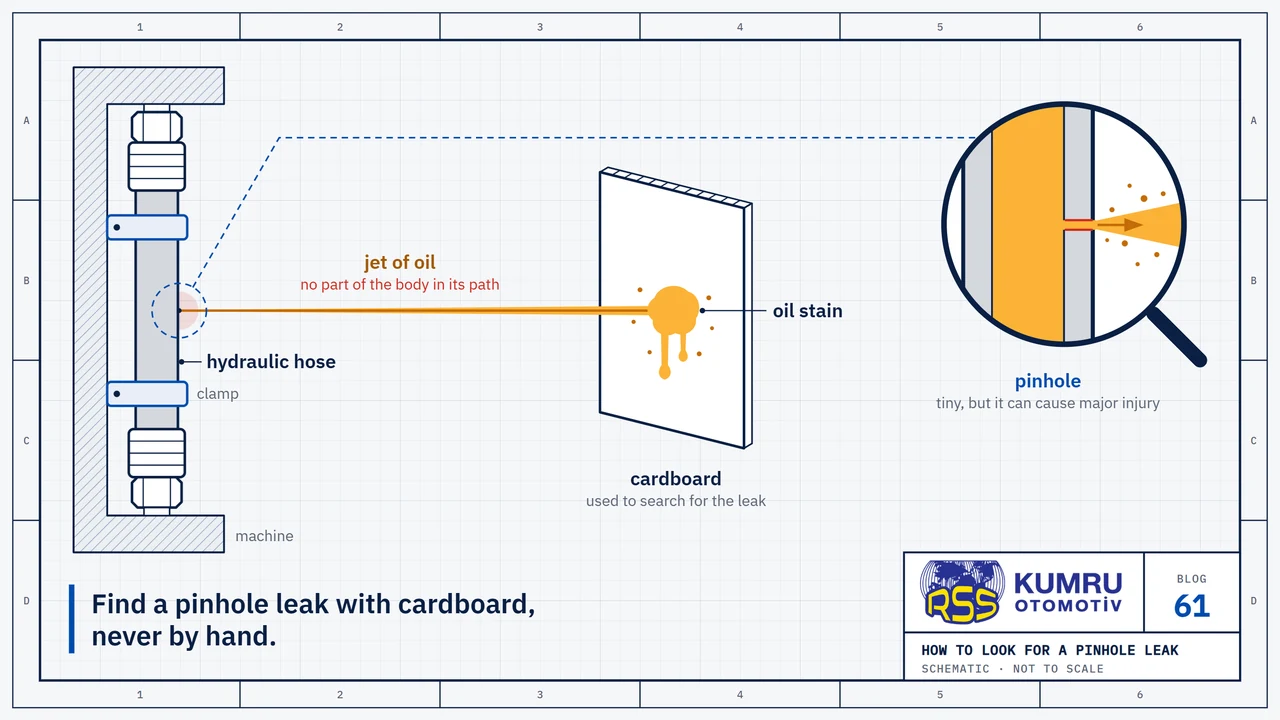
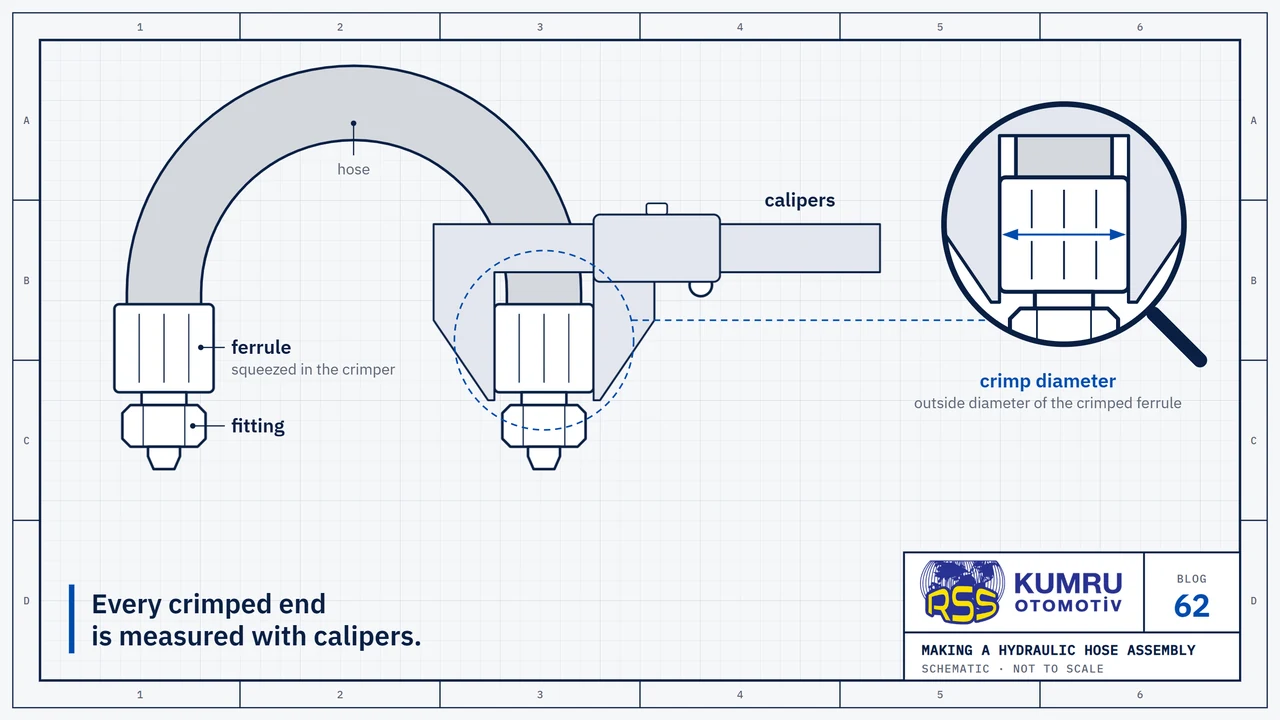
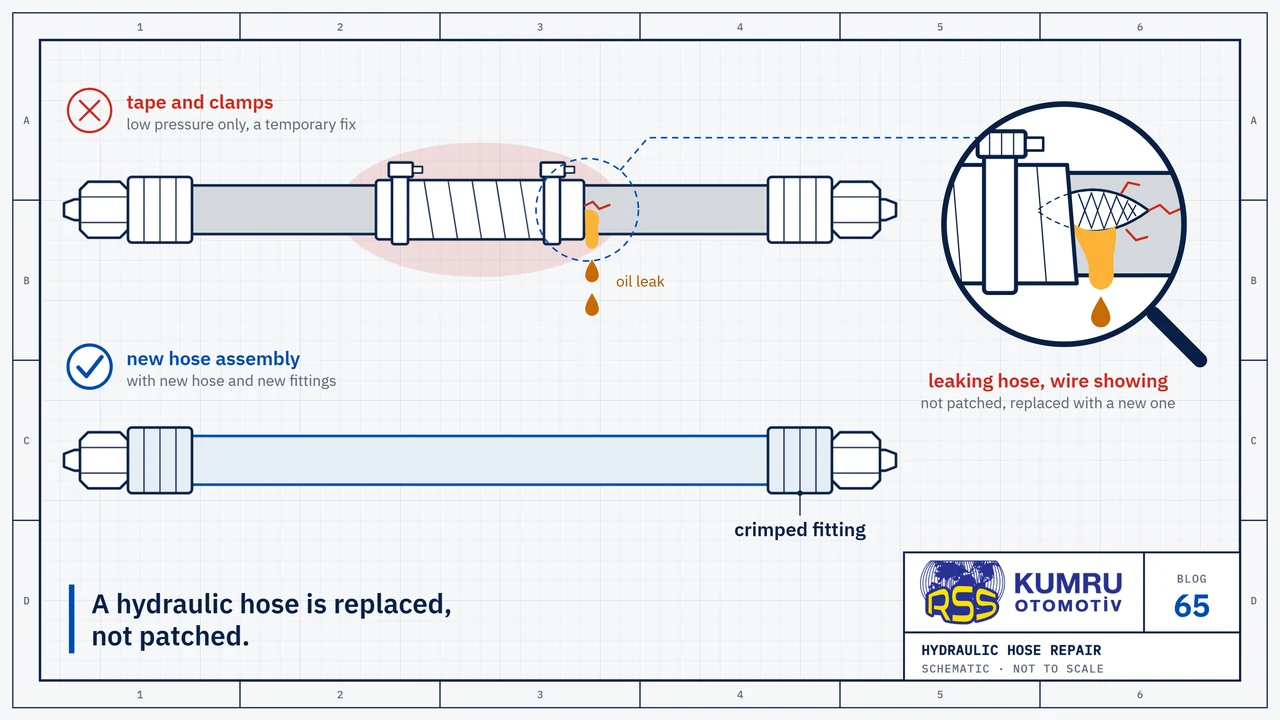
High-pressure hydraulic hose is outside this group: it is not clamped, and a fitting is crimped onto each end. Crimping faults are listed in the hydraulic hose failure article.
Can a hose clamp be reused?
A new hose gets new clamps, and an ear or crimped clamp that has been taken off is replaced, not refitted. SOLAS gives the reason: “Clamps are not expensive, so it is good practice to fit new ones at the same time as new hoses.” An old clamp, it adds, may have been distorted in coming off.
Nissan has the old hose discarded with its clamps, and Volvo’s crimped clamps are cut off. BMW draws a finer line. If the hose sits correctly, the existing ear clamp is crimped tighter; if not, a new one is fitted.
How is a clamp positioned and tightened?
A new clamp of the same type sits just behind the bulge on the fitting and is closed to a torque or to a dimension.
- Clean the fitting. SOLAS uses fine sandpaper or emery cloth; Nissan an alcohol wipe.
- Seat the clamp behind the bulge. Push the hose fully home. The clamp goes behind the bulge, not on it; SOLAS puts it about 6 mm from the hose end.
- Tighten worm-drive and T-bolt clamps to torque. The figure is in the vehicle’s service data. SOLAS warns that over-tightening damages the hose.
- Crimp an ear clamp to dimension. The ear is closed to the size the maker specifies.
- Check again hot. At operating temperature, look for leaks and go over the worm-drive clamps once more.
Sources
- SOLAS (Ireland), “Trade of Motor Mechanic, Phase 2 Course Notes, Module 3 Unit 3: Cooling System (Revision 3.0)”, Irish apprenticeship course notes for motor mechanics, November 2013; the copy on archive.org; clamp types and the hose replacement steps.
- Pierce Manufacturing, “Custom Chassis Operation & Maintenance Manual (Part No. PM-C-OM011-0105)”, operation and maintenance manual from a maker of fire-apparatus chassis, 2005; the copy on archive.org; pages 4-9, 4-10 and 4-14.
- Volvo Trucks, “Fleet Improvement S3779: CAC Crimped Clamp Replacement”, service campaign bulletin, November 2023; from the NHTSA archive; 2023–2024 Volvo VN with D11 and D13 engines.
- Nissan, “Technical Bulletin NTB13-071: 2013 Pathfinder; CVT Fluid Leak at Cooler Hose”, service bulletin, 19 July 2013; from the NHTSA archive; 2013 Nissan Pathfinder, transmission oil cooler hose.
- BMW Motorrad, “SIB 13 01 24: Service Action: Fuel Line Hose Clamp”, service bulletin with its repair instruction, 12 February 2024; from the NHTSA archive; K 1600 GT, GTL and B motorcycles.
- Opelim.net forumu, “radyatör hortum kelepçesinin gevşemesi”, forum thread (in Turkish), 2 December 2020; one owner's field account, not a manufacturer document.
Sources were checked again on October 13, 2026.
RSS Kumru Automotive
RSS Kumru Automotive was founded in 1990 and specialises in hydraulic systems and fluid management. Our range includes hydraulic hoses, hydraulic pipes and fittings.
Brand names and OEM reference numbers are used for identification and compatibility information only.