Can you repair a hydraulic hose? When a repair is acceptable and when it is not
- Author
- Selami Kumru
- First published
- First published:
- Last updated
- Last updated:
- Reading time
- 6 min read
- Category
- Hydraulic hoses
The body of a hydraulic hose is not repaired and not spliced: a hose that leaks, blisters or shows its wire is replaced. The only proper repair is a new assembly made with new hose and new ends; in machine hydraulics, under the German safety rule, the old ends are not reused either. Tape and clamps are an emergency measure for low-pressure hose until the hose is changed.
Short answer
- Hose body: under DGUV’s rule a damaged hydraulic hose assembly is neither repaired nor rebuilt from used parts.
- Splicing, shortening: no new assembly is made from used hose, so no cutting back and re-crimping.
- Ends: DGUV keeps used ends out of a new assembly too. The FAA’s aircraft circular accepts a reusable end on new hose, with a pressure test.
- In the field: clamps and tape on low-pressure hose only, until a permanent repair.
Can you repair a hydraulic hose?
No. A damaged hydraulic hose is not patched; it is replaced. DGUV, the German statutory accident insurance body, puts it in one sentence in its rule on hydraulic hose assemblies:
“Damaged hydraulic hose assemblies must not be repaired or put together again from old, previously used parts!”
DGUV Regel 113-020, October 2017 (in German)
The rule leaves no room for carrying on either: a defect found at inspection that impairs safety is put right at once, or the machine stays out of use until it is repaired. The UK regulator HSE counts “makeshift repairs” and failing to replace damaged hoses among operator errors on farm machinery. Which signs count as a defect is covered in the hose failure signs article.
Can you splice a hydraulic hose?
No. Cutting out the damaged length and joining the pieces with a union means making new assemblies out of used hose, and the DGUV rule does not allow that: a hose assembly must not be made from hose or fittings that have already been part of a hose assembly.
The rule never mentions splicing; applying the sentence to it is our inference. The US Federal Aviation Administration’s aircraft maintenance circular AC 43.13-1B points the same way: for the body of a flexible hose it gives no patch or joint, only replacement with a hose of the same type, size and length.
How do you repair a hydraulic hose, and can the old ends be reused?
A hydraulic hose is repaired by having a new assembly made with new hose and new ends, not by mending the old one. The DGUV rule bars used fittings as well as used hose. The rule recommends crimped fittings and says screw-type fittings should be avoided because their assembly is not safe enough. Cutting a used hose back and crimping on a fresh end fails the same rule.
Practice goes both ways. In a 2021 tractor forum thread, one member had a parts store put a new fitting on a shortened hose; another warns that new fittings on old hose may not last beyond the short term. The DGUV rule sides with the second.
Aircraft practice differs. Under the FAA circular, a hose with a “swaged-end type fitting” is replaced by a complete new hose assembly; where the fittings are “of the reusable type”, a replacement hose may be fabricated. The circular’s assembly figure shows an end that screws onto the hose, and its caption says the instructions “can be used for low pressure hydraulic fluid, and oil line applications”. A test follows:
“When a flexible hose has been repaired or overhauled using existing hardware and new hose material, before the hose is installed on the aircraft it is recommended that the hose is tested to at least 1.5 system pressure.”
FAA Advisory Circular AC 43.13-1B, Change 1, 27 September 2001
What the circular calls a repair is therefore not a patch: the hose is new, only the hardware is old. It is written for aircraft and applies “only when there are no manufacturer repair or maintenance instructions”. The DGUV rule, written for machinery, does not accept old ends even on new hose.
When is a hydraulic hose repair kit, tape or a clamp acceptable?
A repair kit, tape and clamps make a temporary repair, acceptable where standard maintenance cannot be done and only until a permanent repair follows. US Army field manual FM 4-30.31 of 2006, on recovery and battle damage repair, describes kits issued to crews and maintainers. Hose clamps, tape and an elastomer compound “can be used to repair low-pressure rubber hoses”; the maintainer’s fittings serve to “repair low- to high-pressure lines on most equipment”.
The manual also sets limits. Its first principle: “Ensure standard maintenance practice is always the first consideration.” High-risk repairs, those that could endanger people, are permitted only in emergencies and with the unit commander’s authorisation. A component repaired this way is tagged, and the permanent repair follows once the vehicle is back. Tape round a cracked low-pressure line “usually stops the leak until a permanent repair can be performed”.
The manual was not written for civilian workshops; the yardstick we take from it is our inference: a patch on low-pressure hose, marked, and only until the hose is changed. In the 2021 thread, one cut-back hose was held on its fitting with two clamps, a very temporary fix to get the machine back to the barn. At a workplace the DGUV rule does not accept even that: no use until the defect is put right.
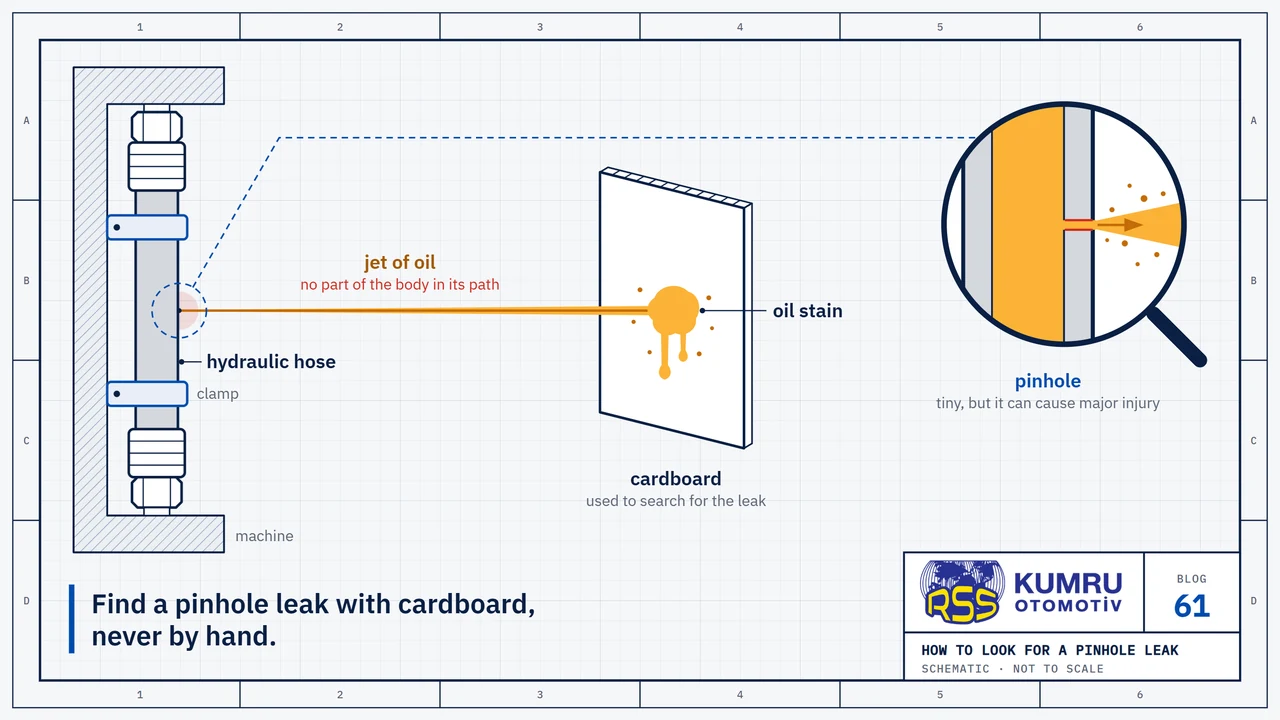
Do not look for the leak with your hand, and do not start work before the pressure is released. HSE: “Even pinprick punctures in pipework can cause major injury.” How oil under pressure gets through skin, and what to do at once, is covered in the fluid injection injury article.
Can a power steering hose be repaired?
A power steering pressure hose is a high-pressure hydraulic hose, and like any other it is not patched or spliced. Trade magazine Brake & Front End describes high-pressure hoses built “to handle up to 1,500 psi” and low-pressure return hoses of a type “tested only to 250 psi”. On leaks it is plain: “Any leak in a hose assembly is a problem that should be addressed.” A bulge means “complete failure is imminent”.
The reason is in the same article: power steering fluid can be flammable, and losing the assist can cause an accident. We found no vehicle maker’s document with a repair rule for steering hoses in particular; the general rules above are what we have. Replacement and bleeding are covered in the truck power steering hose article.
Repair or replace: how do you decide?
A hydraulic hose with a failed body or a failed end is replaced. Under the DGUV rule neither used hose nor a used end goes into the new assembly.
| Situation | Decision | Basis |
|---|---|---|
| Leak, crack, blister or exposed wire in the body | New hose assembly | DGUV |
| Damage near one end, hose long enough to shorten | No cutting back and re-crimping; new assembly | DGUV |
| Crimped or swaged end | End is not reused; new assembly | DGUV, FAA |
| Reusable end | Machinery: new ends (DGUV). Aircraft: new hose may be made up on the old ends, then pressure tested (FAA) | DGUV, FAA |
| Leak in a low-pressure hose in the field | Clamps and tape; marked, hose changed at the first chance | FM 4-30.31 |
The DGUV rule is written for machines and vehicles at workplaces in Germany, the FAA circular for aircraft and FM 4-30.31 for military vehicles. On your own machine, the maker’s service data comes first.
Sources
- Deutsche Gesetzliche Unfallversicherung (DGUV), “DGUV Regel 113-020: Hydraulik-Schlauchleitungen und Hydraulik-Flüssigkeiten, Regeln für den sicheren Einsatz”, rule on hydraulic hose assemblies by the German statutory accident insurance body, October 2017; in German; sections 4.1.1 (crimped and screw-type fittings), 4.1.2 (used hose and used fittings) and 4.4.2.1 (defective hose assemblies, no repair).
- Federal Aviation Administration (FAA), “Advisory Circular AC 43.13-1B: Acceptable Methods, Techniques, and Practices, Aircraft Inspection and Repair (Change 1)”, advisory circular on aircraft inspection and repair by the US aviation regulator, 8 September 1998; Change 1 of 27 September 2001; paragraph 9-30 (hydraulic lines and fittings): replacement of flexible lines, kinds of end fitting, pressure test; Figure 9-8 (hose assembly instructions).
- Headquarters, Department of the Army / United States Marine Corps, “FM 4-30.31 (MCRP 4-11.4A): Recovery and Battle Damage Assessment and Repair”, US Army and Marine Corps field manual, 19 September 2006; preface, chapter 6 (repair principles, tagging, fluid line repair) and glossary; copy held by the Internet Archive.
- Health and Safety Executive (HSE), “High pressure fluid injection hazards”, page on agricultural machinery by the UK health and safety regulator; last updated 24 October 2024; list of operator errors.
- Brake & Front End (Babcox Media), “Andrew Markel: Power Steering Hose Replacement and Problems”, US trade magazine article, 6 October 2021; read from the Internet Archive copy of 14 June 2024 because the magazine's site did not allow an automated download.
- TractorByNet, “I have a leak in my hydro hose by the fitting - can I replace the end?”, forum thread, 1 February 2021 (first page only; last post read is of the same day); field account, not a manufacturer's instruction.
Sources were checked again on October 13, 2026.
RSS Kumru Automotive
RSS Kumru Automotive was founded in 1990 and specialises in hydraulic systems and fluid management. Our range includes hydraulic hoses, hydraulic pipes and fittings.
Brand names and OEM reference numbers are used for identification and compatibility information only.