How to splice a brake line, and can you use a compression fitting on one?
- Автор
- Selami Kumru
- Первая публикация
- Первая публикация:
- Последнее обновление
- Последнее обновление:
- Время чтения
- 6 мин чтения
- Категория
- Стальные трубки
Эта статья пока доступна только на английском языке.
A compression fitting does not belong on a brake line. When a rusted or crushed section has to go, the line is cut back to sound tube, both ends are flared and joined with a flared union. UK inspection manuals rule out compression joints with separate ferrules on hydraulic brake lines; in the US state of Virginia a brake tube repaired that way is grounds for rejection at inspection.
Short answer
- Compression fitting: not on a brake line. Only the squeezed ferrule holds the tube.
- Proper splice: cut back to sound tube, flare both ends, join them with a flared union.
- Heavy vehicles: the UK manual accepts no repair to a hydraulic brake pipe.
- Copper tube, flexible hose, brazing: none is a way to join a brake line.
Can you use a compression fitting on a brake line?
No. The three official inspection texts we opened all say so, each for its own country and class of vehicle. The UK’s Driver and Vehicle Standards Agency (DVSA) states the rule for cars and passenger vehicles in two sentences:
“Repairs to the pressure lines of hydraulic brake systems are unacceptable unless suitable connectors are used. Compression joints of a type using separate ferrules are not suitable.”
DVSA, MOT inspection manual: cars and passenger vehicles, section 1.1.11
The manual does not describe a suitable connector; it tells the tester to fail an unacceptable repair. The agency’s heavy goods vehicle manual is stricter: it accepts a sound sleeved repair to a metal air brake pipe, but no repair to a hydraulic brake pipe. Inadequate repairs and unsuitable joint fittings are a major deficiency there.
In the US, the Virginia State Police inspection regulations list the reasons to reject passenger vehicles and vehicles up to 10,000 pounds (GVWR). One reads: “Any hydraulic brake tubing has been repaired using a compression fitting.”
The American trade magazine MOTOR goes further: “it’s illegal to use them on brake lines”. It cites the federal motor vehicle safety standards (FMVSS) without naming a section. That is a magazine’s statement, made for the US. For Turkey we found no official document that rules on the point.
How does a compression fitting hold the tube, and how does a flare?
In a flared joint the end of the tube sits behind the nut; in a compression joint only the squeezed ferrule holds the tube. In MOTOR’s account, the threads of a flared union clamp the shoulder of the flared line, and the shoulder matches the fitting so that “the line cannot pull through the fitting nut”.
In a compression union the same force bears on a movable ferrule, which pinches onto the outside of the line.
“Since the line’s outside diameter is no larger than the inside diameter of the fitting nut, there’s no fail-safe to prevent separation.”
MOTOR magazine, June 2014
MOTOR adds that an overtightened nut deforms the ferrule and the joint fails; excessive vibration or internal pressure can do the same. Its figures: compression fittings are rated for maximum pressures of 150 to 1200 psi, depending on size and design. Hydraulic brake lines and fittings are engineered for working pressures of up to 3000 psi, with burst strength of approximately 17,000 psi.
MOTOR finds compression fittings quick and easy on fuel and cooler lines. The fuel it means is gasoline; on a diesel’s high-pressure pipe a coupling in the middle is not a repair.
How do you splice a brake line when one section has to go?
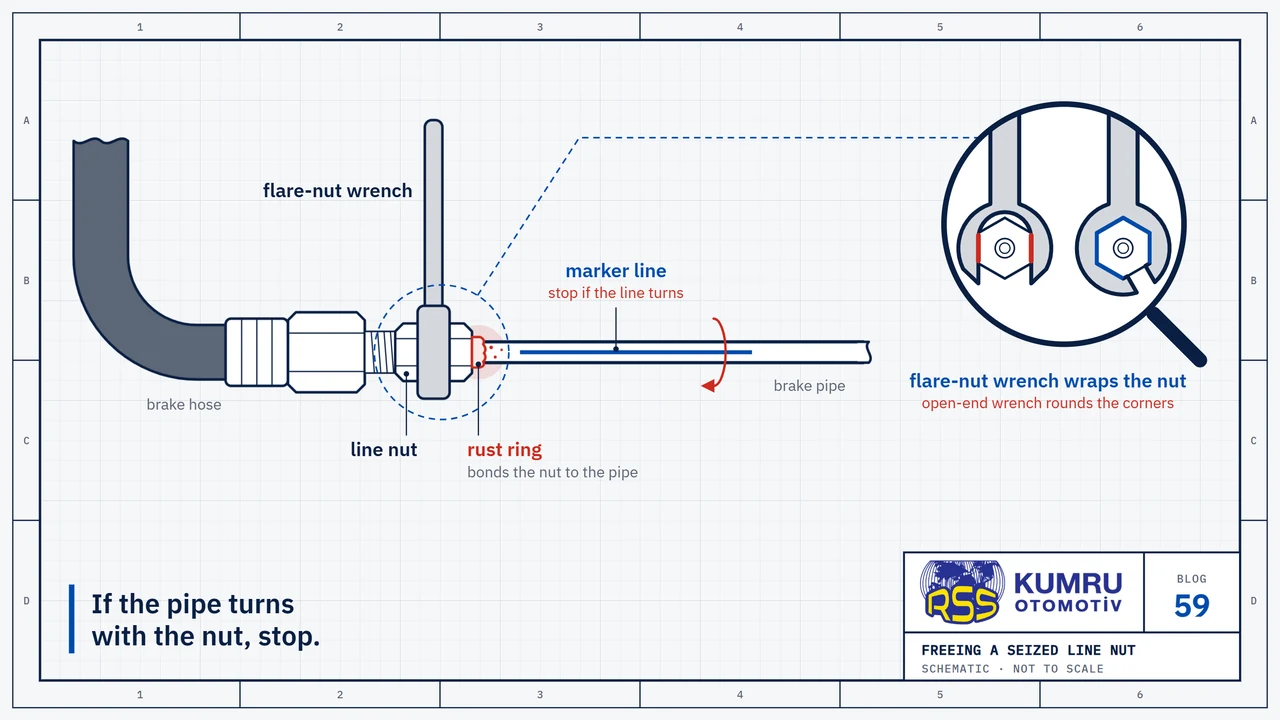
A splice means flaring the two tube ends and joining them with a flared union. MOTOR’s rule: “Only flared fittings are approved for brake line use.” The steps are from its 2014 and 2018 articles. Freeing a seized nut is covered in the article on seized line nuts.
Do not fit a compression fitting to a brake line. MOTOR’s reason: “They may fail, just when you need them the most.” In the DVSA car manual a leaking pipe or connection on a hydraulic brake system is a dangerous defect.
- Go back to sound tube. The old tube has to be sound before it is flared: “When in doubt, cut it out.”
- Cut square and deburr. Use a tubing cutter, perpendicular to the line. Ream the bore and chamfer the outer edge; the chamfer keeps the tube from splitting as the flare forms.
- Slide the nut on first, facing the right way.
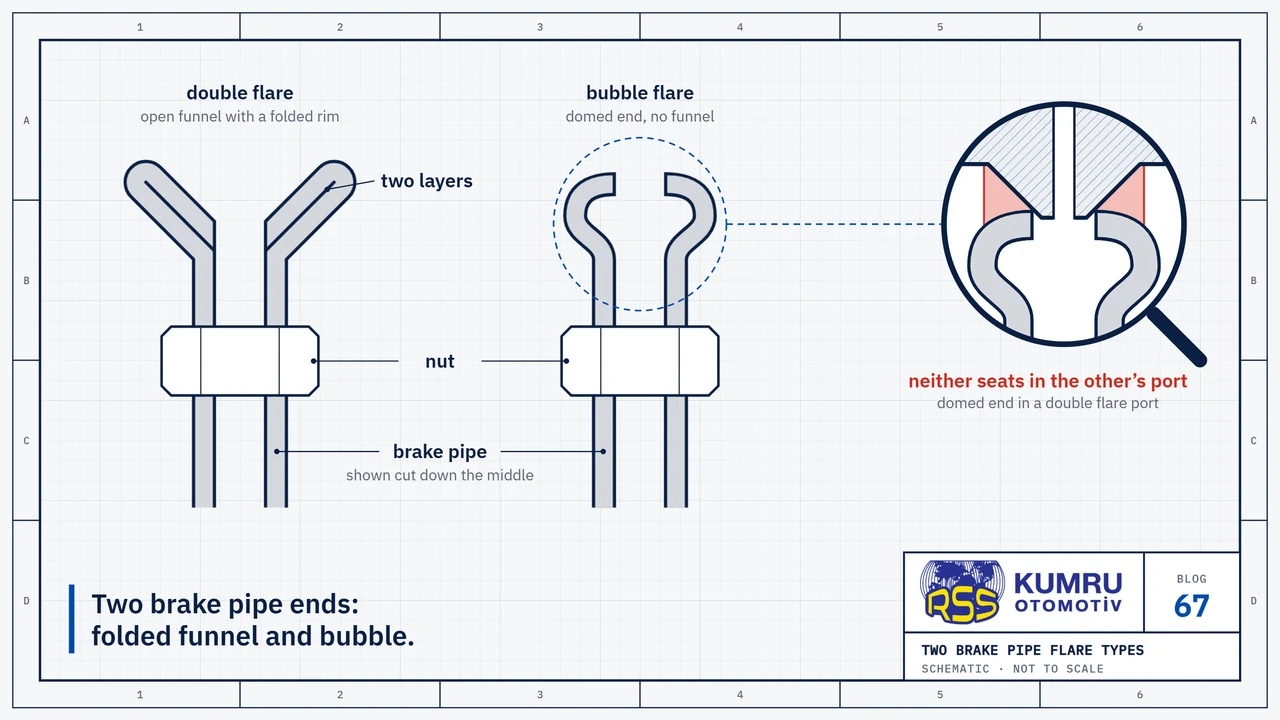
- Form the flare that matches the union. A double-flare end does not go into a bubble-flare union; see the article on flare types.
- Inspect the flare. A cracked or lopsided flare is cut off and made again.
- Assemble the union dry. The seal is metal-to-metal; thread sealant is “neither required nor allowed”.
- Bleed the system. ABS vehicles may need extra scan-tool procedures; check the manual.
When should the whole line be replaced?
Damage in more than one place means a new line, not a splice. MOTOR’s 2018 column says a complete replumb may make more sense and be more efficient in the long run, especially with several damaged areas. Its arithmetic: “When fewer fittings are used, there are fewer opportunities for leaks.”
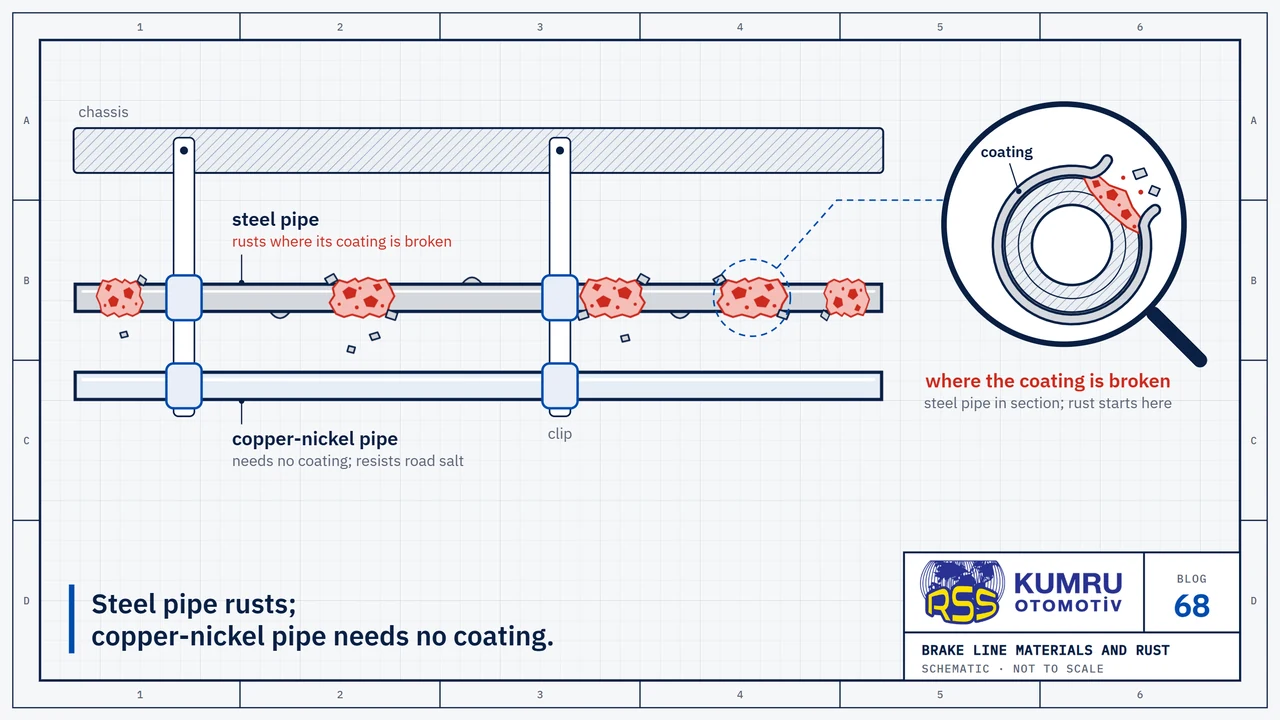
The 2014 article says where rust hides: salt accumulates on top of the line bracket, where it is easily missed. Look there before cutting. The DVSA car manual gives a limit: chafing, corrosion or damage that reduces a rigid brake pipe’s wall thickness by 1/3 (approximately 0.25mm for typical hydraulic brake pipe) justifies rejection.
Can copper tube or a flexible hose bridge the gap?
Neither copper tube nor a flexible hose goes into the middle of a brake line. On copper, MOTOR writes:
“Regular copper tubing is forbidden. Not only does it lack the requisite burst pressure, it tends to ‘work-harden’ when exposed to vibration.”
MOTOR magazine, June 2014
Copper-nickel alloy is a different material; the same article says several high-end makes fit it at the factory. A flexible brake hose cannot stand in for rigid line: by its nature it flexes, which costs a little effective brake pressure. Brazing is no answer either: the DVSA heavy goods vehicle manual does not accept a pipe repaired in situ by brazing.
How should the new section and the union be secured?
The new section follows the old line’s rules. The Virginia regulations list three: brake tubing must be long and flexible enough to take all normal motions of the parts it is attached to without damage; be secured against chafing, kinking or other mechanical damage; and not touch the exhaust or any other source of high temperature.
A pipe that is inadequately clipped or supported is a minor defect in the DVSA car manual and a major deficiency in the heavy goods vehicle manual. No source says where the union itself should sit. Our conclusion from what they say about the pipe: the union, too, belongs away from the exhaust, held by clips and clear of moving parts.
In what order should a mechanic decide?
- Look at the whole vehicle. MOTOR notes that other brake components may be rust-damaged as well. Find out first whether the bleeder valves will open.
- Count the damaged places. Several: replumb the line.
- Check the class of vehicle. On a heavy vehicle the UK manual accepts no repair to a hydraulic pipe.
- Find sound tube. If the old tube is not sound, it gets no flare.
- Join with a flared union. No compression fitting, copper tube, flexible hose or brazing.
- Secure it, bleed it, check for leaks.
Источники
- MOTOR Magazine, “Them's the Breaks: Brake (and Other) Line Repairs”, trade magazine article by Sam Bell, June 2014 (date from the PDF page footers; the web page was published on 11 December 2015); how flared and compression joints hold the tube, pressure ratings, copper tubing.
- MOTOR Magazine, “Brake Shop: Brake Line Repairs”, Brake Shop column of a workshop trade magazine, April 2018 (page published 5 April 2018); how much of the line to replace, cutting back to sound tube, number of fittings.
- Driver and Vehicle Standards Agency (DVSA), “MOT inspection manual: cars and passenger vehicles, section 1: Brakes”, UK official inspection manual for cars and passenger vehicles; published 20 May 2018, last updated 1 June 2026; section 1.1.11, rigid brake pipes: rule on repairs, wall-thickness limit, defect rows.
- Driver and Vehicle Standards Agency (DVSA), “Heavy Goods Vehicle Inspection Manual”, UK official inspection manual for heavy goods vehicles; latest entry in the revision record 1 April 2026; section 59 (brake systems and components): rule on repairs, rows for brake pipes and hoses.
- Virginia Department of State Police, “Virginia Administrative Code 19VAC30-70-80: Service brakes (Motor Vehicle Safety Inspection Regulations)”, official vehicle safety inspection regulations of the US state of Virginia; part for passenger vehicles and vehicles up to 10,000 pounds (GVWR); latest amendment effective 1 February 2024.
Дата повторной проверки источников: 13 октября 2026 г.
RSS Kumru Automotive
Компания RSS Kumru Automotive основана в 1990 году и специализируется на гидравлических системах и системах управления жидкостями. Our range includes brake pipes, fuel pipes, hydraulic pipes and injector lines.
Названия марок и номера OEM используются исключительно для идентификации и указания совместимости.