Can a cracked fuel or hydraulic line be repaired?
- Author
- Selami Kumru
- First published
- First published:
- Last updated
- Last updated:
- Reading time
- 6 min read
- Category
- Injection and fuel lines
A cracked injector line (the steel high-pressure line to an injector or fuel rail) is replaced, not repaired. Welding, brazing and cut-in unions are tried in the field, but none of the manufacturer documents we could open allows them. Perkins has one instruction for a leaking high-pressure line: replace it. On supply, return and hydraulic lines the pressure and the reasoning differ. The answer hardly does.
Short answer
- Injector and common-rail lines: a cracked line is replaced with a new one. That is the manufacturer instruction.
- Welding, brazing, a union in the middle: forum posts describe emergency measures. Nobody calls one permanent.
- Fuel supply and return lines: the pressure is low. A cracked hose is still replaced and a loose clamp tightened.
- Hydraulic pipes: the line maker HANSA-FLEX says a used hydraulic line must not be repaired, by welding or otherwise.
What do manufacturers say about a cracked injector line?
On its fuel system service page the engine maker Perkins has one sentence for a leaking high-pressure line:
“If high-pressure fuel lines are leaking the fuel lines must be replaced.”
Perkins, How to Service Fuel Pumps
The same page gives the reason: “Deformed or damaged high-pressure fuel lines are a point of weakness and a potential cause of failure.” Cummins took the same route when injector supply tubes on its X12 engine cracked. According to the recall report filed with the US regulator NHTSA, they “will be replaced with new fuel tubes”, with vibration isolators added.
Why does welding or brazing not hold?
A torch reaches only the outside of the tube; the fatigue strength of a high-pressure line is decided at its inner wall. Bosch’s reference book on diesel injection describes these lines as seamless precision steel tubing that has to withstand the system’s maximum pressure and very large pressure fluctuations. It puts injection pressure at 200 to 2,200 bar on the nozzle side.
“The primary factor determining the high-pressure line’s compression-pulsating fatigue strength is the surface quality of the inner walls of the lines, as defined by material and peak-to-valley height.”
Bosch, Diesel Engine Management, p. 170
For applications of 1,400 bar and over, Bosch adds, the lines are also prestressed. Before fitting they are “subjected to extremely high pressures (up to 3,800 bar)”, then the pressure is suddenly relieved. That compresses the inner-wall material and strengthens the line from inside. Perkins says its own lines “are formed to a specific shape and then strengthened by a special process”.
Bosch does not mention welding or brazing; what follows is our own conclusion. A patch applied from outside does not reach the inner wall, and the heat passes over strength that was put in cold. The vibration and assembly strain named in the Cummins report are still there afterwards.
Would a union in the middle, or a repair kit, do the job?
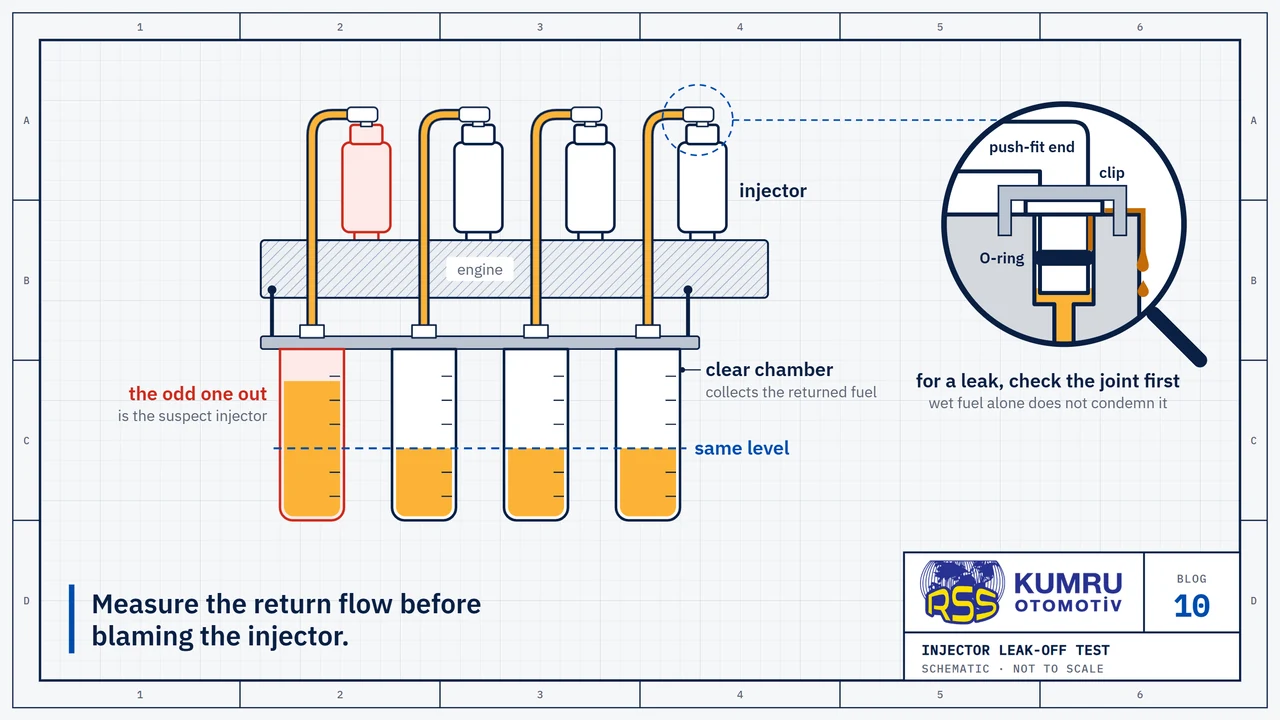
Cutting the line at the crack and fitting a compression union appears in none of the manufacturer documents we opened. Bosch states that the length, diameter and wall thickness of a high-pressure line “all affect the injection process”. A union changes those dimensions at that point and adds two more sealing faces. That is our inference, not Bosch’s statement.
Forum opinion is divided. In a 2003 thread on a boat owners’ forum, one poster writes that an inline compression fitting “might work for a little while but as the pressures are very high will probably leak fairly quickly”. Another says high-pressure stainless fittings would work in the right size. The thread also mentions kits sold for emergency injector pipe repairs. We found no engine or injection-system maker that approves such a kit.
How long do the field fixes last?
In the forum accounts we read, nobody calls a temporary fix permanent. On the same forum one poster reports brazing a sleeve onto an injector pipe “in an emergency”. Another wrapped a split pipe in plastic fuel pipe, slit lengthways and held with about four hose clips. The engine ran at half revs for about half an hour and stopped when the plastic went soft; by then he was back in port.
On an earthmoving forum in 2015, a poster recalls: “We used to braze injector lines, seemed to work good in the short run at least.” The first reply in that thread: “Just replace the line”. Several boat-forum posters end at the same point: “In reality the answer is to carry a spare set of pipes.”
Where the engine is named, these accounts come from older engines with mechanical injection pumps. On common rail, Perkins notes, the high-pressure lines “are constantly charged with high pressure”.
Are supply, return and hydraulic lines different?
On supply, return and hydraulic lines the pressure is different; the rule is not very different. On the low-pressure side the line itself is another kind of part: Bosch notes that besides metal tubes, “flexible, flame-retardant tubes reinforced with braided-steel armoring can be used in the low-pressure stage”. Perkins: “Replace hoses that are cracked or soft and tighten any loose clamps.” We found no manufacturer document allowing a cracked steel supply or return pipe to be soldered or brazed.
For hydraulics, a line maker states the rule outright. HANSA-FLEX describes people sealing leaking hydraulic lines with clamps, tape, shrink tubing “or even welding”. According to the company, under DIN EN ISO 4413 used hydraulic hose lines “must not be repaired”. It continues:
“The same applies to hydraulic pipelines. Welding repairs are not permitted here either, and are accordingly prohibited.”
HANSA-FLEX, 2 September 2024
The article does not distinguish pressure lines from return lines. A tractor forum thread advises having a hydraulic shop make up a simple line and buying a complex one from the machine’s maker. One poster there cut out a rubbed-through section and joined the ends with hydraulic hose; the line maker’s rule prohibits repairs to a used line.
What should you do if it happens on the road?
If the leak is on a high-pressure line, stop the engine and do not drive on. We know of no temporary repair you can rely on to get home. The best result we read about lasted half an hour, on an old boat engine.
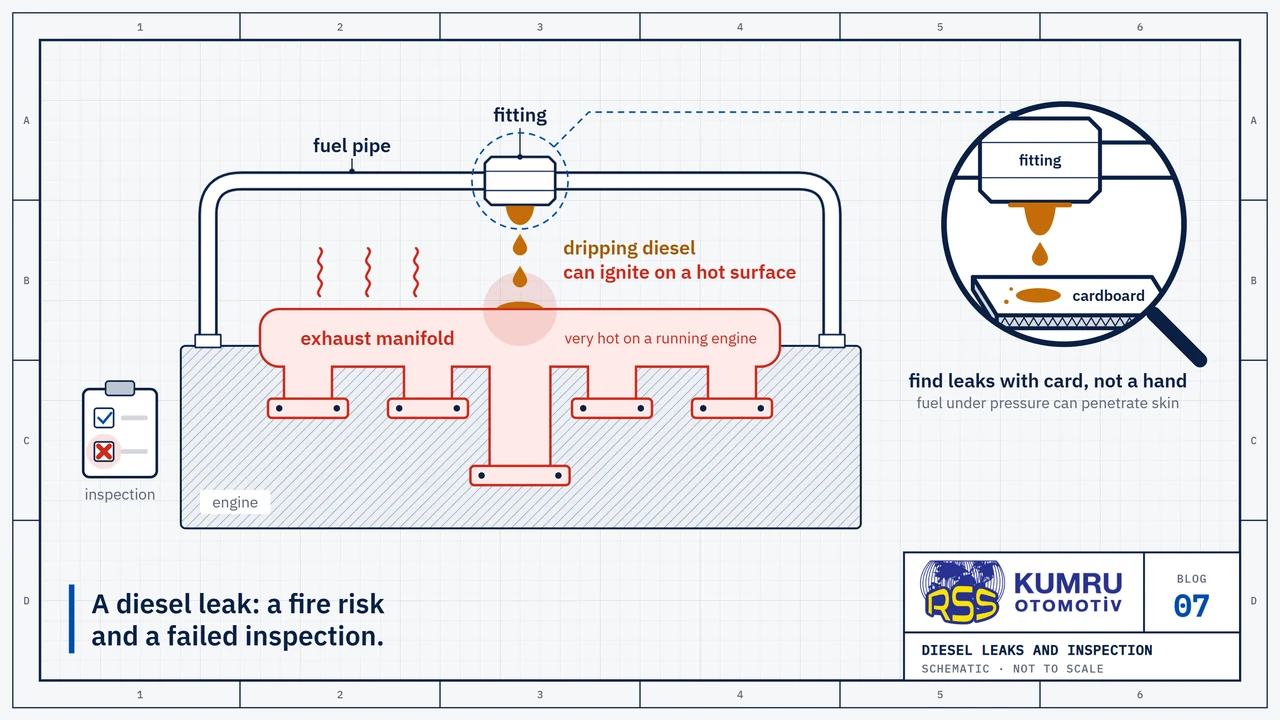
Do not feel for the leak by hand, and do not run an engine that is leaking fuel. Perkins: “Do not operate the engine with a fuel leak. Leaks can cause fires.” On one X12 vehicle Cummins “identified a leak of the #5 cylinder fuel tube as the cause of the fire”. HANSA-FLEX warns that a fine jet of hydraulic fluid “can penetrate or puncture the skin”. Before work on its fuel lines, Perkins wants the engine stopped for 60 seconds on high-pressure fuel systems and for 10 minutes on electronic 1200, 900 and 400 Series engines.
- Identify the line. Engine stopped, with a lamp: injector or rail line, hose, or hydraulic line?
- If it is a high-pressure line, have the vehicle recovered or the line replaced on the spot. A leak at the nut with no crack is a different diagnosis; Perkins warns against over-tightening to stop it.
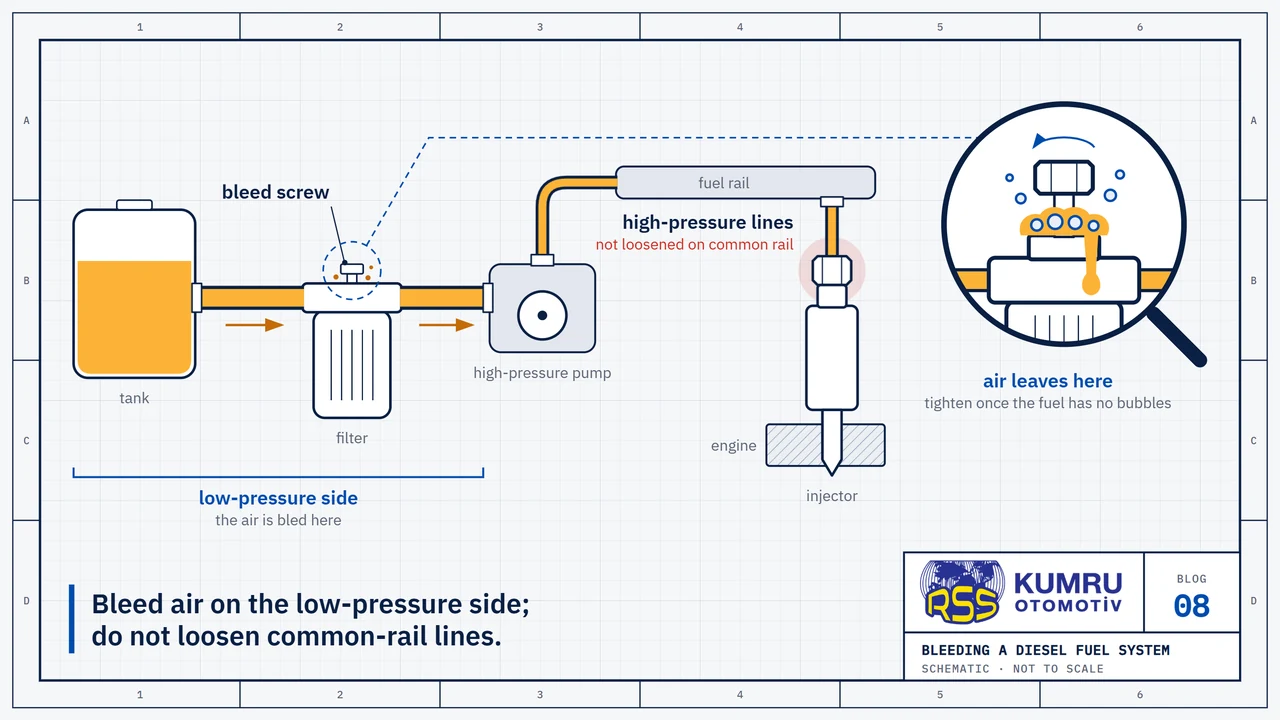
- If it is a hose or a clamp, tighten the clamp and replace the cracked hose. A low-pressure leak lets air into the fuel system, Perkins notes, so purge it before starting.
- If it is a hydraulic line, do not have it patched. Have it replaced.
- Order the new line by its OE number and refit every clamp. If it cracks too, look at the clamps and the alignment first.
Sources
- Perkins, “How to Service Fuel Pumps”, engine maker's service information page, undated.
- Bosch / Springer, “Diesel Engine Management: Systems and Components (ed. Konrad Reif), pp. 169-170”, reference book, 2014; pp. 29, 79 and 169-170, read in Google Books partial view.
- NHTSA, “Part 573 Safety Recall Report 22V-120”, safety recall report, 2 March 2022; injector fuel supply tubes of the Cummins X12 engine.
- HANSA-FLEX, “"No clue - no concern": Repairs to hydraulic hose lines... are they allowed?”, technical article by a hydraulic line maker, 2 September 2024; written by a trainer at the International Hydraulics Academy.
- YBW Forum (Practical Boat Owner), “broken injector pipe”, reader forum thread, 4-5 June 2003; used as field opinion, read in the Internet Archive copy.
- Heavy Equipment Forums, “Leaking Injector Line”, heavy equipment forum thread, 15-16 December 2015; used as field opinion.
- TractorByNet, “Make hydraulic line”, tractor forum thread, June 2014; used as field opinion.
Sources were checked again on October 8, 2026.
RSS Kumru Automotive
RSS Kumru Automotive was founded in 1990 and specialises in hydraulic systems and fluid management. Our range includes close to 700 injector line references, most of them for Caterpillar, Mercedes-Benz, Ford / New Holland and Scania engines.
Brand names and OEM reference numbers are used for identification and compatibility information only.