Cat 3126, C7 or C9 not getting fuel, air in the fuel system: what to check and in what order
- Автор
- Furkan Kumru
- Первая публикация
- Первая публикация:
- Последнее обновление
- Последнее обновление:
- Время чтения
- 6 мин чтения
- Категория
- Caterpillar
Эта статья пока доступна только на английском языке.
A Cat 3126, C7 or C9 that is not getting fuel, loses its prime or has air in the fuel is checked on the low-pressure side, along the fuel’s path: tank and suction line, water separator, transfer pump, filter, the passage in the head, the return. Everything up to the pump is under suction, and a leak there, in Caterpillar’s words, will allow air to enter the fuel.
Short answer
- Suction side: the water separator is under suction. Drain valve, hoses and clamps come first.
- Losing prime: on the 3126 a check valve at the rear of the head holds the fuel.
- Priming: with the priming pump; the fuel lines at the head stay tight.
- Fuel side proven good: next is the HEUI oil side, a separate subject.
What path does the fuel take from the tank to the head?
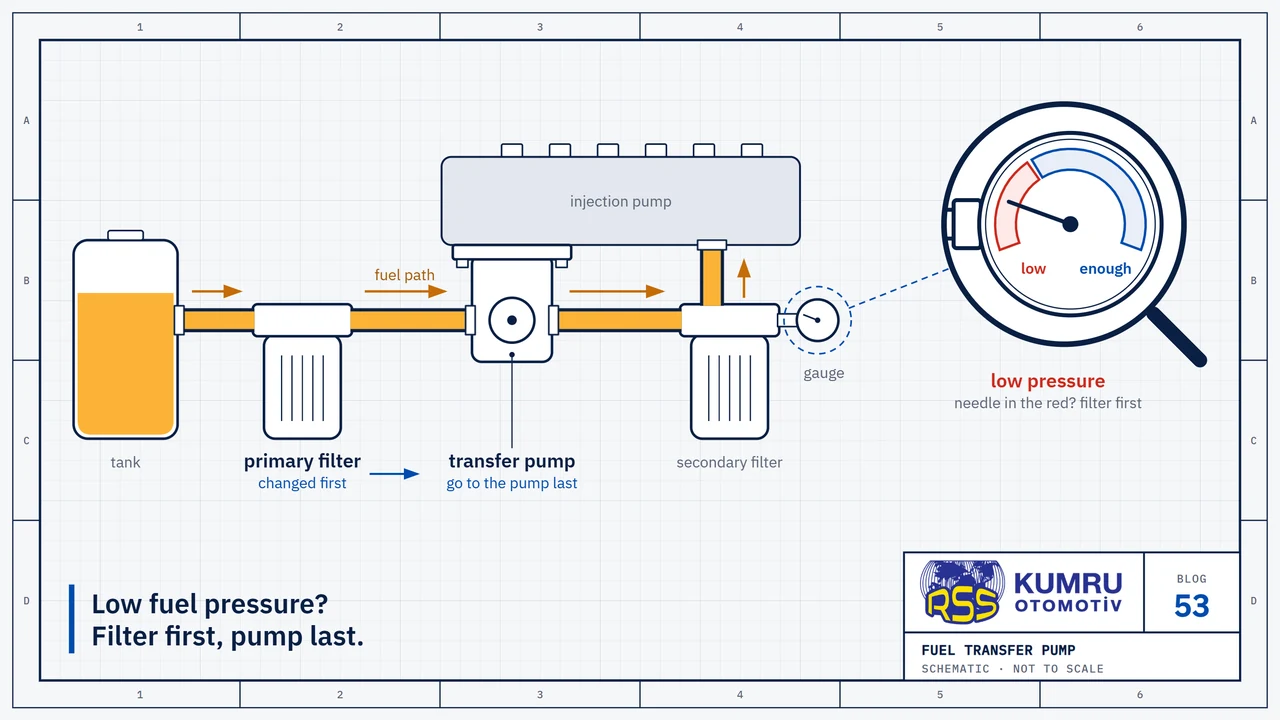
On the 3126, fuel comes from the tank through the primary filter, where fitted, to the transfer pump. The pump sends it to the secondary filter, and a hard line takes it into a drilled passage at the front of the head. The sequence is from a 2002 Caterpillar service training book, which puts the transfer pump “on the rear of the high pressure oil pump”. It also describes the way back:
“The unused fuel and any air exits the cylinder head at the rear and passes through a pressure regulating orifice and a check valve and returns to the fuel tank.”
Caterpillar, Small Engine Fuel Systems course book (LEGV4801-02), September 2002
On the C9 the pump sits in the same place; the priming pump and filter base are at the right front of the engine. We could not open a Caterpillar document describing the C7 this way: the 2009 C7 and C9 on-highway manual gives maintenance steps only. The transfer pump has an article of its own.
Where does air get into the fuel system on a Cat 3126, C7 or C9?
Air gets into the fuel on the suction side, ahead of the transfer pump. In Caterpillar’s 3126B and 3126E manual the water separator is under suction during normal operation, and its drain valve has to be tightened securely to keep air out. The C7 and C9 manual spells out the consequence:
“Detecting leaks is difficult while the engine is running. The primary filter/water separator is under suction. A leak will allow air to enter the fuel. The air in the fuel can cause low power due to aeration of the fuel.”
Caterpillar, C7 and C9 On-highway Engines manual (SEBU8083-09), March 2009
The manual then has the components checked for overtightening or undertightening; the bowl is tightened by hand.
Low power is not the only symptom. A 2012 US Army Research Laboratory report on a failure mode analysis of the C7 lists air in the fuel system, leaking fuel hoses and a faulty fuel pressure regulating valve among the potential causes of stalling at low rpm. Ways of finding a leak are in our article on air in a diesel fuel line.
Why does the engine lose its prime after standing?
On the 3126, the part that keeps fuel in the head with the engine stopped is the return check valve at the rear of the head. Caterpillar’s training book gives it two jobs. Its 0.5 mm orifice holds fuel pressure in a normal operating range of 58 to 75 psi, about 58 to 63 psi at low idle. And: “The check valve prevents the fuel from draining out of the cylinder head and back to the fuel tank when the engine is off.”
The book does not cover fault finding. What follows from the valve’s job is this: on a 3126 that cranks longer the longer it has stood, with a sound suction side, this valve is the next suspect. The 3406E and C15 have a separate article.
How to prime a Cat 3126 engine?
A Cat 3126 is primed with the hand priming pump where fitted, and by cranking where not. Caterpillar’s manual wants the system primed after running out of fuel, storage, or a fuel filter change. The C7 and C9 manual adds a fourth: “The low pressure fuel lines have been disconnected.”
- Priming pump. Open it, work it until a strong pressure is felt, then lock it. The manual warns: “This procedure will require considerable strokes.”
- Start. Start promptly. Crank for no more than 30 seconds at a time; let the starting motor cool for two minutes in between.
- Idle. A rough-running engine stays at low idle until it smooths out. No start: back to the pump.
Without a priming pump, the filter is filled through the plug in the filter base or, where there is no plug, by the starting motor. Both manuals carry the same notice: “Do not loosen the fuel lines at the fuel manifold.” The fittings may be damaged, and priming pressure may be lost.
The C7 and C9 on-highway manual refers to high-pressure fuel lines and warns: “Contact with high pressure fuel may cause fluid penetration and burn hazards.” After the engine has stopped, wait 10 minutes before any work on the fuel lines. For filter work: start switch off, spills wiped up at once.
No fuel at all: how do you find where the flow stops?
The place where the flow stops is found by pumping fuel with the hand primer and opening the circuit one station at a time. We found no manual that sets this out for the 3126; the US Army’s unit maintenance manual for LMTV trucks with the Caterpillar 3116 does. The hose comes off the outlet of the fuel/water separator, and the button on the separator is pressed until a steady stream of clear fuel appears. If fuel comes, the test moves to the pump inlet and outlet, the filter outlet, the tube to the head, then the orifice tube and the pressure regulating valve. Whatever hose, tube or filter stops the flow is replaced. No fuel at the separator: the supply hose and tank pick-up tube are tried with compressed air.
That the order carries over to the 3126, C7 and C9 is our reading, not the manual’s wording: the parts sit elsewhere, but Caterpillar lists them for the 3126 in the same sequence.
Cat 3126 not getting fuel: what order do you check in?
When a Cat 3126 is not getting fuel, start at the tank and finish at the return. The first five stations are from Caterpillar’s 3126B and 3126E manual.
- History. Out of fuel, a filter or line just changed, long parked? Prime first.
- Supply valve and hoses. Valve open. A cracked or soft hose is replaced; loose clamps are tightened.
- Water separator and primary filter. Drain valve tight? The primary filter follows the vehicle or filter maker’s literature.
- Fuel inlet screen. Where fitted, at the transfer pump inlet. Wash it; replace it, or the seal in the pump, if damaged.
- Secondary filter. Never filled with fuel before fitting. For HEUI injectors the manual requires a two micron filter.
- Priming pump and return. Still no fuel: follow the flow station by station. Losing prime: the check valve at the rear of the head.
On Heavy Equipment Forums, the owner of a 3126 that cranked without starting had bubble-free fuel at the return. The reply: “Since you already verified fuel return and no air bubbles, I’d start looking at the HEUI side.” That oil side (high-pressure oil pump, injection actuation pressure) is outside this article.
Источники
- Caterpillar, “3126E Commercial and Truck Engines and 3126B Engine: Maintenance Intervals (excerpted from Operation & Maintenance Manual SEBU7011-17-01)”, excerpt from the operation and maintenance manual, © 2007; copy prepared for Caterpillar's safety site (safety.cat.com); fuel inlet screen, priming, filters, water separator, hoses and clamps.
- Caterpillar, “C7 and C9 On-highway Engines: Maintenance Intervals (Operation and Maintenance Manual excerpt, SEBU8083-09)”, excerpt from the operation and maintenance manual, March 2009; serial prefixes MFF, C7S, C9S, C7W, C9W; the version that refers to high-pressure fuel lines; pp. 215–223.
- Caterpillar, “Small Engine Fuel Systems: Engine Service Training, Instructor Course Book (LEGV4801-02)”, service training course book, September 2002; fuel systems of the 3114, 3116, 3126/3126B/E, C-9 and 3208; slides 112, 116, 118, 149 and 162–166.
- U.S. Army Research Laboratory, “Sensor Technology Baseline Study for Enabling Condition Based Maintenance Plus in Army Ground Vehicles (ARL-TR-5958)”, technical report, March 2012; approved for public release; summarises the failure mode and effects analysis prepared for the Caterpillar C7 engine; Table 1.
- U.S. Department of the Army, “TM 9-2320-365-20-1: Unit Maintenance, M1078 Series, 2 1/2-Ton, 4x4, Light Medium Tactical Vehicles (LMTV), Volume 1 of 5”, US Army unit maintenance manual, June 1998, with Change 1 pages; approved for public release; the truck's engine is a Caterpillar 3116; troubleshooting charts a4 and b1 (pp. 2-74 to 2-79, 2-102 to 2-107).
- Heavy Equipment Forums, “Caterpillar 3126 crank no start”, forum thread, 19 October 2025 to 23 July 2026; used only for what is asked in the field.
Дата повторной проверки источников: 13 октября 2026 г.
RSS Kumru Automotive
Компания RSS Kumru Automotive основана в 1990 году и специализируется на гидравлических системах и системах управления жидкостями. Our range includes more than 1,000 pipe and hose references for Caterpillar engines and machines.
Названия марок и номера OEM используются исключительно для идентификации и указания совместимости.