Cat fuel transfer pump: what it does, how it fails, and where it sits on the 3306, 3406 and C7
- Автор
- Furkan Kumru
- Первая публикация
- Первая публикация:
- Последнее обновление
- Последнее обновление:
- Время чтения
- 6 мин чтения
- Категория
- Caterpillar
Эта статья пока доступна только на английском языке.
On a Caterpillar engine the fuel transfer pump is the low-pressure pump that draws fuel from the tank, moves it through the filters and delivers it to the injection pump or the unit injectors. Its place depends on the engine: bolted to the injection pump housing on the 3306 and 3406, and to the high-pressure oil pump on the C7. When fuel pressure reads low, the manuals we read change the filter first and the pump second.
Short answer
- Job: it pulls fuel from the tank and feeds the engine at low pressure. The surplus returns to the tank, taking air and heat with it.
- Location: 3306, bottom side of the injection pump housing; 3406, same housing, two bolts; C7, bolted to the high-pressure oil pump.
- Symptoms: low power, stalling, misfire, cranking without starting. None belongs to the pump alone.
- Order: fuel and filters, lines, pressure reading, pump last.
What does a fuel transfer pump do?
The transfer pump runs the low-pressure side of the fuel system. In the US Army’s maintenance manual for the Caterpillar D7G tractor (engine: 3306), it pulls fuel from the tank through the primary filter and the priming pump check valves, then pushes it through the secondary filter to the fuel manifold in the injection pump housing. The pumping spring inside the pump keeps system pressure at 25–42 psi (172–290 kPa).
The pump delivers more than the engine burns. On the 3306 a constant bleed orifice sends the surplus down the return line to the tank, and the manual says why: “This helps keep the fuel cool and free of air.” Unit injector engines work the same way. The Army’s operator’s manual for the C15-powered M977A4 truck says the excess flow cools the injectors, and adds: “The excess fuel flow also purges the air from the fuel system.” The 3208 and 3304 are covered in the article on their fuel lines.
Where does the pump sit, and what drives it?
On the 3306, and on the 3406 with a mechanical injection pump, the transfer pump sits on the injection pump housing. The D7G manual on the 3306:
“The fuel transfer pump is a piston pump that is moved by a cam (eccentric) on the fuel injection pump camshaft. The transfer pump is located on the bottom side of the fuel injection pump housing.”
US Army, TM 5-2410-237-23, D7G tractor maintenance manual (engine: Caterpillar 3306)
| Engine | Drive | Location |
|---|---|---|
| 3306 (D7G tractor) | Eccentric cam on the injection pump camshaft; piston pump | Bottom side of the injection pump housing; two capscrews, two fuel lines |
| 3406 (621B scraper) | “mechanically driven by the engine” | On the injection pump housing; two bolts, two lines |
| C7 (Army test report, 2008) | Not stated | Bolted to the high-pressure oil pump; removed from the engine as one assembly |
| C15 (M977A4 truck) | The manual mentions the pump’s gears | Not stated |
All rows come from US Army manuals and reports. The 3406 is the mechanical injection pump version.
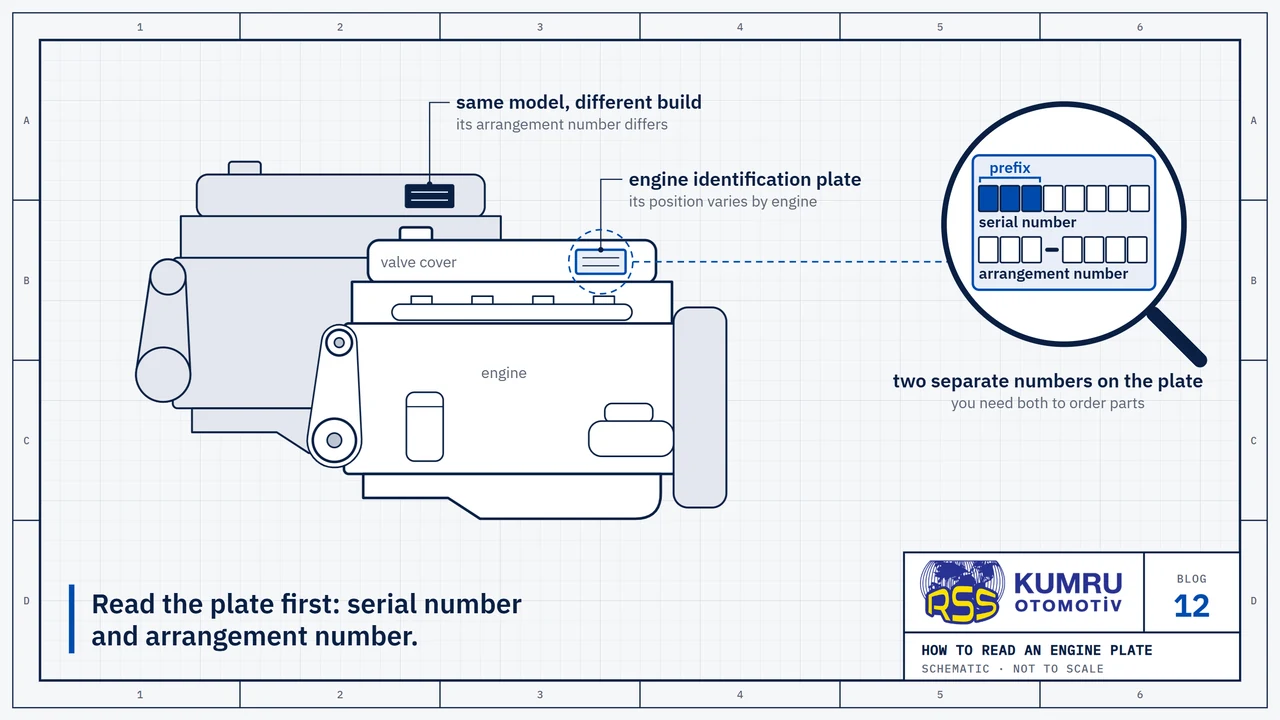
Which manual describes your engine is decided by its serial number and arrangement number.
What are the symptoms of a failing transfer pump?
A 2012 US Army Research Laboratory report summarises a failure mode analysis prepared for the Caterpillar C7. Its table names a faulty fuel transfer pump among the potential causes of four complaints: the vehicle cannot reach its speed limit, the engine cranks but does not start, it misfires or runs rough, and it shuts down intermittently or cuts out. The pump is never alone in a row: each list also holds the fuel filter, the fuel lines or the fuel/water separator.
A fifth row is different: fuel in the lubricating oil. The first cause listed there is “Fuel transfer pump seal faulty”, ahead of a faulty unit injector, excessive idling, low compression and the cylinder head.
The 3306 and 3406 manuals put the fuel pressure check under two of those complaints: misfire and lack of power.
Where is fuel pressure measured?
On the D7G the gauge sits on the secondary fuel filter base, and the transfer pump should supply enough pressure for it to read in the green zone. If not, the gauge is replaced and the pressure checked: 25 psi (172 kPa) minimum at full load and 30 psi (207 kPa) minimum at high idle. In its lack-of-power procedure the same manual takes the reading at the “fuel injector housing inlet”, the inlet of the injection pump housing, and wants at least 15 psi (105 kPa).
On the 3406 in the Army’s 621B scraper the reading is taken at the same point and must be at least 30 psi (207 kPa). For the C7 and C15 the Army documents we read give no figure. That comes from the engine’s service manual; forum numbers are left out.
The D7G manual’s warning: “DO NOT perform fuel system checks, inspections or maintenance while smoking or near fire, flames or sparks.” Some fuel drains when the gauge comes off; catch it and plug the opening in the filter base.
Is it the pump, the filter or a line?
Both manuals work in the same order: below the limit, the primary fuel filter is changed first. Then the pump, in the 3406 manual’s words: “If fuel pressure is STILL below 30 psi (207 kPa), replace fuel transfer pump”. On the D7G a gauge in the red also means new fuel filters.
Before the pressure reading, both manuals send the mechanic to the lines: check them for obstruction, and inspect the connections for leaks and damage. A leaking connection is tightened; cracked or split tubing is replaced.
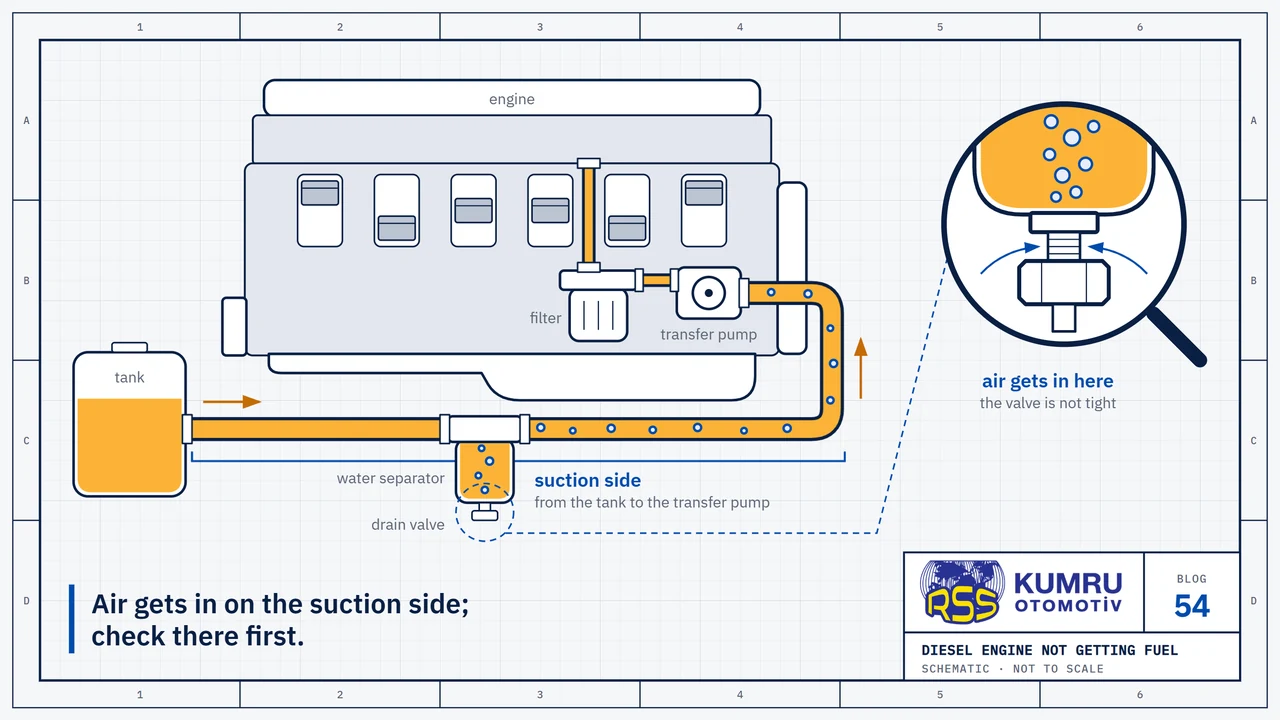
The pump pulls fuel from the tank through the primary filter, so that stretch is under suction, and a loose joint there usually lets air in instead of fuel out. The manuals do not say this; it follows from the flow they describe. The C7 report lists air in the fuel system, low fuel pressure and damaged or leaking fuel hoses as separate causes of stalling at low rpm. Caterpillar’s own sentence on suction leaks, and ways of finding bubbles on the supply and return sides, are in the 3406E and C15 article.
What sets the pressure differs too. On the 3306 it is the pump’s own spring. On the C15 the pump carries “a relief valve in order to protect the system from extreme pressure”, and a regulating valve in the fuel filter base holds the back pressure that fills the injectors. The C7 report counts a faulty fuel pressure regulating valve as a cause of its own. Checking that valve before the pump when pressure stays low on a new filter is our reading of the layout, not a sentence from the manuals.
In what order should a mechanic check?
- Identify the engine and its manual. Pump location and pressure limit change with it.
- Check the fuel and the filters. Water or dirt in a tank sample: drain the tank, change the filters. Gauge in the red: change the filters.
- Walk the lines. Obstruction, leaks, cracked tubing, especially the connections ahead of the pump.
- Read the pressure where the manual says. On the 3306 and 3406, the inlet of the injection pump housing.
- Go to the pump last. New filter, sound lines, pressure still low. On a C7 with fuel in the oil, check the pump seal.
- Prime the system and look for leaks. Both manuals ask for this once the pump is fitted.
Источники
- U.S. Department of the Army, “TM 5-2410-237-23: Tractor, Full Tracked, Low Speed: Diesel Engine Driven, Medium Drawbar Pull, Caterpillar Model D7G (field maintenance manual)”, US Army field maintenance manual for the D7G tractor with the Caterpillar 3306 engine; the copy read has no cover or print date, read on 12 October 2026; work packages 0002, 0003, 0006, 0039, 0042 and 0232.
- U.S. Department of the Army, “TM 5-3805-248-23-1 and TM 5-3805-248-23-2: Scraper, Earth Moving, Motorized, Diesel Engine Driven, Model 621B (maintenance manual)”, US Army maintenance manual for the 621B scraper with the Caterpillar 3406 engine, two volumes; the copy read carries no print date, read on 12 October 2026; work packages 0003, 0009 and 0275.
- U.S. Department of the Army, “TM 9-2320-338-10: Operator's Manual for Truck, Cargo, 8x8, M977A4 (work package 0013, Engine Systems: Fuel System)”, US Army technical manual, 15 October 2008; approved for public release; the truck's engine is a Caterpillar C15; pages 0013-4 and 0013-5.
- U.S. Army Research Laboratory, “Sensor Technology Baseline Study for Enabling Condition Based Maintenance Plus in Army Ground Vehicles (ARL-TR-5958)”, technical report, March 2012; approved for public release; summarises the failure mode and effects analysis TARDEC prepared for the Caterpillar C7 engine; section 4.1 and Table 1.
- U.S. Army TARDEC Fuels and Lubricants Research Facility (Southwest Research Institute), “Engine Durability Evaluation Using Synthetic Fuel, Caterpillar C7 Engine (Interim Report TFLRF No. 391)”, interim report, October 2008; approved for public release; list of abbreviations and pp. 7–8.
Дата повторной проверки источников: 13 октября 2026 г.
RSS Kumru Automotive
Компания RSS Kumru Automotive основана в 1990 году и специализируется на гидравлических системах и системах управления жидкостями. Our range includes more than 1,000 pipe and hose references for Caterpillar engines and machines.
Названия марок и номера OEM используются исключительно для идентификации и указания совместимости.