Cat 3406E and C15 losing prime or hard starting: a fuel line and return line checklist
- Author
- Furkan Kumru
- First published
- First published:
- Last updated
- Last updated:
- Reading time
- 6 min read
- Category
- Caterpillar
A Cat 3406E or C15 that loses its prime and starts hard after standing is checked along the fuel path: tank, primary filter and water separator, transfer pump, secondary filter, the fuel manifold in the head, the pressure regulating valve, tank. Up to the pump the circuit is under suction; a leak there draws air in, and Caterpillar calls such leaks very difficult to detect. Look there first.
Short answer
- Suction side: the water separator is under suction while the engine runs; its drain valve, the hoses and the clamps come first.
- Return: on the C15, excess fuel leaves the head at the rear and returns to the tank through the regulating valve in the filter base.
- Priming: on the 3406E, C-15 and C-16, open the air purge screw after a filter change and the regulating valve after running out of fuel.
What path does the fuel take from the tank to the head and back?
On the C15, fuel is drawn from the tank through the primary filter / water separator into the transfer pump, which pressurises it and sends it through two-micron filters on the filter base. A supply line takes it into the head at the front of the engine; the excess leaves at the rear and returns through the regulating valve in the filter base to the tank.
The sequence is from the US Army operator’s manual for the Caterpillar C15-powered M977A4 truck, which calls the circuit “a conventional design for electronic unit injector diesel engines”. In the same manual, fuel reaches the injectors through a manifold drilled into the cylinder head.
For the 3406E we could not open a Caterpillar book with the same walk-through. Caterpillar’s manual covering the 3406E, C-15 and C-16 truck engines names the same parts: water separator, secondary filter, filter base, fuel that stays in the head.
Where are the check valve and regulating valve, and what do they do?
The pressure regulating valve sits in the filter base, in the path of the fuel returning from the head. The Army’s C15 manual puts a check valve and a relief valve inside the transfer pump: the check valve lets fuel pass around the gears during hand priming, while the regulating valve keeps enough back pressure to fill the injectors. For the 3406E, C-15 and C-16, Caterpillar’s manual gives the location: “The regulating valve is located in the integral fuel filter base.”
None of these books says which valve holds the fuel after shutdown. Two truck-forum threads on the 3406E describe a replaceable check valve: in one it is “on the bottom of the fuel block mounted behind the air compressor”, in the other on the bottom of the primer pump. The first thread names the fault: “Hard starting after it sits for a period, fuel bleeds back to the tank.”
Should the pressure hold after shutdown? Forum posters disagree: one expects the gauge to hold for a while and otherwise blames the check valve; another says his engine holds none at all. Caterpillar’s manual has the mechanic wait one to five minutes before removing the secondary filter, so that residual pressure can fall. A drop within minutes is no proof of a fault: that is our reading, not the manual’s wording.
Where does air get into this circuit?
Air gets into the fuel circuit on the suction side, ahead of the transfer pump: the water separator, its drain valve, the hoses and fittings from the tank. Caterpillar’s drain procedure carries a notice: “The water separator is under suction during normal engine operation.” So the drain valve must be tight. The 3406E and C15 marine manual is more direct:
“Detection of leaks is very difficult especially if the engine is running. The primary filter/water separator is under suction. A leak will allow air to enter the fuel.”
Caterpillar, 3406E and C15 Marine Engines Operation and Maintenance Manual (SEBU7005-08), 2009
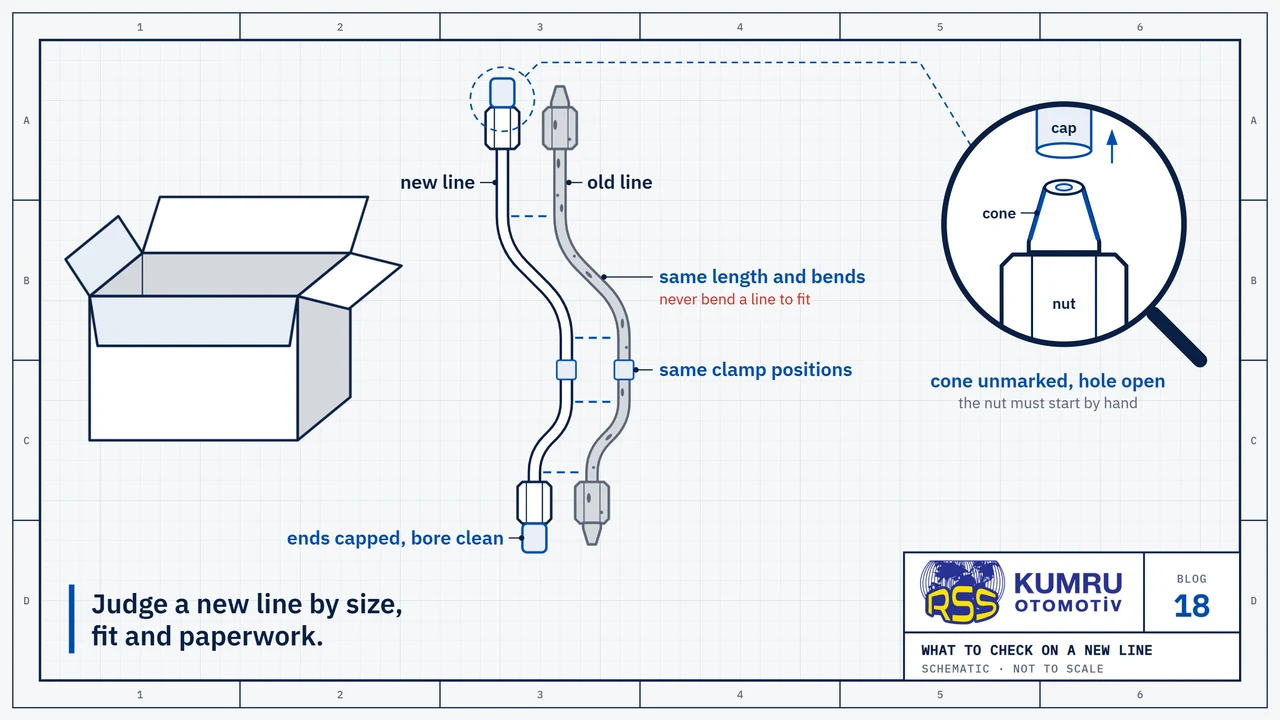
If air is getting in, the same manual has the components checked for overtightening or undertightening. The truck manual’s hose check is short: cracking, softness, loose clamps. “Replace hoses that are cracked or soft.” The same page forbids fitting bent or damaged lines, tubes or hoses.
Past the pump the circuit is under pressure: a loose joint there takes in no air, it puts fuel on the outside. That is our conclusion from the flow description; the truck manual’s air purge screw warning points the same way: “Failure to tighten all fittings could result in serious fuel leaks.” General symptoms and search methods are in our article on air in a diesel fuel line.
How do 3406E owners look for air in the field?
Two truck-forum threads on the 3406E describe four field tests for air in the fuel; none is a manufacturer’s procedure.
- A clear hose ahead of the pump. A short clear fuel line goes in just before the transfer pump and is watched for bubbles. The driver who suggested it found a small hole in the line to the filter’s vacuum gauge.
- Feeding from a separate line. The engine is fed from a bucket of clean fuel or through a bypass hose dropped into the tank. If it then runs properly, the thread’s tank-side suspects are a cracked pickup tube, the tank vent, shut-off valves that let air in and an old hose with a collapsed lining.
- Watching the return. A sight glass goes into the return hose, or the return is run into a bucket. Posters who see plenty of bubbles or foam point to the injector O-rings and seats.
- Listening at the tank. Engine off, tank cap removed: if fuel can be heard draining back, the check valve is suspected.
How is the fuel system primed again?
On the 3406E, C-15 and C-16 the fuel system is primed at the filter base. Caterpillar’s manual separates two cases.
- After a secondary filter change: do not fill the new filter beforehand. Open the air purge screw three full turns without removing it and start the engine. When a small drop of fuel shows at the threads, tighten the screw.
- After running out of fuel: fill the tank and open the regulating valve two and a half turns, without removing it. The manual’s reason: “Open the valve enough to allow the air that is trapped in the cylinder head to be purged from the fuel system.” Crank twice for 30 seconds, letting the starting motor cool for two minutes each time. Then close and tighten the valve and crank at the same rhythm until the engine runs.
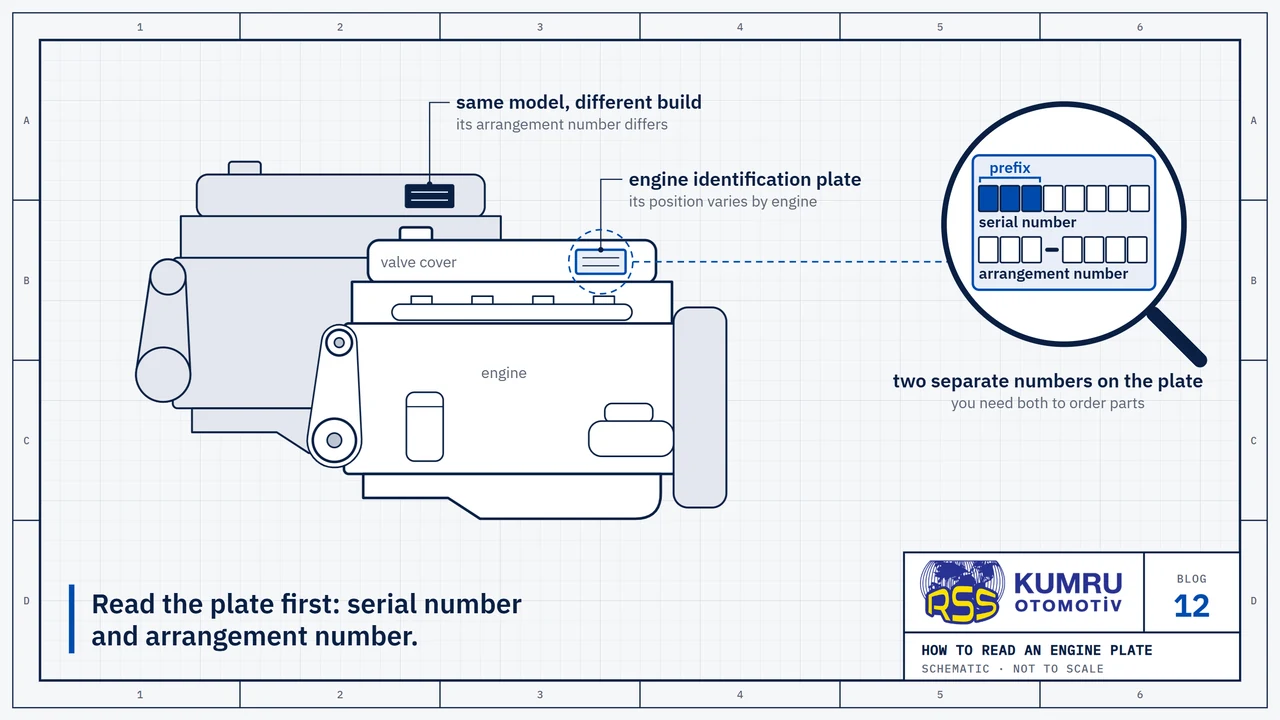
A hand priming pump, where fitted, can replace cranking. The C11, C13 and C15 on-highway engines have their own manual, and its sequence differs. Which manual applies depends on the engine’s identity, the subject of our article on Caterpillar serial numbers. Bleeding other fuel systems is in a separate article.
Caterpillar’s warning: “Fuel leaked or spilled onto hot surfaces or electrical components can cause a fire.” Ignition off for filter work; wipe up spills at once.
What order should you work in?
- Ask about the history. A filter, injector or hose just changed? Did it run out of fuel?
- Go over the suction side. Drain valve, hoses, clamps, tank shut-off valves.
- Look for bubbles. Ahead of the pump first, then in the return.
- Look for fuel outside. Filter base, air purge screw, supply and return connections, loose line clamps.
- Then the valves. Pressure figures are in the engine’s service manual.
- Prime the system. Run the engine, stop it, check for leaks again.
Sources
- Caterpillar, “3406E, C-10, C-12, C-15, and C-16 On-Highway Engines: Maintenance Intervals (excerpted from Operation & Maintenance Manual SEBU7186-08-01)”, excerpt from the Operation and Maintenance Manual, published by Caterpillar for safety.cat.com, 2007; the copy on archive.org; pages 201–214 and 220–221.
- Caterpillar, “3406E and C15 Marine Engines: Maintenance Intervals (excerpted from Operation & Maintenance Manual SEBU7005-08)”, excerpt from the marine engines Operation and Maintenance Manual, 2009; the copy on archive.org; pages 88–92.
- Caterpillar, “C11, C13 and C15 On-Highway Engines: Maintenance Intervals (excerpted from Operation & Maintenance Manual SEBU7695-13)”, excerpt from the Operation and Maintenance Manual, 2009; the copy on archive.org; pages 100–101 (priming sequence).
- U.S. Department of the Army, “TM 9-2320-338-10: Operator's Manual for Truck, Cargo, 8x8, M977A4 (work package 0013, Engine Systems: Fuel System)”, US Army technical manual, 15 October 2008; approved for public release; the truck's engine is a Caterpillar C15; pages 0013-4 and 0013-5.
- TruckersReport, “Help replacing fuel check valve on 3406e”, forum thread, 26–29 October 2011; read from the Wayback Machine copy; a field account, not a manufacturer document.
- TruckersReport, “CAT 3406e fuel problem”, forum thread, 23 August – 7 September 2015; read from the Wayback Machine copy; a field account, not a manufacturer document.
Sources were checked again on October 9, 2026.
RSS Kumru Automotive
RSS Kumru Automotive was founded in 1990 and specialises in hydraulic systems and fluid management. Our range includes more than 1,000 pipe and hose references for Caterpillar engines and machines.
Brand names and OEM reference numbers are used for identification and compatibility information only.