Diesel lift pump: what it does and how to tell when it is failing
- Автор
- Selami Kumru
- Первая публикация
- Первая публикация:
- Последнее обновление
- Последнее обновление:
- Время чтения
- 6 мин чтения
- Категория
- Топливные трубки и трубки форсунок
Эта статья пока доступна только на английском языке.
A diesel lift pump (feed pump, supply pump) draws fuel from the tank and sends it through the filter to the injection pump at low pressure. When it fails, a tractor starts badly, loses power or will not start; a split diaphragm puts diesel in the engine oil. A blocked strainer or a suction pipe drawing air does the same, so test the pump before replacing it.
Short answer
- What it does: lifts fuel from the tank to the injection pump, which cannot draw fuel for itself.
- Symptoms: difficult starting, lack of power, misfiring, erratic running; with a split diaphragm, a rising oil level.
- Test: take off the outlet pipe and work the priming lever; fuel should spurt at every stroke. Then measure pressure against the engine manual.
- Check first: the tank cap vent, the suction pipe, the sediment bowl and the strainer.
What does a diesel lift pump do?
A lift pump moves fuel from the tank, through the filters, to the injection pump. A diesel fuel systems training module from Turkey’s Ministry of National Education gives the reason:
“Diesel injection pumps have no suction ability, so fuel has to be sent to them under pressure.”
Ministry of National Education (Turkey), Diesel Engine Fuel Systems module, 2012
The module describes the diaphragm type as the pump a petrol engine uses, with a hand lever added. That lever is the one worked during bleeding, covered in the tractor bleeding article.
How does a lift pump work, and what types are there?
In both tractor manuals we read, the lift pump is a diaphragm pump driven by an eccentric on the engine camshaft. As Massey Ferguson’s MF 65 service manual describes it, the camshaft lifts the pump’s rocker arm, which pulls the diaphragm down against its return spring and creates a vacuum.
Fuel is drawn in through the sediment bowl, the strainer and the inlet valve. On the return stroke the spring pushes the diaphragm up and the fuel out through the outlet valve to the filters.
The module lists four types: piston, diaphragm, gear and vane. Every diesel fuel system has a feed pump, it says; on trucks and construction machines what changes is the type. The piston type is usually mounted on the injection pump, with a separate hand primer at its inlet (a subject of its own).
A common-rail engine may have an electric pump instead. Thermo King says of the one on its common-rail SG 4000 generator set: “This pump is designed to push fuel rather than pull fuel.”
What are the symptoms of a bad lift pump?
A failing lift pump starves the engine of fuel; the symptom ranges from difficult starting to loss of power. The fault-finding chart in Perkins’ workshop manual for the 3.152 series lists “Faulty fuel lift pump” among the possible causes of six faults:
- will not start
- difficult starting
- lack of power
- misfiring
- knocking
- erratic running
All but the knocking row also list a blocked fuel feed pipe, a choked fuel filter and air in the fuel system, so the symptom alone does not point to the pump. Nor does a system that will not bleed: Vintage Tractor Engineer, a specialist site on old tractors, names an inoperative lift pump among the causes.
A diaphragm pump has one symptom of its own:
“The diaphragm can split providing a route for diesel to enter the engine crank case.”
Vintage Tractor Engineer, 14 January 2009
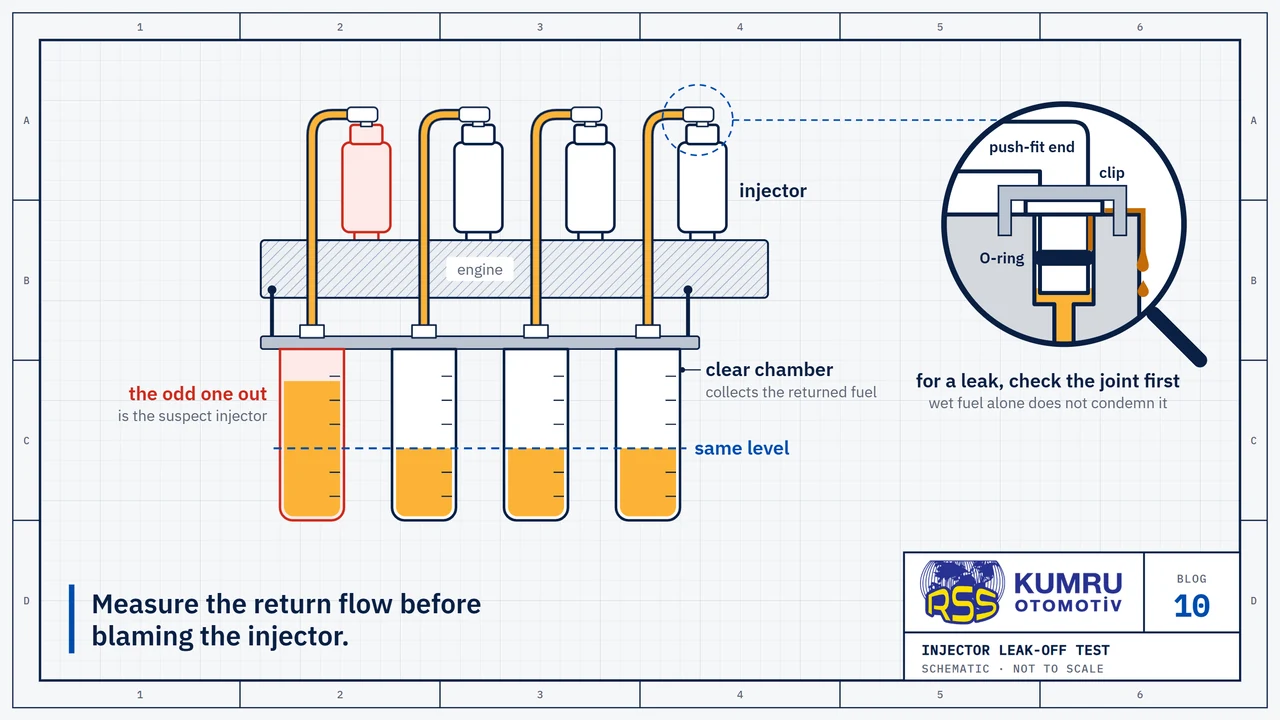
The sign is an oil level that rises for no apparent reason, and thin oil. The site gives two other routes for diesel into the oil: the injection pump shaft seals and leaking injectors.
Inside a diaphragm pump the module lists leaking unions, valves that no longer seal, a holed diaphragm, a weak or broken spring, a worn cam and lever, and a blocked strainer.
How do you test a lift pump?
A lift pump is tested on the engine in two ways: first the flow from its outlet, then its pressure. This is Perkins’ order:
- Flow. Disconnect the outlet pipe, then turn the engine or work the priming lever. Fuel should spurt “once every two engine revolutions, or every time the hand priming lever is depressed”.
- If the lever will not go down. Turn the engine one complete revolution; the eccentric on the camshaft has stopped at its highest point.
- Pressure. Fit a gauge to the outlet and check its connections for leaks. Crank for ten seconds and note the highest reading.
| Engine | How it is measured | Figure |
|---|---|---|
| Perkins 3.152 series | Gauge on the outlet, ten seconds of cranking | Minimum production static pressure 6 lbf/in² (41 kN/m²); minimum test pressure 31 kN/m² |
| Massey Ferguson MF 65, 4A-203 diesel engine | Gauge on the outlet; priming lever or starter | 5–8 psi |
Figures for these two engines only. For any other engine, use its service data.
On the Perkins the test minimum is 75% of the production figure. A second measure: if the pressure falls to half its maximum in less than thirty seconds after cranking stops, the pump needs attention. Before the test, the MF 65 manual says to “make sure the fuel filters are not clogged”.
Is it the lift pump or the fuel line?
If no fuel spurts from the outlet, the fault may lie in the pump or in the line that feeds it. Both manuals measure at the outlet, with the tank, strainer and suction pipe still connected. The manuals do not draw this distinction; it follows from the way the test is set up. Check four places on the suction side:
- Strainer. The Ministry’s tractor module says the feed pump has a strainer for dirt in the fuel, to be cleaned now and then with compressed air.
- Sediment bowl. Perkins wants good joints when the glass bowl is refitted, “as any leakage of air here may cause air locks in the fuel system.”
- Suction pipe. Vintage Tractor Engineer lists blocked pipes and “Split suction pipes allowing air in”. Finding an air leak is covered in the article on air in the fuel line.
- Tank cap. The tractor module says the hole in the cap balances the tank against atmospheric pressure: “This hole must always be kept open and clean.”
The Perkins chart lists a blocked fuel tank vent among the causes of difficult starting, lack of power and erratic running. If the engine picks up when the cap is loosened, look at the vent. The module does not say this; it follows from what the hole is for. What a blocked vent does is in the bleeding article.
An electric pump raises the same question: where one runs but delivers no fuel, Thermo King’s manual points to air leaks, kinked or restricted lines, the bowl gasket and the filter.
What order should you check in?
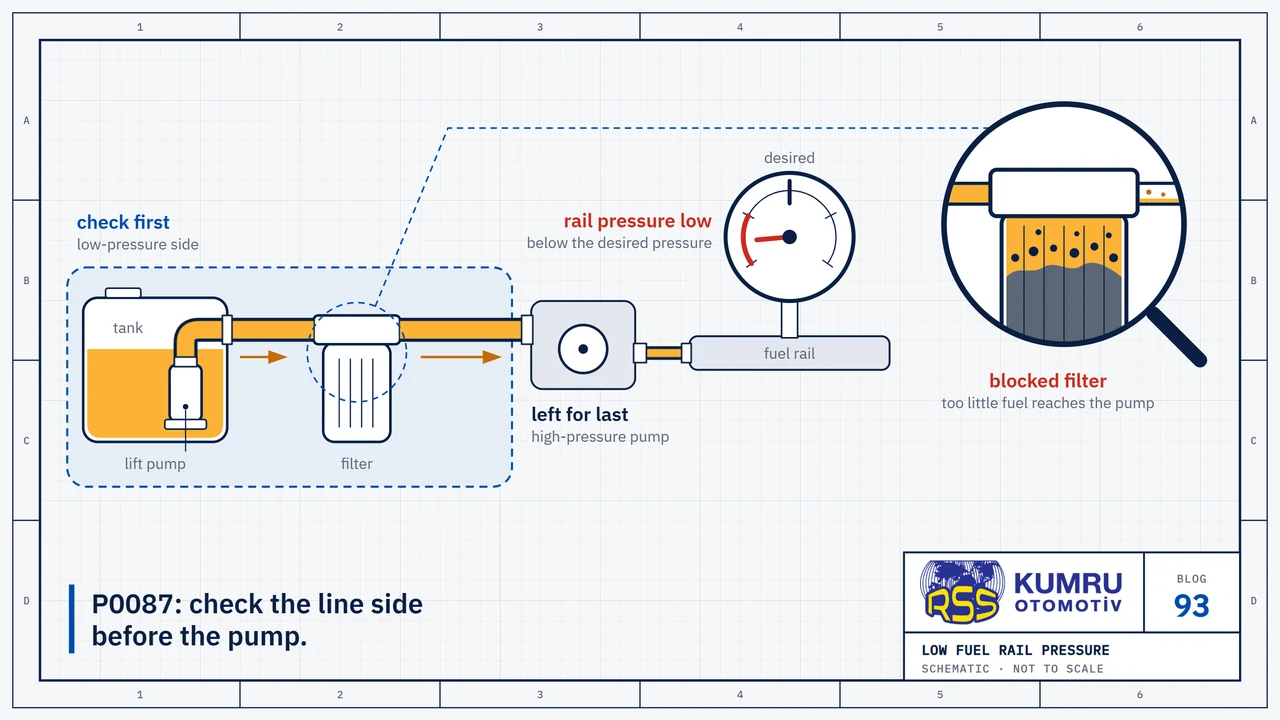
Follow the fuel: tank first, then the suction side, then the pump.
- Tank and tap. Fuel in the tank, tap open, cap vent clear?
- Suction pipe and unions. Look for seepage, a split pipe and loose connections.
- Sediment bowl and strainer. Drain any water, clean the strainer, seat the gasket properly.
- Flow. Outlet pipe off, work the lever: fuel at every stroke.
- Pressure. Gauge on the outlet, against the engine manual’s figure.
- Engine oil. Level up and oil thin: suspect the diaphragm, the injection pump shaft seals and the injectors.
- Filters and air. Replace a choked filter, then bleed the system.
Источники
- T.C. Millî Eğitim Bakanlığı, “Dizel Motorları Yakıt Sistemleri (Motorlu Araçlar Teknolojisi, modül 525MT0297)”, vocational and technical education training module (in Turkish), Ankara, 2012; feed pump chapter (pp. 39–51).
- T.C. Millî Eğitim Bakanlığı, “Traktör ve Yapı Elemanları (Tarım Teknolojisi)”, vocational and technical education training module (in Turkish), Ankara, 2015; fuel equipment section (pp. 5–7).
- Perkins Engines, “Workshop Manual for 3.152 & D3.152 Diesel Engines (Publication No. 601SER06821031)”, engine maker's workshop manual, 1982; fault-finding chart and lift pump section; OCR text of the scan on the Internet Archive, figures checked against the page images.
- Massey-Ferguson, “MF 65 Tractor Service Manual (form no. 1448 812 M1): 4A-203 diesel engine, Fuel and Air System Servicing”, tractor maker's service manual; no print date in the section used; OCR text of the scan on the Internet Archive, the pressure figure checked against the page image.
- Thermo King, “Container Edition SG 4000 Series, Maintenance Manual TK 61010-4-MM: Electric Fuel Pump”, online maintenance manual (e-Tech Library); electric fuel pump page last updated 15 January 2020.
- Vintage Tractor Engineer, “Engine Oil Contaminated With Diesel Fuel Or Water”, specialist site on vintage tractor maintenance, 14 January 2009; not a manufacturer instruction.
- Vintage Tractor Engineer, “Bleeding Off Diesel Fuel Systems”, specialist site on vintage tractor maintenance, 14 January 2009; not a manufacturer instruction.
Дата повторной проверки источников: 13 октября 2026 г.
RSS Kumru Automotive
Компания RSS Kumru Automotive основана в 1990 году и специализируется на гидравлических системах и системах управления жидкостями. Our range includes close to 700 injector line references, most of them for Caterpillar, Mercedes-Benz, Ford / New Holland and Scania engines.
Названия марок и номера OEM используются исключительно для идентификации и указания совместимости.