How to bleed a diesel fuel system after a filter or line change
- Author
- Selami Kumru
- First published
- First published:
- Last updated
- Last updated:
- Reading time
- 6 min read
- Category
- Injection and fuel lines
How a diesel is bled after a fuel filter or fuel line change depends on its fuel system. With an older mechanical injection pump you loosen a bleed screw, work the hand primer until the fuel runs without bubbles, then slacken the injector line nuts and crank. On common rail the low-pressure side is filled first, in our examples by an electric pump, and the high-pressure lines are not loosened to let air out.
Short answer
- Mechanical pump: bleed screw and hand primer, then slacken the line nuts at the injectors and crank. That is Thermo King’s sequence.
- Common rail: fill the low-pressure side (an electric pump in our examples). Perkins is explicit: do not loosen the high-pressure lines to purge air.
- Cranking: the engine’s manual sets time and order. One forbids priming on the starter, another says cranking is enough.
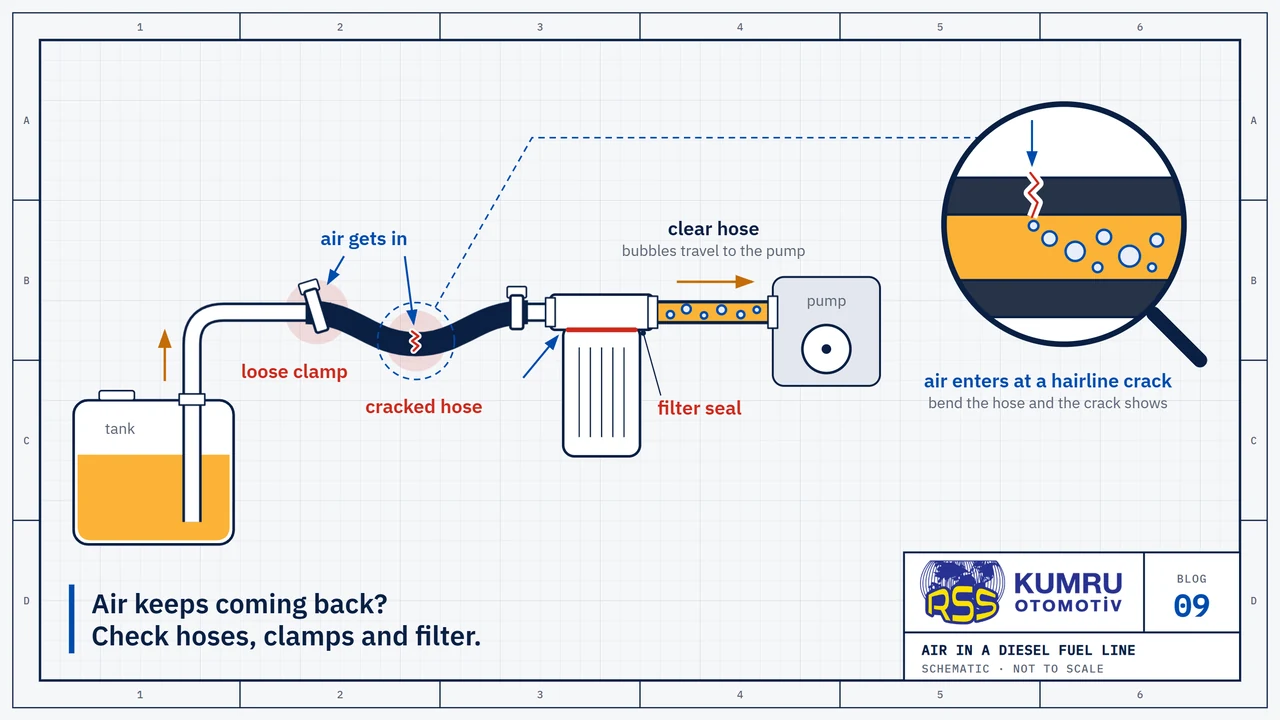
- Air that keeps coming back: look for a leak on the low-pressure side.
Where does the air get in?
On the low-pressure side, going by Perkins’ list. Apart from repairs it names four ways in: the tank has run empty or been partly drained, the low-pressure lines have been disconnected, the low-pressure system has a leak, or the fuel filter has been replaced. The full procedures below start there too.
Thermo King adds the tank vent: “If the vent becomes clogged, a partial vacuum develops in the tank, and this increases the tendency for air to enter the system.”
How do you bleed an engine with a mechanical pump?
In two stages: the low-pressure side with the hand primer, then the injector lines on the starter. Thermo King’s SG 3000e generator set is an example. Its fuel system is a tank, a hand fuel pump, an injection pump and injection nozzles, and the manual gives this sequence:
- Bleed screw. Loosen it about one turn.
- Hand primer. Unscrew the handle and pump until the fuel at the screw shows no bubbles. Tighten the screw, screw the handle back in.
- Injector lines. Loosen the nuts at the injector end. Crank until fuel appears at the injectors, then tighten them.
- Check. Start the engine and watch it for a few minutes. If it will not start, or stops again, repeat.
The same manual has the new filter canister filled with clean fuel before fitting. The slackened line nuts go back to the torque in the engine’s service data. On tractors the bleed points and their order differ by make; that is a separate article.
How is the low-pressure side filled on a common-rail engine?
In our two examples, with an electric pump: the mechanic switches it on and gives the air a way out. The first is the same maker’s common-rail SG 4000 set.
The unit is switched on without letting the engine start, and the fuel pump is run from the controller menu for 1 to 2 minutes. While it runs, the bleed screws on top of the filter heads are opened. Once fuel flows steadily, the primary filter’s screw is closed first, then the secondary’s.
Not every system has a screw. In the instructions FCA US issued for 2019 and 2020 Ram trucks with the 6.7-litre diesel, the ignition switch does the job: turned to RUN without cranking, it runs the transfer pump for at least 30 seconds. That cycle is done twice after any work on the fuel system.
Pre-filling a new filter is engine-specific too. On the SG 4000 the primary filter bowl must not be filled before fitting, while the secondary filter is pre-filled with fresh diesel.
Can you bleed a common-rail engine by slackening an injector line?
No. What the manual itself prescribes on the mechanical engine appears in none of the common-rail instructions we could open. Perkins writes: “It is important that you do not loosen the high-pressure fuel lines to purge air from the fuel system.”
Cummins covers the case where only high-pressure lines have been changed. Its campaign procedure for the X12, which replaces three lines between the fuel rail and the injectors, says this once the nuts are torqued:
“It is not necessary to vent air from the high-pressure fuel system before starting the engine. Cranking the engine will prime the fuel system.”
Cummins, repair procedure for Campaign C2532, 10 February 2022
Thermo King’s common-rail manual also forbids refitting a high-pressure pipe once removed; which pipes are single-use is a separate article.
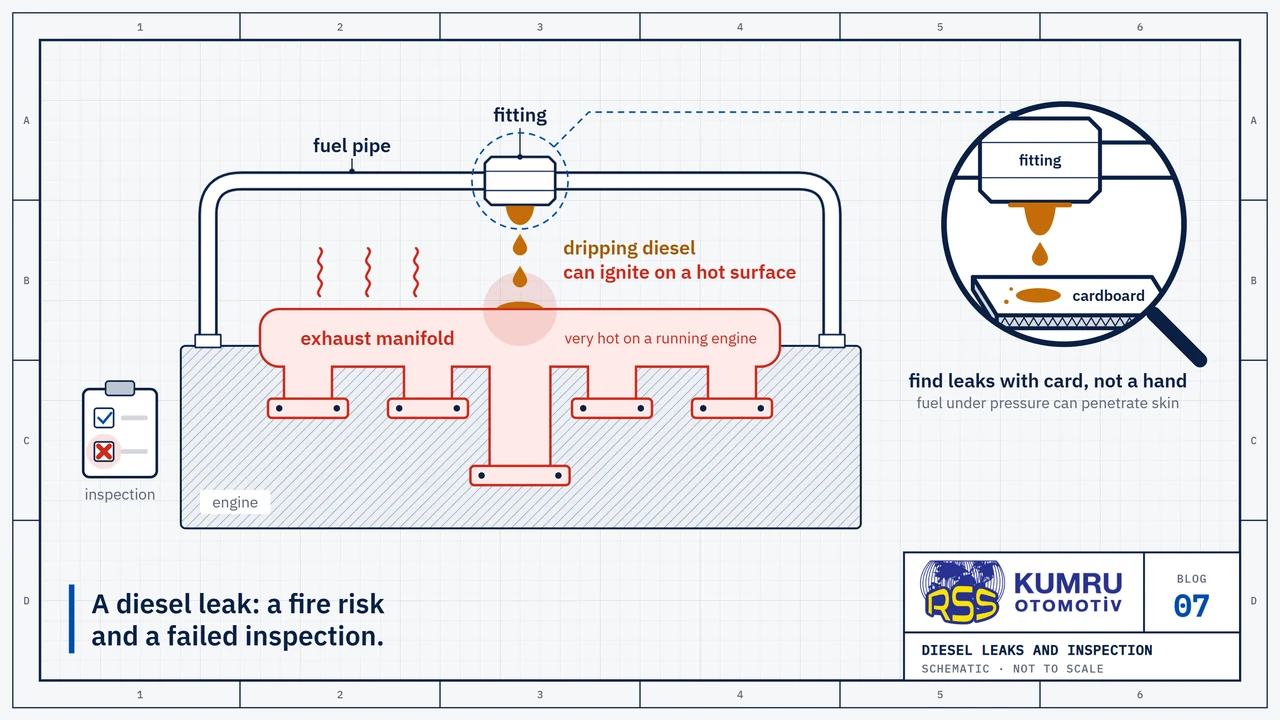
Keep your hands out of the path of the fuel. Thermo King warns in both manuals: “After the engine has stopped, wait 10 to 15 minutes before opening the high pressure side of the fuel system.” Look for leaks with paper or cardboard, not a finger. FCA says fuel at this pressure “can penetrate the skin and cause personal injury” and adds: “Do not loosen fuel fittings while engine is running.”
Can you bleed the system on the starter?
That depends on the engine. Of the four documents in the table, one forbids it, one rations it and two rely on it.
| Document | Low-pressure side | High-pressure lines | Cranking |
|---|---|---|---|
| Thermo King SG 3000e, mechanical pump | Bleed screw and hand primer | Loosened at the injectors | Until fuel appears |
| Thermo King SG 4000, common rail | Electric pump 1 to 2 minutes, filter screws open | Removed pipe not refitted | Forbidden for priming the pump |
| Ram 6.7-litre diesel, common rail | Ignition at RUN: pump at least 30 seconds, twice | Not loosened with engine running | 25 seconds, then at least 2 minutes off |
| Cummins X12, line change only | No step | No venting needed | Primes the system |
Times apply to that unit and engine only.
Thermo King is categorical about the SG 4000: “Never attempt to purge air and prime the high pressure fuel pump by cranking the engine with the starter.” The same page says why: air left in the system risks “possibly severe damage to the high pressure fuel pump”.
FCA adds that once started the engine “may run erratically and be noisy for a few minutes”; that is normal.
The documents do not seem to conflict. On the X12 only the lines between rail and injectors were off; in the other two common-rail instructions an electric pump runs before the starter. That is our reading; the documents do not explain it.
Bled, and the engine still stops?
If the engine starts and then stops, bleed it again first; both Thermo King manuals say so. If air still arrives, the system is drawing it in somewhere. For an electric pump that runs but delivers no fuel, Thermo King lists the checks: air leaks in the lines or connections, a kinked or restricted line, a distorted gasket on the pump’s filter bowl, a clogged filter.
When a line or fitting is changed, do not seal the thread with PTFE tape: Thermo King writes that strands can get into the fuel system and block the injectors.
What order should you work in?
- Identify the system. Fuel rail or mechanical injection pump? What fills the low-pressure side? Open the bleeding section of the service manual.
- Fill the low-pressure side. With screw and hand primer or the electric pump, until the fuel comes without bubbles.
- Decide about the high-pressure side. On a mechanical-pump engine, if the manual says so, slacken the nuts at the injectors and crank. On common rail, leave the lines alone.
- Watch. Run the engine for a few minutes and check the opened joints with paper. If it stops, bleed again; if that fails, look for the leak.
Sources
- Thermo King, “Container Edition SG 3000e Series, Maintenance Manual TK 61979-4-MM: Bleeding the Fuel System”, online maintenance manual (e-Tech Library); bleeding page last updated 11 August 2022.
- Thermo King, “Container Edition SG 4000 Series, Maintenance Manual TK 61010-4-MM: Bleeding the Fuel System”, online maintenance manual (e-Tech Library); bleeding page last updated 16 April 2025.
- Cummins, “Campaign C2532: X12 Fuel Injector Supply Line Safety Campaign, with repair procedure”, field campaign and repair procedure, 10 February 2022; NHTSA recall 21E-099.
- Perkins, “Replace Fuel Injectors (fuel injection equipment information page)”, manufacturer information page, undated.
- FCA US, “Dealer Service Instructions for Safety Recall Y78 / NHTSA 21V-880: High Pressure Fuel Pump”, recall service instructions, Revision 4, June 2024; 2019–2020 Ram 2500 to 5500 with the 6.7 L diesel.
Sources were checked again on October 8, 2026.
RSS Kumru Automotive
RSS Kumru Automotive was founded in 1990 and specialises in hydraulic systems and fluid management. Our range includes close to 700 injector line references, most of them for Caterpillar, Mercedes-Benz, Ford / New Holland and Scania engines.
Brand names and OEM reference numbers are used for identification and compatibility information only.