Oil cooler and transmission cooler line leaks: symptoms, oil in the coolant, and what happens if a line bursts
- Автор
- Ufuk Şahin
- Первая публикация
- Первая публикация:
- Последнее обновление
- Последнее обновление:
- Время чтения
- 6 мин чтения
- Категория
- Грузовые автомобили
Эта статья пока доступна только на английском языке.
When a hose or pipe to an oil cooler leaks, the oil ends up outside: a stain under the vehicle, a falling level and, sooner or later, a warning lamp. Oil in the coolant is a different fault: at the cooler it is an internal leak, not a line leak. That holds for engine oil coolers and automatic transmission oil coolers alike.
Short answer
- A leaking line: oil on the outside. A stain, a falling level, an oil pressure warning, or harsh, delayed gear engagement.
- Oil in the coolant: not a hose fault. Look for an internal leak in the cooler.
- A burst line: the oil goes quickly. The engine can seize, and oil on a hot surface is a fire risk.
- The driver: on a red warning, stops at once and switches the engine off.
What do the lines to an oil cooler carry?
A vehicle can have two oil cooling circuits, one for engine oil and one for automatic transmission fluid. MAHLE’s workshop guide to vehicle cooling says: “There are two basic types of oil coolers: air-cooled and coolant-cooled.”
An air-cooled cooler sits in the airflow at the front of the vehicle. A liquid-cooled one is “connected to the coolant circuit of the engine”, and “coolant flows through the oil cooler”. The guide puts oil coolers in or on the engine radiator or directly on the engine block; compact stacked-plate coolers are replacing tubular ones.
The guide does not list the lines one by one. What follows from its description: the lines to an air-cooled cooler carry oil, while a coolant-cooled cooler has coolant hoses as well. Before ordering an “oil cooler hose”, check which fluid it carries.
Does oil in the coolant come from a leaking hose?
No. A leaking hose or pipe puts oil on the outside; for oil to reach the coolant, the leak has to be inside the cooler. MAHLE lists the two as separate causes: “Oil loss due to leaky connections” and “Ingress of oil into the cooling system (internal leakage)”. Elsewhere the guide names another source of oil in the coolant: a defective cylinder head gasket.
On the transmission side the mixing can run the other way, with coolant entering the transmission fluid. Allison Transmission’s service tip names “a defective transmission fluid cooler” as one source of ethylene glycol in the fluid. Where a unit cools its oil with air, it adds, “it is not possible for a cooler failure to contaminate the fluid with ethylene glycol”. The consequence is severe:
“Any trace of glycol, or greater than 0.2% water contamination, requires complete disassembly and cleanup of the transmission and replacement of seals, gaskets, clutch plates, and bearings.”
Allison Transmission, Service Tips #1898, Rev. B, December 2012
Allison’s signs include oil in the radiator, oil or steam at the transmission breather, and discoloured fluid: water dispersed in the oil shows as “a cloudy or gray, pink, or strawberry color”. On heavy vehicles MAHLE lists the same internal leak for the retarder oil cooler.
What are the symptoms of a leaking cooler line?
A line leak shows first on the ground. Volvo Trucks’ driver guide has it in the daily inspection: “Check that there are no signs of leakage under the truck.” In hot weather, it adds, condensation water dripping from the air conditioning is normal.
- A falling level. MAHLE names oil loss and increased oil temperature among the symptoms of a defective cooler.
- Warnings. A low engine oil level warning and the oil pressure warning lamp; Volvo’s guide describes both.
- Gear engagement. A 2020 recall report filed with the US regulator NHTSA covers the transmission oil cooler line of a medium-duty truck. If the fluid falls far enough, “the customer may experience harsh or delayed transmission engagement”, and the malfunction indicator light may come on.
What happens if a line bursts, and what should the driver do?
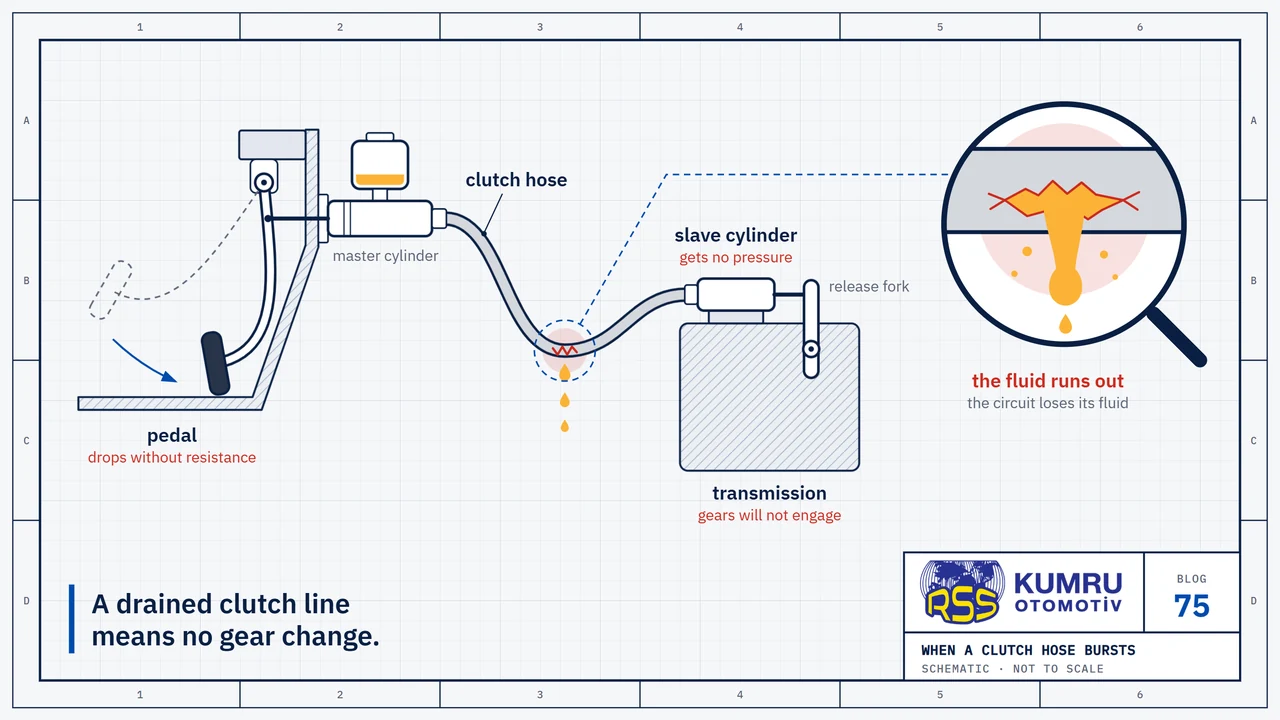
A burst line does not drip; the oil goes quickly. A 2017 recall report filed with NHTSA covers the engine oil cooler lines of a passenger car. The defect was separation where the rubber hose is crimped to the aluminium tube, “which may result in a rapid loss of engine oil”. Then, it says, “the customer may experience impaired visibility due to oil spray on the windshield, engine seizure and/or a potential risk of fire due to engine oil contacting a hot surface”.
In the 2020 truck report, “leaking transmission fluid may contact hot engine components, increasing the risk of a potential engine compartment fire”.
For the oil pressure gauge of its FL model, Volvo Trucks tells the driver: “Stop immediately and turn off the engine if the warning lamp comes on! Find the cause.” Its FH Aero guide applies the same rule to any red notification and adds: “The fault must be rectified before you continue to drive the truck.”
Do not drive on with a line that is losing oil. Both recall reports name the same risk: oil on a hot surface can start a fire. Stop and switch the engine off.
Where on the line does the leak start?
The sources point to three places.
- The crimp. Where a rubber hose is crimped onto a metal tube; the 2017 separation was exactly there.
- A rub point. In the 2020 report the transmission oil cooler line could touch the air conditioning compressor pulley, because the line “may have been improperly oriented during installation”.
- The connections. MAHLE names leaky connections as a cause of oil loss and tells the workshop to check them for external leaks.
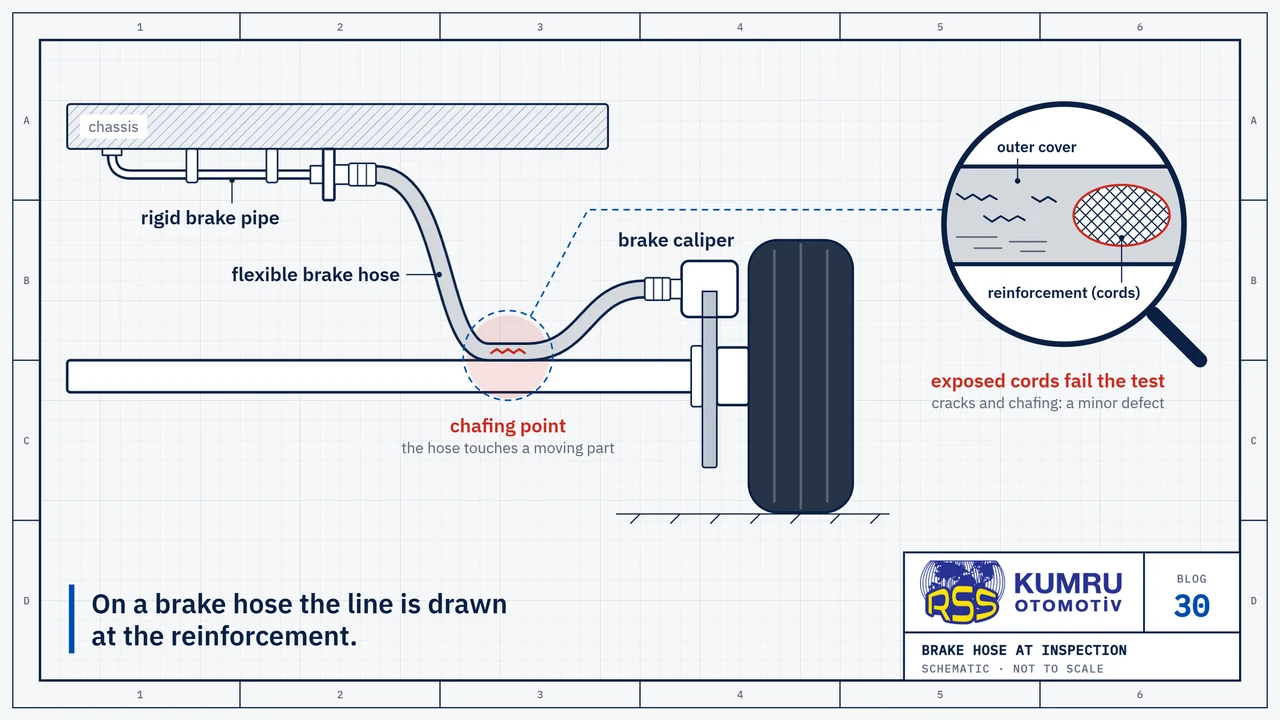
Signs on the hose itself, such as cracks, blisters and abrasion, are covered in the article on hydraulic hose failure signs.
What matters when a line is replaced?
- Routing and clips. The new line follows the old path, sits in every clip and stays clear of anything that turns or gets hot. The 2020 report’s remedy is the same: “Improperly routed lines will be reoriented and secured with a clip”.
- If the fluids have mixed, a new line is not the repair. Look at the cooler. MAHLE’s rule for contaminated coolant is to drain it and flush the cooling system. Where glycol has reached a transmission, Allison says the vehicle cooling system “should be pressure tested to locate the possible source of contamination”.
- Top up, then check the level by the book. The method differs from unit to unit.
Volvo’s guide gives three methods on one truck: engine oil on the dipstick, on level ground, with the engine off “for at least 30 minutes”; gearbox oil at a level sight glass; retarder oil “after driving, when the oil is hot”. For an automatic transmission, follow its maker’s manual.
In what order should a mechanic check?
- Which fluid is going down? Check the engine oil, transmission fluid and coolant levels.
- The coolant. Oil, contamination or discolouration? Then leave the lines and look at the cooler and the head gasket.
- The transmission fluid. Cloudy, grey or pink fluid has water in it.
- The lines, end to end. Crimps, connections, rub marks, missing clips.
- The cooler. Dirt on the outside, damage, hairline cracks.
- Repair and re-check. Replace the faulty part, top up, check the level, then look at the connections again.
Not every oil loss is a cooler line. Turbocharger oil leaks are covered in a separate article, and a burst power steering hose in the truck steering hose article.
The two recall reports cover specific production periods and are cited only for their technical description of the defect.
Источники
- MAHLE Aftermarket, “Vehicle cooling: A compact guide for the workshop”, workshop guide to vehicle cooling, February 2021 edition (MAHLE/2021-02/EN); oil coolers on pages 66–68, flushing the cooling system on page 37.
- Allison Transmission, “Service Tips #1898, Rev. B: Water and/or Ethylene Glycol in Transmission Fluid”, service tip from the transmission maker, December 2012; linked from the service tips page of the maker's own website.
- Volvo Trucks, “Volvo Trucks Driver Guide: Gauges (FL); Messages in the instrument display; Daily inspection of the truck; Lubricants, engine; Lubricants, gearbox; Lubricants, compact retarder (FH Aero)”, online driver handbook; demo truck records (FL and FH Aero), English and Turkish; latest change to the topic records 18 May 2026.
- NHTSA, “Part 573 Safety Recall Report 17V-496”, safety recall report filed with the US regulator, 8 August 2017; passenger car, engine oil cooler lines.
- NHTSA, “Part 573 Safety Recall Report 20V-691”, safety recall report filed with the US regulator, 10 November 2020; vehicle type: buses, medium and heavy vehicles; transmission oil cooler line.
Дата повторной проверки источников: 13 октября 2026 г.
RSS Kumru Automotive
Компания RSS Kumru Automotive основана в 1990 году и специализируется на гидравлических системах и системах управления жидкостями. Our range includes more than 200 cab tilt hose references for Renault Trucks, Volvo, Scania, MAN, Iveco, Mercedes-Benz and DAF.
Названия марок и номера OEM используются исключительно для идентификации и указания совместимости.