Turbo leaking oil and blue smoke: return pipe, seals or crankcase pressure?
- Author
- Talha Kırmızıaslan
- First published
- First published:
- Last updated
- Last updated:
- Reading time
- 6 min read
- Category
- Turbo oil lines
A turbocharger that leaks oil and sends blue smoke out of the exhaust is often not worn out. Its shaft seals are piston rings, which hold only while the oil can run back to the sump and the pressures around the turbo are normal. So the return pipe, the crankcase breather, the air filter and the oil level come before the turbo.
Short answer
- Oil at both ends: the oil cannot drain. Check oil level, return pipe and crankcase ventilation.
- Compressor end only: start at the intake, with a restricted air filter or a blocked or split hose.
- Turbine end only: long idling, an exhaust-side leak, or a turbine-end ring damaged by heat.
- The turbo itself: judged on measured shaft play and wheel damage, not on the presence of oil.
Why does a sound turbo let oil past its seals?
The seal at each end of the shaft is a small piston ring, and it does not hold oil back on its own. Isuzu’s service bulletin for its diesel trucks calls it “a dynamic seal (not a rubber seal)” and explains: “Air pressure (i.e., boost pressure) on the compressor side and exhaust pressure on the turbine side keep the lubricating oil inside the turbocharger center housing.”
So the bearing housing must be able to empty itself, and the pressure in the two outer housings must be normal. Lose either and oil crosses the rings of a perfectly good turbo.
Isuzu wrote the bulletin after examining returned turbos:
“An investigation of returned turbochargers has identified a common occurrence of turbochargers being replaced due to internal oil leaks when, in fact, there is no oil leak in or other fault with the turbocharger.”
Isuzu, service bulletin IB14-J-002B, October 2021
What stops the oil draining back to the sump?
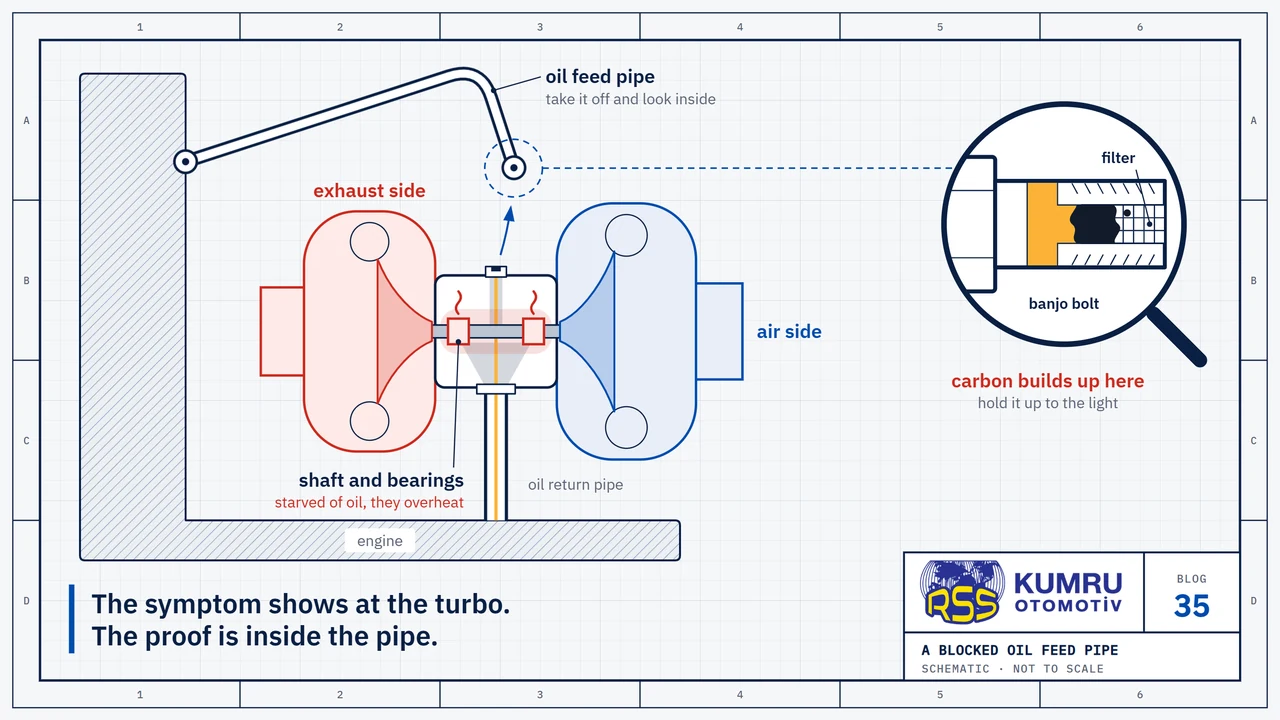
Oil is pumped into the turbo and leaves under its own weight. Narrow the return pipe anywhere and oil arrives faster than it can leave. MAHLE’s damage brochure describes what follows: “As the turbocharger continues to be supplied with oil from the engine circuit, the oil is then forced out to the turbine or compressor side.” What reaches the cylinders or the hot exhaust burns, and that is the blue smoke.
MAHLE names two ways the pipe narrows: carbon inside it, or a kink. It traces the carbon to missing heat shields, poor routing, hot shutdowns, poor oil and liquid sealant. Melett adds the pipe left twisted, bent or trapped.
The bottom of the pipe matters too. In an overfilled sump the returning oil has nowhere to go, and MAHLE notes that the crankshaft whips it into foam, a further barrier.
So does the angle. Garrett’s notes for performance installations want the oil outlet to “follow the direction of gravity +/- 15°”, with no dips in the line and no long runs parallel to the ground. A pipe bent to fit, or one made for another version, can lose that fall.
How does crankcase pressure push oil out of the turbo?
The return pipe ends in the crankcase, so crankcase pressure is also the pressure at the bottom of the pipe. When blow-by or a blocked breather raises it, MAHLE explains, the same pressure reaches the return line. The oil cannot flow out and is forced past the rings at either end.
For several turbo numbers, Melett’s failure notes describe a breather on the cam cover that clogs, raises crankcase pressure and ends up “forcing the oil back up the oil return pipe to the turbo”. Where the culprit is the breather filter, the remedy takes a line: “If the oil leak is caught in time, a filter change will be sufficient to solve the problem.”
Oil at the compressor end or the turbine end: what does each point to?
Oil at both ends means it cannot drain. At the compressor end alone it points to the intake; at the turbine end alone, to idling, the exhaust side or heat damage.
| Oil found | Points to | Look at first |
|---|---|---|
| Compressor end only | Restricted air filter; blocked, split or badly fitted intake hose | Air filter, intake hoses, clamps |
| Both ends | Return pipe blocked, kinked or trapped; oil level or crankcase pressure too high; sealant or wrong gasket at the flange | Oil level, return pipe, breather |
| Turbine end only | Long idling; exhaust-side leak or crack; wrong gasket; turbine-end ring collapsed by heat | Engine use, exhaust joints, then the turbo |
Grouping after Melett’s oil leak guide. Not a rule: MAHLE notes a blocked return can push oil out at either end.
A light oil film in the intake pipes is a separate matter. Closed crankcase ventilation feeds its vapour into the intake, and oil travels with it. Isuzu: “Oil in the intake system is common for a closed PCV system and is not a good indicator of a turbocharger failure.” A restricted air filter draws more through.
Can long idling make a turbo smoke?
Yes. At idle the pressure in the two housings is low, which Melett says “can lead to a vacuum being created, causing the oil to leak into the turbine housing”. At normal engine speeds, it adds, the pressures recover and the leak stops. Smoke that clears on a short drive fits that; smoke that stays under load does not.
What should be checked before the turbo is blamed?
Work from the cheapest check to the dearest.
- Oil level and condition. The level must not be above the maximum mark. Isuzu also checks for fuel dilution and milky, aerated oil, which raises crankcase pressure.
- Air filter and intake. Replace a restricted filter; check the hoses for splits and the clamps for tightness.
- Crankcase ventilation. Check the breather hose and oil separator for blockage. If they are clear and crankcase pressure is still above the service figure, MAHLE’s next step is the pistons and rings.
- Return pipe, off the engine. Look through it for a kink, a flat or carbon, and check where it enters the crankcase. MAHLE goes further: “We generally recommend replacing the line and the connecting piece.”
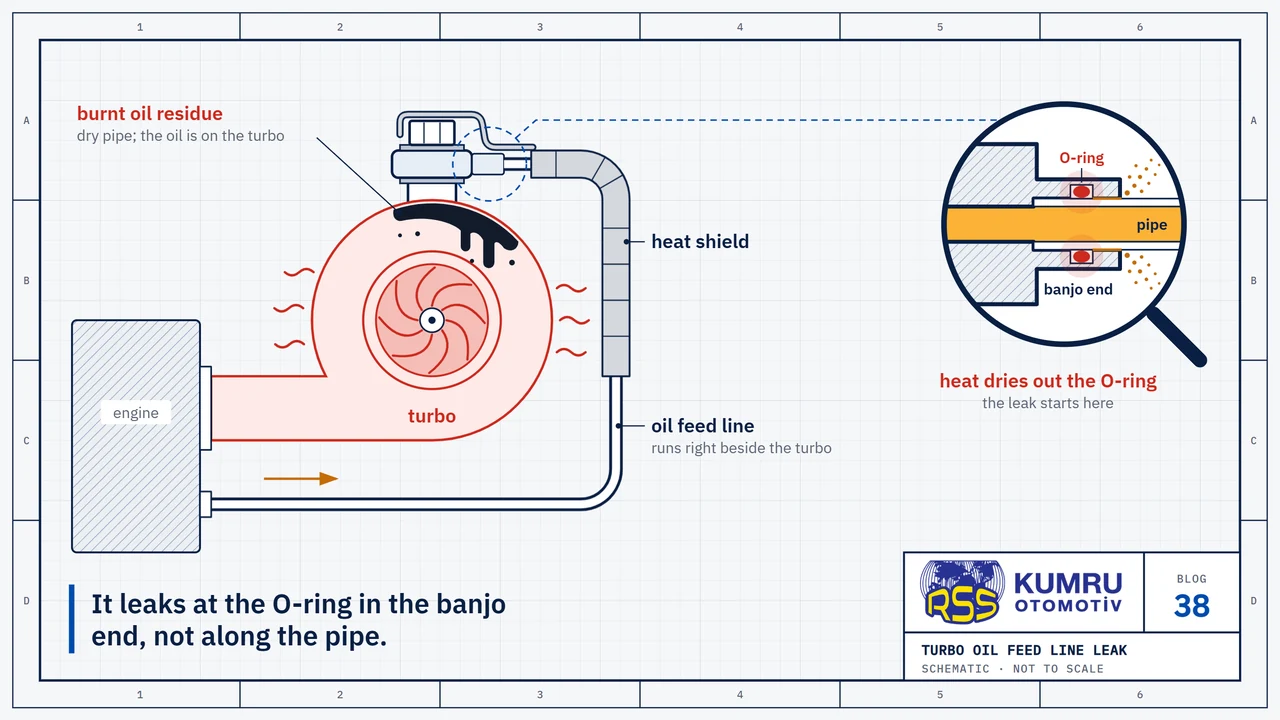
- Refitting. MAHLE wants the original routing and every heat shield. Use the correct gasket without sealant: Melett warns that silicone can come loose and block the oil passages.
- Exhaust side. From Melett’s list: leaks in the exhaust system, a blocked DPF or catalytic converter.
- The turbo, last. Measure shaft play against the service manual and look at both wheels for contact marks.
Empty the intercooler before the engine is revved. MAHLE on what pooled oil can do: “Uncontrolled overspeeds occur in the engine due to engine oil accumulating in the charge air cooler and being blown into the engine air intake and burned.”
When is it really the turbo?
When the measurements say so. Isuzu warns against judging by hand: “Some play in the turbo shaft with the engine off is normal.” Its rule is short: “If there are no signs of the blades hitting the housing, do not replace the turbo.”
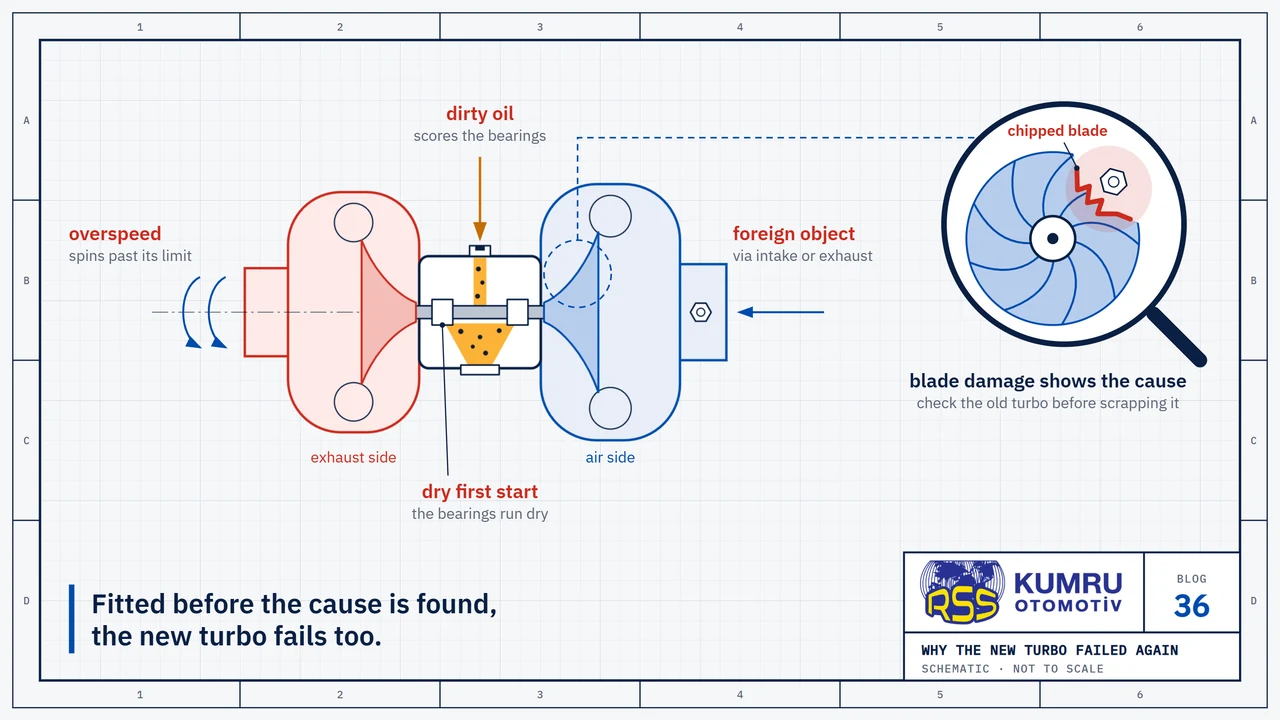
The turbo is at fault when play exceeds the service limit or the wheels have touched the housings. MAHLE adds a third case: particles in dirty oil wear the turbo’s own piston rings until they no longer seal, and oil enters the turbine side.
A leak left alone ends there too. Melett notes that the escaping oil carbonises behind the turbine wheel and the turbo fails. A new turbo on the same blocked pipe or clogged breather then leaks as the old one did.
Sources
- MAHLE Aftermarket, “Turbochargers: Damage scenarios, causes, remedies, and avoidance”, turbocharger damage brochure, English edition, March 2024.
- Isuzu, “Service bulletin IB14-J-002B: Oil in the Intake – Turbocharger Inspection”, service bulletin, October 2021; from the NHTSA archive; N-Series and F-Series diesel vehicles.
- Melett, “Common turbo failure – oil leaks”, Melett technical page, undated.
- Melett, “Why turbos fail: specific failures by turbo number”, Melett technical pages, undated.
- Garrett Motion, “Turbocharger Oil Drainage”, Garrett Knowledge Center, performance section, undated.
Sources were checked again on October 8, 2026.
RSS Kumru Automotive
RSS Kumru Automotive was founded in 1990 and specialises in hydraulic systems and fluid management. Our range includes more than 140 turbo oil feed and return line references.
Brand names and OEM reference numbers are used for identification and compatibility information only.