The banjo filter in the 1.6 HDi / TDCi turbo oil feed pipe: keep it or remove it?
- Author
- Talha Kırmızıaslan
- First published
- First published:
- Last updated
- Last updated:
- Reading time
- 6 min read
- Category
- Turbo oil lines
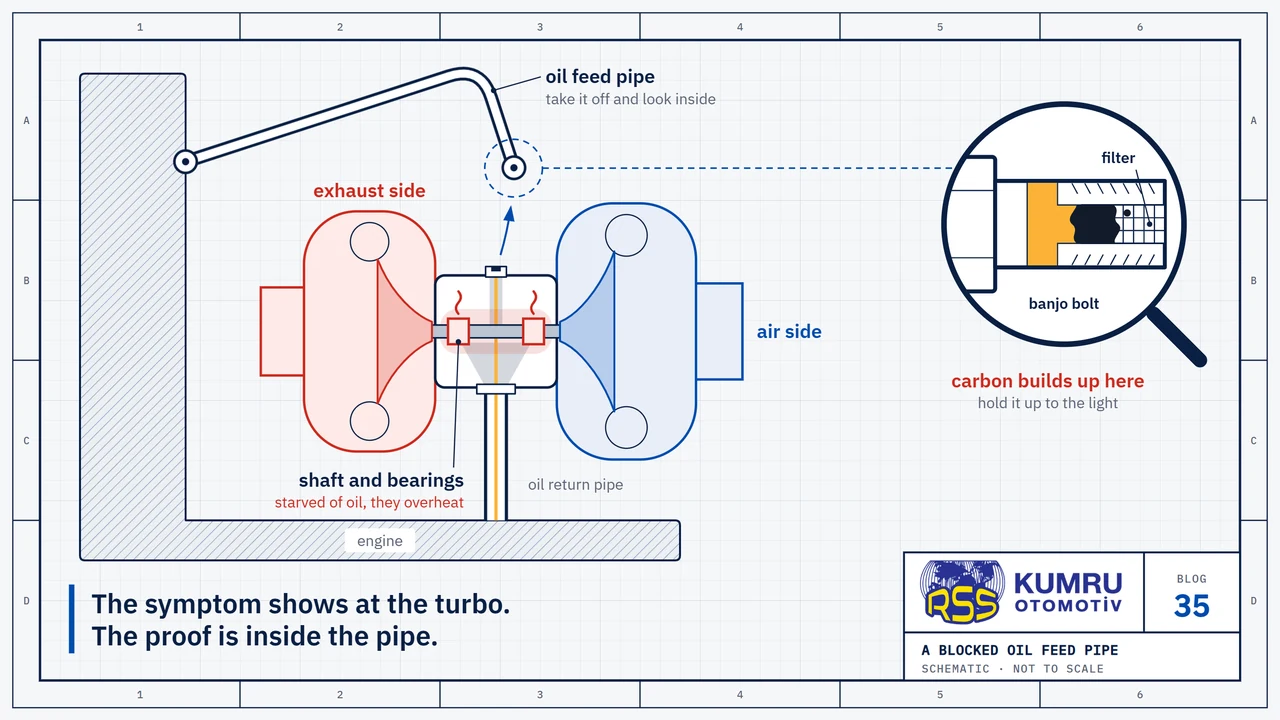
On the PSA 1.6 HDi engine (Ford’s 1.6 TDCi), the banjo bolt of the turbo oil feed pipe carries a small gauze filter; when it blocks, the turbo runs short of oil. Two turbo suppliers want it out when the turbo is replaced. The vehicle maker’s service note, as relayed on a forum, fits a larger one instead. Removing it with a healthy turbo is workshop practice, not a written instruction.
Short answer
- Fitting a replacement turbo: the feed pipe and banjo bolts are renewed. Nissens specifies a bolt with no filter; BTN Turbo has the filter removed after the first run.
- Vehicle manufacturer: the service note relayed on the forum moves to a bolt with a larger, removable strainer. We could not see the original.
- Healthy turbo: taking the filter out is field practice, and workshops are split.
Where is the banjo filter, and why is it there?
The filter sits inside the lower of the banjo bolts on the feed pipe. That is how a garage owner who changes turbos on this engine every week places it on a UK forum for French cars; the particulate filter must come off to reach it. His photo of the early type is captioned “smaller than your little finger nail”.
The vehicle maker put it there. Melett, which makes turbo repair parts, notes that PSA “installed a filter on the oil feed pipe to the turbo” so the engine performs efficiently. Nissens’ fitting guide lists the same engine for Fiat, Ford, Mazda, Mini and Volvo.
Why does the filter block?
Soot in the oil blocks the banjo filter. Reports reaching Melett point to lower-grade oil and a low oil level raising the soot content: “This soot can block the filter installed in the turbo supply pipe, the oil cooler and main filter, causing the turbo to fail.” Melett puts the onset “from 45,000km onwards if the oil level is low”. Symptoms and checks have their own article.
What do turbo suppliers say about the filter?
Of the three turbo suppliers’ documents we read for this engine, two take the banjo filter out and the third does not mention it. Nissens is the plainest: its twenty-step guide for this engine says “this special fitting guide is mandatory” and lists among the parts to replace:
“Banjo-fitting bolts – use bolt without the mesh filter inside (dismount and scrap the filter if attached)”
Nissens, Specific Installation Guide for PSA DV6 engines (turbo models 93037 and 93061)
BTN Turbo’s DV6 check-list, published in Professional Motor Mechanic, takes a different route. First: “Turbocharger oil feed pipe & banjo bolts must be replaced.” Then, near the end: “Engine should be run for 20 to 30 minutes then the oil and filter must be changed and the filter in the banjo bolt removed.” BTN gives no reason. Our inference: the filter stays in as a trap while loosened carbon is circulating.
On the feed line, MAHLE’s Technical Messenger says only “Install a new oil inlet line with new hollow bolts”. The filter is not mentioned.
| Who | Kind of document | What it says about the filter |
|---|---|---|
| Nissens | Turbo supplier, fitting guide | Bolt with no filter; any filter found is scrapped |
| BTN Turbo | Turbo specialist, check-list | New bolts; filter out after a 20 to 30 minute run and an oil change |
| MAHLE | Turbo supplier, technical bulletin | New pipe, new bolts; no mention of the filter |
| Vehicle manufacturer | Service note, as relayed on a forum | Early bolt replaced by one with a larger, removable strainer |
| Forum garages and owners | Field practice | Two views: remove it everywhere; keep the new-style strainer |
The first three rows apply when a turbo is being replaced.
None of the three treats the bolt or its filter as a job in itself. The line sits inside a long sequence: sump off and cleaned, oil pick-up strainer renewed, engine flushed. BTN also has oil delivery measured on this engine, at the return pipe: “60 seconds of idle should produce at least 0.3 Litres of oil”. Nissens and MAHLE both make their warranty conditional on the sequence.
What does the vehicle manufacturer say?
We could not open the vehicle manufacturer’s own document on the 1.6 HDi banjo filter. In the technical note relayed on the forum, the manufacturer does not delete the filter; it changes the bolt. Two members, six years apart, quote the same modification from the manufacturer’s service system: “Replacement of the lower banjo bolt on the turbocharger lubricating pipe with a banjo bolt that has a removable, larger-capacity, strainer filter.”
As transcribed there, the early bolt with its fixed strainer is replaced whenever the turbo is off. The new type is inspected and, if clogged, replaced together with its bolt.
The same thread says the maker’s servicing documentation once advised that the strainer “be removed with a screwdriver ‘if fitted’ during servicing”. One member who relays the note reads that step as “a reminder to take the old assembly off and replace with the new modified part”. Without the original we cannot say which reading is right.
Nor is the date settled. One member believes the new bolt came in from 24 October 2005; another thought it was 2009. Which bolt an engine has is for the manufacturer’s service data to say, by VIN, or for the bolt itself once it is out.
What do workshops actually do?
The field is split: on the same forum, garage owners and car owners fall into two camps. The same garage owner is firm: “We change one or two turbos a week on this engine, and have NO comebacks with filter removed.”
The opposing view: with no filter, a blocked strainer cannot starve the turbo, but “small particles of carbon could be pumped directly to the turbo bearings”. The member who wrote that argues that carbon breaking away after the main filter ends up in the bearings or in the strainer, so the new-style strainer “is probably better than having no filter at all”. His own, at about 90,000 miles, “was still as clean as whistle”.
The forum also says Garrett recommends removing the filter on higher-mileage cars. The video cited is no longer available, and we found no document for this engine on Garrett’s website. Forum posts show what workshops have seen; they do not replace instructions.
What should you do?
- If you are fitting a replacement turbo, read the instructions in the box together with the vehicle’s service data; Nissens wants its guide used “as well as with any specific car manufacturer instructions issued for the vehicle”. If they differ on the filter, no document we read says which prevails. Ask the turbo supplier in writing.
- Look inside the new bolt. Nissens describes a bolt with no filter; one forum member reports taking the filter out of a new bolt he bought.
- If the turbo is healthy and the bolt is out, check which strainer it has and how clean it is. For the early fixed type, the relayed manufacturer note points to the new bolt. Running with no filter at all is field practice.
- Do not treat the filter as the only cause. As Melett notes, the same soot can block the oil cooler and the main filter. BTN says the risk is reduced by following every step of its list.
Sources
- Nissens A/S, “Specific Installation Guide: Nissens Turbo Models 93037, 93061 (PSA DV6 engines)”, engine-specific fitting guide; undated, PDF file created September 2018; Internet Archive copy.
- BTN Turbo, “Turbo charger fitment check-list”, Professional Motor Mechanic, 27 January 2016.
- MAHLE Aftermarket, “Technical Messenger 1/2014: Peugeot DV6 turbocharged engines, essential steps for long-lasting damage repair”, technical bulletin, issue 1 of 2014; copy in the TechTips archive.
- Melett, “Why turbos fail: specific failures by turbo number”, Melett technical pages, undated.
- French Car Forum, “1.6 Hdi / DV4 / DV6 turbo feed modification”, forum thread, 152 posts, December 2013 to April 2026; posts quoted date from 2013 to 2019; used for field practice and for the manufacturer note as relayed by members.
Sources were checked again on October 8, 2026.
RSS Kumru Automotive
RSS Kumru Automotive was founded in 1990 and specialises in hydraulic systems and fluid management. Our range includes more than 140 turbo oil feed and return line references.
Brand names and OEM reference numbers are used for identification and compatibility information only.