The new turbo failed again: what to check besides the oil pipes
- Author
- Talha Kırmızıaslan
- First published
- First published:
- Last updated
- Last updated:
- Reading time
- 6 min read
- Category
- Turbo oil lines
When a replacement turbo fails soon after going on with new oil pipes, it is most likely not to blame: whatever killed the first one is still on the engine. Four places remain: the oil, debris left in the intake and exhaust, whatever spins the turbo past its design speed, and the first start. The old turbo usually shows which.
Short answer
- Oil: fitted without cleaning the sump, a turbo runs on the old oil’s abrasives.
- Air and exhaust paths: swarf and oil from the old turbo stay in the intercooler, hoses and manifold and reach the new one later.
- Overspeed: a remap, vanes stuck with soot or a faulty control spins the turbo beyond its limit.
- First start: an unprimed turbo runs its bearings dry until oil arrives.
Why does a turbo fail again when the oil pipes are new?
The pipe is only one thing that kills a turbo; while the others remain, the new one fails too. MAHLE’s turbocharger damage brochure warns early on:
“A successful repair depends on analyzing and eliminating the cause of the failure. Otherwise, the new turbocharger might fail again after a short period of time.”
MAHLE Aftermarket, turbocharger damage brochure, March 2024
BTN Turbo, a UK distributor, says that when a customer reports “the turbo’s packed up”, the cause “will almost certainly be elsewhere in the engine”. Garrett’s installation guide lists the areas to check: foreign objects, lack of lubrication, oil contamination, over-speeding and excessive temperature. New pipes, banjo bolts and washers close one route to one of these: lack of lubrication.
What does the failed turbo tell you?
The marks on a failed turbo’s wheels and shaft usually show what killed it, so look before throwing it away.
| Seen on the turbo | Points to | Look at first |
|---|---|---|
| Grooved bearing bushings, shaft worn at the bearings | Particles in the oil | Sump, oil, filter, intercooler |
| Damaged compressor wheel vanes | Object drawn in through the intake | Air filter, filter housing, intake hoses |
| Damaged turbine wheel inlet edges, bent variable-geometry vanes | Fragments from the engine or manifold | Valves, piston rings, inside the manifold |
| Small dents on the back of the compressor wheel, burst wheel | Overspeed | Mapping, vane mechanism, control system |
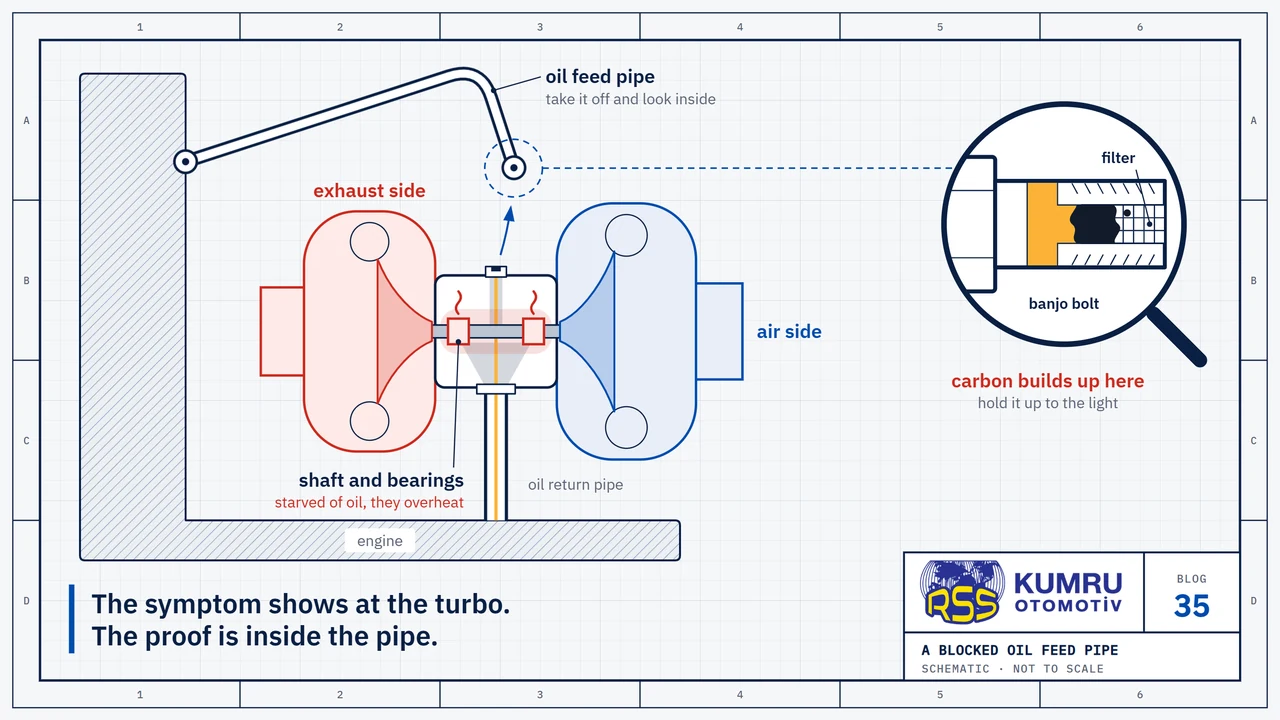
| Shaft discoloured by heat | Lack of lubrication | Oil level, feed line, inlet gasket |
Source: MAHLE turbocharger damage brochure, March 2024; summary ours.
The brochure’s sections on lack of lubrication, contaminated oil and overspeed all end with a wheel touching its housing. The brochure does not say so, but it follows that a rubbed wheel alone does not name the cause.
What should be checked in the sump and the oil filter?
An oil and filter change alone may not leave the oil clean. MAHLE: “Even the smallest particles in the oil can cause serious damage to the turbocharger due to its extremely high rotational speeds.” It lists the routes: on an overdue service the filter cannot cope and dirt passes its open bypass valve; a worn engine sheds metal; fuel or water dilutes the oil.
BTN’s instruction for the Ford Transit 2.5LD points at the sump: “Abrasive contaminants collect in the sump, so the turbo suffers both a lack of supply and bearing damage.” It recommends removing and cleaning the sump and replacing the oil strainer and feed pipe with the turbo.
Melett reports finding contaminants in the oil of failed units “despite the oil being changed during the installation process”. One possible cause is the turbo repair itself: a poorly cleaned bearing housing lets shot-blasting beads into the oil feed. With debris present, it “can take only a matter of seconds for a new turbo unit to fail”.
Where do objects in the intake or exhaust come from?
Debris reaching a new turbo is most often left from the previous failure: swarf and oil from the old unit stay in the intercooler and hoses. MAHLE: “Accumulated engine oil, chips, or fragments from previous damage usually find their way into the engine with a time delay.” Blown into the intake and burnt, MAHLE adds, that oil sends the engine into uncontrolled overspeed.
The sources differ on the remedy. MAHLE wants a new charge air cooler and air filter with every replacement turbo, and the filter housing and charge air path vacuum-cleaned. Garrett and Melett also want a new filter and clean air pipes, but neither mentions the intercooler.
Objects also enter from outside. BTN: “A small item, such as a nut or a washer, can quickly do a significant amount of damage to turbocharger vanes.” For the VAG 1.9TD it advises removing the intake and breather pipework between turbo and air filter box and looking inside. Exhaust-side fragments come from the engine: MAHLE cites a torn-off valve and fractured piston rings, which pass through the manifold and hit the variable-geometry vanes and turbine wheel.
How does overspeed destroy a turbo?
A turbo’s parts are designed for a defined speed range. Beyond it, MAHLE says, “major turbocharger damage can occur within seconds”. The brochure names three causes: tuning, variable-geometry vanes jammed by carbon in their low-speed position, and a defective or leaking pneumatic or electronic control.
Garrett comes at it from the fitting side: none of the turbo’s settings may be changed. On a variable-geometry (VNT) turbo, check a pneumatic actuator’s hoses or, for an electronic one, the vehicle wiring loom and connectors, because “water leakage or broken wires are quite common”.
BTN gives an exhaust-side example: on the Vauxhall (Opel) Astra, Corsa, Combo and Meriva 1.7D, soot makes the EGR valve stick, “rapidly leading to turbocharger damage”. It does not explain the mechanism; it advises removing the exhaust manifold, checking for soot, and cleaning or replacing the valve.
How do you prime a turbo before the first start?
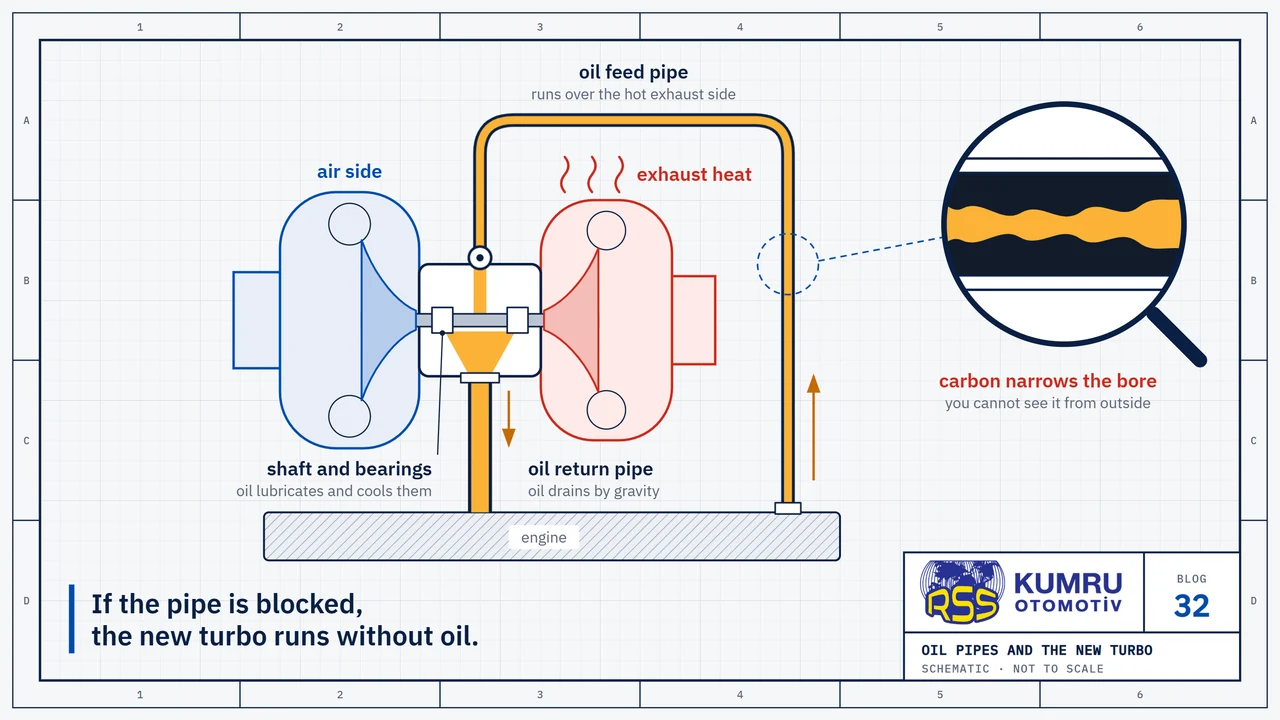
The turbo is filled with clean oil before the feed pipe is bolted on. Melett explains: “During start-up of the engine after installation, there is a short delay before oil reaches the turbo.” An unprimed turbo spends that delay dry, and its bearings wear.
- Oil filter. Garrett wants the new filter filled with clean oil where possible and, if accessible, the pressure line from pump to filter back-filled; on high-mileage engines it may empty during an oil change.
- Inside the turbo. Fill it through the oil inlet. Melett: “Using a syringe makes this much easier.”
- Gasket. Garrett wants the gasket’s centre hole “perfectly aligned” with the hole in the oil inlet flange, and advises against liquid sealant: excess material can enter the turbo, “reducing or stopping oil flow”.
- Cranking. In Garrett’s guide the engine is cranked for 10 to 15 seconds without starting, then idled for 3 to 4 minutes for leak checks, stopped, and the oil level rechecked.
Garrett’s guide does not say how to crank without firing; the vehicle’s service data does.
What should be done before a third turbo goes on?
Find the cause first, then work in this order.
- Read the old turbo. Compare its marks with the table.
- Oil circuit. Grooved bearings: as BTN asks on the Transit, remove and clean the sump and renew the oil strainer. New oil and filter always.
- Air path. New air filter; clean filter housing and hoses. For the intercooler, MAHLE’s instruction is a new one.
- Exhaust and control. After engine damage, look inside the manifold. Check the actuator, its hoses and wiring; count any remap among the causes.
- Fitting. Correct gasket, no sealant; filter and turbo filled with oil; first movement on the starter.
Sources
- MAHLE Aftermarket, “Turbochargers: Damage scenarios, causes, remedies, and avoidance”, turbocharger damage brochure, English edition, March 2024.
- Garrett Motion, “Garrett Turbocharger Installation Guide, Part 1”, Garrett Knowledge Center, rules to follow before installation, undated.
- Garrett Motion, “Garrett Turbocharger Installation Guide, Part 2”, Garrett Knowledge Center, installation steps and first start, undated.
- Melett, “Turbo refitting”, Tech Tips page in Autobiz magazine, October 2016; by Gary Brook, Technical Engineer at Melett.
- BTN Turbo, “The top reasons for turbo failures”, Professional Motor Mechanic, 24 July 2015.
Sources were checked again on October 8, 2026.
RSS Kumru Automotive
RSS Kumru Automotive was founded in 1990 and specialises in hydraulic systems and fluid management. Our range includes more than 140 turbo oil feed and return line references.
Brand names and OEM reference numbers are used for identification and compatibility information only.