Mini Cooper S (R56, N14) turbo oil feed line leak: why it leaks and what to check when replacing it
- Author
- Talha Kırmızıaslan
- First published
- First published:
- Last updated
- Last updated:
- Reading time
- 6 min read
- Category
- Turbo oil lines
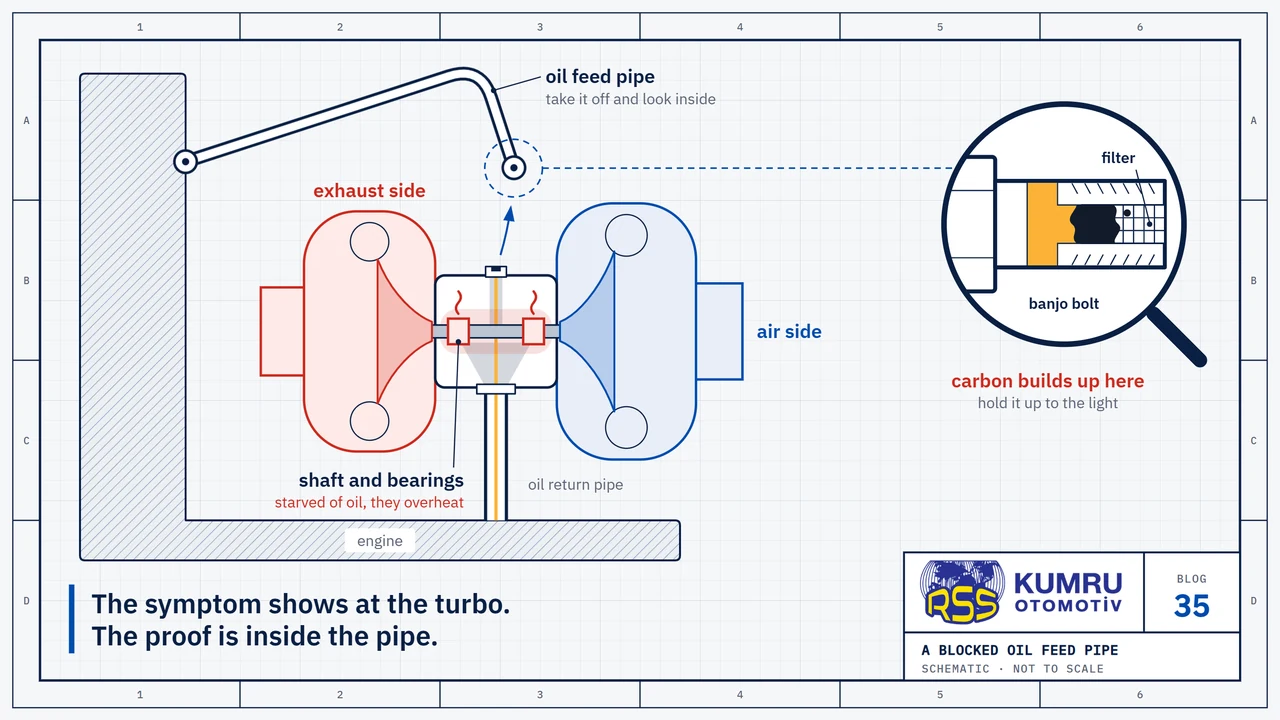
On the N14 engine of the R56 Mini Cooper S, the turbo oil feed line runs from the block to a banjo bolt on the turbocharger, right beside the turbo. In the field the leak is placed at the banjo end, where an O-ring seals a rotating joint and dries out with heat. The same heat can bake the oil inside the line. The O-ring cannot be changed alone: the whole line is replaced, with new sealing washers and its heat shield.
Short answer
- Where it leaks: the O-ring-sealed rotating joint at the banjo end. A line that turns in its fitting is not a fault in itself.
- Signs: burnt oil residue on the turbo housing, a smell of burning oil, smoke once the leak has grown.
- Replacement: new line, new sealing washers, heat shield. Torque comes from the workshop manual.
Where does the oil feed line run on the N14?
On the N14 the turbo oil feed line is a shaped steel pipe held by a banjo bolt at each end: the lower end on the block, next to the oil cooler, the upper end on the turbocharger. Pelican Parts’ turbocharger replacement article for the R56 places the turbo at the front of the engine, under a heat shield.
The vehicle maker’s service bulletin for the N14 (R55, R56 and R57) gives the cause in one line: “Close proximity of the turbocharger engine oil supply line and the turbocharger”.
Why does the feed line leak?
In the accounts we read, the N14 feed line leaks at the joint on its banjo end, not through the tube. Pelican describes “a rotating banjo fitting sealed with an O-ring”: the tube can turn inside the fitting, and that rubber ring is what keeps the oil in.
The turbo remanufacturer Carwood describes what happens to O-rings on feed pipes in general:
“Over time, they can dry out and become brittle, leading to oil seeps and leaks”
Carwood, in Professional Motor Mechanic, 27 May 2021
On a Mini owners’ forum the same is said of this line: the fitting is swaged onto the tube and relies on an O-ring, which dries out as the line heats and cools.
In the same thread an owner finds the line can be moved by hand. One member answers “It should not be loose whatsoever”; another writes that a technician showed him new parts that moved the same way. Pelican’s description fits the second view. Our reading: a line that turns in its fitting is not a fault in itself; oil around the joint is.
What are the signs of a leaking feed line?
The first trace of a feed line leak is on the turbo, not on the pipe. In another thread on the same forum an owner asks why oil shows around the banjo bolt while the pipe is dry. The answer: oil is under pressure, so “it’s not leaking as much as it’s misting”; most of it settles on the turbo housing and burns off, leaving a residue.
The second sign is smell. A member whose block-side joint was not quite tight describes oil weeping onto the downpipe and “a noxious smell”. The other thread adds that a leak left alone gets worse and may smoke.
The official list of warning signs we have is for a different engine. A recall report filed with the US regulator NHTSA in 2024 covers the oil feed line on another manufacturer’s 3.3-litre turbo engine, which deteriorates in the radiant heat of the exhaust manifold. It lists “Oil leak, burning smell, white smoke from engine compartment” and the oil pressure warning light.
Do not keep driving with a smell of burning oil or smoke from the engine bay. The same report states the risk: an oil leak, “in the presence of hot exhaust components, increases the risk of an engine compartment fire while driving.” Look for the leak with the engine and exhaust cold.
What does a leaking or restricted line do to the turbo?
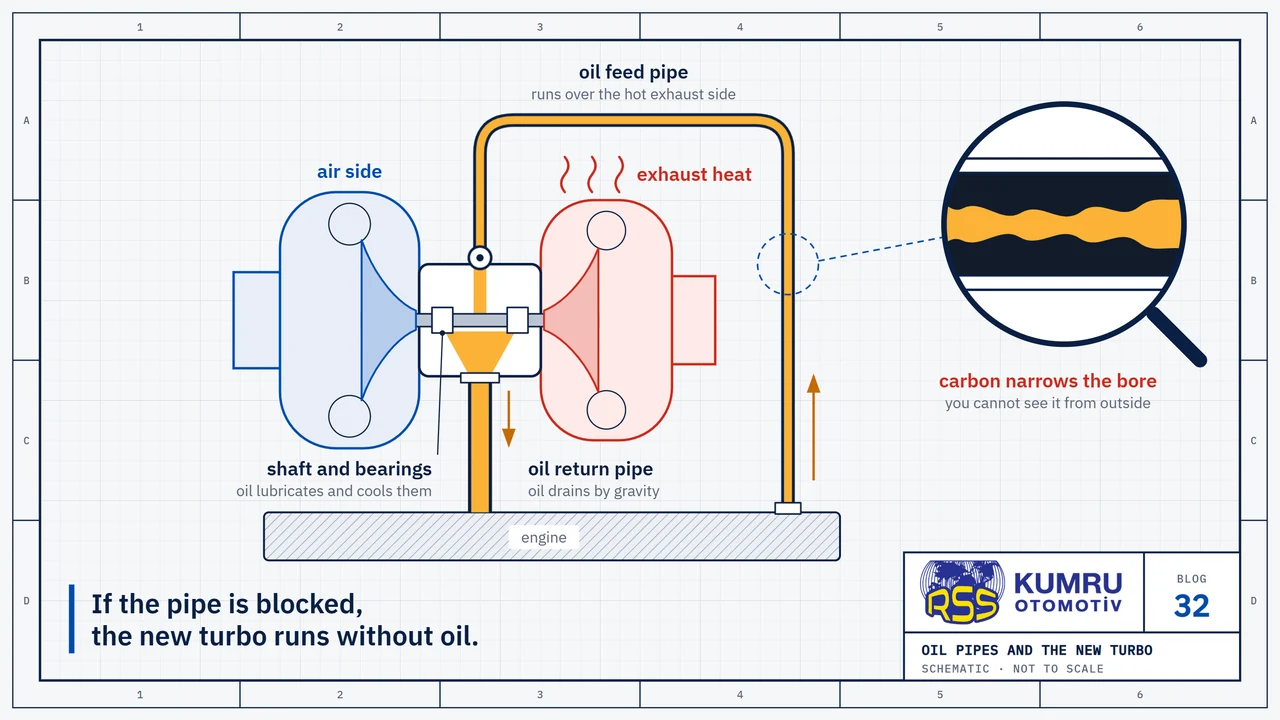
A feed line starves the turbo in one of two ways: the oil escapes, or it bakes inside the line and narrows it. The vehicle maker’s bulletin describes the second:
“After switching off the engine, the heat radiating from the turbocharger may cause the engine oil to solidify in the oil supply line to the turbocharger.”
MINI (BMW of North America), Service Information SI M11 05 13, October 2013
The result, the bulletin says, can be a restriction in the line and damage to the turbocharger bearings. A service note on the same engine in Underhood Service magazine, credited to ALLDATA, gives the customer’s complaint as “loss of performance and turbocharger noise” and the end point as oil starvation and a seized turbocharger.
Carwood treats a leak and a blockage alike: either one restricts the oil supply, and “even a momentary restriction” can severely damage the turbo. Symptoms and tests for a restricted line are in our article on blocked feed pipes.
What does the vehicle maker say about the heat shield?
MINI’s October 2013 bulletin is a service action: certain N14-engined cars built from November 2006 to December 2009 get a heat shield on the turbo oil supply line. A smaller shield, if one is already fitted, is removed and discarded. The new shield has fabric insulation that wraps round the line and clips in place over the banjo bolt. Its part number is 11 65 7 634 747.
A car that has had it done carries a B-pillar label with code number 62 punched out. The bulletin was issued for North America; elsewhere a dealer can check coverage by VIN.
What should you watch when replacing the line?
- Replace the line, not the O-ring. The forum says the banjo end cannot be opened for a new O-ring: “the coupling is not serviceable”. Pelican adds that a refitted line leaks at that joint.
- Fit new sealing washers. The old one can stay stuck to the block. Material and reuse are covered in our article on banjo bolts and washers.
- Do not force the line. Carwood: “Never bend the pipe or use excessive force.” Where O-rings sit in movable connectors at the pipe ends, force can damage them.
- Position and torque. Pelican wants the new line clear of the engine and the oil cooler. Carwood wants both ends torqued to the vehicle manufacturer’s figures; see the workshop manual.
- Refit the heat shield. Then run the engine and check both ends.
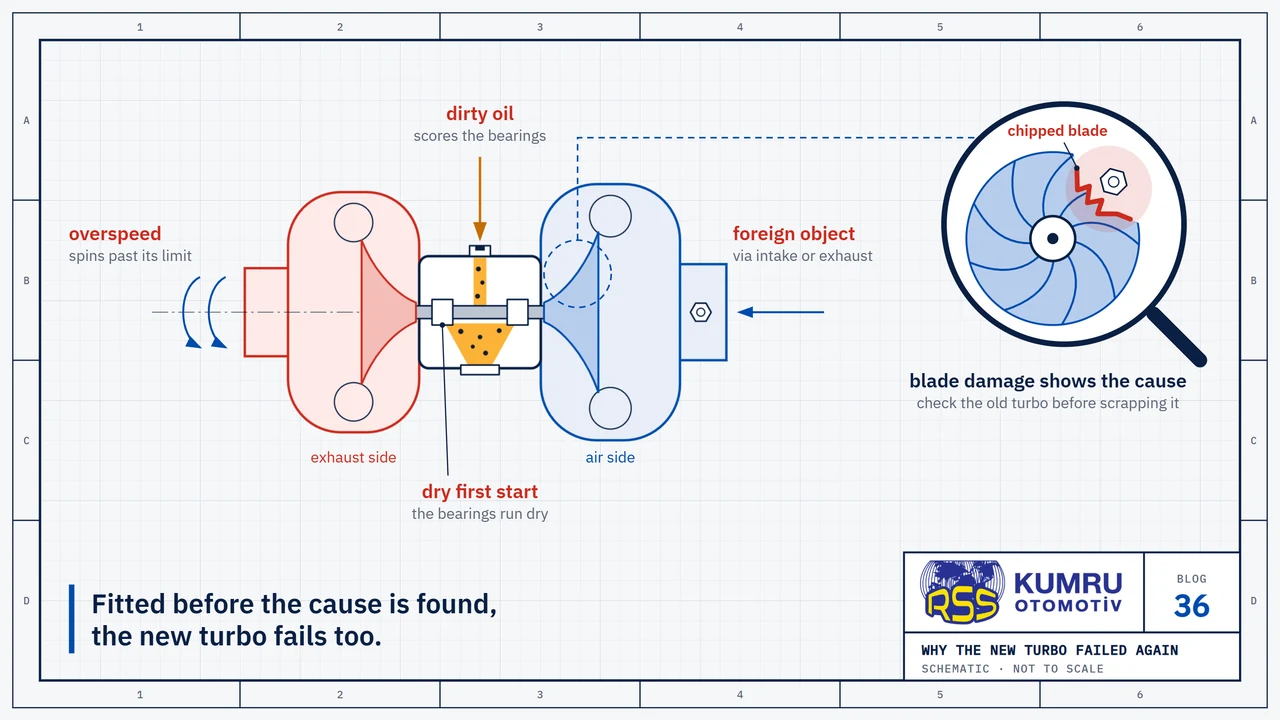
When the turbo itself comes off, the Underhood note sets the minimum: inspect the oil supply lines for blockage, collapse or kinks, and if there is a restriction replace them along with the engine oil and filter. Pelican and Carwood go further and recommend a new line every time; Pelican says the same of the return hose under the turbo. That is also the rule in our article on oil pipes at turbo replacement.
In what order should a mechanic look?
- Turbo housing and banjo bolt area. Look for burnt oil residue; a dry pipe does not clear the line.
- Block end and its neighbours. On the forum: the oil filter housing and oil cooler joint sits right next to the feed line’s block end, and oil on the front of the block just above the downpipe is likely to come from there.
- Valve cover. The same thread names it as the other common place for a leak.
- Heat shield. Is one fitted, and which one?
Sources
- MINI (BMW of North America), “SI M11 05 13: Service Action, N14 Engine Retrofit Turbocharger Engine Oil Supply Line Heat Shield”, service information bulletin, October 2013; from the archive of the US regulator NHTSA; R55, R56 and R57 with the N14 engine.
- Underhood Service, “MINI Turbocharger Failure Caused By Oil Supply Line Blockage”, trade magazine, service note credited to ALLDATA, 10 September 2015; Internet Archive copy.
- Carwood, “Why the oil feed pipe can fail”, technical article, Professional Motor Mechanic, 27 May 2021.
- NHTSA, “Part 573 Safety Recall Report 24V-169”, safety recall report, 1 March 2024; Kia America, turbo oil feed line on Stinger and K900 cars with the 3.3-litre turbo engine; a different engine, used only for the warning signs and the risk statement.
- Pelican Parts, “MINI Cooper R56 technical article: Engine Turbochargers Replacement”, parts retailer's technical article (by Nick Czerula); page last updated 22 October 2015; Internet Archive copy.
- North American Motoring, “07 turbo oil line loose?”, forum thread, 6 posts, 14–15 March 2014; Internet Archive copy; used for field accounts and the disagreement, not a manufacturer instruction.
- North American Motoring, “leaking turbo oil line”, forum thread, first page (25 posts), 14–28 July 2014; Internet Archive copy; used for field accounts, not a manufacturer instruction.
Sources were checked again on October 8, 2026.
RSS Kumru Automotive
RSS Kumru Automotive was founded in 1990 and specialises in hydraulic systems and fluid management. Our range includes more than 140 turbo oil feed and return line references.
Brand names and OEM reference numbers are used for identification and compatibility information only.