Blocked turbo oil feed pipe: symptoms, checks, and can you just clean it?
- Author
- Talha Kırmızıaslan
- First published
- First published:
- Last updated
- Last updated:
- Reading time
- 6 min read
- Category
- Turbo oil lines
A blocked turbo oil feed pipe has no symptom of its own. What the driver notices is a turbocharger running short of oil: less pull, black smoke under load, a change in turbo noise. Other faults produce the same signs, so the proof lies in the pipe itself and in the oil measured at the turbo. On cleaning, the turbo makers themselves give two answers.
Short answer
- Symptoms: loss of power, black smoke, a change in turbo noise. None points to the feed pipe alone.
- Proof: carbon in the pipe ends or banjo bolt, and oil pressure or flow at the turbo below the engine maker’s figure.
- On a stripped turbo: a heat-blued shaft shows lack of lubrication, not its cause.
- Cleaning: with a replacement turbo, fit a new pipe. Otherwise, refit only a pipe you can see through.
What are the symptoms of a blocked turbo oil feed pipe?
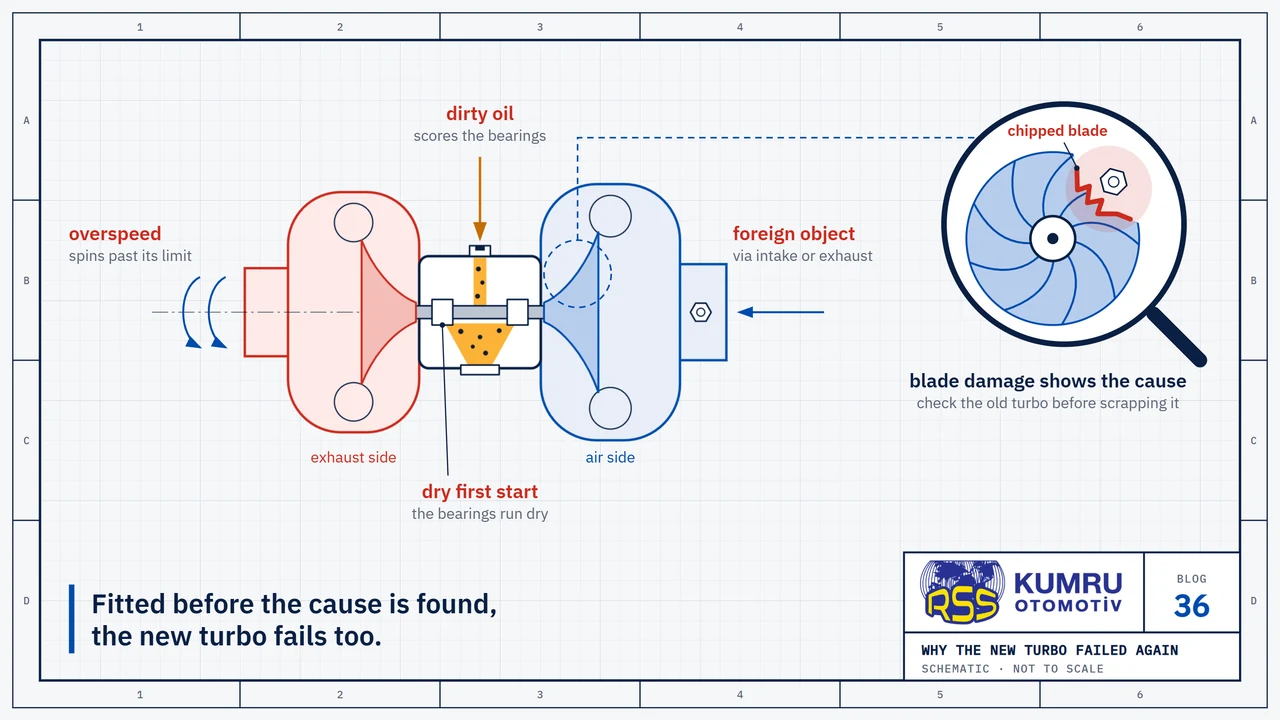
A blocked feed pipe shows up as a turbocharger short of oil: low boost, a flat engine, black smoke. MAHLE’s turbocharger damage brochure gives the chain. With too little oil, mixed friction starts between the shaft and its bearings, and “the rotating assembly no longer reaches the maximum speed and can no longer build up full pressure as a result”. Short of air, the engine runs rich and smokes black.
The pipe need not be shut for this. Melett, which makes turbo repair parts, calls it a misunderstanding that a starved turbo has no oil in it: “the oil that is present is not enough to do the job required”. Oil appearing at a loosened union therefore does not clear the pipe.
| Sign | Can it be the feed pipe? | What else causes it |
|---|---|---|
| Low boost, black smoke | Yes. Bearing friction slows the shaft | Restricted exhaust, air mass flow meter, cracked intake ducting |
| Whistling | Not directly | Gasket fitted the wrong way round, leaking charge air hose |
| Blue smoke, oil in the intake | Not the first suspect | Blocked or kinked return pipe, overfilled sump, crankcase pressure |
Sources: MAHLE turbocharger damage brochure (March 2024) and MAHLE Technical Messenger 2/2014.
Does a whistling turbo mean the feed pipe is blocked?
A whistling turbo does not by itself mean a blocked oil feed pipe; a whistle is first an air noise. MAHLE’s Technical Messenger traces whistling straight after a turbo change mostly to assembly: “A gasket inserted the wrong way around”, or a charge air hose that lets air escape.
The bulletin names one more source: an impeller striking its housing, “audible as ‘scratching’ or whistling”. Worn bearings end there too: the brochure describes worn bushings letting the shaft wobble until a wheel touches the housing. Shaft play you can feel at that stage means the bearings have gone, and the question is what starved them.
What does a turbo that ran short of oil look like inside?
A turbo that ran short of oil carries heat marks on its shaft. MAHLE’s bulletin lists the clear indications of inadequate lubrication as a loose nut on the impeller, a broken shaft “or discolouration due to high temperatures”. Melett sees the same on the repair bench: material transfer and discolouration on the shaft journals and the thrust parts.
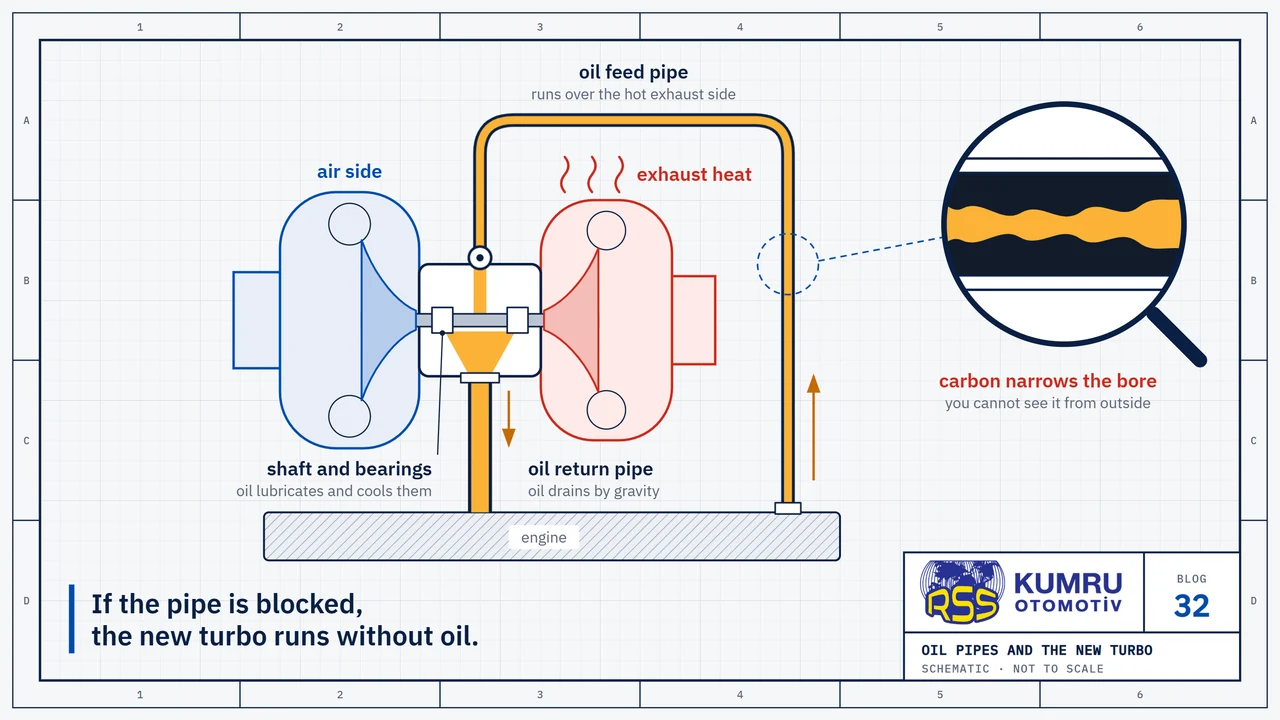
A blued shaft proves starvation, not the restriction behind it. Melett’s list of causes runs from a low sump and a neglected filter to silicone on the inlet gasket, a kinked pipe and “carbon deposits in the oil feed pipe”. All leave the same marks, so the pipe needs its own inspection.
How do you check whether the feed pipe is blocked?
A feed pipe is checked by taking it off and looking, then by measuring the oil that reaches the turbo with the engine running. BTN Turbo, writing about the PSA 1.6 HDi, notes that carbon sludge is easy to see in the sump, the oil pump and the strainer “but harder to detect internally”.
- Pipe ends and banjo bolts. A hard black crust in the bore is carbon. If the banjo bolt carries a filter, as on the 1.6 HDi BTN describes, hold it up to the light.
- Bends and gasket. A kink restricts flow as surely as carbon, and MAHLE warns that the feed bore can be narrowed “either by an incorrect flange seal or a liquid sealant”.
- Oil at the turbo. Nissens gives two checks at idle: “measuring the oil pressure at the feed line”, for which it quotes three to four bar, or checking the flow with the drain line disconnected.
Nissens states no quantity for the flow test and we give none: no source we read publishes one that holds across engines. The yardstick is the vehicle manufacturer’s service data, which also overrides Nissens’ pressure range. With the drain line off, catch the oil and keep it away from the hot manifold.
Can you just clean the pipe?
On cleaning a feed pipe the sources split. Nissens writes that “best practice is to install new oil feed and drain lines”. BTN is blunt about the 1.6 HDi: “As carbon can easily block the oil feed pipes, they must be replaced.” Yet Melett’s list for preventing lubrication failures includes “Clean or replace oil inlet pipes”, and Nissens leaves the same door open:
“If the lines are reused however, they must be thoroughly cleaned and be free of any inner restrictions, as well as having no bends or surface abrasions.”
Nissens Automotive, in Professional Motor Mechanic, 5 October 2026
Both camps want a pipe with nothing in its bore. They differ on whether a workshop can prove it. A short rigid pipe that can be sighted through can be proven clear. One with tight bends, banjo ends or a braided section cannot.
Workshops clean feed pipes all the same, for practical reasons: the turbo is still healthy, the pipe is not in stock, the vehicle has to leave today. That is defensible where the whole bore can be inspected. Where it cannot, a new pipe is the smaller risk.
Where does the carbon come from?
The carbon in a feed pipe comes from overheated oil, and MAHLE names two routes. An oil that is “not sufficiently heat resistant” forms more oil carbon, which can coke up the feed line and the oil bores of the bearing housing.
The other route is the driver: “If the engine was turned off while hot, the oil feed bore can become carbonized, restricting the supply of oil to the turbocharger.” MAHLE’s remedies follow: let the engine cool down at moderate speed after full-load driving, use only the oils the engine manufacturer specifies, keep to the service intervals.
Nissens adds the heat shields, which keep a line near the exhaust from coking and must go back on after a repair. Good servicing lowers the risk without removing it. BTN reports a 1.6 HDi, dealer-serviced at the correct intervals, that still “suffered two turbo failures in just 110,000 miles”.
What should you do?
- The turbo is being replaced: fit a new feed pipe with new banjo bolts and washers, and find out first what starved the old turbo.
- The turbo works but the signs are there: check the air side and the exhaust, measure the oil at the turbo, then take the pipe off.
- Carbon in the pipe, turbo healthy: replace any pipe you cannot see through. Change the oil and filter and check the heat shield.
- The shaft is already blue: a new pipe protects the next turbo, not this one.
Sources
- MAHLE Aftermarket, “Turbochargers: Damage scenarios, causes, remedies, and avoidance”, turbocharger damage brochure, English edition, March 2024.
- MAHLE Aftermarket, “Technical Messenger 2/2014: Trivial Pursuit, the search for the turbo culprit”, technical bulletin, issue 2 of 2014.
- Melett, “Why do turbo failures occur? Insufficient Lubrication”, Melett technical pages, undated.
- Nissens Automotive, “Step-by-step turbocharger replacement”, Professional Motor Mechanic, 5 October 2026.
- BTN Turbo, “Tackling Turbo Trouble: PSA 1.6 HDI Engine”, Professional Motor Mechanic, 3 November 2017.
Sources were checked again on October 8, 2026.
RSS Kumru Automotive
RSS Kumru Automotive was founded in 1990 and specialises in hydraulic systems and fluid management. Our range includes more than 140 turbo oil feed and return line references.
Brand names and OEM reference numbers are used for identification and compatibility information only.