Replacing brake hoses: the order of work, how long it takes and what drives the cost
- Author
- Talha Kırmızıaslan
- First published
- First published:
- Last updated
- Last updated:
- Reading time
- 6 min read
- Category
- Cars and light commercials
A brake hose is replaced by undoing the pipe nut at the body end and the banjo bolt or screw-in fitting at the caliper. The new hose goes on without twist, a banjo joint gets new washers, and the brakes are bled. The carmakers’ documents we opened allow 0.5 to 0.6 hours for one hose on a RAM ProMaster and about 90 minutes for four on a Subaru. The cost depends on the number of hoses, labour, brake fluid and parts damaged during removal.
Short answer
- Order: the pipe nut comes off first; on refitting, the caliper end goes on first and the pipe nut is tightened last.
- Time: 0.5–0.6 hours for one hose, 1.3–1.4 for four, in carmakers’ documents for nearly new vehicles.
- Cost: parts, labour, fluid and bleeding; a seized pipe nut adds to it.
- If it bursts: that circuit holds no pressure, the other still brakes, and the stopping distance grows.
How is a brake hose connected at each end?
One end of a brake hose joins the steel brake pipe on the body, the other the caliper. At the body end the pipe’s flare nut screws into the hose fitting, which sits in a bracket and is held by a clip.
The caliper end depends on the vehicle. In the brake systems module of Turkey’s Ministry of National Education (MEB) and in Subaru’s service bulletin for the 2017–18 Impreza and 2018 Crosstrek, a banjo bolt with washers holds the hose to the caliper. In FCA’s dealer instructions for the 2014 RAM ProMaster the hose end screws straight into the caliper, and no washer is mentioned.
What matters when the new hose goes on?
The new hose must sit without twist and must not touch the suspension on full lock in either direction. Suzuki’s Vitara service manual wants the front hose fitted with the steering wheel straight ahead and with “no twist or kink”, then adds:
“Check to make sure that hose doesn’t contact any part of suspension, both in extreme right and extreme left turn conditions. If it does at any point, remove and correct.”
Suzuki, Vitara Service Manual, March 1991
Washers are used once. The MEB module’s rule: “Do not reuse the brake hose washers.” Subaru gives the reason: a new washer stacked on an old one leaks.
Torque differs by vehicle: the pipe flare nut is 15 Nm on the Subarus, 18 N·m on the ProMaster and 14–18 N·m on the Vitara; Subaru’s banjo bolts take 26 Nm. Yours is in the service data.
How long does it take to replace brake hoses?
Two carmakers’ documents state the labour time allowed to the dealer: FCA gives 0.5 to 0.6 hours for one hose on the ProMaster and 1.3 for all four; Subaru gives 1.4 hours for four.
| Vehicle | Job | Time |
|---|---|---|
| ProMaster | One front hose | 0.6 hours |
| ProMaster | One rear hose | 0.5 hours |
| ProMaster | Both front hoses | 0.9 hours |
| ProMaster | Both rear hoses | 0.8 hours |
| ProMaster | Four hoses | 1.3 hours |
| Subaru | Four hoses | 1.4 (owner letter: approximately 90 minutes) |
Sources: FCA instructions P03 (March 2014), Subaru bulletin WUR-03R (November 2019). The ProMaster times include a visual check of all four hoses; the check alone is 0.2 hours.
Both documents cover young vehicles: the ProMasters were built up to November 2013, the oldest Subarus in 2016. We opened no document giving a time for an older vehicle with rusted pipe nuts; the same two say what stretches the job.
- A seized pipe nut. Subaru has the flare nuts sprayed with silicone-free penetrant first, to avoid damaging the brake pipes. If the nut turns the pipe with it, follow the sequence in the seized line nut article.
- A falling fluid level. Below the MIN mark, Subaru warns, the master cylinder and the hydraulic control unit (VDC HCU) may need bleeding separately; with a manual gearbox the clutch is bled too.
What drives the cost of a brake hose replacement?
Five items make up the cost of a brake hose replacement; we give no prices, because they vary with the vehicle and the workshop.
- Parts. The hose is ordered by the part number in the vehicle’s catalogue; Subaru’s hose kit number differs even between the Impreza and the Crosstrek, and the ProMaster’s front and rear hoses are different parts. A banjo joint also needs new washers.
- Labour. A second hose does not double the time: 0.9 hours for both ProMaster fronts against 0.6 for one.
- Brake fluid. Both documents list it among the parts.
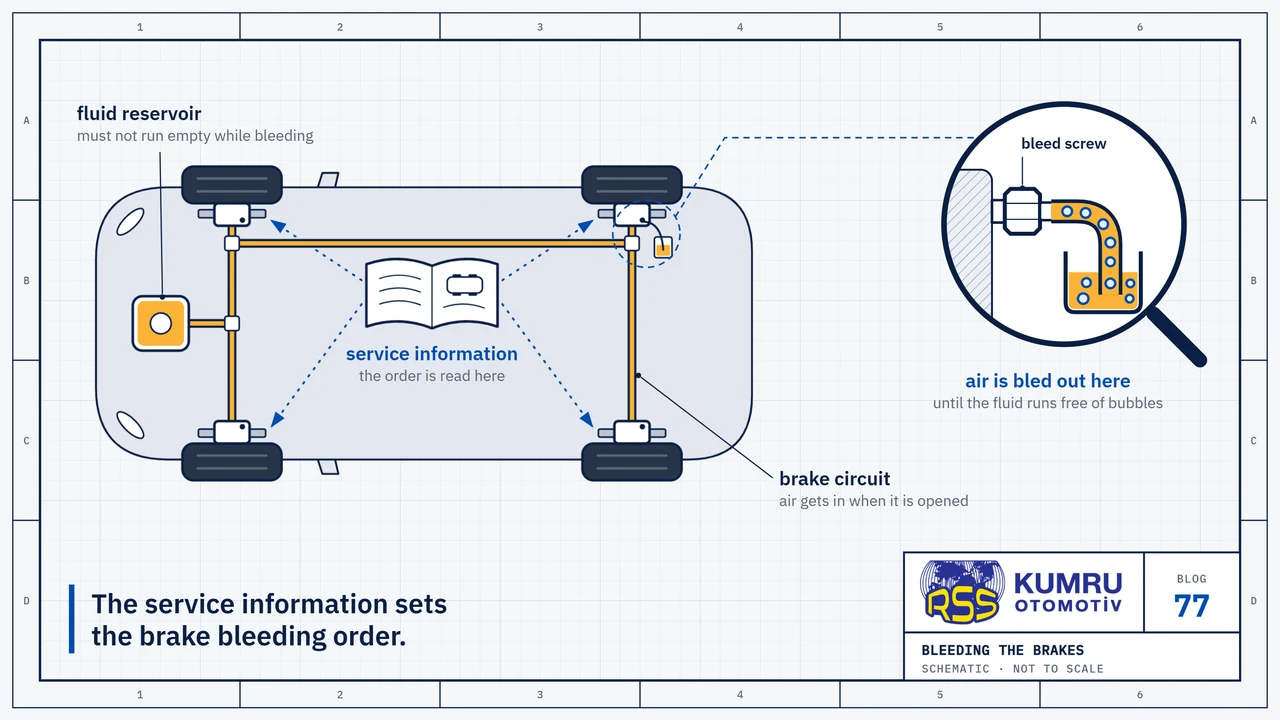
- Bleeding. It follows every hose change and grows if the reservoir ran low; the methods are in the brake bleeding article.
- Parts damaged during removal. A rounded nut, a twisted pipe, a broken bleed screw; FCA notes that the ProMaster’s front bleed screws break easily.
Neither document concerns a worn hose, and neither makes pairs a rule: FCA replaces only a hose damaged during vehicle assembly, Subaru all four because the fitting design had changed. Look at the other hoses before you decide; what to look for is in the brake hose inspection article.
What happens if a brake hose bursts?
When a brake hose bursts, its circuit cannot hold pressure and the vehicle brakes on the other circuit. In the MEB module, the hydraulic system of current vehicles is split into two lines and the reservoir into two chambers, so a leak in one circuit leaves fluid for the other.
In Suzuki’s manual, one master cylinder piston first travels without building pressure; only then does pressure rise in the remaining circuit. According to FCA, a damaged hose can leak fluid and lengthen the stopping distance.
In what order is a brake hose replaced?
The vehicle does not go back on the road until the brakes are bled and every joint is checked for leaks. FCA on a damaged hose: “This could cause a crash without warning.” Subaru ends the job with a road test; without a brake tester, the MEB module has the brakes tried in a safe driving area.
The sequence is common to FCA’s instructions and the MEB module. If your vehicle’s manual differs, follow the manual.
- Raise and support the vehicle, and remove the wheel.
- Keep the fluid in the reservoir. FCA holds the pedal down past its first 25 mm of travel with a holding tool; the master cylinder is isolated and the reservoir does not drain. Subaru replaces the hoses one at a time.
- Clean both fittings, then undo the pipe nut. Cap the open pipe; Subaru uses a rubber bleed screw cap.
- Remove the clips and take the hose off the caliper. Discard the old washers.
- Lay the new hose beside the old one. Length, both end fittings and the bracket position must match.
- Fit the new hose to the caliper first. New washers on a banjo joint, tightened to torque.
- Seat the hose in its bracket and connect the pipe nut. FCA’s note: “Do not tighten the flare nut at this time.” It is tightened once the hose fitting is clipped into the body bracket.
- Turn the steering to full lock both ways. Suzuki’s check: the hose must not touch the suspension.
- Bleed the brakes and top up the reservoir.
- Check every joint for leaks, refit the wheel and test the brakes.
Sources
- Chrysler Group LLC (FCA US), “Dealer Service Instructions for Safety Recall P03 / NHTSA 14V-034: Flexible Rubber Brake Hoses”, carmaker's dealer service instructions, March 2014; 2014 RAM ProMaster (vehicles built through 15 November 2013); sequence, torque and labour times; from the US regulator's public archive.
- Subaru of America, Inc., “Service Program Bulletin WUR-03R: Brake Hose Swelling Service Program”, carmaker's service bulletin, 12 November 2019, revised 20 November 2019; 2017–18 Impreza and 2018 Crosstrek; replacement of all four brake hoses, torque and labour time; from the US regulator's public archive.
- Suzuki Motor Corporation, “Suzuki Vitara Service Manual (99500-60A10-01E)”, carmaker's service manual, 1st edition, March 1991; brakes section, pages 5-9 and 5-26; OCR text of the Internet Archive scan, checked against the images of the two pages used.
- T.C. Millî Eğitim Bakanlığı, “Motorlu Araçlar Teknolojisi: Fren Sistemleri (modül)”, vocational training module of Turkey's Ministry of National Education, Ankara 2013 (in Turkish); sections 3.2 and 3.3 (dual-circuit system, reservoir) and section 5 (brake pipes and hoses, practical exercise).
Sources were checked again on October 13, 2026.
RSS Kumru Automotive
RSS Kumru Automotive was founded in 1990 and specialises in hydraulic systems and fluid management. Our range includes brake and steering hoses, turbo pipes and hoses, and oil pipes.
Brand names and OEM reference numbers are used for identification and compatibility information only.