Cab won’t tilt, won’t lower or creeps down: pump, cylinder or hose?
- Author
- Ufuk Şahin
- First published
- First published:
- Last updated
- Last updated:
- Reading time
- 6 min read
- Category
- Trucks
When a truck cab will not tilt, stops part-way or will not come back down, the hand pump is the first part people reach for. Diesel Technic’s fault-finding sequence puts it further down the list: latches, selector valve and oil level first, then a pressure test of the pump, then hoses and cylinder. A cab that goes on sinking once the lever is still has a cylinder fault, not a pump fault.
Short answer
- Will not tilt: latches, selector position and oil level come before any part.
- Pump: test it on the truck with a gauge. Diesel Technic’s figure is about 350 bar in both selector positions.
- Sinks after you stop pumping: internal leakage in the cylinder. Never replace the pump for it.
- Goes up, will not come down: rule out crossed hoses first.
Which symptom points to which part?
The order below is the fault-finding section of Diesel Technic’s assembly instruction for its hydraulic cab tilt system (DB6010). It tells the mechanic to “search for a defect systematically” and to check pump and cylinder while they are still on the vehicle.
| Symptom | Look here first | How to check |
|---|---|---|
| Cab does not move at all | Latches, selector position, oil level | Latches released, selector fully in UP. Reservoir full, some 20 strokes in DOWN, then UP again. |
| Still will not tilt | Pump pressure | Lines off, gauge on the pump: about 350 bar in UP and in DOWN. |
| Pump passes, cab still will not tilt | Hose, pipe or cylinder | Look for leakage or blockage. |
| Goes up, will not come down | Crossed hoses | Trace each hose from pump port to cylinder port. |
| Keeps moving down after you stop pumping | Internal leakage in the cylinder | Stop part-way down and watch the cab. |
Source: Diesel Technic DB6010; the crossed-hose row follows from its functional description. A cab that stops part-way is not listed separately: take it through the same order. One maker’s hand-pump system and figures; the truck’s workshop data comes first.
The cab will not move at all: what do you check first?
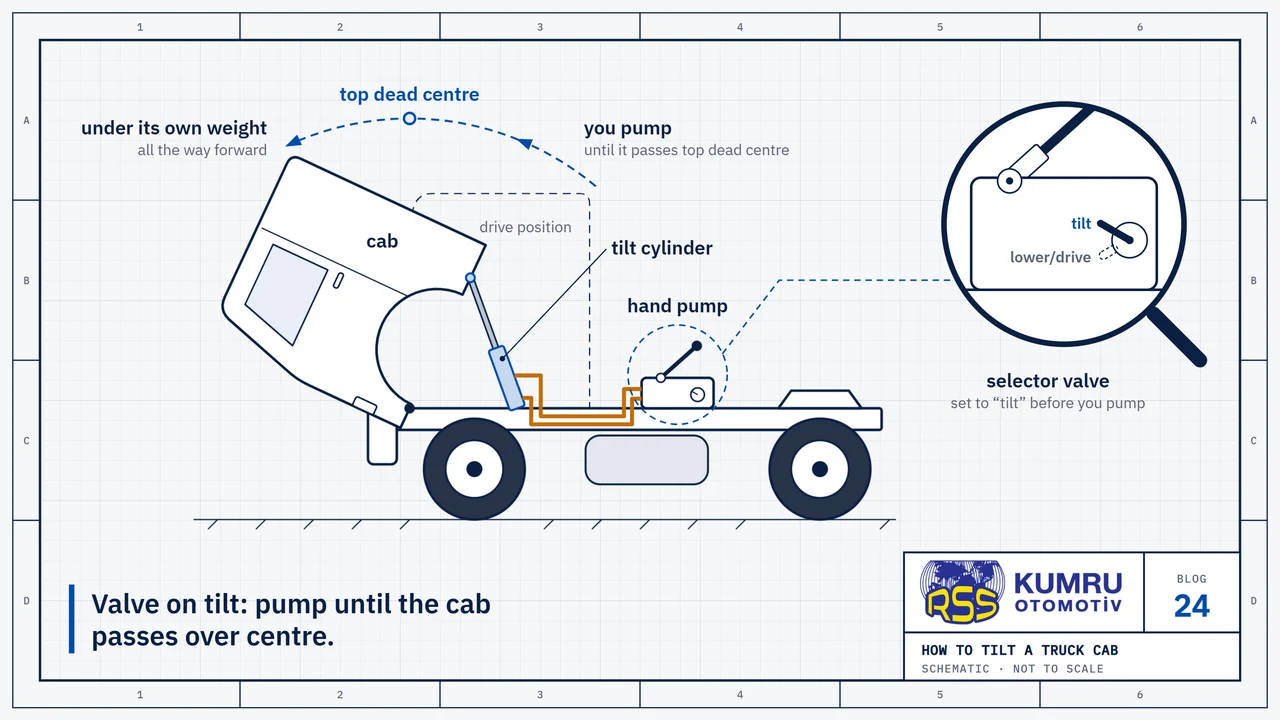
Three things that need no parts. First the cab latches: until they release, no pump will lift the cab. On some trucks the pump itself opens them: according to an owner’s log on the Volvo FM/FH system, the lock stays closed until enough pressure has built up, so a stuck latch can be a pressure fault.
Then the selector. In DOWN/DRIVE the pump feeds only the line that brings the cab down. A selector left in its driving position gives you a lever that works and a cab that stays put.
Third, the oil. The instruction starts there: reservoir filled, about 20 strokes with the selector in DOWN, oil topped up, then UP. Do it with the cab down; the sheet forbids topping up while the cab is tilted. Air after a hose or pump change needs the full bleeding sequence, a separate job.
How do you test the pump without taking it off?
With a pressure gauge. DB6010 gives the test in four moves and one figure, printed as ± 350 bar.
- Disconnect every line from the pump.
- Fit the gauge to the bottom rear port, as the sheet shows.
- Close all the other ports with blind plugs.
- Pump with the selector in UP, then in DOWN. Both should reach about 350 bar.
A needle that falls back slowly once you stop is not a failed test: “It is quite normal that the reached pressure drops gradually after discontinuation of the pump action.”
A pump that misses the figure comes off the truck for “disassembly, internal inspection and repair”, which is not the same as ordering a new one. A pump that passes sends the search on to pipes, hoses and cylinder: leakage or blockage.
Why is a cab that sinks on its own a cylinder fault?
Because once you stop pumping, the pump no longer holds the cab. On the way down, oil under the piston can leave only through a pilot-operated check valve, and pump pressure keeps that valve open. When the lever stops, the valve closes on that oil and the cab should hang at the angle it has reached. “Stop pumping” under the diagram shows that state.
Pump stopped: the check valve closes, the oil under the piston is trapped, and the cab stays where it is.
“If, however, the downward movement is continued, this may most likely be caused by internal leakage of the cylinder. In this case replace or repair the cylinder, but never replace the pump!”
Diesel Technic, Assembly Instruction DB6010, Version 1, 9 September 2024
The test: bring the cab back from the fully tilted position, stop pumping part-way and watch from beside the truck. In the comments under the Volvo log, one reader had already rebuilt his pump and the cab still sank back between strokes; the author pointed him to the valve on the cylinder.
One movement that looks like sinking is normal here. Near the end of the way down the piston enters a free-floating zone: “Instantly, the cab will now drop to its locked and drive position.”
Why does a cab lift but refuse to come down?
Look for crossed hoses first, especially after a hose, pump or cylinder change. In UP the pump delivers from both ports, so the cab lifts whichever way round the hoses are. In DOWN it delivers from one port only, and that oil has to reach the top of the cylinder and the pilot side of the check valve. Crossed hoses send it under the piston instead, and the valve never opens.
The Volvo log agrees: it lists swapped hoses as the likelier cause of a cab that will not lower, ahead of a sticking valve in the cylinder.
If a hose bursts, does the cab fall?
In the system DB6010 describes, it should not. The cab can come down only while pump pressure holds the check valve open: “It is the unique feature of this system, that only by pressurizing the return line B, it is possible to lower the cabin.” Lose that pressure, or cut a line, and the valve closes and blocks the return path. The Volvo log places its counterpart in the cylinder itself.
The valve has limits. It holds oil, so it does nothing about a cylinder that leaks internally, and nothing about how the cylinder is fastened to the truck.
On 4 May 2021 the Australian government’s vehicle recall register published recall REC-001191 for 353 Scania G, P and R trucks from 2020 and 2021. The defect as published: “In some vehicles, the nut holding the cab tilt cylinder has not been tightened. Because of this, the cab may fall forwards when it’s tilted.”
A valve is not a support. The UK Health and Safety Executive’s workshop guidance says tilting cabs are “commonly fitted with a prop, which should be locked in position before gaining access”. A cab stuck part-way is the semi-tilted position Diesel Technic calls extremely dangerous to work beneath. Support it before anyone reaches in to look for a leak.
So which part do you replace?
Only the part a test has condemned.
- None, if the cause was the latches, the selector, the oil level or crossed hoses.
- A hose or pipe, if the pump passes its test and the line leaks or is blocked. Then bleed.
- The cylinder, repaired or replaced, if the cab sinks after you stop pumping.
- The pump, only if it fails the gauge test. Even then the instruction says to open and repair it.
Sources
- Diesel Technic, “Hydraulic cabtilt system, Assembly Instruction DB6010”, assembly instruction, Version 1, 9 September 2024.
- Health and Safety Executive (HSE), “Health and safety in motor vehicle repair and associated industries (HSG261)”, UK regulator's guidance; first published 2009, reissued with amendments 2011; paragraph 210.
- Australian Government, Department of Infrastructure, Transport, Regional Development, Communications and the Arts, “Vehicle recall REC-001191”, official vehicle recall record, published 4 May 2021; 353 vehicles.
- DRIVE2, “Система подъема кабины на Volvo FM / FH + схемы + артикулы + возможные проблемы”, owner's maintenance log and comments (in Russian), 9 June 2024; used as a field observation.
Sources were checked again on October 8, 2026.
RSS Kumru Automotive
RSS Kumru Automotive was founded in 1990 and specialises in hydraulic systems and fluid management. Our range includes more than 200 cab tilt hose references for Renault Trucks, Volvo, Scania, MAN, Iveco, Mercedes-Benz and DAF.
Brand names and OEM reference numbers are used for identification and compatibility information only.