Cab tilt oil: which fluid goes in, and why it turns milky
- Author
- Ufuk Şahin
- First published
- First published:
- Last updated
- Last updated:
- Reading time
- 6 min read
- Category
- Trucks
A cab tilt pump takes the hydraulic fluid the truck maker specifies for that pump, and there is no single “cab tilt oil” that suits every truck. Volvo’s driver handbook lists “Hydraulic oil BLV”, the system maker Power-Packer recommends an ISO 15 anti-wear hydraulic fluid, and the fire-truck chassis builder Spartan tops its pump up with Dexron 3 ATF. Oil that has turned milky has most likely taken in water.
Short answer
- Which fluid: the one the truck’s workshop manual lists for the cab tilt pump. The documents do not agree.
- ATF and brake fluid: Power-Packer rules out both. Use ATF only where the truck’s own document says so.
- Milky oil: usually water. It can freeze in winter and damage parts in the circuit.
- Level: checked with the cab down, in the driving position. No oil goes in while the cab is tilted.
Which fluid goes in a cab tilt pump?
The one the vehicle manufacturer specifies for that pump. Diesel Technic’s workshop video points the same way: the new oil “should comply with the vehicle manufacturer guidelines”. Three documents side by side show why.
| Document | Vehicle or system | Fluid it names |
|---|---|---|
| Volvo Trucks Driver Guide | FH Aero, FH16, FM | Hydraulic oil BLV |
| Power-Packer installation and service manual (2017) | Its own cab tilt systems | ISO 15 anti-wear hydraulic fluid; MIL-PRF-5606H for sustained work below −20 °F |
| Spartan service bulletin (2024) | Fire-truck chassis | Dexron 3 ATF |
Each row covers only the vehicle or system its document describes. The Power-Packer manual is a US edition, hence the Fahrenheit figure.
BLV is the name the Volvo handbook gives the oil; its cab tilt section adds no viscosity grade or specification number. The Power-Packer manual says two things: its specification section recommends an ISO 15 fluid, and its operating section asks for “hydraulic fluid meeting MIL-H-5606 specification or equivalent”, with the reason:
“This is a constant viscosity fluid, and is required to ensure consistent operation of the system.”
Power-Packer, Installation and Service Manual, Hydraulic Cab Tilt System, January 2017
Can you use ATF or brake fluid?
That depends on the document. Power-Packer is blunt: “Do not use Automatic Transmission or Brake Fluid.” Spartan’s bulletin of 13 November 2024 specifies ATF for its own chassis: “Add Dexron 3 ATF to the cab tilt pump reservoir as needed.” Each is right for its own system; neither carries over to another truck.
An owner’s maintenance log for a Volvo FH shows the same split on one page: the author filled the pump with ATF, one commenter says newer trucks take BLV instead, and another uses hydraulic oil 32. Volvo’s current handbook names only BLV.
If you do not know what is in the reservoir, do not top it up with a different oil. For bodywork hydraulics the same handbook says to “be careful not to mix different types of hydraulic oil without first having cleaned the hydraulic system”.
What does the wrong fluid do?
The first effect is on viscosity. Power-Packer writes that in cold temperatures “slower operation will occur”, says ISO 15 fluids work well in its systems down to −20 °F, and recommends a fluid conforming to MIL-PRF-5606H for consistent work below that.
The second is mixing. An article in the trade journal Machinery Lubrication notes that “a hazy or milky appearance can result from mixed incompatible oils”, and that the cause of the haze can often lead to “deposits and sludge which can impede part movement, oil flow and heat transfer”.
Why does cab tilt oil turn cloudy or milky?
Usually because of water. In Diesel Technic’s video two master mechanics drain the old oil while changing a truck’s tilt pump and say what they see:
“This hydraulic oil is very milky – this means that there is too much residual water in the oil. In the winter this can cause it to freeze, which can result in defective components in the hydraulic circuit.”
Diesel Technic, “PS Tip” workshop video, 18 May 2017
The Machinery Lubrication article gives the general rule: “Small amounts of water can give an oil a caramel color while more water will give it a milky, Irish-cream appearance.” No laboratory is needed then, and “the need for corrective action is immediate”. On a small hand-pump reservoir that means draining and refilling; the article does not say so, that is our inference.
Water is not the only cause: the same article lists air among the things that make an oil turbid. In a cab tilt circuit, air shows up in the bleeding instructions, where Power-Packer has you pump until “solid oil” appears at the loosened fitting. Oil that comes out full of bubbles needs bleeding, not changing. That is not the manual’s sentence either; it follows from the procedure.
None of these sources says how the water gets into the reservoir.
How is the oil level checked, and with the cab in which position?
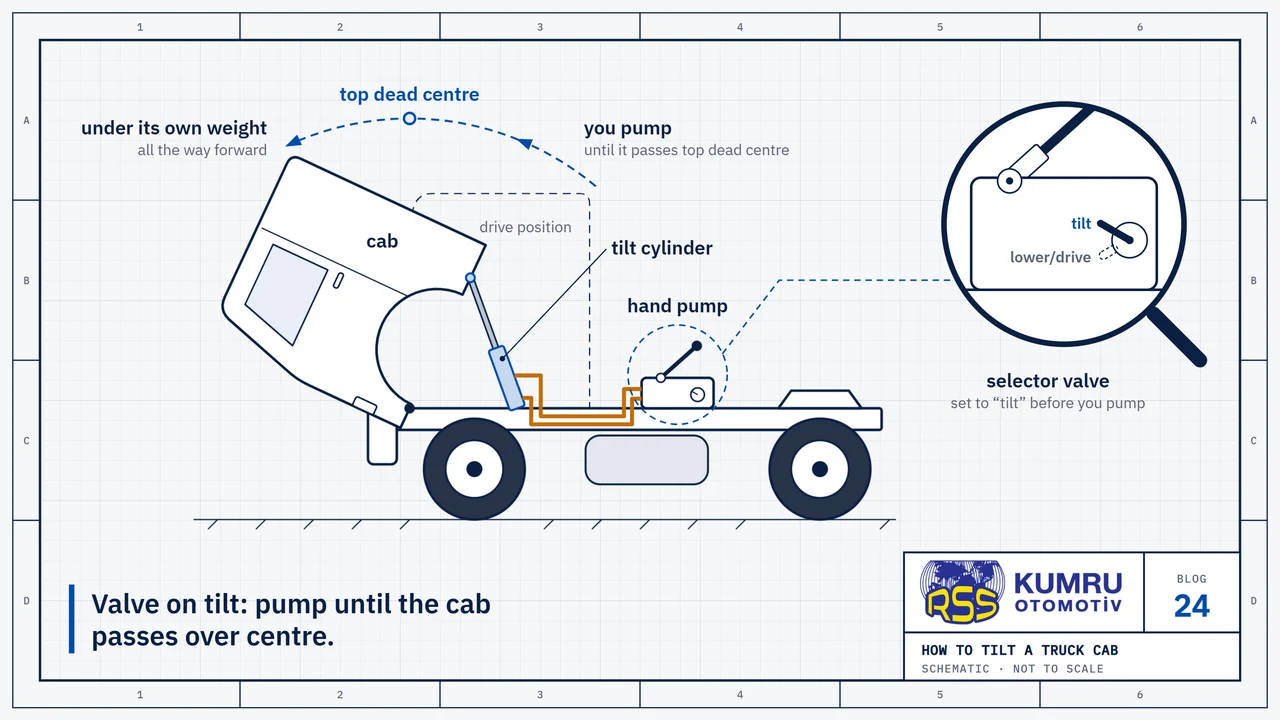
With the cab down, in the driving position. Volvo’s handbook gives this sequence for the FH and FM:
- Set the control valve to “up” and pump the cab up 35–45 cm (approximately 50 strokes).
- Set the valve to “down” and pump the cab back to its drive position.
- Set the valve to “up” again to release any remaining pressure; put the pump lever in its rearmost position.
- Remove the cover by the pump and open the filler plug.
- Look down into the filler: “the oil must cover the piston”. Top up as required, close the plug, refit the cover.
The cab moves during this check. Volvo opens the same section with a warning: “No-one is to remain under or in front of the cab while tipping is in progress.”
The handbook adds: “Never fill oil into the hydraulic system when the cab is tilted.” Power-Packer has the same ban and has the reservoir refilled “with cab in down position until oil flows from fill port”. Its troubleshooting table covers overfilling too: fluid forced out of the breather means an overfilled reservoir.
The position can differ by vehicle. At the end of a cylinder replacement, Spartan’s bulletin has the fluid added with the cab raised and resting on its safety lock bar. Unless your truck’s own document says otherwise, check and fill with the cab down.
When is the oil changed, and how?
Not by the calendar. Volvo’s handbook: “The oil only needs to be changed in connection with repairs.” Milky oil comes out the same way, with the circuit opened. Diesel Technic’s video works in this order:
- Drain. Mark the two hydraulic lines, loosen them and catch the old oil. Telling the hoses apart is covered in our guide to cab tilt hoses.
- Connections. Check the seals at the fittings and replace any that are damaged. Refit the lines without swapping sides.
- Fill. Fill the pump completely with the truck maker’s fluid. Leave the filler cap off until bleeding is done.
- Bleed. Tilt the cab all the way forward once and pump it back.
- Final check. Check the oil again and screw the cap on. The video notes that this cap contains a relief valve protecting the system from overpressure.
The video gives bleeding one sentence; the full sequence, which differs by truck, is in how to bleed a cab tilt pump. If the oil is fresh and the cab still will not tilt, go to cab won’t tilt, won’t lower or creeps down.
Sources
- Volvo Trucks, “Volvo Trucks Driver Guide: Cab tilt system; Lubricants, bodywork (FH Aero, FH16, FM)”, the maker's online driver handbook, demo trucks FH Aero, FH16 and FM; topic record last changed 25 April 2026.
- Power-Packer, “Installation and Service Manual, Hydraulic Cab Tilt System (Part # 3010003741 rev 0B)”, the cab tilt system maker's installation and service manual, January 2017; US edition.
- Diesel Technic Group, “PS Tip: Fahrerhauskippzylinder & Pumpe – Praxistipps für Mechaniker”, workshop video, 18 May 2017; narration read from the English and German subtitles supplied by the publisher.
- Spartan Fire, “Recall Service Bulletin RSB24-230-001 (NHTSA recall 24V-799)”, recall service bulletin for fire-truck chassis, 13 November 2024.
- Machinery Lubrication (Noria Corporation), “Jim Fitch, Diagnosing a Cloudy Oil”, trade journal article; first published in Practicing Oil Analysis, November 2007.
- DRIVE2, “Замена цилиндра подъёма кабины, насоса и трубок (Volvo FH, 2006)”, owner's maintenance log and comments (in Russian), 6 February 2024; used as a field observation.
Sources were checked again on October 8, 2026.
RSS Kumru Automotive
RSS Kumru Automotive was founded in 1990 and specialises in hydraulic systems and fluid management. Our range includes more than 200 cab tilt hose references for Renault Trucks, Volvo, Scania, MAN, Iveco, Mercedes-Benz and DAF.
Brand names and OEM reference numbers are used for identification and compatibility information only.