EXW, FOB and CIF explained: Incoterms® rules for parts importers
- Author
- Alperen Kumru
- First published
- First published:
- Last updated
- Last updated:
- Reading time
- 6 min read
- Category
- OEM numbers and sourcing
EXW, FOB and CIF are delivery terms that settle who arranges freight, insurance and customs clearance for an order of spare parts, and where the risk of damage passes to the buyer. Under EXW the goods are left for the buyer at the seller’s premises. Under FOB the seller loads them on the ship; under CIF it also pays freight and minimum insurance. In all three, import clearance and duty stay with the buyer.
Short answer
- EXW: loading, export clearance, freight and insurance are the buyer’s.
- FOB: the seller clears the goods for export and loads the vessel; risk passes on board.
- CIF: the seller also pays freight and minimum insurance; risk still passes at loading.
- Cartons and pallets: FOB and CIF are sea rules. By truck or air, use an any-mode rule such as FCA or CIP.
What are the Incoterms® rules, and what do they leave out?
The Incoterms® rules are delivery terms published by the International Chamber of Commerce (ICC). They divide the tasks, costs and risks of delivery between seller and buyer. First published in 1936, they are now in the Incoterms® 2020 edition, in force since 1 January 2020. Seven of its eleven rules (EXW, FCA, CPT, CIP, DAP, DPU, DDP) work with any mode of transport; four (FAS, FOB, CFR, CIF) are for sea and inland waterway transport.
They are not the whole contract. According to the US International Trade Administration they do not state the price, the method or timing of payment, or when title passes. The quotation has to.
What is EXW?
EXW (Ex Works) means the seller places the goods at the buyer’s disposal at its own premises, such as a factory or warehouse. According to the customs valuation manual of HMRC, the UK customs authority, the seller need not load the collecting vehicle or clear the goods for export. In ICC’s guidance note of April 2025, EXW is the only rule that puts export clearance on the buyer.
A pallet of hydraulic hoses waits on the seller’s dock; you arrange the truck, the loading, the export declaration and the cargo insurance. The European Commission tells exporters that “the Incoterm® EXW may not change your responsibility as the exporter towards the authorities in your country”.
What is FOB?
FOB (Free on Board) means the seller delivers the goods on board the vessel named by the buyer, at the port of shipment. In HMRC’s manual risk passes at that point: once the goods are on board, loss or damage is the buyer’s risk, and so are later costs.
The European Commission’s guide for importers lists the split. The supplier pays for transport to the port of shipment, loading and export clearance; the buyer for transport from that port onwards, insurance, unloading and delivery from the port of arrival.
What is CIF?
CIF (Cost, Insurance and Freight) adds two things to the seller’s side of FOB: freight to the named port of destination, and insurance. The seller pays as far as that port, but in HMRC’s manual the risk passes where it does under FOB, on the ship at the port of shipment.
“Under CIF your supplier is responsible for all costs until the products arrive at their destination port.”
European Commission, Access2Markets, Guide for import of goods
The insurance is minimum cover. ICC states that under CIF “the Institute Cargo Clauses (C) remains the default level of coverage”. HMRC’s advice to a buyer who wants more: agree it expressly with the seller or arrange extra insurance yourself.
Which rule fits a carton or pallet sent by truck or air?
FOB and CIF are rules for sea and inland waterway transport, and in both the point of delivery is the ship. A pallet on a truck or a carton sent by air takes one of the seven rules for any mode of transport, FCA and CIP among them.
Under FCA the seller hands the goods to the carrier chosen by the buyer, at its own premises or another named place, and clears them for export. Under CIP the seller also pays carriage and insurance to the named destination; ICC says CIP “now requires a higher level of cover, compliant with the Institute Cargo Clauses (A) or similar clauses”.
Putting FCA in place of FOB and CIP in place of CIF, for a part load by sea as well, is our reading; ICC’s open pages do not say so. It rests on ICC’s history: a free-carrier term was introduced in 1980 for goods “not actually received by the ship’s side but at a reception point on shore, such as a container yard”. A part load is handed over on shore too.
| Rule | Transport | Main carriage | Insurance | Where risk passes |
|---|---|---|---|---|
| EXW | Any mode | Buyer | No obligation | At the seller’s premises |
| FCA | Any mode | Buyer | No obligation | On handover to buyer’s carrier |
| FOB | Sea, inland waterway | Buyer | No obligation | On board, port of shipment |
| CIF | Sea, inland waterway | Seller | Seller, minimum cover | On board, port of shipment |
| CIP | Any mode | Seller | Seller, higher cover | On handover to carrier |
Sources: HMRC’s customs valuation manual, ICC’s open pages, the Turkish Ministry of Trade’s e-export guide. Our summary, not the text of the rules. Except under EXW the seller clears the goods for export; import clearance and duty are the buyer’s under all five.
What does each term mean for small, frequent shipments?
With small, frequent shipments EXW leaves the truck, the loading and the export declaration to the buyer every time; a buyer who takes a few cartons a month sets the same work up again and again. That is our own conclusion from the rules as described; the official sources we read say nothing about shipment frequency.
Under FCA or FOB export clearance stays with the seller and you choose the carrier. Under CIF or CIP the seller arranges freight and insurance, but the risk is yours once the goods are on the ship or with the carrier. For door delivery with duty paid, ICC’s guidance note is plain: “DDP is the only Incoterms® rule where the seller pays tariffs”.
Do not leave insurance open. The Turkish Ministry of Trade’s e-export guide notes that only CIF and CIP contain an insurance obligation; for the rest, in our translation, “as a general rule, whoever bears the risk is taken to arrange the insurance”. A carrier’s liability is not cargo insurance: for air freight, the European Commission says, compensation is “usually limited to a fixed amount per gross kilogram of damaged or lost goods”.
In what order should you choose a delivery term?
- Mode of transport. Port to port by ship: FOB or CIF. Truck, air or a part load: FCA, CPT or CIP.
- Export clearance. If nobody in the seller’s country can file an export declaration for you, do not choose EXW.
- Insurance. Put in writing who arranges it and at what level of cover.
- Place. Name the port of loading for FOB, the port of destination for CIF, the place of delivery for EXW and FCA. The clause wording is in our article on sourcing from Türkiye.
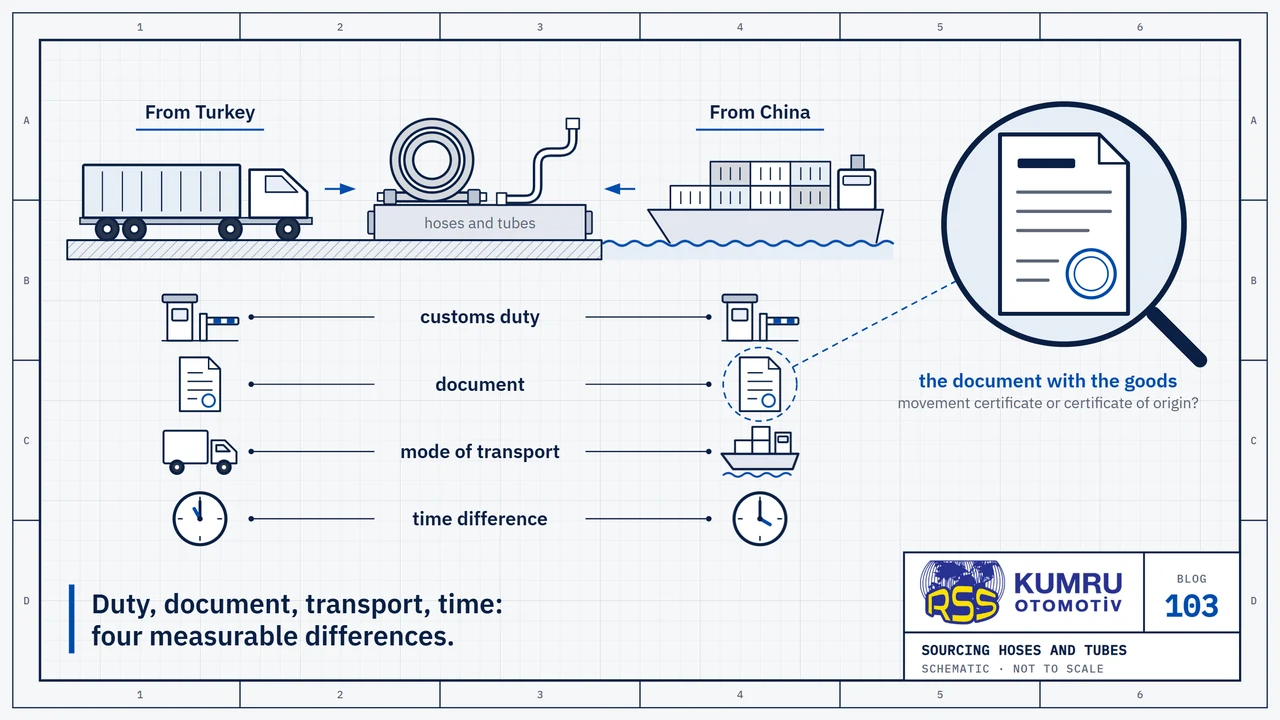
- Duty calculation. Check how the customs authority of the importing country builds the customs value. In Türkiye, the Ministry of Trade says, freight and insurance up to the port or place of entry are added to the price paid. Compare EXW and CIF prices on the basis that applies to you; for the code itself see our article on HS codes.
Incoterms® is a trademark of ICC. The Incoterms® rules are protected by copyright owned by ICC.
Sources
- ICC, “Incoterms® rules, Incoterms® 2020, Incoterms® Rules history; Guidance Note: Using the Incoterms® 2020 Rules to Manage Tariff Risk in International Trade”, Incoterms® pages of the International Chamber of Commerce (undated, viewed 13 October 2026) and its free guidance note of 24 April 2025; the text of the rule book was not used.
- HM Revenue & Customs, “Customs valuation: Incoterms”, Incoterms page of the customs valuation manual of the UK tax and customs authority; published 25 June 2025, updated 14 April 2026.
- European Commission, “Access2Markets: Guide for import of goods; Guide for export of goods; Freight insurance”, European Commission guides for importers and exporters and its freight insurance page, undated; viewed 13 October 2026.
- T.C. Ticaret Bakanlığı, “Esnaf ve Sanatkâr İşletmeleri Özelinde E-İhracat Kılavuzu; Teslim Şekline İlişkin Kodlar; Sıkça Sorulan Sorular: Gümrük Kıymeti”, e-export guide of Türkiye's Ministry of Trade, December 2023 (section on delivery terms and insurance); its list of delivery term codes, undated; its customs value FAQ, 25 August 2023; all in Turkish.
- International Trade Administration, U.S. Department of Commerce, “Know Your Incoterms”, exporter page of the US International Trade Administration, undated; viewed 13 October 2026; number of rules, split by mode of transport and what the rules do not cover.
Sources were checked again on October 13, 2026.
RSS Kumru Automotive
RSS Kumru Automotive was founded in 1990 and specialises in hydraulic systems and fluid management. Our range includes injector lines, fuel and oil lines, hoses and fittings.
Brand names and OEM reference numbers are used for identification and compatibility information only.