What drives lead time on custom hose and tube orders?
- Author
- Alperen Kumru
- First published
- First published:
- Last updated
- Last updated:
- Reading time
- 6 min read
- Category
- OEM numbers and sourcing
Lead time on a custom hydraulic hose assembly or steel tube is the interval between placing the order and receiving the goods, and machine time is only one piece of it. Sample or drawing approval, material, tooling and set-up, the queue in the shop, testing, packing, freight and customs are added in turn. Several of those pieces are in the buyer’s hands, not the manufacturer’s.
Short answer
- Meaning: the time between ordering and receiving.
- How it adds up: phases follow one another and their times are summed; days spent waiting for an approval count too.
- What the buyer controls: complete technical data, an early sample, prompt first-piece approval, repeat orders and blanket orders.
- In the quotation: the day the clock starts, where it stops, the delivery term and any partial shipments.
What is lead time in manufacturing?
Lead time is the time between placing an order and receiving it. Saylor Academy’s open operations management textbook defines a product’s lead time as “the amount of time it takes for a customer to receive a good or service once it’s been ordered”.
The buyer’s own paperwork is inside it. In a 2007 report on spare parts for the US armed forces, the Government Accountability Office (GAO) splits acquisition lead time into two parts:
“Administrative lead time is the time interval from the initiation of a procurement action to the contract award, while the production lead time is the interval from the contract award to delivery of the items.”
GAO, report GAO-07-281, 2 March 2007
The same report treats lead time as a forecast: the buyer’s “best estimate of when an item will be received”.
What makes up the lead time for custom hydraulic hose assemblies and tubes?
On a custom hydraulic hose assembly or tube, manufacturing lead time is the sum of phases that follow one another, from ordering the material to the last operation; our article on MOQ gives the definition and the part played by set-up. Part of that time nothing is being made: the Saylor textbook counts waiting as a waste, the wait for the queue ahead to empty included.
The buyer’s tasks count too: the Federal Acquisition Regulation (FAR), the rule book for US federal purchasing, tells buyers setting a delivery schedule to consider the administrative time for obtaining and evaluating offers and the “time for the Government to perform its obligations under the contract”.
None of the sources we read mentions hoses or tubes, or gives a typical number of days for them, from manufacturers in Turkey or anywhere else; we give none either. The breakdown below is our own inference:
- Quotation and approval. Sample or drawing review, quotation, order and, where required, first-piece approval.
- Material. Tube or hose, fittings and nuts.
- Tooling and set-up. Bending and end-forming tools or crimp dies, then trial parts.
- Queue. The wait behind the orders ahead.
- Processing and testing. Cutting, bending, end forming or crimping; checks and tests.
- Packing and shipment. Freight and customs.
Manufacturing lead time vs delivery lead time: what is the difference?
Manufacturing lead time and delivery lead time differ in where the clock stops. The Saylor textbook’s cumulative lead time, the sum described above, runs “to completion of final assembly”: the part is finished, not delivered. The GAO’s production lead time runs “to delivery of the items”. The FAR lists “Production time” and “Transportation time” separately. Ask where a quoted lead time ends.
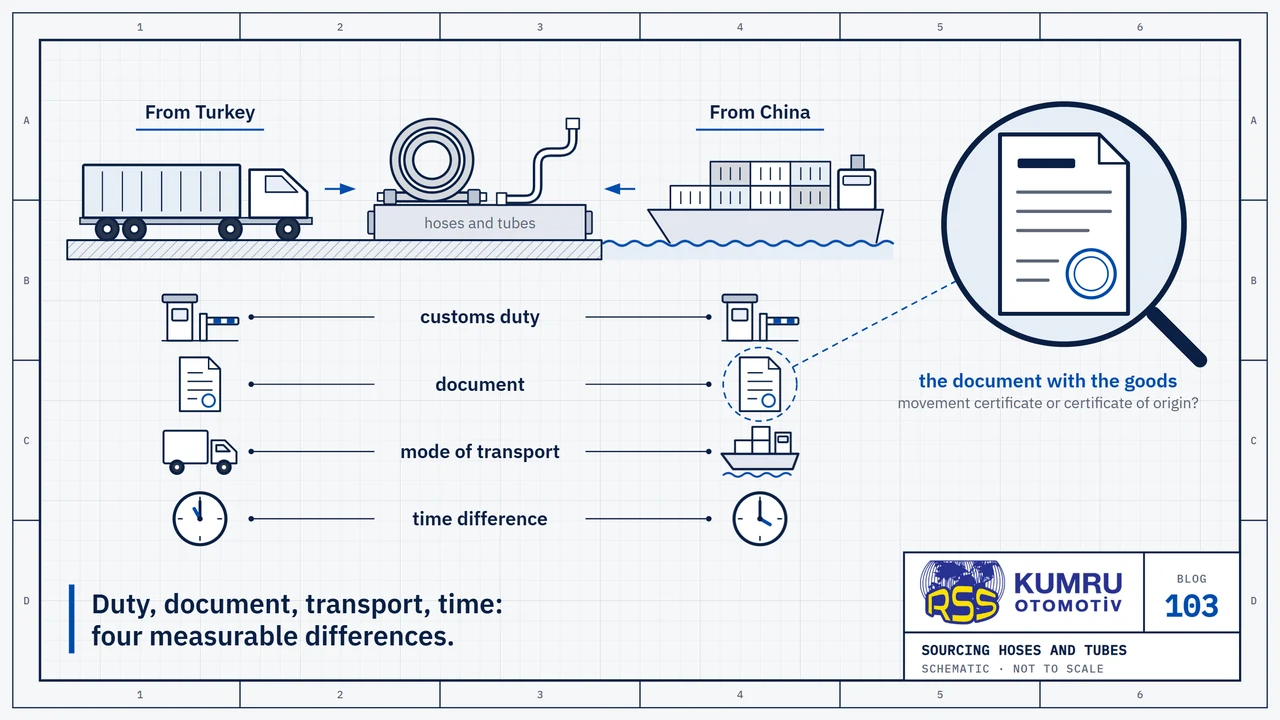
The delivery term decides how much of the gap is the seller’s. Under FOB, the European Commission’s guide for importers says, the supplier pays for transport to the port of shipment, loading and export clearance; transport from that port onwards is the buyer’s. Our article on EXW, FOB and CIF covers the other rules.
Import clearance is usually left to the buyer. The same guide says goods at the EU border may be cleared on the documents submitted or selected for a document or physical check, and warns importers that “EORI registration can take some time”.
How can a buyer reduce lead time from a supplier?
A buyer shortens lead time before the order and during approvals. The GAO report’s example is technical data: engineers “often had to delay the acquisition process while they prepared technical drawings and wrote technical specifications”, with delays that “ranged from days to several months”. Entering the data in advance greatly reduced administrative lead time.
The second link is first-piece approval, in FAR terms first article approval. The FAR clause has the buyer state how many calendar days after receiving the first article it will answer in writing; if it overruns, delivery dates are adjusted at the contractor’s request. The same regulation shows why the manufacturer waits:
“Before first article approval, the acquisition of materials or components, or commencement of production, is normally at the sole risk of the contractor.”
FAR, section 9.305
The FAR and the GAO report describe public purchasing; applying them to a private order for hoses or tubes is our reading. On it, the buyer controls:
- Complete information, sent early. Sample, drawing or part number, quantity and yearly requirement; see our article on having a pipe made from a sample. If the quotation depends on a sample, nothing starts until it arrives.
- Repeat orders. The FAR lets first-article testing be waived where identical or similar supplies have already been delivered and accepted; the schedule may then “provide for earlier delivery”.
- Blanket orders. The FAR notes that contracts giving one supplier a buyer’s whole requirement “may permit faster deliveries when production lead time is involved, because contractors are usually willing to maintain limited stocks”. In the GAO report, items on long-term contracts allowed “faster order processing”.
How should lead time be written into a quotation?
A quotation should give the lead time with the day it starts, where it ends and the delivery term. The FAR calls the time of delivery “an essential contract element” that must be “clearly stated”, and warns that schedules set unnecessarily short “may result in higher contract prices”.
The FAR lists four ways to express a delivery schedule: specific calendar dates; a period from the date of the contract; a period from the day the contractor receives notice of award; and, under standing contracts, a “specific time for delivery after receipt by the contractor of each individual order”. Its model clause is a table headed item number, quantity and “Within Days After Date of Contract”: each quantity has its own period. Ask for partial shipments in that form.
Turkey’s Ministry of Trade describes the pro forma invoice as a quotation more than an invoice, stating the delivery term, the loading date, the place of unloading and how long the price is valid. The European Commission wants a written contract to contain “the address and time for delivery and receipt of the goods”. At RSS Kumru we quote lead time together with the price.
What should you do before placing the order?
The order we suggest:
- Complete the information. Sample, drawing or number; quantity; how often you will reorder.
- Send the sample with the enquiry.
- Have the lead time written out. Start day, end point, delivery term and place, partial shipments.
- Commit to an approval time. State how many days you need for the first piece.
- Order early, and ask again. The Saylor textbook: “Lead time itself can be addressed by ordering that many days in advance.” For a part you buy infrequently, ask for the current figure: in the GAO report, standard default lead times “greatly understated the actual lead times”.
Sources
- Saylor Academy, “Operations Management (open textbook): 9.3 Inventory Control, 6.1 Lean Manufacturing, 3.5 Process Selection”, openly licensed operations management textbook, 2021; definitions of lead time and cumulative lead time, waiting and queues, ordering in advance.
- U.S. Government Accountability Office (GAO), “Defense Inventory: Opportunities Exist to Improve the Management of DOD's Acquisition Lead Times for Spare Parts (GAO-07-281)”, report by the audit arm of the US Congress on lead times for spare parts bought for the armed forces, 2 March 2007; administrative and production lead time, technical data, long-term contracts.
- Federal Acquisition Regulation (FAR), acquisition.gov, “Subpart 11.4 Delivery or Performance Schedules; Subpart 9.3 First Article Testing and Approval; 52.209-4 First Article Approval-Government Testing; 52.211-8 Time of Delivery; Subpart 16.5 Indefinite-Delivery Contracts”, the US federal purchasing regulation, text in force on 13 March 2026 (FAC 2026-01); how delivery schedules are written, first article approval, standing contracts.
- European Commission, “Access2Markets: Guide for import of goods; Guide for export of goods; Trade contracts”, European Commission guides for importers and exporters and its trade contracts page, undated; viewed 13 October 2026; the FOB split, customs at the border, time of delivery in the contract.
- T.C. Ticaret Bakanlığı, “Esnaf ve Sanatkâr İşletmeleri Özelinde E-İhracat Kılavuzu”, e-export guide of Turkey's Ministry of Trade, December 2023, in Turkish; what a pro forma invoice is and what it states.
Sources were checked again on October 13, 2026.
RSS Kumru Automotive
RSS Kumru Automotive was founded in 1990 and specialises in hydraulic systems and fluid management. Our range includes injector lines, fuel and oil lines, hoses and fittings.
Brand names and OEM reference numbers are used for identification and compatibility information only.