Sourcing hoses and tubes from Turkey or China: duty, transport and time difference
- Author
- Alperen Kumru
- First published
- First published:
- Last updated
- Last updated:
- Reading time
- 6 min read
- Category
- OEM numbers and sourcing
For a buyer in the EU, the measurable differences between Turkey and China as a source sit in four places: customs duty, the accompanying document, the mode of transport and the time difference. Turkey is in a customs union with the EU: on 13 October 2026 the EU tariff database TARIC showed 0% duty for Turkey and 3% for third countries on metal-reinforced rubber hose with fittings (4009 22 00 90). This article is published on the blog of a fluid management systems manufacturer producing in Turkey; as an interested party we compare neither quality nor price, only differences that can be read in official sources.
Short answer
- Customs duty: zero from Turkey on the industrial goods the customs union covers. Chinese-origin goods pay the third-country duty, which depends on the tariff code.
- Document: goods from Turkey come with an A.TR movement certificate. It shows free circulation, not origin.
- Transport: in 2025 most rubber hose imported into the EU from Turkey arrived by road, most from China by sea.
- Time difference: Turkey is 1 or 2 hours ahead of Germany, China 6 or 7.
Is Turkey in the EU customs union?
Yes. Turkey is not a member of the EU, but it is in a customs union with it, in force since 1995 according to the European Commission. The union covers industrial products and processed agricultural products; agricultural products and the products of the coal and steel treaty are outside it.
Decision No 1/95, which completed the customs union, also placed an obligation on Turkey: alignment with EU rules, among them “technical legislation related to the scope of the Customs Union”. Goods from Turkey still have to meet the technical requirements the EU sets for imports, which the Commission lists by customs code.
Is there import duty from Turkey to the EU?
There is no customs duty on goods from Turkey that the customs union covers; the Commission’s page says “zero customs duties and zero quotas for goods covered by the customs union”. On 13 October 2026, TARIC showed a “Customs Union Duty” of 0% for Turkey on code 4009 22 00 90 and on 8409 99 00 90, where parts of diesel engines are classified.
Zero customs duty does not remove import VAT. The Commission’s import guide says VAT applies to goods “imported from outside the EU” and “is usually paid by the importer”; Turkey is not an EU member, so that includes goods from Turkey.
What is the import duty from China to the EU on a hydraulic hose?
On the code for a steel-braided rubber hydraulic hose with fittings (4009 22 00 90), the EU’s “Third country duty” in TARIC was 3% on 13 October 2026; our query for Chinese origin returned no duty line specific to China. The 2026 Combined Nomenclature gives the same rate for all eight subheadings of heading 4009. On 8409 99 00 90 the third-country duty is 2.7%.
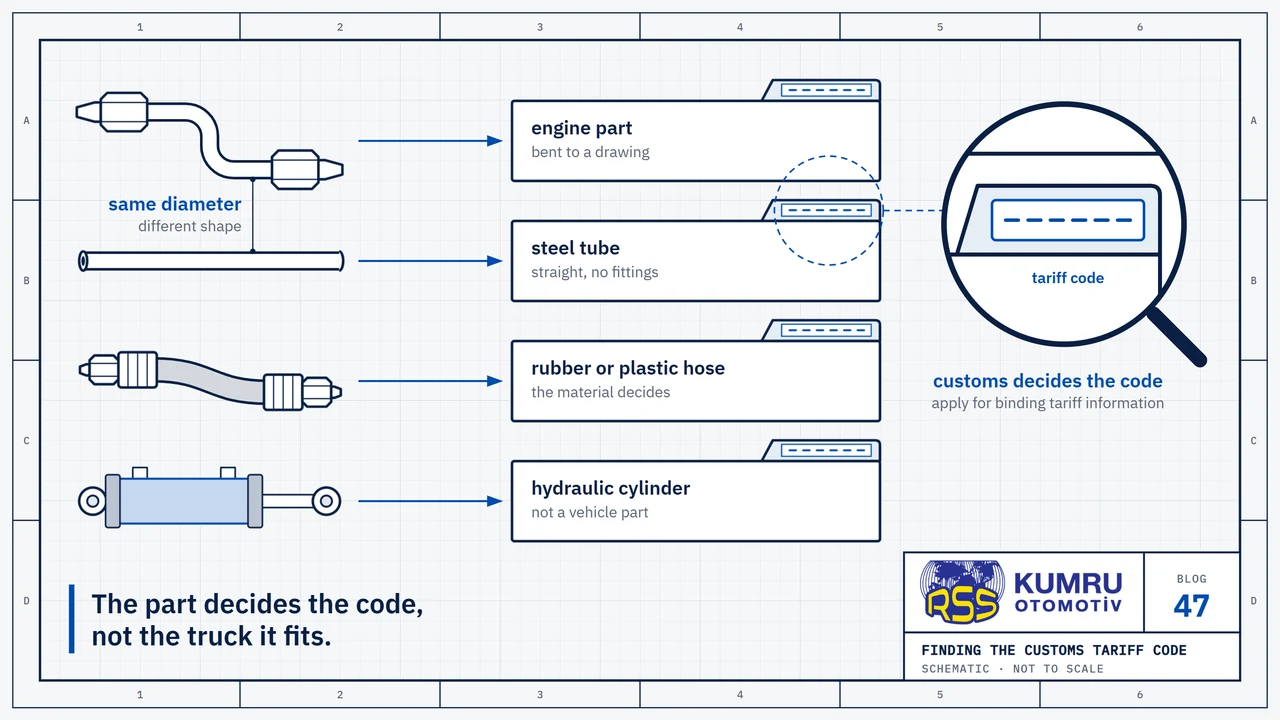
Rates depend on the code and the date: look up your ten-digit code in TARIC for both origins. How a code is decided is covered in the article on tariff codes.
Plain steel tube is a different picture. On the code for cold-drawn seamless stainless tube (7304 41 00) the third-country duty is already 0%. Its subdivision 7304 41 00 90 carries a definitive anti-dumping duty on tube of Chinese origin: under Regulation (EU) 2024/1475 the rate runs from 48.3% to 71.9%, depending on the producer. Since 1 July 2026 the code is also under a tariff quota with a 50% duty on imports outside it, a measure TARIC shows in the query for Turkey as well.
Which document comes with the goods: A.TR or a certificate of origin?
With goods from Turkey, the document that opens the zero duty is the A.TR movement certificate. The Commission says goods produced in the customs union, or put into free circulation in it, can circulate anywhere in its territory as long as an A.TR accompanies them. The certificate shows free circulation, not origin, and it is origin that decides duty and trade measures:
“The concept of origin matters because, when goods are imported, the calculation of customs duties and the application of trade policy measures … are determined by the country of origin.”
Republic of Türkiye Ministry of Trade, Frequently asked questions: Origin, 20 January 2025
The measures the Ministry lists include anti-dumping duty. Goods from China have no counterpart to the A.TR: they pay whatever the tariff shows for that origin. The documents to ask a supplier for are covered in the article on sourcing from Turkey.
How do goods from Turkey and from China reach the EU?
According to Eurostat, in 2025 the EU imported €381.1 million of goods under heading 4009 (rubber tubes, pipes and hoses) from Turkey, of which €315.0 million reached the EU border by road. Imports from China came to €198.7 million, of which €167.3 million arrived by sea. The shares are our calculation: 83% by road for Turkey, 84% by sea for China.
Eurostat records the “active means of transport” on arrival in the EU, not door-to-door time. The official sources we read give no transit days for either route, so we give none. Ask the carrier for the transit time in writing, together with the delivery term; delivery terms are covered in the article on EXW, FOB and CIF.
What is the time difference?
Turkey keeps UTC+3 all year and the whole of China is on UTC+8, according to the country guides of the US International Trade Administration. The same guides give Germany as UTC+1 in winter and UTC+2 in summer. By our arithmetic, Germany and Turkey are 2 hours apart in winter and 1 in summer; Germany and China, 7 and 6.
On a winter day, 09:00 in Germany is 11:00 in Turkey and 16:00 in China. Allow for that when a sample approval or a drawing query needs a same-day answer.
Which questions decide it for your own order?
These differences do not say which country is better. They show which one weighs on your order.
| Difference | From Turkey | From China |
|---|---|---|
| Customs duty, 4009 22 00 90 | 0%, customs union duty | 3%, third-country duty |
| Document | A.TR movement certificate; does not show origin | No counterpart to the A.TR; origin decides the duty |
| Mode of transport, heading 4009, 2025 | 83% of the value by road | 84% of the value by sea |
| Time difference with Germany | 1 or 2 hours | 6 or 7 hours |
Sources: duty, TARIC, 13 October 2026; document, European Commission and Turkey’s Ministry of Trade; transport, Eurostat, 2025 (shares are our calculation); time, US International Trade Administration (differences are our arithmetic).
For a buyer outside the EU, the duty and document rows do not apply: check the tariff of your own customs administration. According to the Commission, Turkey has 22 free trade agreements in force, including with the EFTA countries and the United Kingdom.
Five questions to settle before you decide:
- Tariff code. Which ten-digit code, and what does TARIC show for each origin?
- Place of delivery. Will the goods clear customs in the EU, in which country and under which delivery term?
- Batch size and order frequency. A few large batches a year, or small and frequent shipments?
- Samples. How many rounds before approval, and by which route?
- Origin. Where are the goods made, and does the tariff or your customer ask for proof of origin?
Sources
- European Commission, DG Taxation and Customs Union, “TARIC measure information: codes 4009 22 00, 8409 99 00 and 7304 41 00, origins China and Türkiye”, the EU's tariff database; viewed 13 October 2026 (last database update 12 October 2026). Code descriptions from the 2026 Combined Nomenclature; Regulations (EU) 2024/1475 and 2026/1457, which TARIC cites for the anti-dumping duty and the steel quota; two binding tariff rulings for the hose and engine-part codes.
- European Commission, “Access2Markets: EU-Türkiye Customs Union; Guide for import of goods”, European Commission information pages for importers, undated; viewed 13 October 2026; scope of the customs union, zero duty, the A.TR movement certificate, import VAT.
- European Commission, DG Trade and Economic Security, “EU trade relations with Türkiye. Facts, figures and latest developments”, the Commission's country page, undated (latest data year 2025); viewed 13 October 2026; the alignment required by Decision No 1/95 and Turkey's free trade agreements.
- T.C. Ticaret Bakanlığı, “Sıkça Sorulan Sorular: Menşe”, customs FAQ page of Türkiye's Ministry of Trade, 20 January 2025, in Turkish; why origin matters and what the A.TR certificate shows.
- Eurostat, “Comext dataset DS-059334, Extra-EU trade since 2002 by mode of transport, by HS2-4-6; Statistics Explained: International trade in goods by mode of transport”, trade database of the EU's statistical office, data updated 15 September 2026; EU imports under heading 4009 from Turkey and China in 2025, by mode of transport; the shares are our own calculation.
- International Trade Administration, U.S. Department of Commerce, “Country Commercial Guides, Business Travel: Turkey, China, Germany”, country guides of the US International Trade Administration; Turkey 29 January 2026, China 25 September 2025, Germany 1 August 2025; time zones of the three countries.
Sources were checked again on October 14, 2026.
RSS Kumru Automotive
RSS Kumru Automotive was founded in 1990 and specialises in hydraulic systems and fluid management. Our range includes injector lines, fuel and oil lines, hoses and fittings.
Brand names and OEM reference numbers are used for identification and compatibility information only.