How to bleed a cab tilt pump
- Author
- Ufuk Şahin
- First published
- First published:
- Last updated
- Last updated:
- Reading time
- 6 min read
- Category
- Trucks
When a cab tilt hand pump strokes freely while the cab stays where it is, or raises it in soft, springy steps, the first things to suspect are air in the circuit and too little oil in the reservoir. The cure is a bleed with the cab lowered. Diesel Technic’s sequence opens nothing: about 30 full strokes in DOWN/DRIVE, refill, one complete tilt and return, top up.
Short answer
- Symptom: the lever moves and the cab does not, or the pump feels spongy. Check the oil level first.
- Bleed with the cab lowered. Diesel Technic: about 30 full strokes in DOWN/DRIVE, refill, tilt fully, lower fully, top up.
- Some systems are bled at the fittings. Use the procedure written for the system on the truck.
- Safety: a circuit with air in it may not hold or slow the cab. Stay out of its path.
How does air get into a cab tilt system?
The first way in is an opened circuit: a hose, the cylinder or the pump has been changed. In Power-Packer’s service manual every repair that opens the circuit ends with a bleed, and its remedy for crossed hoses is “Replumb and bleed”.
The second way in is a low reservoir. In the same manual’s fault table, a pump that “functions only on last portion of stroke” has “Reservoir low on oil” as its first cause. Oil does not disappear on its own, which points to the third: a weeping fitting or a chafed hose.
Power-Packer puts it in one margin note: “Air, dirt and lack of oil account for 75% of all hydraulic problems.”
How do you know it is air?
By the feel of the lever. The workshop manual for the Condor, a North American cab-over chassis, describes it in the middle of its tilting instructions:
“If air is present in the hydraulic tilt system, the pump operation may seem spongy or ineffective.”
Condor Workshop Manual, section 60.00, January 2000
Low oil feels much the same, so look before you bleed. With the cab lowered, take out the filler plug and check the level. Diesel Technic’s fault-finding starts there too: fill if necessary, about 20 strokes in DOWN, more oil if the level has dropped, then UP. After that, the sheet says, “Tilting the cab should now be possible without any further problems.”
What bleeding sequence does the manufacturer give?
Power-Packer’s manual: “The hydraulic cab tilt system is a cab lifting, not a cab holding device. Before working under a raised cab, always engage the mechanical cab holding device.” It also warns that when the system is full of air “the cab could free fall unchecked”. Engine off, parking brake on, and nobody in the cab’s path until it has made one clean trip up and down.
Diesel Technic’s instruction sheet DB6010 puts a condition ahead of the steps: “cab must be in lowered position!”
- Lines and level. Every hose connected, the reservoir filled.
- Selector to DOWN/DRIVE, fully anticlockwise. Work the lever through about 30 full strokes. The level falls as oil replaces air, so refill.
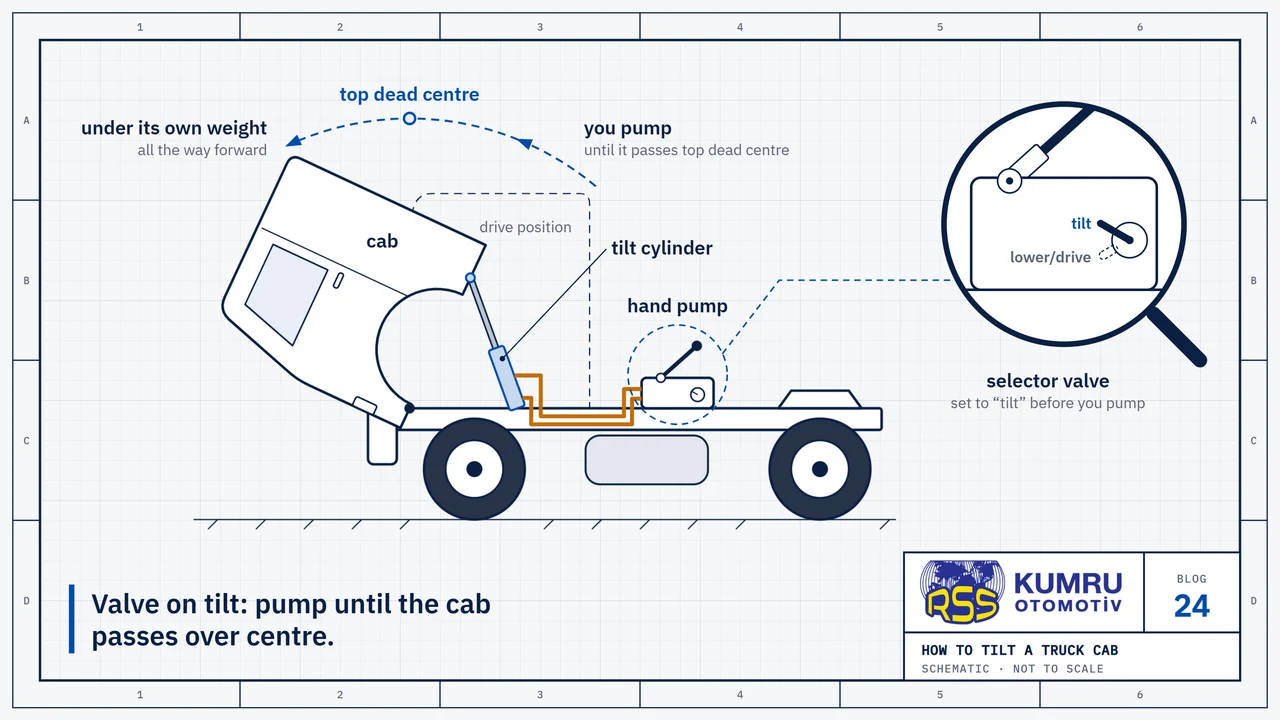
- Selector to UP, fully clockwise. Pump until the cab passes its top dead centre, then let it travel all the way forward.
- Selector back to DOWN/DRIVE. Pump until the cab is fully lowered and has dropped into its locks.
- Top up and refit the filler plug. Leave the selector in DOWN/DRIVE, where the sheet wants it whenever the system is not in use.
Nothing is opened, and the sheet’s description of the circuit suggests why. In DOWN/DRIVE the pump delivers to the top of the cylinder only, and the same pressure opens the check valve on the other line, the way back to the reservoir.
With the cab lowered, the piston sits in what the sheet calls the “free floating area”, where oil can pass around it. Thirty strokes therefore send oil round the whole loop, and the air leaves it in the reservoir. That is our reading; the sheet gives the steps, not the reason.
Pump stopped: the check valve closes, the oil under the piston is trapped, and the cab stays where it is.
Why do other manuals tell you to loosen the fittings?
Because not every circuit can carry its air back to the reservoir. Power-Packer explains that cylinder rods usually sit higher than the base end, so “air goes to the top and will not discharge to the reservoir”. The Condor manual says the same of hydraulic cab latches. Both let the air out where it collects: a connection is loosened, never disconnected, and the pump worked until the oil runs free of bubbles.
| Manual | Cab position | What is loosened | Order |
|---|---|---|---|
| Diesel Technic DB6010 (2024) | Lowered | Nothing | About 30 strokes in DOWN/DRIVE, refill, tilt fully, lower, top up |
| Power-Packer service manual (2017) | Lowered | Connections at the tilt cylinders and cab latches | CAB LOWER for the pull side; then CAB RAISE, latch lines first, push ports last |
| Condor workshop manual (2000) | Lowered, then fully tilted for the pull port | Push and pull fittings on the cylinder | Push port, fill, tilt fully, pull port, lower, fill |
Summarised from the three documents. Each describes its own system, and each ends by topping up with the cab lowered.
The order is part of the procedure. Power-Packer adds a note: “Do not reverse the sequence of this procedure.” The Condor manual allows two exceptions, the pull port and the cab latches, and otherwise rules: “never bleed any part of the system while the cab is tilted”.
So use the method written for the system on the truck. If the pump also releases hydraulic cab locks, if the cylinder has its own bleed screw or if the pump is electric, read the truck’s workshop manual before assuming that 30 strokes reach every branch.
How full should the reservoir be, and which oil goes in?
Full, and filled only with the cab down. Diesel Technic: “Keep the reservoir filled to the top at all times.” Both it and Power-Packer forbid filling with the cab raised.
Neither gives the reason, but the mechanics are plain. With the cab up, the rod is out of the cylinder and oil from the reservoir has taken its place. Fill to the brim then and that oil has nowhere to go when the rod comes back. Power-Packer’s fault table has the matching entry: “Hydraulic fluid forced out of breather”, cause “Reservoir overfilled”.
On the oil itself the manuals agree on one point only, and Diesel Technic prints it in capitals: “DO NOT USE BRAKE FLUID!” Power-Packer and the Condor manual also exclude automatic transmission fluid (ATF). Yet a 2024 recall bulletin from the fire-truck builder Spartan says: “Add Dexron 3 ATF to the cab tilt pump reservoir as needed.” A rule learned on one truck does not carry over to the next. The specification is in the truck’s own documentation, and the oils themselves are a subject for a separate article.
Bled properly and the cab still will not lift?
Then air was not the fault, or not the only one. Diesel Technic’s sheet carries on in a fixed order: cab latches, pump pressure with the lines off, then leaks or blockages in the hoses and the cylinder. That is fault-finding, a different job with a guide of its own. One question does belong here: where did the oil go? A system that was low without having been opened has a leak, and a bleed without a repair lasts only until the level falls again.
Sources
- Diesel Technic, “Hydraulic cabtilt system, Assembly Instruction DB6010”, assembly instruction, Version 1, 9 September 2024.
- Power-Packer, “Installation and Service Manual, Hydraulic Cab Tilt System (Part # 3010003741 rev 0B)”, installation and service manual, January 2017.
- American LaFrance, “Condor Workshop Manual, section 60.00 Cab-Tilt System (Supplement 0)”, vehicle workshop manual, January 2000.
- Spartan Fire, “Recall Service Bulletin RSB24-230-001 (NHTSA recall 24V-799)”, recall service bulletin, 13 November 2024.
Sources were checked again on October 8, 2026.
RSS Kumru Automotive
RSS Kumru Automotive was founded in 1990 and specialises in hydraulic systems and fluid management. Our range includes more than 200 cab tilt hose references for Renault Trucks, Volvo, Scania, MAN, Iveco, Mercedes-Benz and DAF.
Brand names and OEM reference numbers are used for identification and compatibility information only.