Injector line leaking at the nut: tighten, clean or replace?
- Author
- Selami Kumru
- First published
- First published:
- Last updated
- Last updated:
- Reading time
- 6 min read
- Category
- Injection and fuel lines
A high-pressure injector line that weeps at the nut is not cured by more torque. The joint has no gasket: a formed cone on the end of the line is pressed into a seat, steel on steel, and it seals only when both faces are clean, unmarked and square to each other. The nut gets the torque in the engine’s service data, once, with a torque wrench. If the joint still leaks at that figure, it has to come apart.
Short answer
- Tighten: only up to the specified torque, with a torque wrench and the engine stopped. Beyond it the cone is deformed, not sealed.
- Clean: workshop practice on older pump-line-nozzle engines, and only when cone and seat are unmarked.
- Replace: on common rail the makers answer a leaking joint with a new line. On any engine, a crushed, scratched or pitted cone means a new line.
Is the fuel really coming from the nut?
Not always. Diesel creeps along a line and gathers at the lowest point, so the wet nut is not necessarily the leaking one. A General Motors bulletin for the 6.6-litre Duramax shows how far it travels: a leak “found at the bottom of the flywheel housing” can come from the line fittings between the high-pressure pump and the rail. The bulletin tells technicians who find it there not to replace the pump.
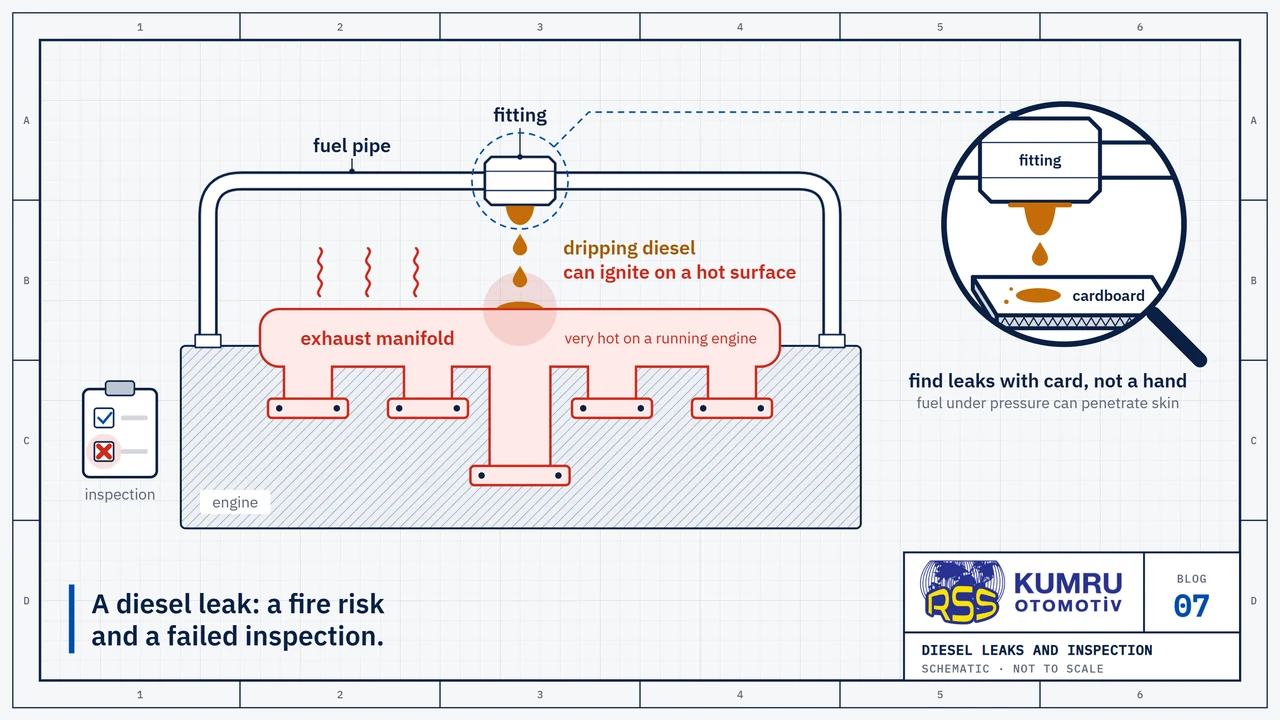
Wash the area down, dry it, run the engine through its rev range, stop it, then look with a lamp. Idle alone proves little: a joint can stay dry at tick-over and weep once revved. A hairline crack just behind the nut wets the same spot, and that line is scrap whatever the nut does.
Never put a spanner or a hand on a high-pressure joint while the engine is running. Detroit Diesel’s instruction for the DD15 and DD16 reads: “To prevent the escape of high pressure fuel that can penetrate skin, ensure the engine has been shut down for a minimum of 10 minutes before servicing any component within the high pressure circuit.” The waiting time for your engine is in its own service data.
Should you tighten the nut further?
A leaking injector line nut should be tightened further only if it is below its specified torque. The GM bulletin names the usual causes in one sentence:
“Leaks at the high pressure line fittings are almost always caused by misaligned lines and/or low torque of the line nuts.”
General Motors, Service Bulletin 19-NA-138, June 2019
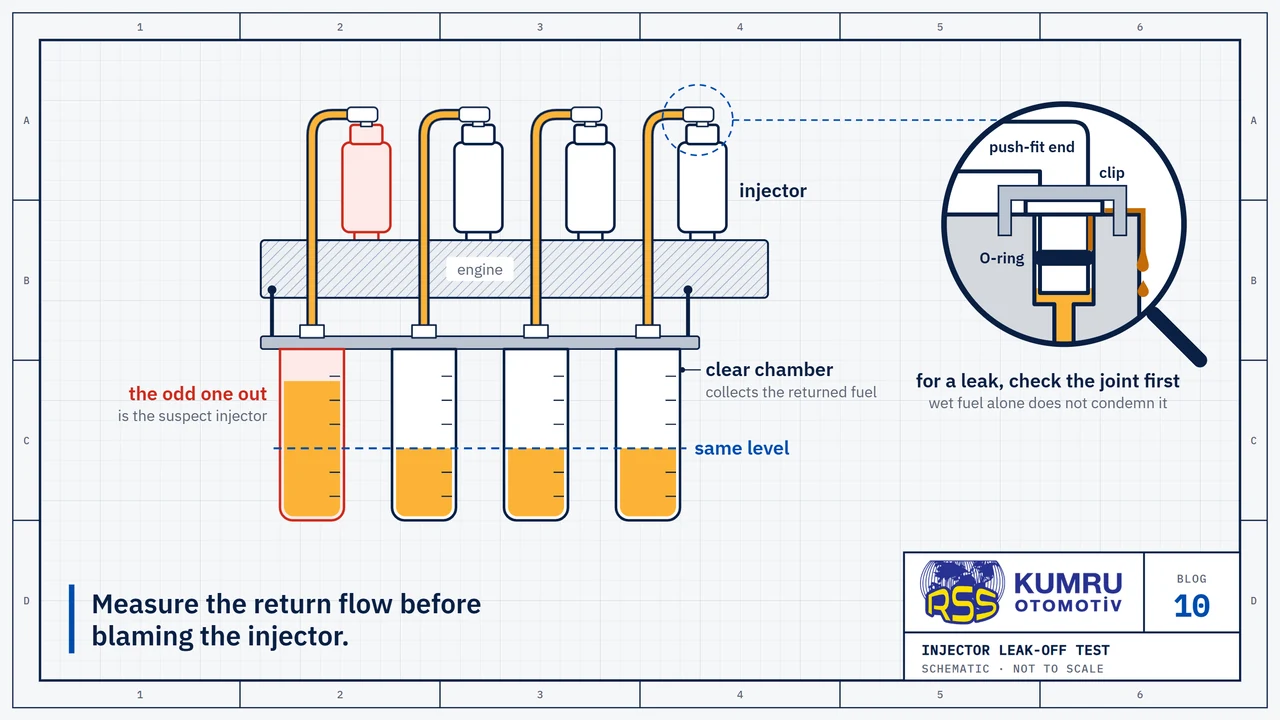
Low torque takes a minute to rule out: engine stopped, pressure gone, torque wrench at the service figure, one steady pull. If the nut turns before the wrench clicks, it was loose. On an older engine that can be the whole repair.
If the wrench clicks and the nut has not moved, torque was never the problem, and more of it does damage. Delphi’s note on common-rail pipes describes both errors: too much torque deforms the end of the pipe and narrows its bore, too little leaves a joint that leaks under pressure.
What do you look for once the joint is apart?
Two things: how the line sits when the nut is undone, and the state of the two sealing faces. Slacken every clamp on that line first, undo the nut fully and watch what the line does. Then look at cone and seat under a strong light.
| Finding | What it means | What to do |
|---|---|---|
| The line springs away from the seat or meets it at an angle | The nut was pulling it into place. GM notes that the brackets and isolators holding a line can themselves cause misalignment. | Find the reason: clamps tightened first, a wrong or bent line. Never pull the line in with the nut. |
| Dirt or metal particles on cone or seat | Delphi: tightening a thread produces fine swarf, which comes free when the nut is undone. | Clean, and cap whatever is open. |
| A scratch or pitting across the sealing band | GM: “A scratch in the sealing surfaces may result in a fuel leak”. | On the cone: new line. On the seat: the injector, rail or pump connector is the faulty part. |
| Cone visibly crushed, or the bore narrowed at the end | Over-tightened, or refitted many times. | New line. |
Can the seat be cleaned and the same line refitted?
On common rail, the maker instructions we could open do not clean a leaking joint; they replace the line. GM: if leaks are found at the line fittings, “both lines should be replaced”. Whether a sound line may go back on after other work is a separate question, answered engine by engine.
On older pump-line-nozzle engines workshop practice differs: a joint that leaked through dirt or a crooked fit is cleaned, lined up and tightened to the figure. The maker documents we opened do not cover these engines, so the engine’s own manual has the last word. If the joint weeps again at the correct torque, the line is replaced.
Cummins has the fittings and the area around them cleaned with electrical contact cleaner before a line is undone, and the open ends capped at once. Detroit Diesel wipes the sealing area inside each fitting with “a clean lint-free cloth”. None of these instructions puts sealant, tape or paste on the joint: the seal is steel on steel, and anything between the faces is a foreign body.
Some mechanics go further and polish a weeping cone with an abrasive pad, and on forums you can find a report of it working. We would not: the pad takes metal off the narrow band that seals, and it leaves grit just ahead of the injector.
Is there a standard torque for the nut?
There is no standard torque for a high-pressure line nut. Each engine maker publishes a figure for its own joint. In the bulletins cited here, Cummins gives 31 Nm for the injector supply lines of the X12, GM 38 Nm for the pump-to-rail lines of the 6.6-litre Duramax, and Detroit Diesel 40 Nm for the pump-to-rail lines of the DD15 and DD16. Those figures belong to those engines only.
All three are applied with a torque wrench; Detroit Diesel rules out power tools. A crowfoot adapter goes on at a right angle to the wrench: in line with the handle it changes the lever length, and the nut no longer gets what the wrench is set to.
What is the right order of work?
Source first, torque second, inspection third. A new line goes on only once you know why the old one leaked.
- Find the source. Clean, dry, run, stop, look.
- Check the torque once. Engine stopped, torque wrench at the service figure, no extra quarter turn.
- Still leaking: open the joint. Clamps slack, nut off, open ends capped. Read cone and seat against the table.
- Decide. Common rail, or any mark on the cone: new line. Older engine with clean faces: wipe and refit, if its manual allows.
- Fit without strain. Clamps loose, both nuts started by hand. Cummins: “Make sure the lines are centered within the nut.”
- Nuts first, clamps after. GM leaves the line isolators loose until the fittings are torqued. On the X12, Cummins even slackens the fuel rail bolts first and torques them last.
- Prove it. Cummins: “Operate the engine. Check for leaks.”
- New line, same leak? Stop fitting lines. Look at how the line sits, and at the seat on the injector, rail or pump.
Sources
- General Motors, “Service Bulletin 19-NA-138: Fuel Odor or Signs of Fuel At High Pressure Pump To High Pressure Fuel Lines”, technical service bulletin, June 2019; vehicles with the 6.6 L Duramax (LGH, LML).
- Delphi, “Re-use of High Pressure Injectors: Importance of Renewing High Pressure Pipes”, Delphi technical article, undated.
- Cummins, “Campaign C2532: X12 Fuel Injector Supply Line Safety Campaign, with repair procedure”, field campaign and repair procedure, 10 February 2022; NHTSA recall 21E-099.
- Detroit Diesel, “18SP727Rev: DD15/16 High Pressure Fuel Feed Lines, Mounting Bracket and P-clips Service Kit”, service kit installation instructions; in the NHTSA archive under 2019.
Sources were checked again on October 8, 2026.
RSS Kumru Automotive
RSS Kumru Automotive was founded in 1990 and specialises in hydraulic systems and fluid management. Our range includes close to 700 injector line references, most of them for Caterpillar, Mercedes-Benz, Ford / New Holland and Scania engines.
Brand names and OEM reference numbers are used for identification and compatibility information only.