Is a diesel leak dangerous, and will it pass inspection?
- Author
- Selami Kumru
- First published
- First published:
- Last updated
- Last updated:
- Reading time
- 6 min read
- Category
- Injection and fuel lines
A diesel leak is dangerous, and a vehicle with one will not pass a roadworthiness inspection. Diesel that reaches a hot surface or sprays out under pressure can start a fire, and a high-pressure leak can drive fuel through skin. Britain’s MOT manual classes a leaking fuel system as a major defect, or dangerous if the leak is excessive or a fire risk. Turkey’s official defect table calls it a serious defect.
Short answer
- Fire: the refiner Tüpraş puts the flash point of diesel at 55 °C minimum and warns of ignition on contact with a hot surface.
- Injury: fuel under pressure can penetrate skin. Never feel for a leak with your hand.
- Inspection: a major defect in the MOT manual, dangerous if excessive or a fire risk. A serious defect in Turkey, where the inspection is then not approved.
- Driving on: stop the engine if fuel is spraying, running or dripping onto anything hot. Other leaks should not wait either.
Can a diesel leak cause a fire?
Yes. Tüpraş, the Turkish refiner, classifies its diesel fuel as a “flammable liquid and vapour” and gives a minimum flash point of 55 °C. The flash point is the lowest temperature at which the vapour above the liquid can be lit by a flame. The exhaust manifold and the turbocharger of a running engine are far hotter than that. The data sheet’s own conclusion:
“If the product comes into contact with a hot surface, there is a danger of ignition or explosion.”
Tüpraş, safety data sheet for diesel fuel (Motorin), revision 10, 21 September 2020
An engine maker names two separate routes. Caterpillar’s operation and maintenance manual for the 3406C generator set says: “Fuel leaked or spilled onto hot surfaces or electrical components can cause a fire.” It lists spray on its own: “High pressure fuel spray may cause a fire hazard.”
Why should you never feel for a leak by hand?
Because fuel under pressure can go through skin. The same Caterpillar manual: “Contact with high pressure fuel may cause fluid penetration and burn hazards.”
Do not look for the leak with your hand. Caterpillar’s note: “Always use a board or cardboard when the engine components are checked for leaks. Leaking fluid that is under pressure can cause serious injury or possible death. This includes leaks that are the size of a pin hole.” No hose or fitting comes off until the pressure in the system has been relieved.
Contact without pressure is not harmless either. The Tüpraş sheet lists diesel as a skin irritant: take off contaminated clothing, wash the skin with plenty of water for at least 15 minutes, and get medical help if in doubt.
What other risks are there besides fire and injury?
Two more: diesel on the road makes the surface slippery, and diesel that leaks inside the engine ends up in the oil. The Tüpraş sheet states the first plainly: “Spilled product can make the surface slippery.” The MOT manual judges a fluid leak on two counts: harm to the environment, and whether it is likely “to pose a safety risk to other road users”.
The second cannot be seen from outside. A technician on the Adept Ape channel shows a Cat C7 with fuel in its oil: an overfull dipstick, thin oil, and an injector leaking under the valve cover. On older mechanical engines, he says, fuel gets in through the nozzles, the lines leading to them or the high-pressure pump. Diluted oil “can cause bearing damage”, so he changes oil and filter with the repair.
Will a diesel leak pass an MOT?
No. The MOT inspection manual sorts defects into minor, major and dangerous, and a vehicle with any major or dangerous defect “must be failed”. Under the fuel system item (6.1.3) a leaking fuel system is major. If it is “leaking excessively or a risk of fire” it becomes dangerous, which the manual defines as “a direct and immediate risk to road safety”.
The same item rates a chafing fuel pipe or hose as minor and a damaged one as major. The fluid leaks item (8.4.1) adds a measure, taken with the engine idling: the vehicle should fail if a leak “creates a pool on the floor within 5 minutes that’s more than 75mm in diameter”.
How does Turkey’s periodic inspection class a fuel leak?
As a serious defect, whatever its size. The defect table of the Ministry of Transport and Infrastructure, applied from 1 June 2026, puts leaking fuel pipes or tank, a leaking fuel pump or filter, and damaged or cracked fuel pipes and hoses in the ağır kusur (serious defect) group. The entries cover every vehicle class except trailers.
The inspection regulation defines that group as defects “of a degree that needs repair”: the inspection is not approved, and the owner has one month to return for a re-test. A higher group, emniyetsiz (unsafe), covers defects that endanger life, property and traffic safety; fuel leaks are not in it.
Unlike the MOT manual, the Turkish table has no step for the size of the leak. An engine oil leak, by comparison, is a minor defect (hafif kusur).
Does it matter where the leak is?
Not to the inspection result, but it changes the risk. None of the sources ranks the three sides of the fuel system; the order below is our own reading of what they say.
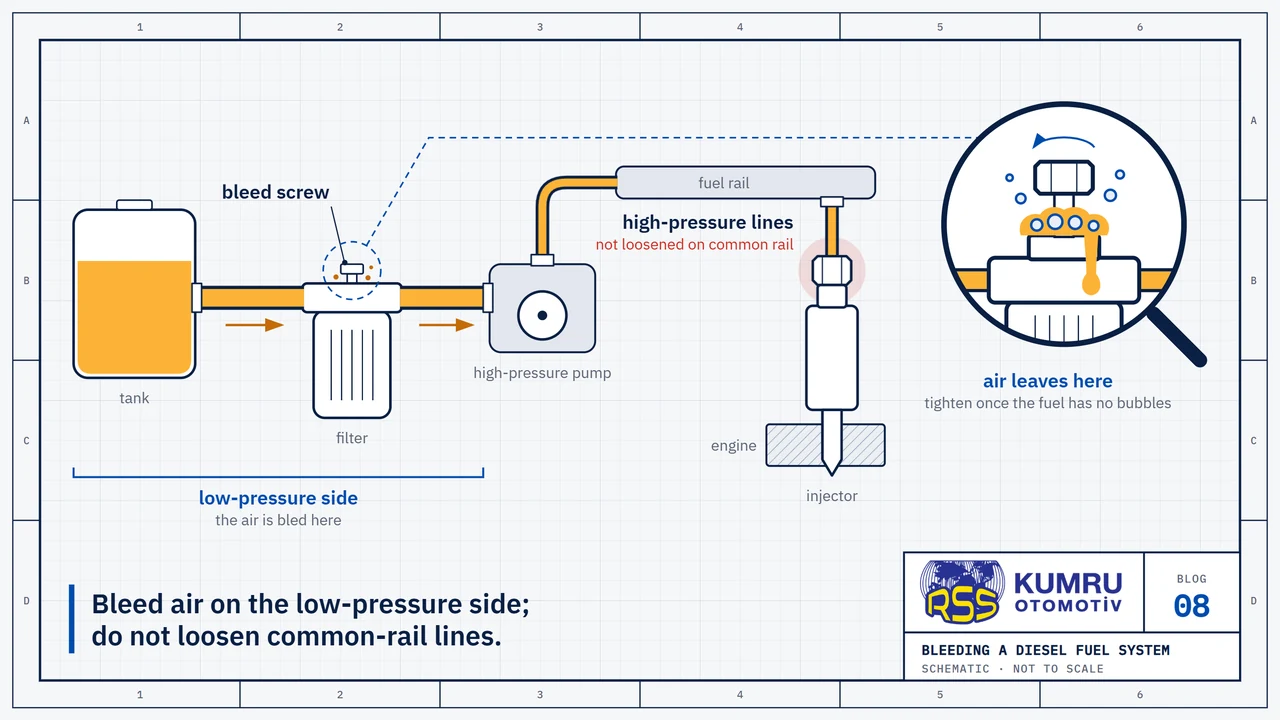
- High-pressure side (pump, rail, injector pipes): this is where Caterpillar’s spray and penetration warnings apply. The manual says not to check these lines with the engine or the starter running, and to wait 10 minutes after shutdown before working on them; that figure belongs to that manual. Symptoms and the order of work are in our article on common-rail pipe leaks.
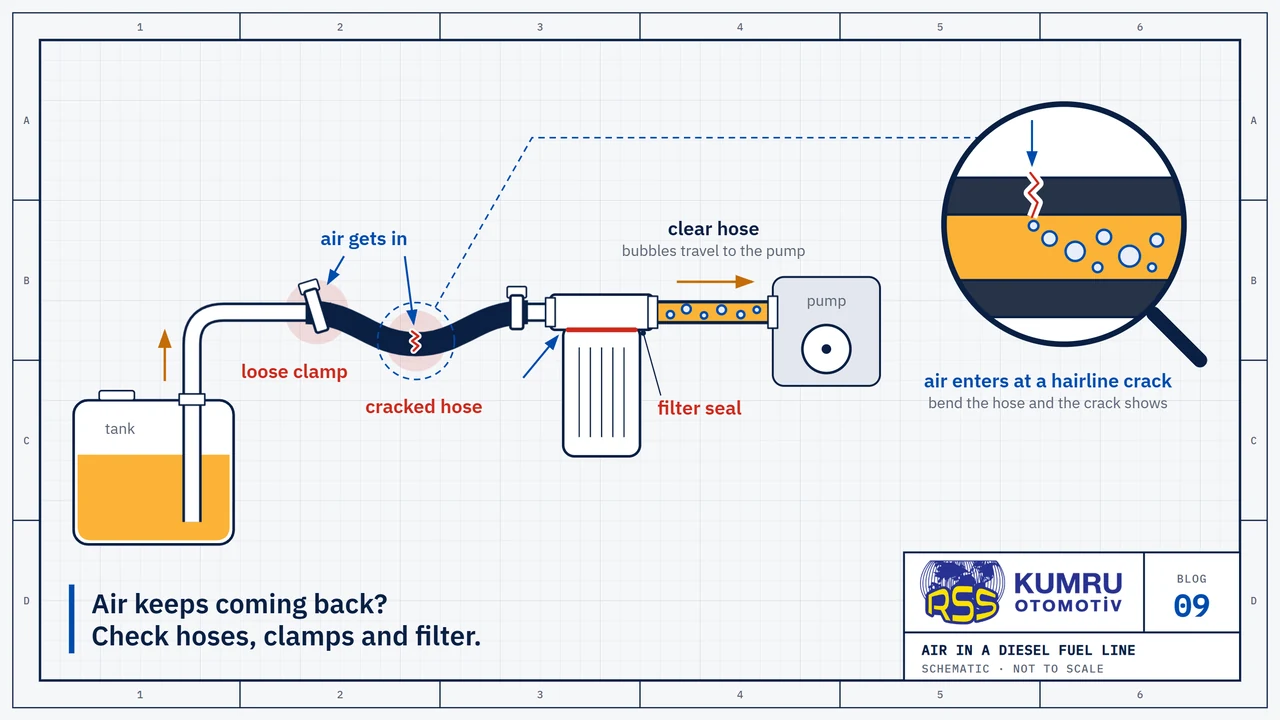
- Low-pressure supply side (tank, filters, lift pump): fuel drips, it does not spray. A section that works under suction may draw air in instead of letting fuel out, and Caterpillar notes that air in the fuel “can cause low power”. That symptom is the subject of our article on air in the fuel line.
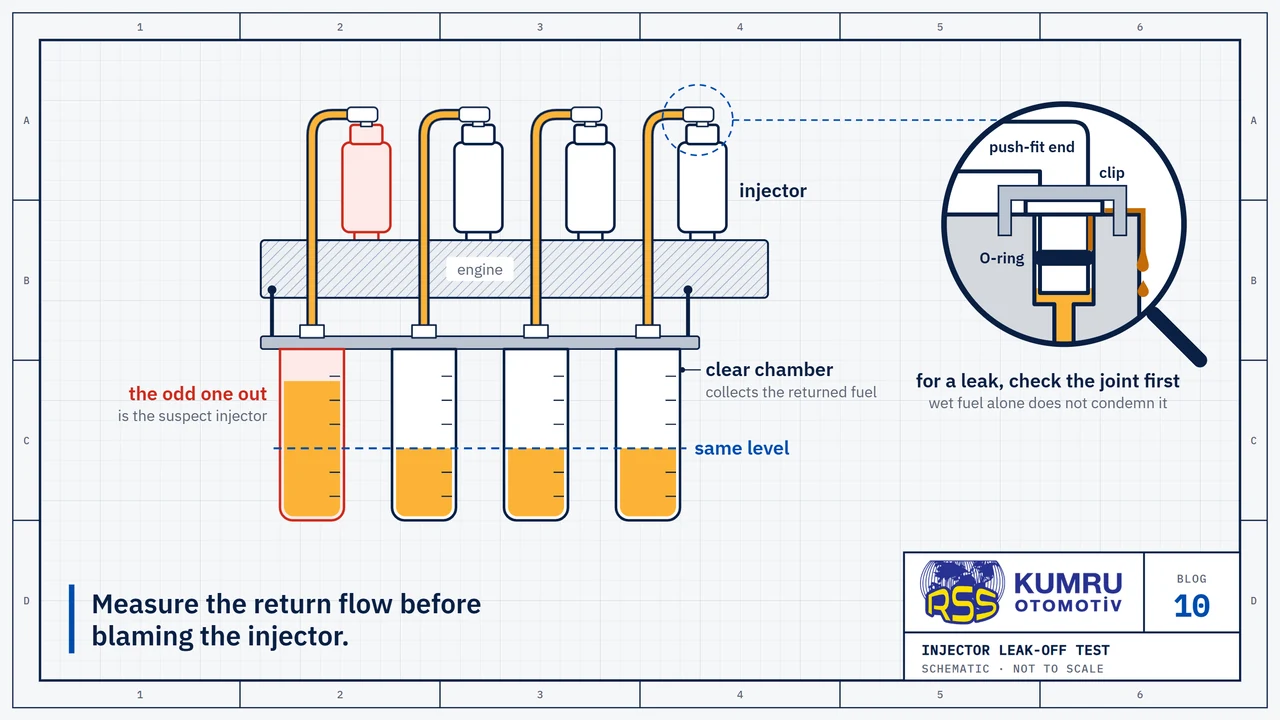
- Return (leak-off) line: low pressure, but it runs over the injectors across the top of the engine, so the Tüpraş hot-surface warning applies to whatever drips from it. A tractor example is in the article on leak-off hoses.
Can you keep driving with a diesel leak?
You should not. None of the sources gives an amount of leakage that is safe to drive with, and Caterpillar’s rule is short: “If leaking is observed, find the source and correct the leak.” Applying the MOT manual’s two steps at the roadside is our own inference; on that basis the order is:
- Fuel spraying, misting, running or dripping onto a hot part: stop the engine. The vehicle should not be driven as it is.
- A joint on the cold side that is only weeping: do not put the repair off. Neither inspection scheme has a light grade for a leaking fuel system.
- Clean up the spilled diesel. Caterpillar wants the fluid cleaned up after any leak; Tüpraş says to stop it spreading with sand, earth or absorbent.
- Look for the source with a piece of card, not a hand. Before you touch a joint, have the engine stopped and the pressure released.
- Repair, run, look again. After a fuel hose is replaced, Caterpillar’s manual has the engine started and the fuel system inspected for leaks.
Sources
- T.C. Ulaştırma ve Altyapı Bakanlığı, “01 Haziran 2026 Tarihinden İtibaren Uygulanacak Kusurlar Tablosu (Araç Muayenesi Sonucu Belirlenen Eksikliklere İlişkin Kusur Grupları Yönergesi eki)”, official defect table for periodic vehicle inspection, applied from 1 June 2026; from the ministry's vehicle inspection page; in Turkish.
- Resmî Gazete, “Araç Muayene İstasyonlarının Açılması, İşletilmesi ve Araç Muayenesi Hakkında Yönetmelik (sayı 31356)”, regulation, 6 January 2021; Article 8 defines the inspection results (no defect, minor, serious, unsafe); in Turkish.
- Driver and Vehicle Standards Agency (DVSA), “MOT inspection manual: cars and passenger vehicles (Introduction; 6.1.3 Fuel system; 8.4.1 Fluid leaks)”, official inspection manual on GOV.UK; first published 20 May 2018, last updated 1 June 2026.
- Tüpraş, “Ürün Güvenlik Bilgi Formu: Motorin (TPR.YPG.GBF.0403, Rev. 10)”, the refiner's safety data sheet for diesel fuel, revision 10, 21 September 2020; in Turkish.
- Caterpillar, “3406C Generator Set: Maintenance Intervals (Operation and Maintenance Manual Excerpt, SEBU7828-10)”, operation and maintenance manual excerpt, August 2010; the copy held by archive.org of a document marked safety.cat.com.
- Adept Ape, “How To Troubleshoot Fuel In Oil Contamination. Diesel Fuel Dilution.”, workshop video, 5 May 2016; the engine shown is a Cat C7; read from the subtitles; field practice, not a manufacturer document.
Sources were checked again on October 8, 2026.
RSS Kumru Automotive
RSS Kumru Automotive was founded in 1990 and specialises in hydraulic systems and fluid management. Our range includes close to 700 injector line references, most of them for Caterpillar, Mercedes-Benz, Ford / New Holland and Scania engines.
Brand names and OEM reference numbers are used for identification and compatibility information only.