Should you replace the oil pipes when you fit a new turbo?
- Author
- Talha Kırmızıaslan
- First published
- First published:
- Last updated
- Last updated:
- Reading time
- 6 min read
- Category
- Turbo oil lines
Yes. When a turbocharger is replaced, the oil feed pipe should be replaced with it, and the oil return pipe should either be replaced or proven clear. The old feed pipe is very often what starved the old turbo, and nobody can see inside it.
Short answer
- Oil feed pipe: fit a new one with every replacement turbo.
- Oil return pipe: fit a new one on engines known for blocked drains. On the rest, take it off, look through it, and replace it if there is any doubt.
- Banjo bolts, washers and gaskets: new every time.
Why does the feed pipe matter so much?
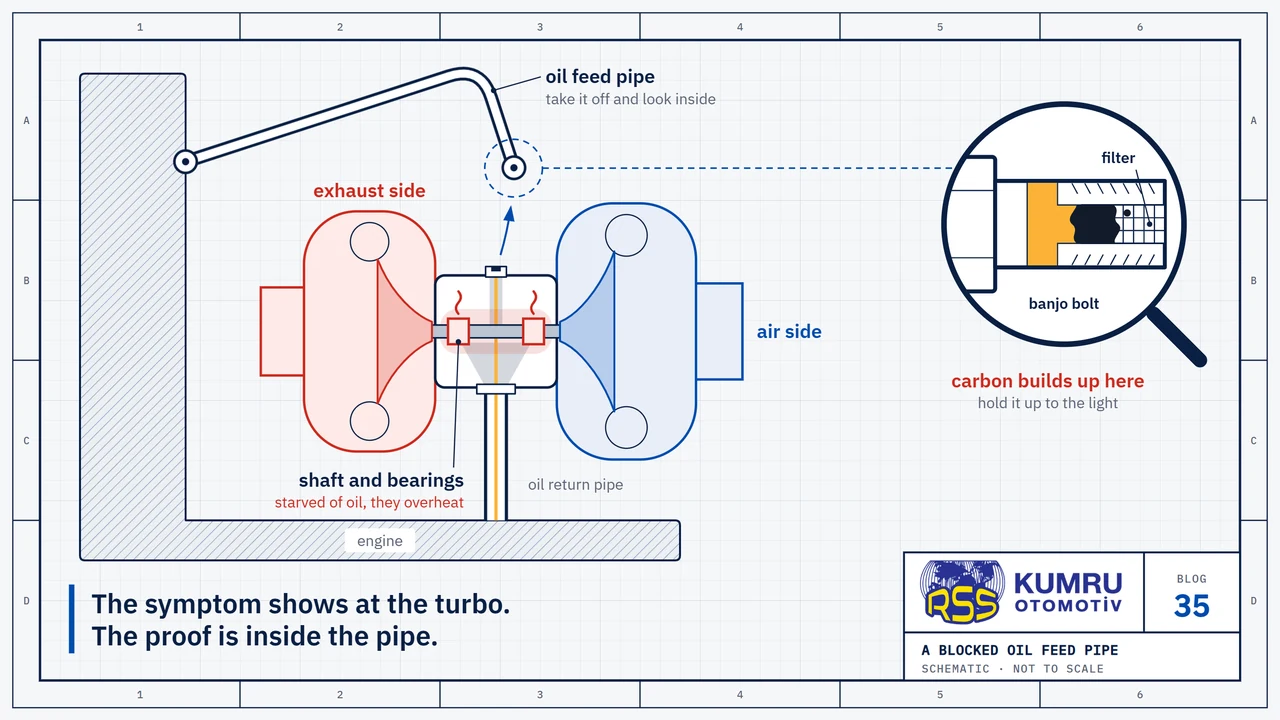
A turbocharger shaft turns on a thin film of engine oil, and all of that oil arrives through one narrow pipe. On most engines the pipe runs close to the exhaust manifold or the turbine housing. Each time the engine is switched off hot, the oil left standing in the pipe is baked a little more, and over the years a layer of hard carbon grows on the inside wall.
The UK turbo specialist BTN Turbo puts the result plainly: the original pipe “is prone to carbon deposits building up over time, which considerably restricts oil flow and, ultimately, will block it completely.” A pipe in that state still looks perfect from the outside. The new turbo is bolted on, receives a fraction of the oil it needs, and fails the same way as the one it replaced.
Can the old pipe be cleaned and refitted?
Not with any certainty. BTN again:
“It is virtually impossible to clean out carbon deposits from existing oil feed pipes and be 100% certain that they are totally clear.”
BTN Turbo, in Professional Motor Mechanic, 9 May 2018
Solvent and compressed air move the loose sludge. Baked carbon in a tight bend, or behind the banjo at either end, tends to stay where it is.
Garrett’s installation guide asks for oil lines that are “totally clean” and undamaged, then adds a warning about lines with a flexible section. The inner liner can collapse, or be damaged by heat, while the outside looks sound. In Garrett’s words this is “common on some vehicles and difficult to detect without cutting the pipe”. Its conclusion: “We recommend fitting a new oil inlet pipe when installing the new turbo.”
Note the wording. Garrett recommends. For particular turbos the remanufacturers go further: Melett’s failure notes for one unit say it is “imperative to replace the oil inlet hose when the turbocharger is replaced / remanufactured.” Either way the sum is simple. The pipe costs a small part of what the turbo costs.
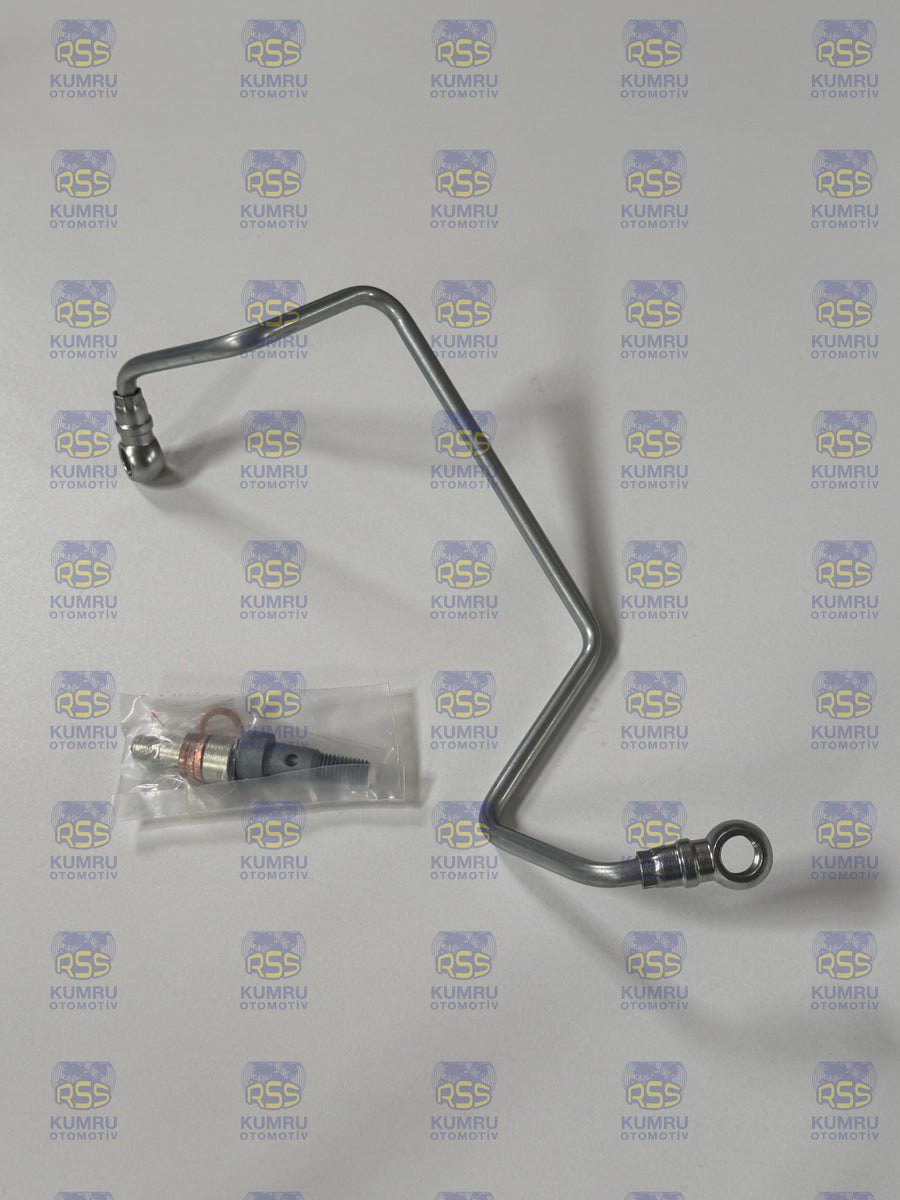
Does the oil return pipe need replacing too?
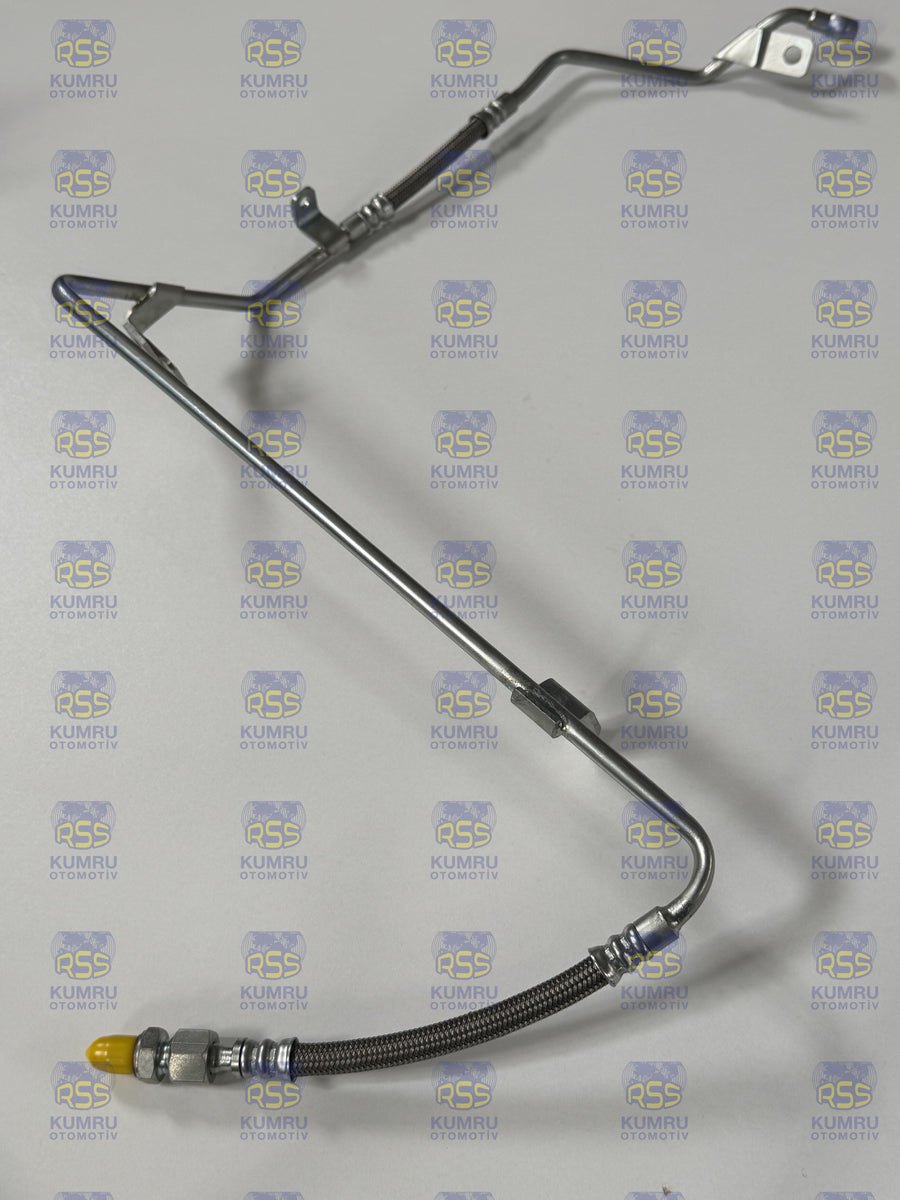
Often, yes, and for a different reason. Oil is pushed into the turbo under pressure, but it leaves by gravity alone. Anything that narrows the return pipe (carbon, a kink, a flattened section) makes oil back up inside the bearing housing. From there it finds its way past the seals into the intake and the exhaust.
The symptom is blue smoke and oil in the intake pipework, which is easily taken for a faulty turbo. Melett describes it for turbo number 720168-0011: the drain pipe “has a tendency to clog over time causing increased oil pressure within the turbo”, oil passes into the exhaust and the intake, “causing blue smoke from the exhaust”, and so “the oil drain pipe must be replaced on changing the turbo.” Melett adds that this can happen “even during the process of fitting a new turbo, even when it has previously not happened”.
The return pipe has to come off with the turbo in any case. If it is a plain steel tube, you can see daylight through it and it is clean, it can go back with new gaskets. If it has a bend you cannot see through, a flexible section, or any trace of baked oil, replace it.
Which engines are known for it?
BTN Turbo names these as the engines where replacing the feed pipe is the “core critical instruction” in its fitting advice:
- Ford Transit / Land Rover 2.2, 2.4 and 2.5 LD
- Vauxhall (Opel) Astra, Meriva, Insignia and Zafira, A14 NEL / NET
- Vauxhall (Opel) Signum 2.0 Turbo
- Peugeot and other PSA 1.6 HDi, 2004 onwards
- Saab 9-3 and 9-5, 2.0 Turbo and 2.3 Turbo
- Audi A4 and VW Passat 1.8T
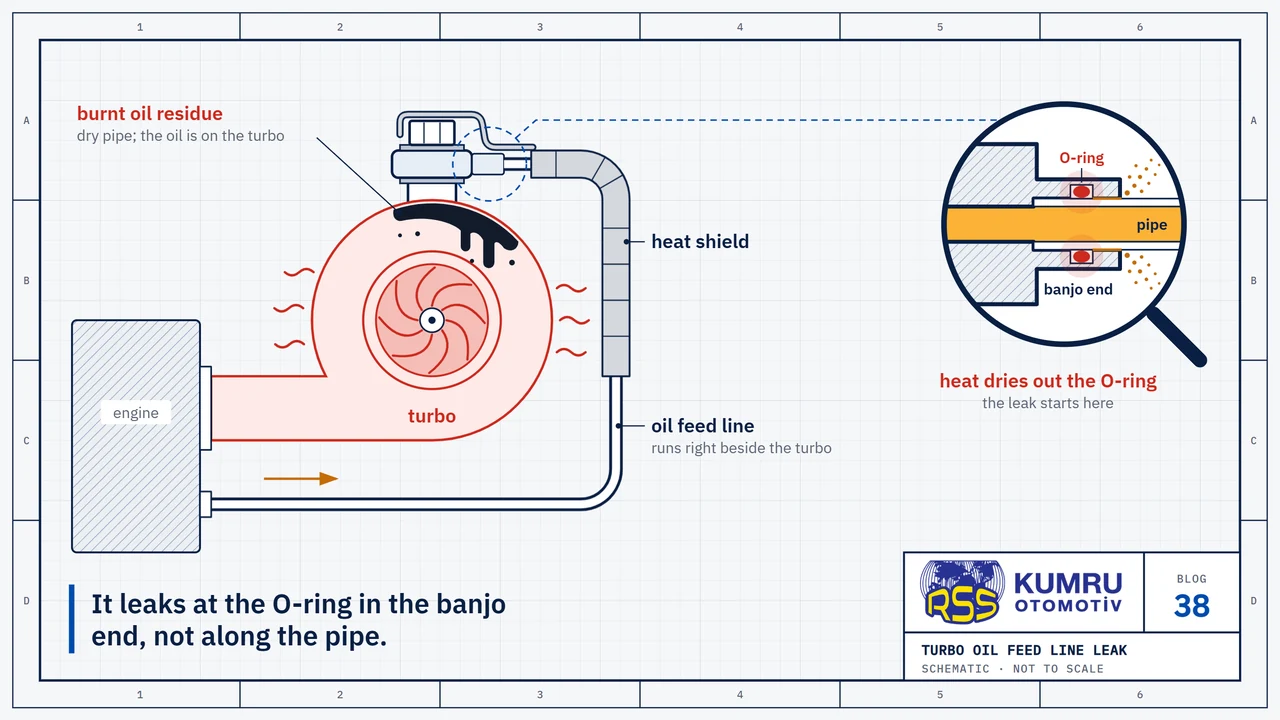
The list is not a boundary. Any turbo whose feed pipe runs beside the exhaust lives with the same heat. These are simply the engines where the failure was seen often enough to be written down. The Mini Cooper S with the N14 engine is not on the list; its feed line leak is covered in a separate article.
| Engine | Line | OE reference | Listed for |
|---|---|---|---|
| PSA / Ford 1.6 HDi, 1.6 TDCi | Feed | 0379.68 / 9651785280 | Citroën C3, C4, Berlingo; Peugeot 206, 207, 307, 308, 407 |
| PSA / Ford 1.6 HDi, 1.6 TDCi | Feed | 0379.69 / 9651785380 | Citroën C4, Berlingo, Jumpy; Peugeot 308, 3008, Partner, Expert; Ford C-MAX |
| Opel / Chevrolet 1.4 Turbo | Feed | 55592600 / 25198546 | Opel Astra, Insignia, Meriva, Zafira, Corsa, Mokka; Chevrolet Aveo, Trax |
| VAG 1.8 T 20V | Feed | 06B 145 771 P | Audi A4, A6; VW Passat; Skoda Superb |
| VAG 1.8 T 20V | Return | 06A 145 735 AA | Audi A3, TT; VW Golf, Bora; Seat Leon; Skoda Octavia |
The 1.6 HDi alone has more than one feed pipe, depending on turbo and model year. Order by the OE number on the old pipe or by VIN, not by engine size.
What else should be done while the pipes are off?
- Fit the return pipe first. Then pour clean engine oil into the turbo’s oil inlet and connect the feed pipe.
- Turn the compressor wheel by hand. It should spin freely.
- Use new banjo bolts, washers and gaskets. An old copper washer has already been crushed once.
- Before the first start, crank the engine for 10 to 15 seconds without letting it fire, so the feed pipe and the turbo fill with oil. Then let it idle for 3 to 4 minutes and check every joint for leaks.
- Do the engine-specific extras. BTN’s advice calls for a new oil strainer on the Ford / Land Rover and Vauxhall / Saab engines and a new heat shield on the VAG 1.8T, and lists several more steps for the PSA 1.6 HDi.
Steps 1, 2 and 4 are Garrett’s. On the 1.6 HDi, one of the extra points is the small gauze filter in the feed line, which on this engine sits in the banjo bolt. Melett notes that soot “can block the filter installed in the turbo supply pipe”. A new pipe fitted with the old, half-blocked bolt has solved nothing.
New pipes fitted and the turbo still failed?
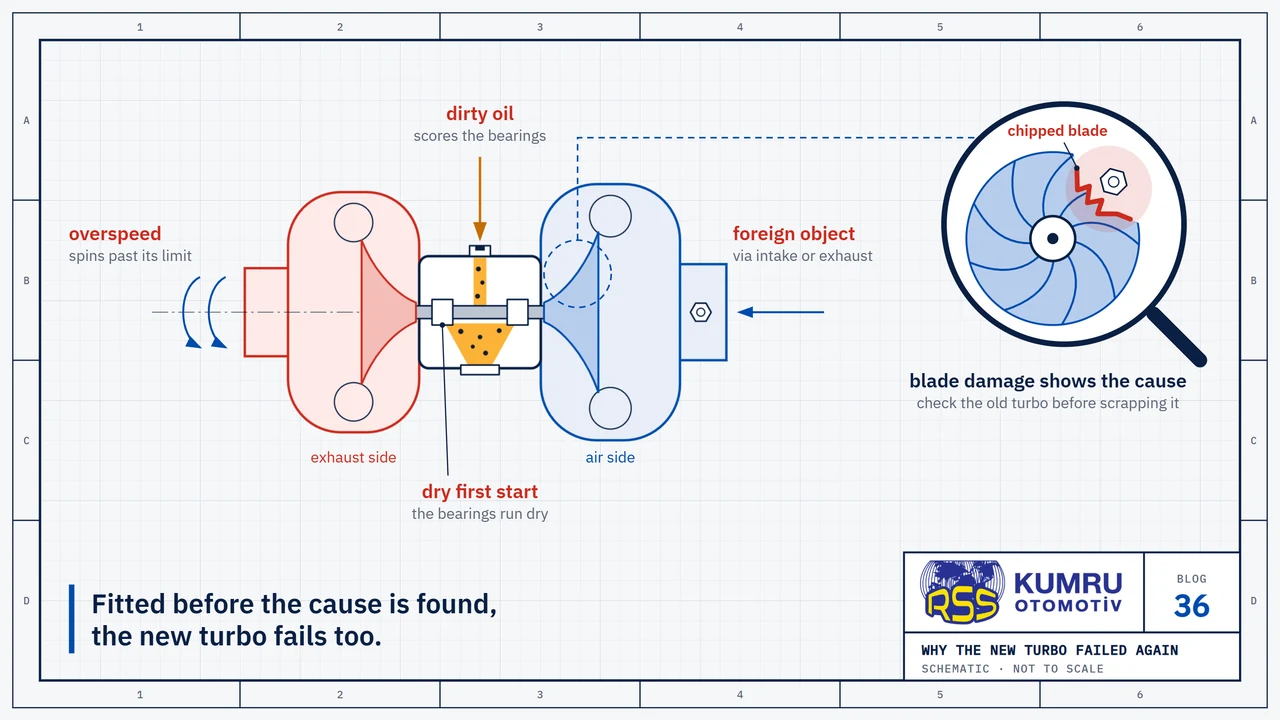
Then the pipes were not the only restriction. The carbon that blocks a feed pipe also settles in the sump and on the oil pick-up strainer, and overdue oil changes bring it back faster than any new part can cope with. Before a third turbo goes on, the lubrication system needs checking from the sump upwards.
Sources
- Garrett Motion, “Garrett Turbocharger Installation Guide, Part 2”, Garrett Knowledge Center, undated.
- BTN Turbo, “Oil Feed Pipe Critical Fitments”, Professional Motor Mechanic, 9 May 2018.
- Melett, “Why turbos fail: specific failures by turbo number”, Melett technical pages, undated.
Sources were checked again on October 8, 2026.
RSS Kumru Automotive
RSS Kumru Automotive was founded in 1990 and specialises in hydraulic systems and fluid management. Our range includes more than 140 turbo oil feed and return line references.
Brand names and OEM reference numbers are used for identification and compatibility information only.