Why do hydraulic hoses burst on an excavator, and how do you replace one?
- Author
- Selami Kumru
- First published
- First published:
- Last updated
- Last updated:
- Reading time
- 6 min read
- Category
- Hydraulic hoses
A hydraulic hose on an excavator bursts for a short list of reasons: twist, a tight bend, a hose that is too short, rubbing, heat, pressure spikes, age and a badly made assembly. Replacing one follows a fixed order: lower the work equipment, release the pressure, mark and remove the hose, fit the new one without twist or tension, bleed the air, check for leaks.
Short answer
- Why it bursts: twist and tight bends lower the pressure a hose can carry; rubbing, heat, pressure spikes and age lead to the same failure.
- When it bursts: oil sprays out and can ignite on a hot engine or exhaust.
- Before and after: release the pressure before a fitting is loosened; bleed the air and check every joint afterwards.
Why do hydraulic hoses burst?
Hydraulic hoses burst because of twist, bending below the minimum bend radius, abrasion, excess heat, pressure spikes and ageing. The first two reduce the pressure the hose can carry. A hose that was wrongly selected or badly crimped ends the same way.
The list comes from the hydraulic hose rule of DGUV, Germany’s statutory accident insurance body (DGUV Regel 113-020). The rule names these as causes of oil spraying from a hose line under pressure, and adds an unsuitable fluid, stress in storage, damaged seals and overlong replacement intervals. Takeuchi tells its mini excavator operators the same in one sentence:
“Never use twisted, bent or cracked pipes, tubes or hoses; otherwise, they may burst.”
Takeuchi, TB260 Operator’s Manual, February 2015
On twist the rule is categorical: a hose installed twisted “always” has a markedly shorter life, because the reinforcement layers chafe against each other. A pressure spike comes from a valve that shuts or opens abruptly, or from a moving mass that is accelerated or braked, and can reach several times the working pressure. DGUV’s examples of moving masses include earth; applying that to a machine that digs is our step, not the rule’s.
What happens when a hose bursts on an excavator?
When a hose bursts, oil is sprayed around the machine and can ignite if it lands on something hot. A 2002 bulletin on hydraulic excavators from the Queensland mines inspectorate reports major fires on working machines: “A common mechanism has been oil spray or mist from a damaged hose coming into contact with a hot spot on the diesel engine or exhaust.” It notes that some of an excavator’s high-pressure hoses flex and are exposed to mechanical damage.
The second danger is a falling boom. Takeuchi’s optional emergency shut-off valve “prevents the boom or arm from falling rapidly in case the hydraulic hose is broken”. If it has stopped the boom, the manual says to get clear of the lifted load, then lower the boom slowly with the lever.
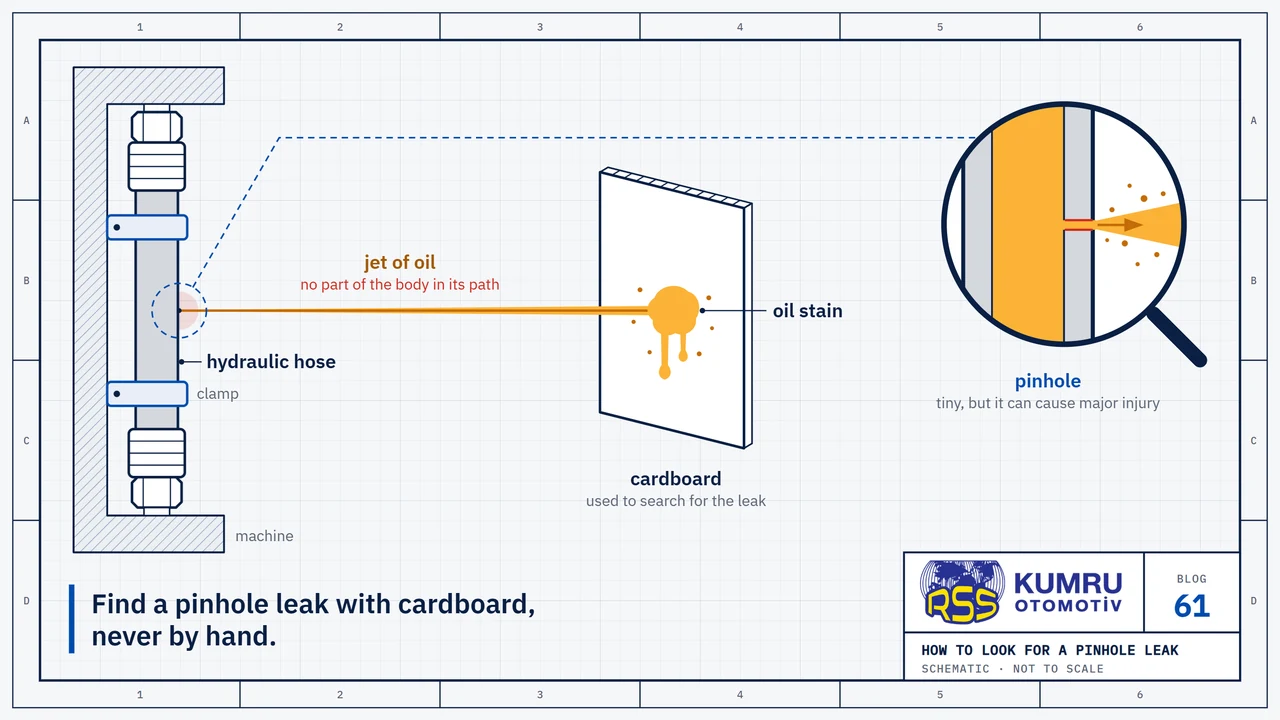
Do not look for the leak with your hand. Takeuchi’s manual says the oil can penetrate skin and asks for goggles, thick gloves and a piece of paperboard or plywood. Komatsu: “If you are hit by a jet of high-pressure oil, consult a doctor immediately for medical attention.” Why is explained in the fluid injection injury article.
How do you relieve hydraulic pressure before removing a hose?
Stopping the engine is not enough. In Takeuchi’s words, “Pressure is maintained in the hydraulic circuit long after the engine has been shut down.” Komatsu’s operation and maintenance manual for the PC130-6K gives this sequence:
- Park. Level ground, work equipment on the ground, engine stopped. Let the hot oil cool.
- Levers. Move the right work equipment lever several times to RAISE and LOWER to release the remaining pressure, then set the safety lock lever to LOCK.
- Tank. Release the pressure in the hydraulic tank; the filler cap is turned slowly.
- Loosen slowly. Do not stand in front of the joint.
On the TB260 the starter switch stays on: straight after the engine stops, with the safety lock lever unlocked, every lever and pedal is moved several times in each direction, and the tank is vented with the air breather button. DGUV adds two rules: a raised load is lowered or supported first, and a fitting that still releases oil under pressure is opened no further.
How do you replace a hydraulic hose on an excavator?
Six steps, compiled from the sources named in each:
- Mark. A maintenance module of Turkey’s Ministry of National Education wants a note of what connects where before any pipework comes off, and numbered tags on the parts.
- Catch the oil. Put a pan under the joint.
- Use two spanners. Hold the fitting with one and loosen the nut slowly with the other, as Takeuchi shows.
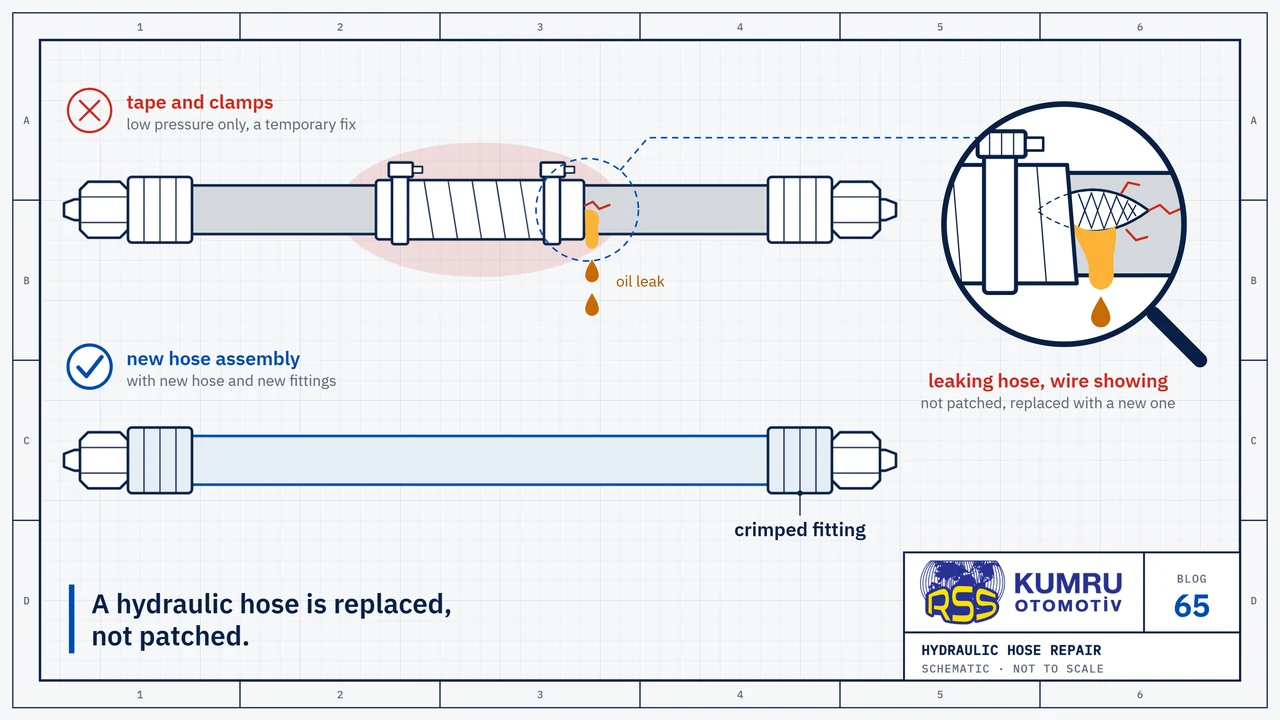
- Compare the new hose. DGUV ties the choice to the machine maker’s data: nominal size, pressure rating, length and end fittings must match it. How to read the rating is covered in the pressure rating article.
- O-rings and clamps. Komatsu and Takeuchi want new O-rings with a new hose, and a deformed or cracked clamp replaced with it.
- Torque. Komatsu says the torque “is determined according to the type of hose and size” and wants its distributor to do the job. The figure is in the machine’s service data.
How should the new hose be routed and clamped?
The new hose must run without twist, tension or rubbing. DGUV’s rule supplies the detail:
- Hold the hose against turning while the nut is tightened. With an elbow fitting, connect the elbow end first.
- Where space allows, start the bend after a straight length of at least 1.5 times the hose’s outside diameter. The minimum bend radius is most often undercut directly behind the fitting.
- Lay the hose with some sag. Under pressure a hose can get shorter or longer.
- Put clamps on straight sections. A clamp should guide the hose, not grip it.
Takeuchi wants clamps, guards and cushions securely fixed; otherwise vibration or contact with other parts can damage the hose.
How do you bleed the air and check for leaks afterwards?
After hydraulic piping has been removed, the circuit must be bled. DGUV gives the reason: with air left in the system, cylinders and motors can move suddenly and unpredictably. The sequence in Komatsu’s PC130-6K manual, set out under the hydraulic oil change:
- Pump. Loosen the air bleeder on the pump and tighten it once oil oozes out.
- Idle. Start the engine and keep it at low idling for 10 minutes.
- Cylinders. At low idling, extend and retract each cylinder 4 to 5 times, stopping about 100 mm before the end of the stroke. Then work each to the end of its stroke 3 to 4 times, and 4 to 5 times more.
- Wait, then look. Stop the engine and wait at least 5 minutes before starting work, so the bubbles leave the oil in the tank. Then check every joint for leaks.
The manual warns against high engine speed and full stroke at the start, because air inside the cylinder “may cause damage to the piston packing or other parts”. Takeuchi’s sequence differs in detail; follow the manual for your own machine. For the final test DGUV recommends trying every hydraulic function, taking the system up to its maximum working pressure and checking the hoses for leaks, rubbing, kinks and twist.
Komatsu and Takeuchi list the boom, arm and bucket cylinder hoses among the safety-critical parts replaced every 2 years; Komatsu adds 4000 hours. Two years is also DGUV’s guide value for hose lines under increased demands; the comparison is ours. General service-life values are in the hose life article.
Sources
- Deutsche Gesetzliche Unfallversicherung (DGUV), “DGUV Regel 113-020: Hydraulik-Schlauchleitungen und Hydraulik-Flüssigkeiten, Regeln für den sicheren Einsatz”, rule on hydraulic hose lines by the German statutory accident insurance body, October 2017; in German; causes (section 3.1), installation and routing (4.2), pressure spikes (4.3), replacement intervals (4.5.1), removal and recommissioning (4.6).
- Komatsu, “Operation & Maintenance Manual UEAM000602: PC130-6K, PC150LGP-6K Hydraulic Excavator”, operation and maintenance manual by the excavator maker; no print date on the book, open copy on the Internet Archive; warnings on high-pressure oil and hoses, releasing pressure, safety critical parts (section 22), air bleeding sequence (section 24).
- Takeuchi Mfg. Co., Ltd., “Operator's Manual TB260 Mini Excavator (No. 43754)”, operator's manual by the mini excavator maker, eighth edition, February 2015; open copy on the Internet Archive; handling of hoses (p. 1-29), releasing pressure (p. 1-30), emergency shut-off valve (p. 2-82), safety-critical parts (p. 5-12).
- Queensland Government, Department of Natural Resources and Mines, “Mines safety bulletin no. 32: Fire and explosion risks on hydraulic excavators”, safety bulletin by the mines inspectorate of Queensland, Australia, 9 December 2002; fire and explosion risks on hydraulic excavators; Internet Archive copy of 16 April 2018.
- T.C. Millî Eğitim Bakanlığı, “Makine Teknolojisi: Hidrolik Sistemlerin Bakım ve Onarımı (ders modülü)”, course module for vocational schools, Ankara 2014; in Turkish; procedure for dismantling pipework (noting and numbering before removal).
Sources were checked again on October 13, 2026.
RSS Kumru Automotive
RSS Kumru Automotive was founded in 1990 and specialises in hydraulic systems and fluid management. Our range includes hydraulic hoses, hydraulic pipes and fittings.
Brand names and OEM reference numbers are used for identification and compatibility information only.