Tractor power steering line leaks: Ford 2000–5000 and Massey Ferguson 50 and 65
- Author
- Süleyman Kumru
- First published
- First published:
- Last updated
- Last updated:
- Reading time
- 6 min read
- Category
- Tractors
On a tractor’s power steering lines an oil leak has three possible sources: a connection, the steel pipe or the hose. Ford’s service manual for the 2000, 3000, 4000 and 5000 treats each one. A leaking connection gets a new seal where one is fitted and is tightened; a fractured pipe or cracked hose is renewed. Afterwards the reservoir is topped up and the steering worked to drive out the air.
Short answer
- Order of checks: connections, the pipe behind each nut, the hoses. If tightening fails, take the pipe off and look at the flare.
- Symptoms: in Ford’s trouble-shooting table, loose connections and damaged tubing put air in the system. Steering turns slow; the pump gets noisy.
- Clamps: clamps left off or wrongly placed are the manual’s cause of pipe failure.
- Afterwards: fill the reservoir, turn the steering lock to lock with the engine running, top up.
Which pipes and hoses carry the steering oil?
The pump draws oil from the reservoir and sends it down a pressure line to the control valve. The valve feeds the power cylinder; a return line takes the oil back to the reservoir. The lines differ from tractor to tractor:
| Tractor | Layout | Lines |
|---|---|---|
| Ford 2000 and 3000 | Valve on the steering gear; a cylinder for each front wheel | Inlet and excess oil pipes at the pump; pressure and return pipes at the valve; two pipes per cylinder |
| Ford 4000 | Valve bolted to the cylinder | Pressure and return pipes to the cylinder |
| Ford 5000 | Cylinder and valve at the front axle support | Tube and flexible hose to the valve; a second hose and tube for the return |
| Ford 4000 and 5000, integral unit (1970) | Cylinder and valve inside the steering gear | Pressure and return pipes; one more pipe outside the unit |
| Massey Ferguson 50 and 65 | Cylinder and valve outside, behind the front grille | Pressure and return lines at the pump; hoses to the valve |
We could not open a Massey Ferguson manual for the 135 and later models; their layout is in the tractor’s own book.
Is the leak at a connection, in the pipe or in the hose?
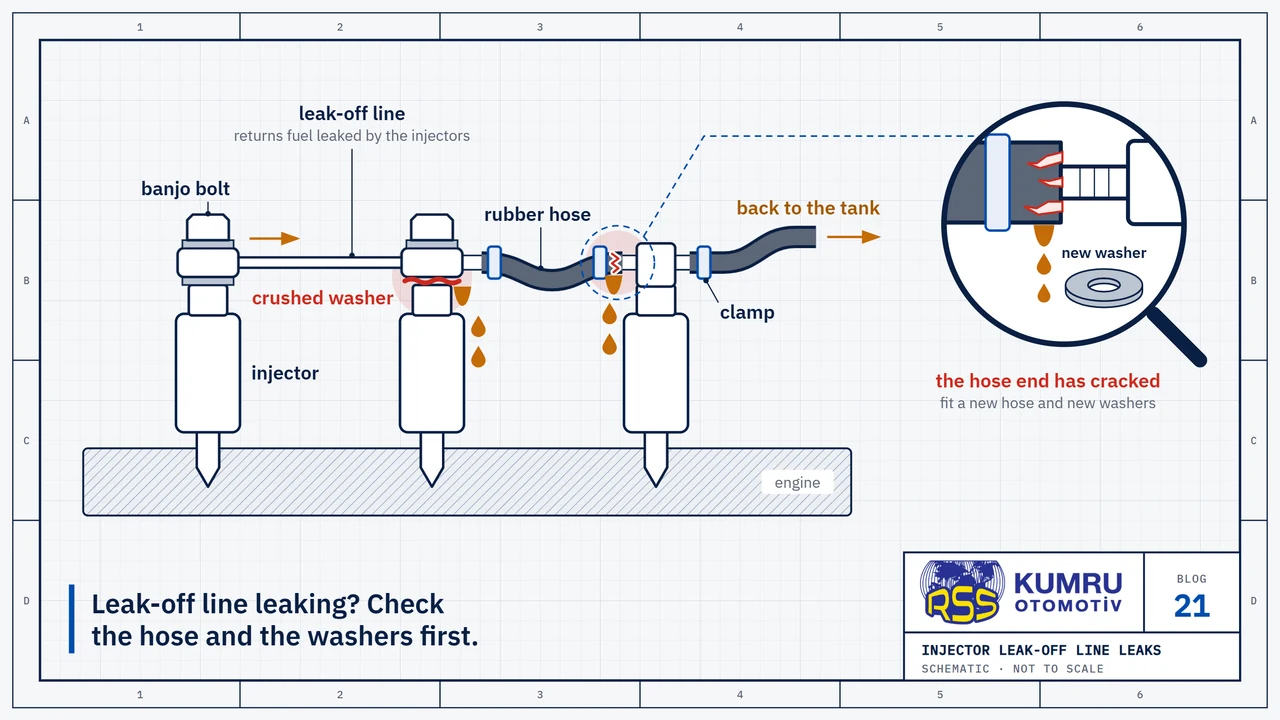
Ford’s manual inspects the hydraulic pipes in three steps. First the connections: oil seals are replaced where fitted and loose connections tightened. Then the pipe itself: “Inspect pipes for signs of fracture and renew if necessary.” Last, the flexible hoses are checked for cracks.
A leak at a connection does not always come from the joint. On a tractor forum, a Ford 3600 owner with a leak at the elbow under the pump finds oil coming from two places: the elbow’s O-ring and the flared end of the pipe. In the same thread a Ford 4000 owner tightens the nut until the elbow’s thread strips, then takes the pipe off and finds a fracture through half its diameter under the nut: “All my tightening would have never worked.”
Oil from the steering box is a separate matter. Ford’s specification table lists steering gear oil (S.A.E. 90 E.P.) and power steering oil (S.A.E. 10) on separate lines. On the same forum a Massey Ferguson 135 owner has oil coming from the box’s air vent; the repair shop he asked pointed to the steering shaft seals.
Why does a newly fitted pipe leak again?
Ford’s trouble-shooting table points to the clamps. The table in its 1970 chapter has a row for “Excessive pipe vibration or pipe failure.” Its possible cause: “Nylon clamps not fitted or fitted in incorrect location.”
The first reply in the Ford 3600 thread agrees: the bracket and plastic clip that hold the two lines are often left off after a repair. “You just want the lines to be fastened down so they don’t vibrate.” The 3600 had neither.
One member writes that some joints carry an O-ring or Teflon washer between nut and flare and that end fittings vary with serial number; that is a field observation. Teflon tape is turned down, because “it’s a metal to metal fitting”. Tape belongs on tapered threads only, as our guide to fitting and thread types explains.
What does a leaking line do to the steering?
Two rows in Ford’s trouble-shooting table for the 2000 to 5000 matter here: “Slow Steering Action or No Steering Action.” and “Pump Noisy.” Both list an incorrect oil level in the reservoir, and both list this:
“Air in system due to loose connections or damaged tubing.”
Ford Motor Company, service manual (2000–7000 series), steering trouble-shooting table, July 1967
A leaking line brings both at once: the level drops, and air gets in at the loose joint. The table does not say so; it follows from reading the two entries together. The same rows also name the pump valves, worn pump gears and a leaking cylinder.
Without pressure the steering does not lock. The manual says the 2000 and 3000 are then steered by hand, “with an increase in the steering effort”.
What matters when a pipe or hose is replaced?
Do not feel for the leak with your hand. The Canadian Centre for Occupational Health and Safety (CCOHS) warns: “Hydraulic fluid escaping through pinhole leaks is difficult to see, but its high pressure can puncture the skin.” Such a wound goes to a physician at once. Pass cardboard or wood over the area instead. Ford’s relief valve settings run from 600 psi on the 2000 and 3000 to 1,150 psi on the 5000.
Release the pressure first. The CCOHS tractor maintenance fact sheet gives the order: lower the equipment, shut off the engine, move the hydraulic lever back and forth a few times, let the system cool. A Massey Ferguson 250 owner with a pinhole in a steering hose is also told on the forum to loosen the nut slowly.
Ford has open pipe ends and pump ports plugged against dust. Line the joint up before tightening, the forum advises; the torque is the figure in the tractor’s service manual.
How is the system topped up and bled afterwards?
Fill the reservoir, start the engine, work the steering several times and top up. Ford’s service manual ends the pump, cylinder and steering gear jobs with that step. The operator’s handbook says how: “turn the steering from lock to lock”. With the engine stopped and the wheels straight ahead, the level “should reach the bottom of the filler neck”. The service manual warns against holding full lock for more than 30 seconds.
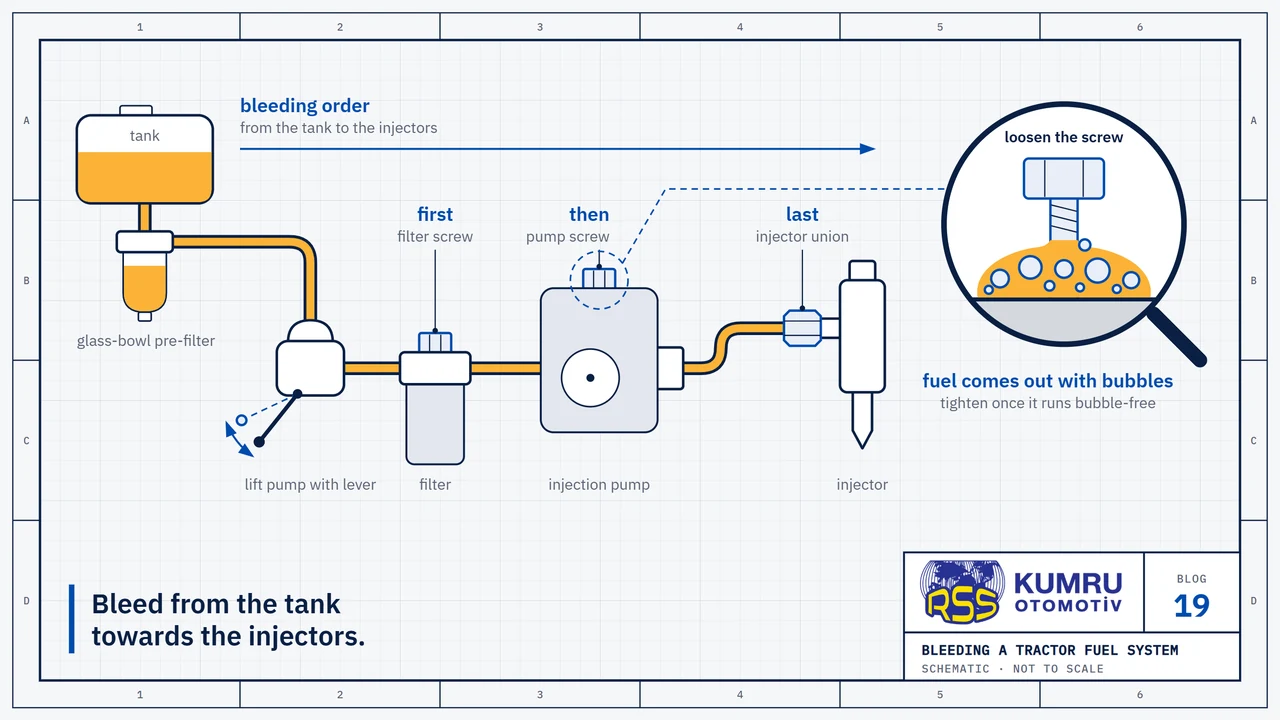
Massey Ferguson’s MF 50 and 65 manual gives the same order and has the level rechecked with the engine stopped. The books differ on the oil: Ford specifies S.A.E. 10 antifoam oil, Massey Ferguson “only automatic transmission oil, type A”. Air in the fuel system is a different job, covered in our guide to bleeding a tractor fuel system.
In what order does a mechanic check?
- Reservoir. Is the level right, engine stopped and wheels straight ahead?
- Connections. Look for the leak with cardboard. Tighten the loose union; renew its seal where one is fitted.
- Pipe and hose. If tightening fails, take the pipe off; look at the flare and under the nut. Check the hose for cracks and pinholes.
- Clamps. Are the clamps, bracket and clip in place?
- Oil and air. Fill, turn the steering lock to lock, top up.
- If the symptom stays. The pump and cylinder come next. Ford has pump pressure measured with a gauge.
Sources
- Ford Motor Company, “Ford Tractor Service Manual, Tractor Series 2000, 3000, 4000, 5000, 7000: Part 12, Steering Systems”, maker's service manual, Part 12 (steering); pages dated June 1965, July 1967 and April 1970; machine reading of the page images of the scan on the Internet Archive.
- Ford Motor Company, “Tractor Operations: Operators Handbook, Ford 2000, 3000, 4000 and 5000 (SE 3112)”, operator's handbook; print date illegible on the cover; OCR text of the scan on the Internet Archive.
- Massey-Ferguson, “MF 65 Tractor Workshop Service Manual (Publication No. 1448 812 M1)”, maker's workshop manual; the steering section covers the MF 50 and 65; print date not legible in the text; OCR text of the scan on the Internet Archive.
- Canadian Centre for Occupational Health and Safety (CCOHS), “Tractors - Maintenance”, government agency fact sheet (OSH Answers); last revised 12 September 2017, confirmed current 7 December 2023.
- TractorByNet, “Power steering leak”, forum thread, 18 May to 16 October 2012; accounts by Ford 3600 and Ford 4000 owners and the replies; used as a field account, not a manufacturer instruction.
- TractorByNet, “Massey 135 Power Steering Leak”, forum thread, 22 July 2013 to 3 December 2018; a Massey Ferguson 135 owner's account; used as a field account, not a manufacturer instruction.
- TractorByNet, “Massey Ferguson 250 hydraulic hose”, forum thread, 23 July 2022; a Massey Ferguson 250 owner's question and the replies; used as a field account, not a manufacturer instruction.
Sources were checked again on October 8, 2026.
RSS Kumru Automotive
RSS Kumru Automotive was founded in 1990 and specialises in hydraulic systems and fluid management. Our range includes more than 300 pipe references for Massey Ferguson and Ford tractors.
Brand names and OEM reference numbers are used for identification and compatibility information only.