Tractor injector leak-off line leaks: hose, washer or injector?
- Author
- Süleyman Kumru
- First published
- First published:
- Last updated
- Last updated:
- Reading time
- 6 min read
- Category
- Tractors
The thin line across the tops of a tractor’s injectors takes the fuel that leaks through each injector back to the filter and the tank. When it leaks, check the line first: aged rubber hose, a slack clamp, the washers under a banjo bolt. Two signs point to the injector instead: fuel seeping from its body, or too much fuel at its leak-off connection.
Short answer
- What it carries: the back leakage that lubricates the injector needle, back to the filter and tank.
- Why it leaks: rubber hose ages, clamps lose their grip; on a banjo joint the washers or bolt are loose.
- Line or injector: wash the area, run the engine, see where it gets wet first. Excess fuel at the leak-off connection means an injector test.
- When refitting: new washers on banjo joints, new clamps on rubber hose; bleed the system if a line came off.
What does the leak-off line do, and where does it run?
The leak-off line, also called the leak-off pipe or injector return line, is the low-pressure line that takes fuel leaking through the injectors back to the tank. The leakage is not a fault. The Massey Ferguson MF 65 service manual explains:
“A very small amount of back leakage is necessary for the lubrication of the nozzle valve and body.”
Massey Ferguson, MF 65 Tractor Service Manual, Perkins A4.203 engine section
Going by that manual’s part names, the MF 65 line joins the injectors and ends at a tee: one branch to the secondary fuel filter, the other to a reservoir at the rear of the fuel tank, piped to the main tank. The Ford 2000, 3000, 4000 and 5000 handbook shows a leak-off pipe with a banjo fitting at each injector and a second pipe back to the tank.
On TractorByNet an injection pump rebuilder describes two layouts: a steel pipe from injector to injector with a rubber line at the end, or a two-barb fitting on each injector joined to the next by rubber hose.
Why does a leak-off line leak?
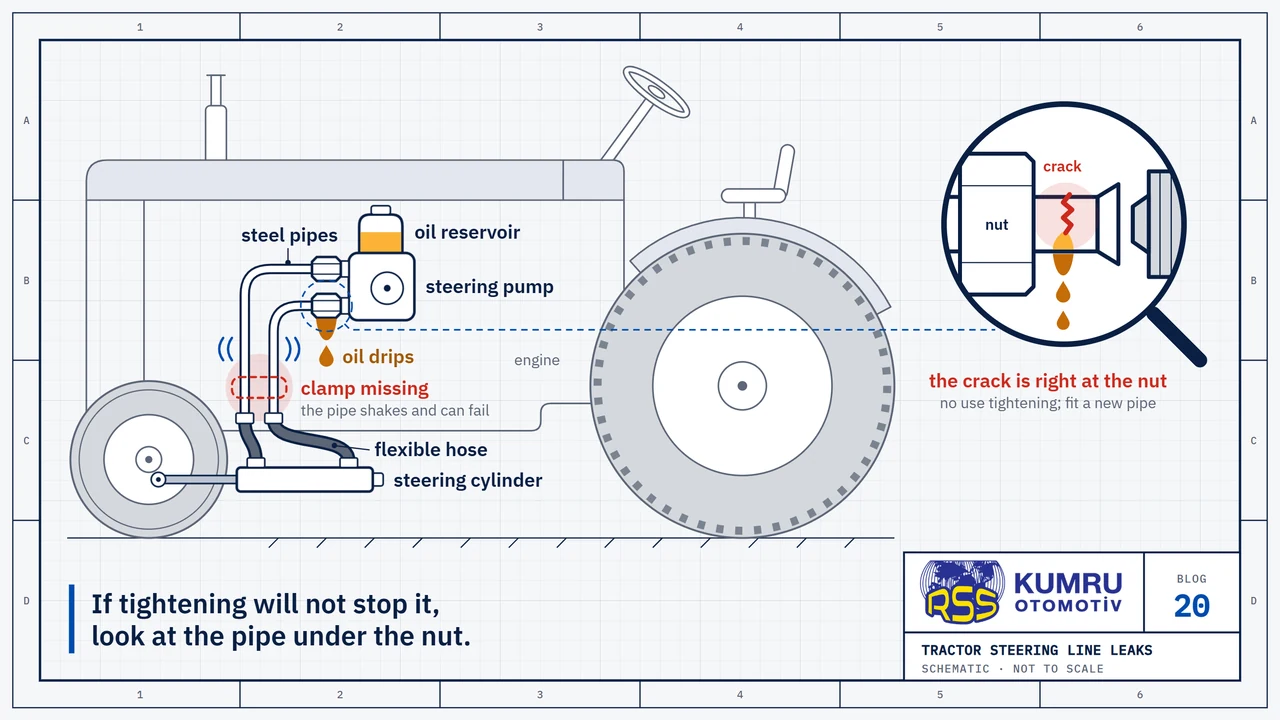
A leaking leak-off line is checked in two places: the rubber hose ends and the banjo washers. Perkins writes: “Fuel system hoses and clamps are often areas of failure.” Leaks, it adds, “are often caused by cracking, softness or loose clamps”. Kubota’s B2301 and B2601 workshop manual says fuel lines “are subject to wear and aging”.
The rebuilder says of rubber return hose: “Those lines get brittle & crack & its VERY COMMON”. The thread’s starter, 20 years into owning his John Deere 4100, found the opposite: his hoses “were soft and slid off the nipples without depressing the clamps”. In another thread, wire clamps were too weak to keep an eight-year-old tank return hose on its steel pipe.
On a banjo joint the washers either side of the fitting make the seal; the rebuilder’s second suspect is “a loose washer under the return pipe”. On an MF 65 with the early secondary filter, the bolt holding the leak-off line to the filter is undone at every element change. The manual does not call it a cause of leaks; we list it because it is opened so often.
What does a leak lead to?
A leak in the leak-off line first shows as a smell of diesel and a wet engine top. The same owner smelt diesel while clearing snow and found the number 2 injector wet. A few days later he “could see that the leak has grown”.
Do not work a tractor that is leaking fuel. Perkins: “Do not operate the engine with a fuel leak. Leaks can cause fires.” Kubota has the engine stopped and the key removed before fuel lines are checked. The MF 65 manual has the engine started after the repair to check for leaks; our advice is to run it no longer than that check takes when you are looking for the leak, too.
The same route carries air too: on the MF 65 the reservoir returns air purged by the secondary filter to the tank. Air drawn in through a leaking return line is covered in the article on air in a diesel fuel line.
Is the leak from the line or from the injector?
To tell a line leak from an injector leak, clean the area and watch where the fuel first appears. That owner washed round the injectors with solvent and ran the engine for about 15 minutes; the leak showed at the nipple for the rubber hose. The rebuilder had already told him the injector need not come out or apart.
| Wet patch or symptom | Where to look |
|---|---|
| Rubber hose end, at the nipple | Hose and clamp |
| Round a banjo bolt | Washers, bolt tightness |
| Between nozzle holder and nozzle | Pressure faces, nozzle cap nut |
| Blow-by round the injector | How the injector sits in its recess (the manual fits a new copper washer every time) |
| Excess fuel at the leak-off connection | Nozzle; injector test stand |
Rows one and two: forum account and Ford handbook; the rest: MF 65 manual.
The MF 65 manual treats excess fuel at the leak-off connection as an injector fault: worn or damaged lapped surfaces of the nozzle valve and body, or internal leakage past the pressure faces. It is measured on a test stand, not the engine: the pressure must take at least six seconds to fall from 2,200 to 1,470 psi (about 152 to 101 bar). The figures are for that engine’s C.A.V. injector.
What should you watch when replacing it?
- Clean first, cover the open ends. Ford has the area round the injectors cleaned and the pipe ends and leak-off ports covered: “This is extremely important to prevent the entry of dirt.”
- New washers on banjo joints, low torque. Ford fits new sealing washers “above and below each banjo fitting”; the washer material is in the banjo bolt article. The MF 65 manual gives 5 to 7 ft-lb (about 7 to 9.5 Nm) for its banjo-type leak-off bolts, that engine only. Perkins: “If there is a leak do not over-tighten the connection to stop the leak.”
- Replace rubber hose with its clamps. The only manufacturer procedure we could open for this layout is for a generator set, not a tractor: Thermo King’s SG 3000e manual discards the old clamps, end cap and return lines and routes the long line as straight as possible.
- Take the size from the old hose. The rebuilder says the hose is metric, 6 or 7 mm on those tractors, and to “take a line w/ you”. The owner who started the second thread bought diesel-rated line.
- Do not bend the pipes; check the tank end. The MF 65 manual, in capitals: “DO NOT BEND THE FUEL LINES WHEN REMOVING THE INJECTORS.” Ford has the unions on the tank return pipe checked for tightness.
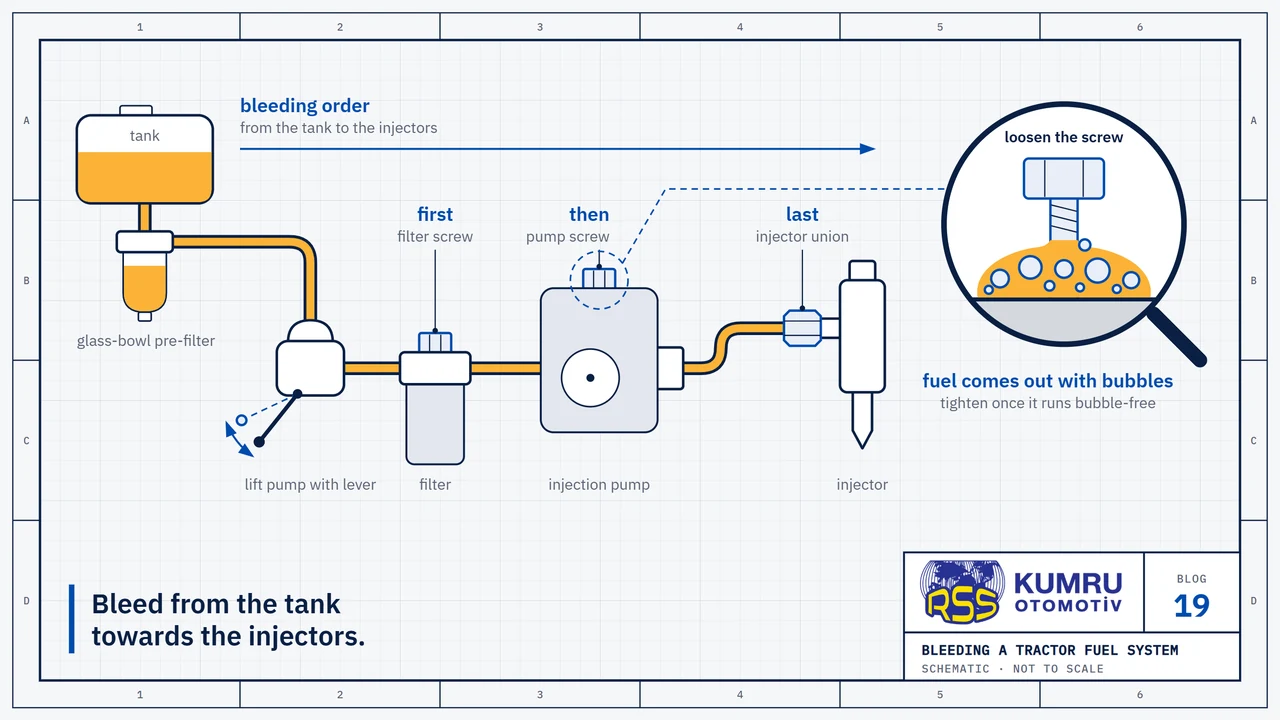
- Bleed the system. Kubota: “If the fuel line is removed, be sure to properly bleed the fuel system.” The order is in the article on bleeding a tractor fuel system. The MF 65 manual then runs the engine and checks for leaks.
In what order should a mechanic check?
- Wash, then run. Clean the area with the engine stopped; run it briefly and find the first wet spot.
- Hose, clamps, banjo washers. On the Kubota B2301 and B2601 the fuel line is checked every 100 hours.
- Tank and filter ends. Check the unions and the end hose.
- If the line is dry, the injector. Look between nozzle holder and nozzle, and for blow-by at the recess.
- If too much fuel comes back. The injector goes on the test stand; the limit is in the engine’s service manual.
Sources
- Massey Ferguson, “MF 65 Tractor Service Manual (form no. 1448 812 M1), Part 3: Perkins A4.203 Diesel Engine”, tractor maker's service manual; no print date in the diesel engine part; OCR text of the scan on the Internet Archive, the pages used were checked against the page images.
- Ford Motor Company, “Tractor Operations: Operators Handbook, Ford 2000, 3000, 4000 and 5000 (SE 3112)”, operator's handbook, injector replacement page; print date illegible on the cover; OCR text of the scan on the Internet Archive.
- Perkins, “How to Service Fuel Pumps”, engine maker's service information page, undated.
- Kubota, “Workshop Manual, Tractor B2301, B2601 (code no. 9Y131-11560)”, tractor maker's workshop manual, November 2014; general section (maintenance chart and fuel line check); text of the PDF on the Internet Archive.
- Thermo King, “Container Edition SG 3000e Series, Maintenance Manual TK 61979-4-MM: Fuel Return Line Replacement”, online maintenance manual (e-Tech Library); a generator set, not a tractor; page last updated 5 December 2017.
- TractorByNet, “JD injector leaking”, forum thread, 10 to 19 February 2019, 12 messages; a John Deere 4100 owner's account and an injection pump rebuilder's replies; used as a field account, not a manufacturer instruction.
- TractorByNet, “Leaking Diesel”, forum thread, 7 to 8 June 2018, 5 messages; two tractor owners' accounts; used as a field account, not a manufacturer instruction.
Sources were checked again on October 8, 2026.
RSS Kumru Automotive
RSS Kumru Automotive was founded in 1990 and specialises in hydraulic systems and fluid management. Our range includes more than 300 pipe references for Massey Ferguson and Ford tractors.
Brand names and OEM reference numbers are used for identification and compatibility information only.