Why do injector lines crack?
- Author
- Selami Kumru
- First published
- First published:
- Last updated
- Last updated:
- Reading time
- 5 min read
- Category
- Injection and fuel lines
A steel injector line almost never cracks because the pressure inside was too high. It cracks from fatigue: a tiny bending movement repeated for as long as the engine runs, concentrated at the point where the tube is held rigid. How long a line lasts comes down to three things: how much it vibrates, how much strain it was fitted with, and the steel it is made of.
Short answer
- The crack is a fatigue crack. It usually starts right behind a nut or under a worn clamp.
- Missing clamps and lines forced into place are the two causes a workshop controls.
- A cracked line is replaced. It is not brazed, sleeved or sealed.
What does an engine maker say?
The clearest statement we know of comes from a safety recall. In 2022 a recall report filed with the US regulator NHTSA covered the injector fuel supply tubes of the Cummins X12 engine. The cause takes one sentence:
“The subject fuel tubes (for cylinders 4, 5 and 6) are susceptible to cracking due to metal fatigue failure resulting from a combination of vibration strain, assembly strain and material strength.”
NHTSA Part 573 Safety Recall Report 22V-120, 2 March 2022
The remedy says as much as the cause. The tubes were replaced with new ones of the same part number, “and vibration isolators will be added to the fuel tubes”. On the production line, “the injector alignment to the cylinder head was improved by implementing an improved alignment fixture”. The tube kept its part number. What changed was how much it could shake and how squarely it met the injector.
What actually happens in the steel?
An injector line is a thin steel tube fixed at both ends. The engine shakes it, and every injection sends a pressure pulse down it. The tube answers by flexing, by an amount too small to see. Below a certain stress, steel will put up with that for the life of the engine. Above it, a crack opens at the surface where the stress is highest and grows a little with every cycle, until fuel finds its way out.
The stress is highest where the tube stops being free to move: directly behind the nut, where it leaves the rigid joint, and under a clamp that has worked loose. That is why so many cracked lines look alike, with a hairline running round the tube just behind the nut.
Do the clamps really matter?
More than anything else a mechanic can influence. Clamps tie the lines to each other or to the engine, so that no length of tube is long enough to swing freely. Leave one off and the same line starts to move in a way it was never meant to.
The rubber insert is part of the clamp. Once it has hardened, shrunk or fallen out, the clamp damps nothing. It rubs steel on steel and wears a groove into the tube. A clamp in that state is replaced with the line, not refitted to the new one.
What is assembly strain?
A line that has to be pulled or pushed to meet its seat is loaded before the engine has turned once. Vibration then comes on top of that load. Cummins dealt with it by aligning the injectors better. In a workshop the same result comes from the order of work:
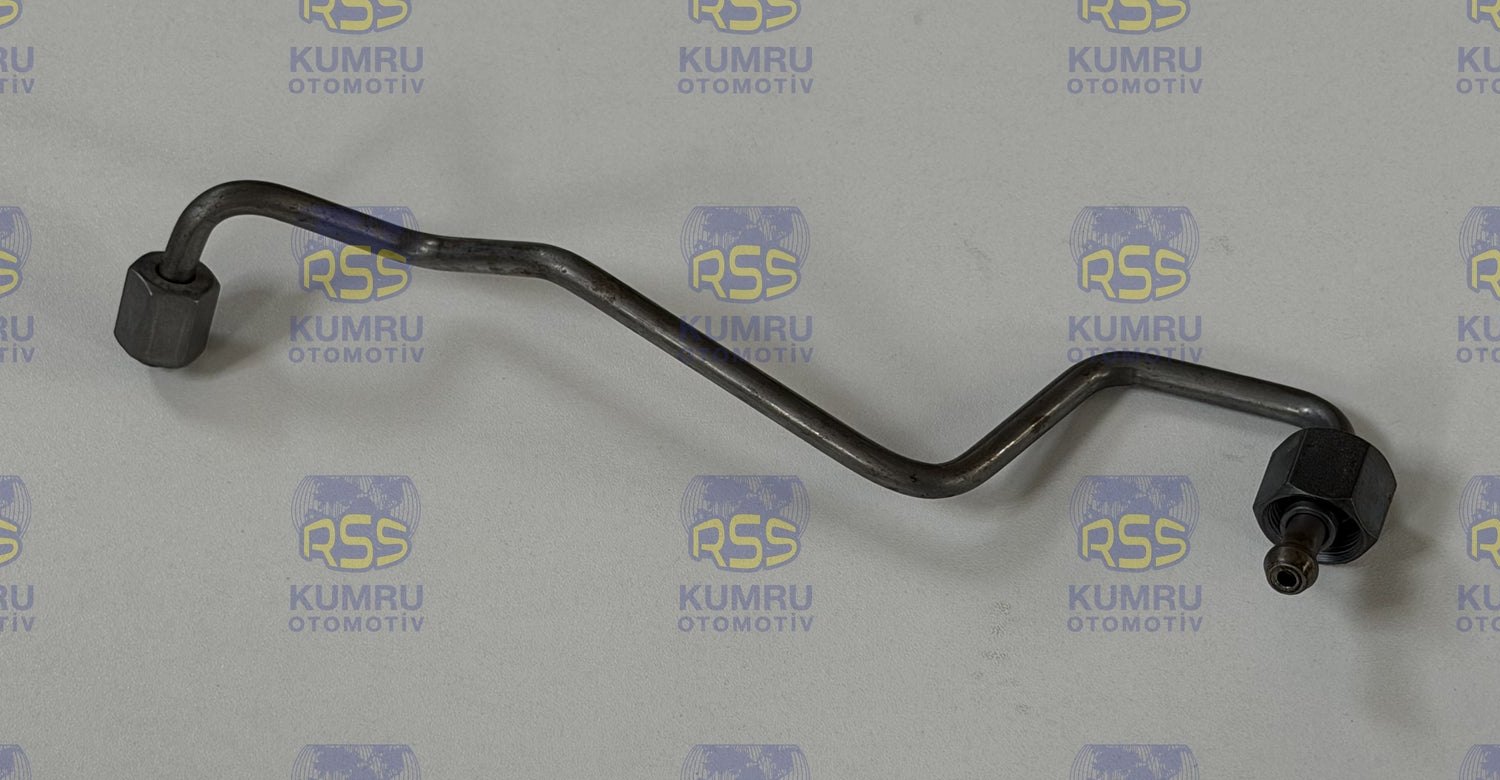
- Lay the new line next to the old one and compare them bend for bend before fitting.
- Leave every clamp loose. Start both nuts by hand.
- Check that each end sits square on its seat without being held there. If it springs away, find out why: wrong line, bent line, or an injector that is not fully home.
- Tighten the nuts to the figure in the workshop manual. Only then tighten the clamps.
Never bend a line to help it reach. Each re-bend hardens the steel at that spot and can flatten the bore. Why lines share one length, and why not to shorten or bend them, is covered in the injector line length article.
Can over-tightening crack a line?
Yes. The nut presses a formed cone onto its seat, and the short length of tube behind the cone is the hardest-worked part of the whole line. Extra torque deforms it. A joint that still weeps at the correct torque has a damaged or dirty seat, and another quarter turn makes that worse, not better.
Delphi’s instruction for common-rail pipes is written in capitals for a reason: “THE NEW PIPE MUST BE TIGHTENED AT THE CORRECT TORQUE VALUE WITH A TORQUE WRENCH. REFER TO THE RELEVANT WORKSHOP MANUAL.” We give no torque figures here because they differ from engine to engine.
How do you spot a cracked line?
The recall report lists the warnings: a leak may be found during maintenance, and an operator “may smell fuel or observe a mist due to the fuel leak”. In practice that means a smell of diesel with the engine warm, one line that is wet when the others are dry, or a fine haze around the injectors at idle.
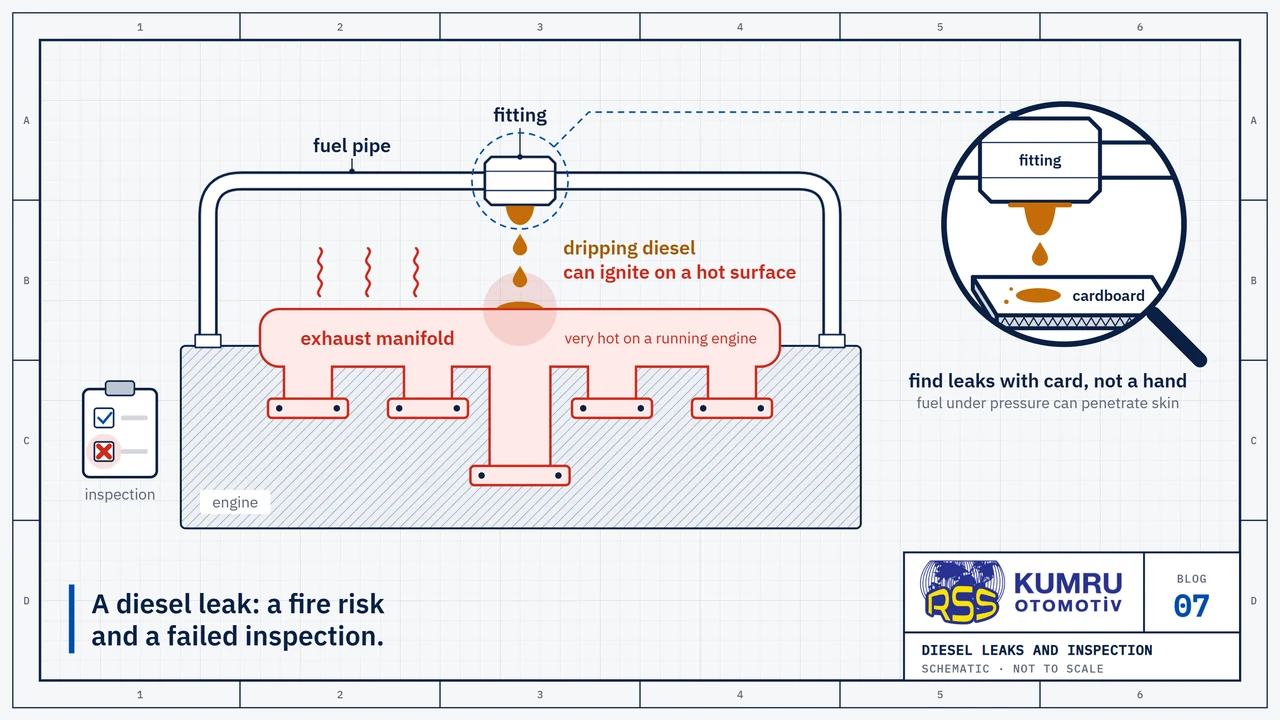
Do not look for the leak with your hand. Delphi gives the pressure in a common-rail system as “up to 1800 bar”. A jet from a hairline crack can go through skin, and that is a hospital matter even when the wound looks trivial. Look with a lamp, hold a piece of card near the line if you must, and keep clear of anything hot. The recall report states the risk in one line: “A high pressure fuel leak in the presence of an ignition source may increase the risk of a fire.”
Can a cracked line be repaired?
No. Brazing, a sleeve or a compression fitting puts a new stiff point next to steel that has already fatigued, and tape or sealant does nothing against injection pressure. For common-rail pipes Delphi goes further and wants a new pipe every time one is removed, because on first tightening the cone “deforms to mate precisely to the connector seat”. A cracked line is scrap. On marine diesels, double-walled lines catch the fuel from a cracked one; we cover this in the jacketed marine pipe article.
Sources
- NHTSA, “Part 573 Safety Recall Report 22V-120”, submitted 2 March 2022; vehicles with the Cummins X12 engine.
- Delphi, “Common rail high pressure pipes replacement”, Delphi technical article, undated.
Sources were checked again on October 8, 2026.
RSS Kumru Automotive
RSS Kumru Automotive was founded in 1990 and specialises in hydraulic systems and fluid management. Our range includes close to 700 injector line references, most of them for Caterpillar, Mercedes-Benz, Ford / New Holland and Scania engines.
Brand names and OEM reference numbers are used for identification and compatibility information only.